
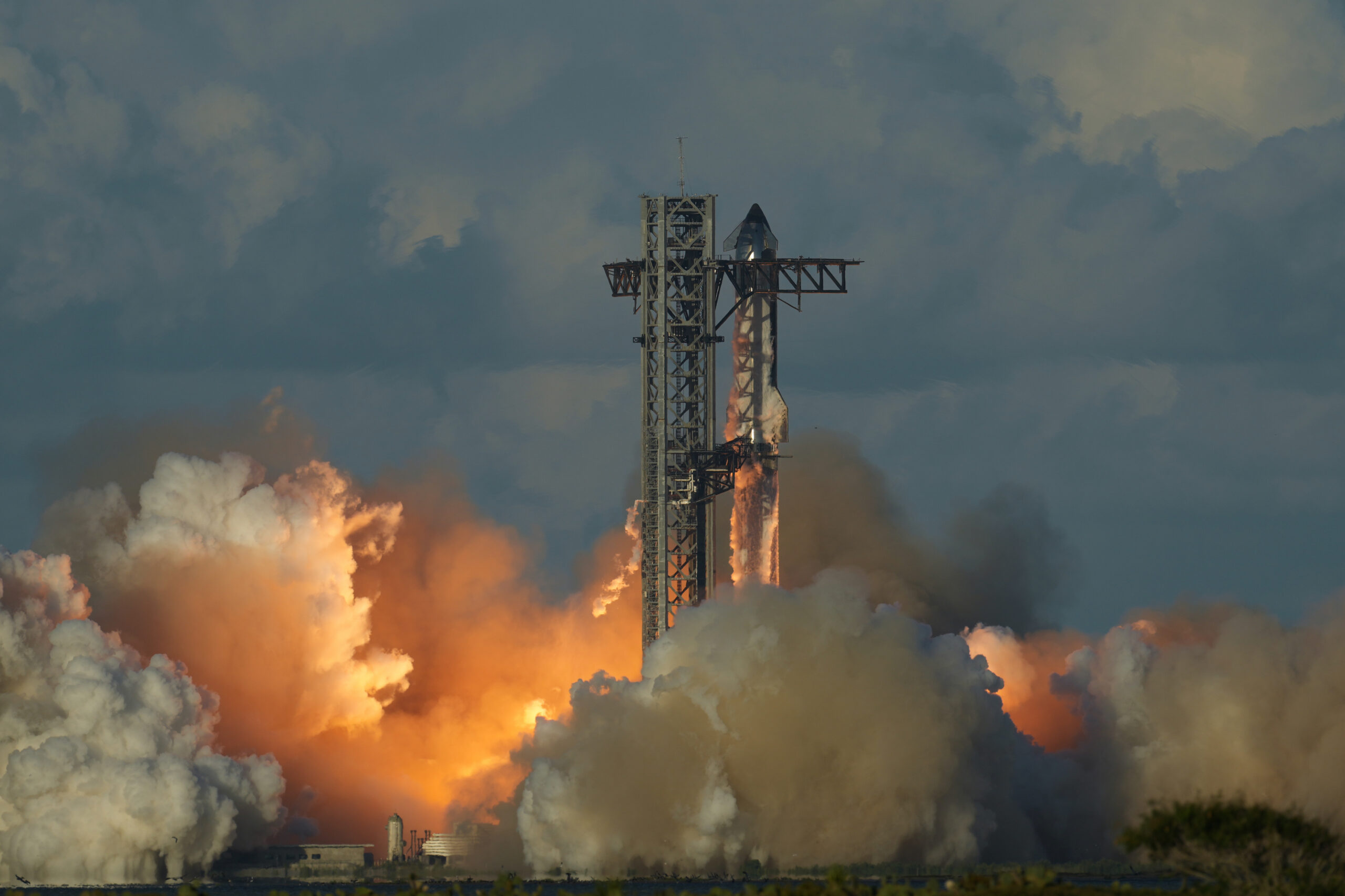
Image Credit: Associated Press
Key Points
- SpaceX completed the largest IPO in history on June 12, raising $75 billion under the ticker SPCX, with proceeds earmarked for expanding its rapidly growing communications network.
- Comcast and Charter collectively lost more than 1.1 million broadband subscribers in 2025, highlighting mounting competitive pressure on traditional telecom providers.
- Several legacy telecom companies face long-term structural challenges, while a group of infrastructure companies tied to the Starlink ecosystem is benefiting from renewed investor interest and higher valuations.
AT&T (T) dropped 4.4% on June 3.
Not because of an earnings miss. Not because of a scandal. Because one analyst at Oppenheimer — Timothy Horan — removed his price target entirely, called AT&T “most at risk” among major U.S. telecoms, and warned that new fiber construction could halt within three years as satellite pricing reaches parity with terrestrial broadband.
The stock had already been sliding for three months before Horan published that note. AT&T was down 12% before Horan put words to what the tape was already pricing.
I spent nearly three decades on the trading floors in Chicago. When the tape moves before the analyst does, that’s not a coincidence. That’s institutional money repositioning — and the question you have to ask is: Repositioning out of what, and into what?
The answer, in this case, is pretty straightforward.
They’re getting out of companies that spent decades building infrastructure that a satellite constellation is now pricing into obsolescence. And they’re getting into the picks-and-shovels ecosystem that scales every time SpaceX (SPCX) puts another rocket in the air.
On June 12, SpaceX went public under ticker SPCX — the largest IPO in history. They raised $75 billion. The question isn’t whether Starlink is a threat to legacy telecom anymore. The question is which companies survive it, which ones don’t, and which infrastructure names nobody is talking about yet are quietly getting re-rated alongside it.
Why Cable Companies Are Losing Broadband Subscribers to Starlink
Here’s what I’d ask anyone still holding legacy telecom names to sit with.
Comcast (CMCSA) and Charter Communications (CHTR) lost over 1.1 million broadband subscribers combined in 2025. Not in a recession. Not because of a price war. Because customers found better options and left.
And here’s the part that matters: SpaceX’s Starlink satellite system hadn’t reached a single suburban market yet when that happened.
The bleeding pre-dates the satellite threat. SpaceX’s IPO didn’t create the disruption — it posted the scoreboard and handed the winning team $75 billion to finish the job.
The cost structure tells you why this doesn’t reverse. Starlink’s deployment cost per customer runs under $1,000. Fiber to the home can run up to $50,000 per customer. That is a 50-to-1 structural disadvantage, and no amount of capex closes it. You cannot capex out of physics.
Comcast, Charter, AT&T, and Lumen: What the 2025 and 2026 Earnings Reports Actually Show
I’m going to skip the satellite hype and go straight to what the annual reports and earnings calls actually show.
Comcast
Lost 711,000 broadband subscribers in full-year 2025 — confirmed in the annual report. They shed another 65,000 in Q1 2026, though that came in better than analysts expected, suggesting their pricing pivot is beginning to work at the margins.
Charter
Lost over 400,000 broadband subscribers in 2025. Stock dropped 25% the day after Q1 2026 earnings when the company guided to flat broadband revenue through year-end. CEO Chris Winfrey acknowledged on the record that Starlink had “gained penetration in some rural markets where Charter is building, requiring Charter to convert customers rather than enter a pure greenfield opportunity.” That is a CEO telling you, in polished conference-call language, that the expansion playbook is done.
AT&T
Made a $250 billion, five-year infrastructure commitment in March 2026 — roughly $23 billion to $24 billion per year — into a market that is structurally losing customers. Oppenheimer’s Horan warned the same month that new fiber builds could halt in three years as satellite pricing converges. Every year that subscriber erosion continues, the return on that commitment gets harder to justify.
Lumen (LUMN)
Posted free cash flow of negative $765 million in Q4 2025. Revenue fell 8.7% year-over-year. They already sold their consumer fiber business to AT&T for $5.75 billion — which tells you everything about their conviction in the fiber thesis. AI is simultaneously eliminating the enterprise wireline layer that was their other revenue base. Starlink is additive pressure on a company that was already in structural decline before satellites entered the conversation.
Starlink
Crossed 12 million active subscribers on June 4 — more than double the 4.4 million from a year earlier. Adding roughly 27,700 customers per day. Available in over 160 countries.
The divergence between those two trajectories is the trade.
What Is a Hyperscaler Backstop and Why It Matters for Starlink Infrastructure
Before I get to the names, there’s one piece of machinery that explains why the picks-and-shovels side of this trade can actually get built.
Fifteen- to 25-year infrastructure leases require cheap financing. Cheap financing requires creditworthy guarantors. And increasingly, that guarantor is showing up as a hyperscaler — an Alphabet (GOOG), a Microsoft (MSFT), an Amazon (AMZN) — co-signing the lease obligations of the companies building out satellite ground infrastructure.
On the trading floor, we had a saying: Watch what they do, not what they say. A trillion-dollar company putting its balance sheet behind a 25-year infrastructure lease is very much “what they do.” That’s not a press release — that’s a credit guarantee. And when you can borrow against a Google-backed receivable, the entire capital structure changes.
That’s the quality filter for everything below.
5 Stocks Positioned to Benefit From the SpaceX IPO and Starlink Growth
1. NextNav (NN) — The Spectrum Play
NextNav holds 15 MHz of contiguous low-band 900 MHz spectrum — the largest single U.S. terrestrial positioning position in existence.
SpaceX has been publicly cited as a credible buyer by analysts covering the Federal Communications Commission (FCC) process. Their EchoStar spectrum acquisition — approved by the FCC in May 2026 — signals active appetite for exactly this kind of low-band position. Current spectrum trades at roughly $0.80 per MHz-PoP. A competitive bidding process gets you to $2-plus quickly.
The FCC ruling is the binary catalyst. Analysts raised their price target to $50 from $25 with an Outperform rating against a stock trading near $20. The gap between current price and target tells you where the market is still catching up.
Masters in Trading is long NN.
2. Iridium (IRDM) — The One That Can’t Be Replaced
Here’s something worth understanding about the satellite communications food chain: Starlink’s growth doesn’t hurt Iridium. It expands the market Iridium operates in.
Iridium runs the only truly global constellation — pole to pole, 160 countries, no dead zones. As commercial drone operations scale under Beyond Visual Line of Sight regulations globally, those drones need a satellite communications layer that terrestrial networks literally cannot provide. Iridium is the only option for operations at the poles, over open ocean, or anywhere the terrestrial grid doesn’t reach.
Up 35% year-to-date. Analysts raised the price target to $60 from $48.
3. BlackSky (BKSY) — AI-Analyzed Imagery on a Falling Cost Curve
More SpaceX launches mean lower revisit costs across the entire space imagery food chain — and BlackSky sits directly in that food chain.
BlackSky delivers AI-analyzed satellite imagery to government and defense customers, with seven-figure contracts building across both segments. The 52-week range of $10.80 to $52.88 tells you this is a volatile name — know what you’re buying. Jefferies: $50 price target · Buy · stock trading near $30.
Masters in Trading is long BKSY.
4. Equinix (EQIX) — Where Orbital AI Lands
The SpaceX S-1 disclosed an Anthropic lease in their infrastructure footprint, with the company noting that AI and large language model demand was “pricing above spot market.”
Orbital compute has to connect to Earth somewhere. Equinix is the dominant neutral data center operator — the interconnection layer where satellite infrastructure meets terrestrial cloud.
Record Q1 backlog. Up 42% year-to-date. 25 Buy ratings on Wall Street. Citi price target $1,240. This isn’t a satellite hype play. It’s the toll road that everything described in this article has to drive through.
5. TeraWulf (WULF) — AI Power Infrastructure
TeraWulf is the name that bridges two of the biggest infrastructure themes of 2026 in a single ticker.
The company’s nuclear co-location strategy gives it access to ultra-low-cost, carbon-free baseload power — exactly what AI infrastructure buildout requires. When SpaceX’s $75 billion raise deploys into orbital data centers and AI compute infrastructure, the power demand behind it scales accordingly.
3 Telecom Stocks to Avoid as Starlink Disrupts the Broadband Market
1. AT&T (T)
The downgrade from Oppenheimer removed the price target entirely — a rare move. AT&T was already down 12% before that note hit. The $250 billion infrastructure commitment is being made into a shrinking market. Defined-risk puts, 60-90 days, if the options flow confirms what the tape has already told you.
2. Lumen (LUMN)
Preexisting condition with a satellite overlay. Negative free cash flow in Q4 2025, revenue contracting, consumer fiber already sold. The AI wave is dismantling their enterprise wireline base simultaneously. This was already in structural decline before Starlink entered the picture.
3. EchoStar / HughesNet (SATS)
GEO-locked with no LEO path. HughesNet operates at 600 to 800 milliseconds of latency. Starlink operates at 20 to 60 milliseconds. That is not a gap you close with a software update — it’s a physics problem. SpaceX acquired EchoStar’s most valuable spectrum in the May 2026 FCC deal. The value is transferring to the winning side in real time.
3 Risks That Could Derail the Starlink Infrastructure Trade
Three things, and I’d ask you to think carefully about all of them before falling in love with any of these charts.
1. The joint venture
On May 14, AT&T, T-Mobile (TMUS), and Verizon (VZ) announced a joint venture to pool spectrum resources specifically against Starlink Mobile. Three fierce competitors cooperating against a single new entrant is fear made official. SpaceX President Gwynne Shotwell responded on X: “I guess Starlink Mobile is doing something right! It’s David and Goliath (X3) all over again — I’m bettin’ on David.”
But don’t dismiss the JV entirely. If the three largest U.S. carriers successfully coordinate spectrum, that’s a legitimate near-term obstacle to Starlink Mobile’s domestic rollout.
2. Regulatory and spectrum risk
The FCC process is a binary event for multiple names in this ecosystem. Decisions that take longer than expected, or go differently than analysts project, reprice the whole basket.
3. AI capex cycle
The orbital data center thesis and much of the infrastructure re-rating depends on continued AI capital spending. If the hyperscaler spending cycle cools — and cycles always turn — the downstream demand assumptions get revised.
How to Use Options Flow to Find Starlink Infrastructure Stocks Early
Here’s the part of this story I find genuinely interesting, because I watched the early moves happen on my screens before the headlines caught up.
Institutional desks don’t wait for analyst notes. They position ahead of them — and that positioning leaves footprints in the options market. Unusual size. Unusual strikes. Unusual timing in names retail isn’t watching yet.
I spent much of my career on the trading floor standing next to the people placing those orders. Now I read their footprints off a screen.
We built our Advanced Notice system to separate genuinely informed options flow from noise — and we just rebuilt its entire scoring engine after backtesting roughly 127,000 flagged options events. The new engine asks one question: Which unusual flow actually goes on to beat the market’s own volatility expectations? In testing, the top-tier signals cleared that bar 77% of the time.
The names rising to the top of those rankings right now look a lot like the quiet infrastructure plays in this article. Real businesses with real contracts whose options flow genuinely surprised the market before the press releases arrived.
When an industry is being re-rated from “legacy utility” to “stranded asset” in real time, the edge is knowing which names institutions are accumulating before the next round of headlines. That’s the whole game. It always was.
Jonathan Rose breaks down institutional options flow live every trading day at 11 a.m. ET on the Masters in Trading YouTube channel — including the names Advanced Notice is flagging in the Starlink infrastructure ecosystem right now
Frequently Asked Questions
How do you buy SPCX?
SPCX is the ticker symbol SpaceX began trading under following its IPO on June 12, 2026 — the largest in history, raising $75 billion. Shares are available through most major brokerages the same way you’d buy any publicly traded stock. Prior to the IPO, SpaceX was private and inaccessible to retail investors; SPCX now offers direct exposure to both the Starlink broadband business and SpaceX’s broader launch and satellite operations.
Why did AT&T stock drop in June 2026?
Oppenheimer analyst Timothy Horan downgraded AT&T from Outperform to Perform on June 3 and removed his price target entirely. He named AT&T “most at risk” among major U.S. telecoms due to its large wireline footprint and exposure to satellite broadband competition. The stock had already declined roughly 12% in the three months before the downgrade, suggesting institutional money was repositioning ahead of the analyst call.
What is the Starlink subscriber count in 2026?
Starlink crossed 12 million active subscribers on June 4, 2026 — confirmed by SpaceX. That’s more than double the 4.4 million subscribers from a year earlier. The service is adding approximately 27,700 new customers per day and is available in over 160 countries.
What is NextNav (NN) and why does the SpaceX IPO matter for it?
NextNav holds the largest contiguous low-band 900 MHz spectrum position in the United States — 15 MHz of prime positioning spectrum. SpaceX has been cited by analysts as a credible potential buyer, and their EchoStar spectrum acquisition in May 2026 demonstrates active appetite for domestic spectrum assets. The FCC ruling on NextNav’s spectrum is the binary catalyst; analysts have a $50 price target against a stock trading near $20.
What is the AT&T, Verizon, T-Mobile joint venture about?
On May 14, 2026, the three carriers announced an agreement in principle to pool spectrum resources against direct-to-device satellite connectivity — primarily targeting Starlink Mobile. It marks the first time the three largest U.S. carriers have attempted to cooperate on spectrum. LightShed Partners noted: “You announce an agreement in principle when the point is the announcement, not the deal.”
Will Starlink hurt cable companies?
The structural cost gap — under $1,000 per customer for Starlink versus up to $50,000 for fiber to the home — doesn’t close regardless of the pace of rollout. The question for cable operators isn’t whether the disruption continues, but how long the urban core remains protected.
Editor’s Note: Elon Musk has spent 27 years waiting for this moment. Now, it’s rolling out across America… and has the potential to be 15X-bigget than Space X. Luke Lango, who called Palantir, AMD, and Nvidia before they soared, says Musk’s latest rollout is the biggest wealth-building opportunity of his career. He’s giving away one free stock pick in this presentation.