
Listen to the audio version of this article (generated by AI).
Today’s issue in preview:
-
Three Elon Musk suppliers that will benefit from soaring space spending
-
Two actionable stock ideas for betting on AI’s rising power needs
-
The dollar’s loss of purchasing power will shock you. Here’s how to protect yourself
-
Learn our Top Themes to buy now
Three Elon Musk suppliers that will benefit from soaring space spending

Credit: SpaceX
In our August 18 issue, we analyzed the health of the space economy theme and came away thinking that, after suffering a large sell-off, this theme is an attractive bet.
Avid Money & Megatrends readers will recall our belief that space-related industries will enjoy tremendous growth and generate many large stock market winners over the next five years.
On Sept. 22, 2025, I wrote a bullish piece on space stocks and said it’s a sector that the “public could go wild for.” I stated the bull case like this:
When people think of investing in space, they often go towards the business of launching rockets and Elon Musk’s SpaceX. But many of the most promising “space stocks” are in the business of space-based communication platforms and equipment. Think government surveillance, military communication, GPS, internet service, and cell service.
The best big picture fundamental case for space stocks right now is that the Trump administration believes America is in a hugely important competition with China and other countries for “space dominance.” This means regulatory and financial support for the U.S. space industry.
Soon after our note, many space stocks soared 50%-100%, powered in part by anticipation of SpaceX’s (SPCX) gigantic IPO in June. After that runup, however, space stocks experienced a large correction. I viewed this correction as natural, given its huge preceding run-up. No sector runs higher week after week in a straight line. The space trade needed to “work off” a lot of froth and enthusiasm.
Now that the SpaceX IPO is in the rear-view mirror, Elon has more than $80 billion to spend on the next chapter of his storied business career.
Elon is expected to spend this pile of money on building an enormous semiconductor complex in Texas, increasing SpaceX’s rocket launch cadence, and a multi-year program to build, launch, and operate space-based AI data centers.
If Elon pulls off his “AI data centers in space” master plan, he will eventually have many deep-pocketed customers like Google lining up to pay SpaceX tens of billions of dollars to launch their own data centers into space.
In other words, Elon Musk – the most aggressive, most successful manufacturing mind of our time – can now direct huge money flows into specialized semiconductor, satellite, high-tech materials, and communications equipment industries.
This makes it a good time to know “who’s who” in the industries that supply SpaceX and other rocket, satellite, and aerospace firms with critical materials their technologies cannot function without. These firms stand to get a big boost from increased space economy investment over the next five years.
Here are three names worth having on your radar:
Materion (MTRN) is a $5.5 billion specialty materials company that controls approximately 56% of the global supply of beryllium. Beryllium is a lightweight, ultra-strong metal used in structural components of SpaceX’s Starship. It’s an extremely difficult material to source, with no easy substitute currently available at scale, giving MTRN a near-monopoly position within SPCX’s supply chain that is hard to displace as Starship production ramps up.
Carpenter Technology (CRS) is a $25 billion specialty alloys manufacturer and a direct SPCX supplier of steels and alloys that are used inside Raptor engines and Starship’s hardware. These materials require specialized vacuum melting and repeated purification processes that only a handful of companies worldwide can perform to the standards needed in the aerospace market. Re-qualifying a new supplier would take years, so CRS currently has a huge advantage as the SPCX supplier over the next few years as production scales.
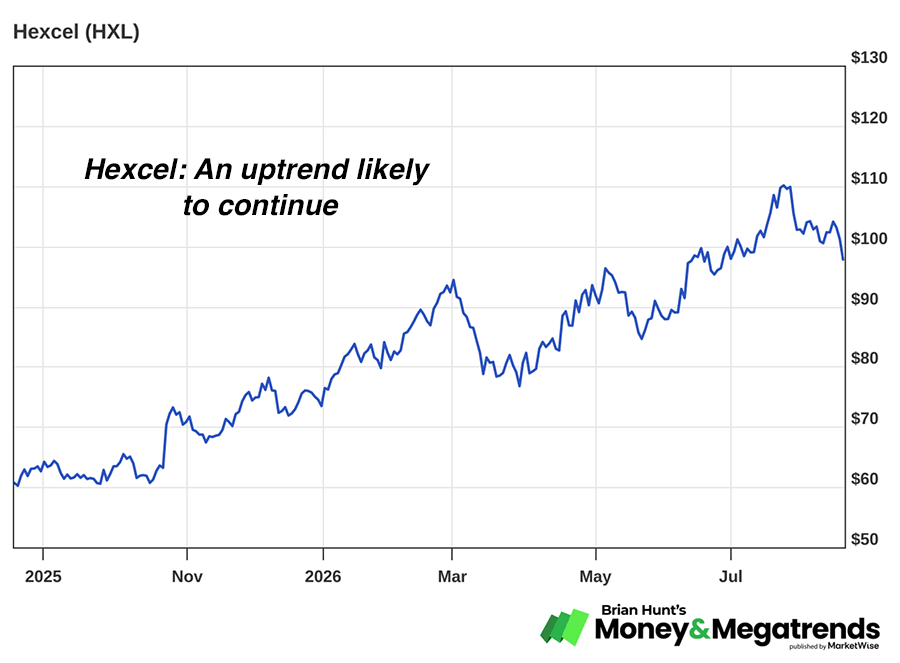
Hexcel Corporation (HXL) is a $7 billion advanced composites company that makes strong, lightweight carbon-fiber materials used in aerospace and has a long-standing relationship with SPCX. Its materials are used in the Falcon 9, structural parts of Starlink satellites, and other lightweight, high-strength components for SPCX. As SPCX increases the number of launches they do and expands Starlink, demand for HXL’s materials will grow in line with SPCX.
These three materials suppliers sit directly in the path of SPCX’s expansion. As Starship production, launch cadence, and space-based AI plans accelerate, the companies that provide the hard-to-replace metals, alloys, and carbon fiber materials that SPCX needs stand to benefit.
SpaceX stock may end up being a big winner. But given its current giant size and very high valuation (over 80 times revenue), we currently prefer owning stocks that sell components and materials to Elon and his competitors in the space economy buildout.
Recommended Link:
A “bloodbath” Is Coming

Silicon Valley billionaires are hoarding guns, gold, and even military grade gas masks… or fleeing the country altogether. What do they know that you don’t? This AI insider is stepping forward with this time-critical message: Move your money before August 31st, ahead of the dangerous next phase of the AI market. Here’s the urgent move you need to make with your money immediately.
Two actionable stock ideas for betting on AI’s rising power needs

Credit: Jeremy Poland
David Tepper is bullish on AI’s soaring power needs.
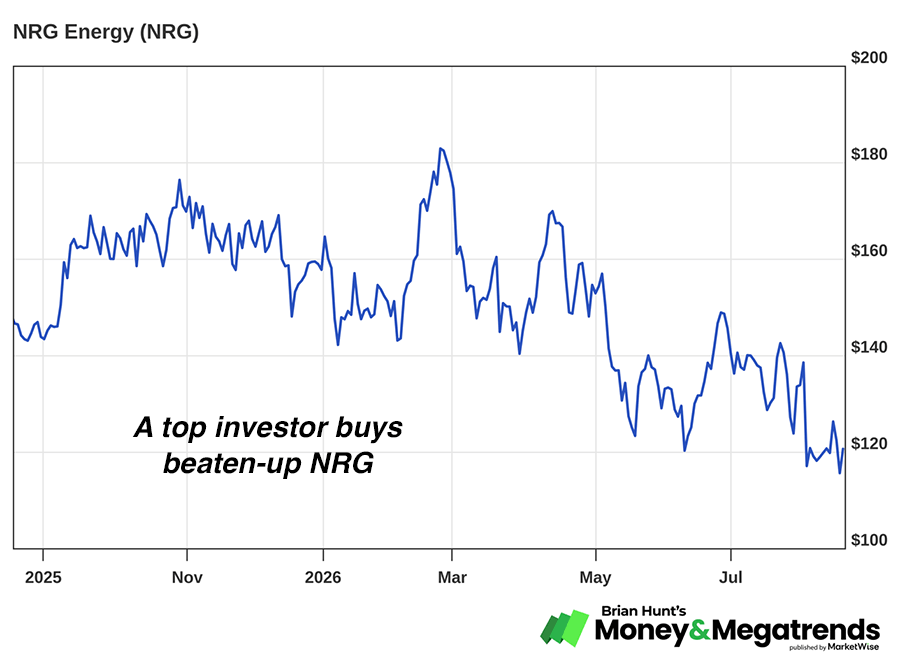
And he’s backing that stance with big positions in Vistra Energy (VST) and NRG Energy (NRG).
This is another valuable insight we can take away from “13F analysis season.”
Last week, 13F filings for the world’s largest money managers were made public. This means it is “13F analysis” season, a time of year that can lead to big investment returns. Here’s why…
The SEC likes to keep tabs on large money managers to ensure markets are reasonably stable and working reasonably well. In pursuit of those goals, the SEC requires large money managers to report their public-market positions via “13F filings.”
Those filings are made every quarter and are public. 13F filings essentially let you look over the shoulders of top investors, which is often useful for spotting trends and good stock ideas.
Top money managers typically spend fortunes on industry and stock research. They can hire teams of very smart analysts that work 80+ hours a week researching stocks. They can pay big bucks to hire industry experts and get specialized, insider knowledge. They can pull strings to get access to privileged information. They will go to the ends of the earth to get an information edge that helps them pick stocks.
After all, there are literally billions of dollars on the line. Spending $5 million to research an industry can yield a hedge fund $500 million or more in profit.
And through 13F filings, we can see exactly how all their hard work, time, and money invested is translating into stock positions. It’s like accessing millions of dollars of stock research for free.
This week, our 13F analysis turned up a handful of interesting stocks and market positions. There’s a lot of information and ideas here, so we will be publishing them in a series over the coming weeks.
We kicked off our series on Monday by detailing how the master “quality” investor Chris Hohn has accumulated stakes in construction aggregate giants Vulcan Materials (VMC) and Martin Marietta (MLM). In the past, I’ve highlighted how these two stocks are excellent “inflation defense” assets.
On Wednesday, we detailed how some of the world’s top “quality” investors have taken large stakes in entertainment streaming giant Netflix (NFLX).
Today, we highlight an important bet world-class investor David Tepper is making with Vistra and NRG. Tepper – who founded the ultra-successful hedge fund firm Appaloosa Management – is a master of timing profitable megatrends. Any time he bets big on an industry, it’s worth noting.
His firm’s recent 13F filings show that it increased stakes in both Vistra Energy and NRG Energy during the second quarter.
Given AI’s enormous promise, large tech firms such as Google, Amazon, Microsoft, and Meta have invested over $1 trillion in specialized semiconductors, data centers, and other AI infrastructure components. They are on pace to invest over $700 billion this year alone and more than $3 trillion after that. Both the scale and the velocity of this investment boom are unprecedented. It is the largest collective investment effort of all-time.
All that AI infrastructure is poised to consume huge amounts of electricity. Goldman Sachs forecasts global data center power demand will climb 50% by 2027 and as much as 165% by the end of the decade. J.P. Morgan forecasts that global power demand will grow at a 3.6% compound annual rate from 2026 to 2030, a pace 50% higher than the previous decade.
This megatrend should work very much in favor of Independent Power Producers (IPPs) such as Vistra and NRG.
IPPs are companies that own fleets of electric power plants and sell their production to the highest bidders. Unlike conventional regulated utilities that are tightly controlled by local governments, IPPs operate relatively freely. They can take capital expenditure risks that regulated utilities can’t make and charge higher prices that regulated utilities can’t charge. This makes IPPs higher-risk, higher upside investments than conventional utilities.
The group of established IPP stocks is relatively small. Back in May, I detailed how IPP giants Constellation Energy (CEG) and Vistra are two leaders in this area.
In addition to these two giants, investors can consider smaller IPPs such as NRG, Talen Energy (TLN), and Canada’s TransAlta (TAC).
IPP stocks enjoyed a big rally from mid-2023 to mid-2025. Since then, they have digested their gains and traded lower, with NRG, VST, and CEG reaching one-year lows.
Given the electric power industry’s bullish long-term fundamentals, these stocks are likely to resume their long-term uptrends. We believe Tepper’s bet will prove to be a good one.
The dollar’s loss of purchasing power will shock you. Here’s how to protect yourself

Credit: Backyard Production
Over the past six months, I’ve written a special series of research notes on publicly traded assets such as timberland giant Weyerhaeuser (WY), aggregate firm Vulcan Materials (VMC), and Freeport McMoRan (FCX) that can add a robust “inflation defense” component to your financial life.
You probably know why being vigilant against inflation is important: governments in most Western nations have promised far too many things to far too many people. They are spending far more on social programs, pensions, and wars than they collect in tax revenues.
The related debts and obligations governments have taken on cannot be paid back with sound money. They can only be paid back with debased, devalued money… much of which is created out of thin air. This is driving inflation and significant currency debasement. Prices are going up because the value of our money is going down.
Measured against a basket of widely used raw materials like crude oil, corn, silver, sugar, and soybeans, the U.S. dollar has lost 51% of its value over the past seven years.
I’ve spent far more time thinking and writing about unique inflation defense assets such as timberland, copper mines, and gravel mines than I have on gold, the widely known and popular “OG of inflation defense assets.”
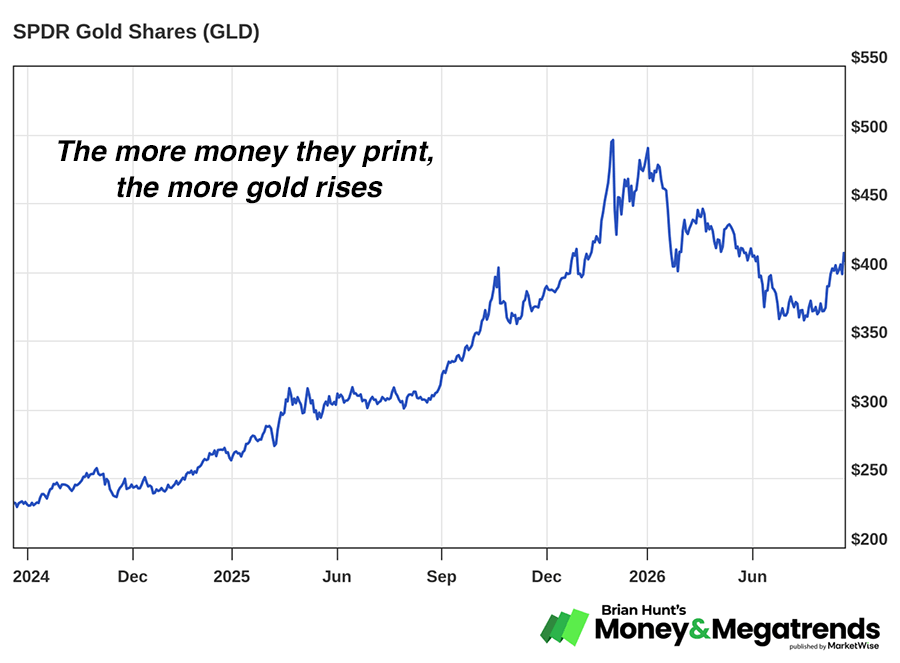
I’ve written less about gold than about other inflation-defense assets because it has been in a downtrend for most of 2026. Plus, I feel like you can find solid information about gold from dozens of sources. You don’t need me to cover it for you. I tend to offer higher “value add” services than that.
But a lot of people like gold, and I like gold, so let’s talk about gold…
In 2003, I placed over half of my net worth into physical gold. Since making that bet, gold is up about 1,170%, far outperforming stocks. I haven’t sold one ounce along the way. Over the years, I’ve held huge positions in gold stocks.
And now, all these years later, the best reason I can find to be bullish on gold is the same reason why I bought gold in the first place: See above.
The U.S. government is spending far more money than it takes in and then makes up the difference by borrowing and printing money by the trainload. Every freshly printed unit of currency debases an existing one. This raises the nominal price of real money (gold). Gold has spent the past 23 years constantly revaluing itself to accommodate for the huge increase in new currency units.
Here in mid 2026, the problem is worse than ever. In America, millions of people are net tax recipients – meaning they receive more in benefits than they pay in taxes.
No politician can win a major election by promising reduced spending. Too many people are now riding the gravy train. Democrat or Republican, it doesn’t matter. Campaigning on sensible spending is a sure loser.
So, what stops the insanity?
How can we get spending under control?
Sorry – bad news. Too many voters either work for the government directly or indirectly or are net tax recipients. They will flat-out not vote for someone who promises to cut benefits, handouts, and spending. This crazy spending is a runaway train.
We will only “get religion” after a financial market crisis forces us to get it.
It’s like how most alcoholics won’t make a change until they’ve almost killed themselves in a car crash or something… or how someone that doesn’t exercise and has a horrible diet won’t change their ways unless a health crisis forces them to.
It’s just human nature. We tend not to change unless we get hit with a metaphorical 2×4 to the head.
This is why I’ve stayed long gold for 23 years. It’s why I’m also long gold mining stocks now.
I can’t know when a financial market crisis will force a change in America. Nobody knows. It could be over five years away. It could be 15 years away. But I own gold in case it’s two years away. And it doesn’t even need to be a big crisis. A medium-sized one could force change.
Stocks can soar and the economy can grow for a long time before a crisis arrives. I’m bullish on the U.S. but also concerned about the future and the owner of gold for its inflation-insurance value.
So sure, let’s keep gold in our “inflation defense” group of assets. Over the next few weeks, I’ll show you some interesting ways to profit from elevated gold prices.
Market Notes
-
Our September 2025 recommendation to get long the oil and gas uptrend continues to pay off. The State Street Energy Select Sector SPDR ETF (XLE) hit a new high today. Individual stock leaders Permian Resources (PR), Talos Energy (TALO), Ovintiv (OVV), Cenovus (CVE), EOG Resources (EOG), and Diamondback Energy (FANG) reached new highs today.
-
AI health diagnostics and drug discovery firm Tempus AI (TEM) – which we’ve highlighted in the past – reached a new six-month high today.
-
Leading cancer diagnostics firm Caris Life Sciences (CAI) reached a new six-month high today. It’s up 45% since we profiled it less than three weeks ago.
-
Bitcoin reached its highest point in over two months today.
Top Themes to Buy Now
⚒ The bull market in copper miners is poised for a breakout. Are you positioned to benefit?
🦾 A tech leader poised to benefit from the robotics boom
🛰 Space stocks have huge upside potential. How to trade the group from here
Regards,


Brian Hunt
Editor, Money & Megatrends
An urgent message from our colleagues:
Porter Stansberry’s Critical New Warning: The Great Dollar Repricing Has Begun

Ray Dalio – founder of the world’s largest hedge fund – says this is the “breakdown of the monetary order”… Discover how Trump’s New Silicon Dollar is about to change everything.
Click here to learn more.