

Listen to the audio version of this article (generated by AI).
Today’s issue in preview:
-
Eight stocks for investing in the U.S. missile restocking boom
-
The bull market in copper miners is poised for a breakout. Are you positioned to benefit?
-
A key AI player soars to a new high. It’s a huge step in the right direction for the AI infrastructure trade
-
Learn our Top Themes to buy now
The bull market in copper miners is poised for a breakout. Are you positioned to benefit?
Credit: FactoryTh
For shareholders looking for inflation protection, copper miners are doing their job. The U.S. government keeps debasing the dollar, and copper miners keep rising in response.
Over the past six months, I’ve written a special series of research notes on publicly traded assets such as timberland giant Weyerhaeuser (WY) and construction aggregates firm Vulcan Materials (VMC) that can add a robust “inflation defense” component to your financial life.
You probably know why being vigilant against inflation is important: governments in most Western nations have promised far too many things to far too many people. They are spending far more on social programs, pensions, and wars than they collect in tax revenues.
The related debts and obligations governments have taken on cannot be paid back with sound money. They can only be paid back with debased, devalued money… much of which is created out of thin air. This is driving inflation and significant currency debasement. Prices are going up because the value of our money is going down.
Measured against a basket of widely used raw materials like crude oil, corn, silver, sugar, and soybeans, the U.S. dollar has lost 51% of its value over the past seven years.
Everyone should consider which assets can help them preserve their wealth during periods of inflation.
When I provide recommendations on how to approach this challenge, I urge people to keep my number one rule in mind: own in-demand, useful assets that cannot be easily replaced or replicated.
That is inflation defense in a nutshell.
You want to own businesses and properties that produce in-demand, scarce resources, products, experiences, and services.
This group of assets includes quality farmland, beachfront real estate, timberland, mountain-view properties, great businesses, and oil and gas pipelines.
When a very difficult or impossible-to-replicate business or property produces in-demand, scarce resources, products, experiences, or services, it tends to hold its value no matter what the dollar is doing.
Its price will constantly “recalibrate” to accommodate an increase in currency units. It’s like the difference between slicing a pizza into 6 or 8 pieces. The number of slices changed, but the amount of pizza is the same.
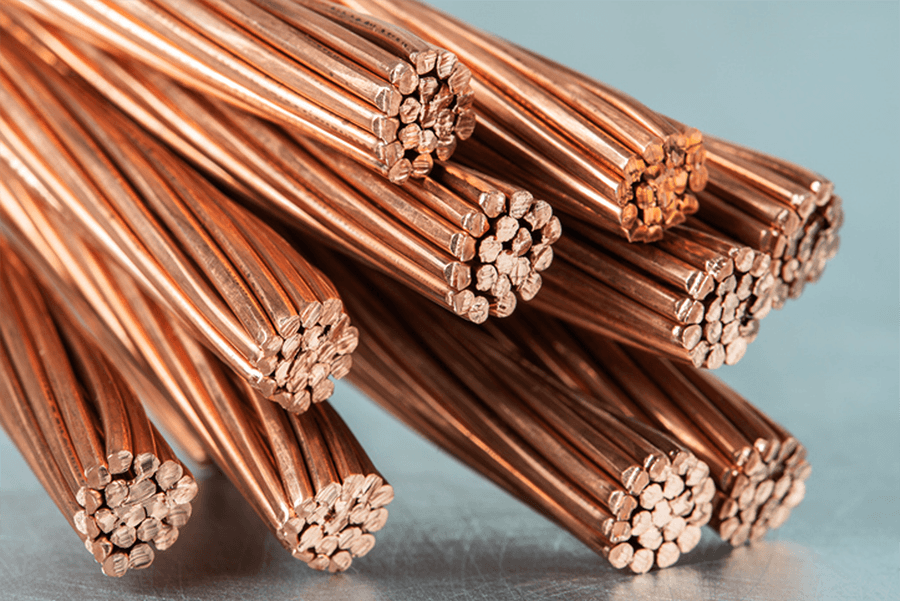
With this framework in mind, we can say that top-tier copper mines and deposits qualify as good inflation defense assets. Copper is a wonderful conductor of electricity with attractive qualities that no other material can currently match. Because of this, it is increasingly in demand, driven by AI data center construction, renewable energy projects, and electric vehicles.
The legendary mining entrepreneur Robert Friedland likes to say the world needs six new tier-one copper mines every year to meet global copper demand.
However, quality copper deposits and mines are scarce resources. Over the past 20 years, the copper mining industry has discovered or developed few meaningful copper deposits. The industry is “living on” discoveries made more than 50 years ago. Importantly, you cannot “vibe code” a copper mine into existence. A good copper mining business is “AI-proof.”
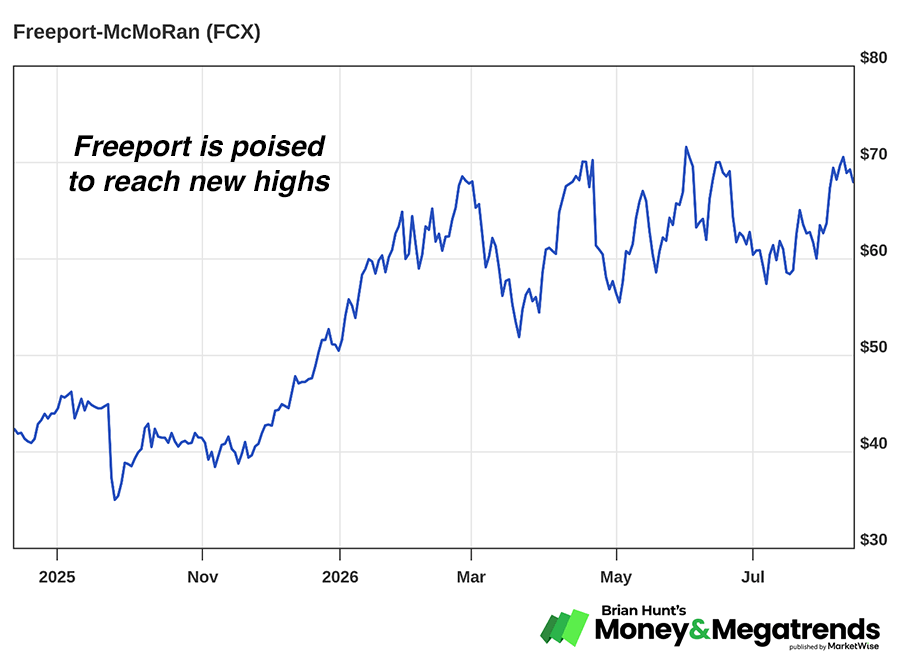
This is a recipe that makes top-tier copper miners like Freeport-McMoRan (FCX) and Southern Copper (SCCO) strong inflation defense assets. The value of their properties and production rises as the number of dollars in circulation rises.
Over the past month, FCX and SCCO have advanced 13% and 12.5%, respectively, and are close to their all-time highs. This recent rally adds to the gains in bull market runs that started a year ago.
If you’re looking for inflation defense vehicles to add to your portfolio, you’ll find them in the copper business. We bet this uptrend continues.
Recommended Link:
Forget SpaceX, Elon’s M.A.G.I. Could Be Bigger

While everyone was distracted with the recent SpaceX IPO… Elon Musk quietly filed a patent with the U.S. Patent and Trademark Office to protect what Jeff Brown believes will be his next breakthrough… Something he called “the greatest tech invention in history.” Click here to see the details because Elon is predicting this new AI breakthrough will unleash a $1 quadrillion new wealth wave.
Eight stocks for investing in the U.S. missile restocking boom
Credit: vadimrysev
For better or worse, it’s a bull market in making missiles.
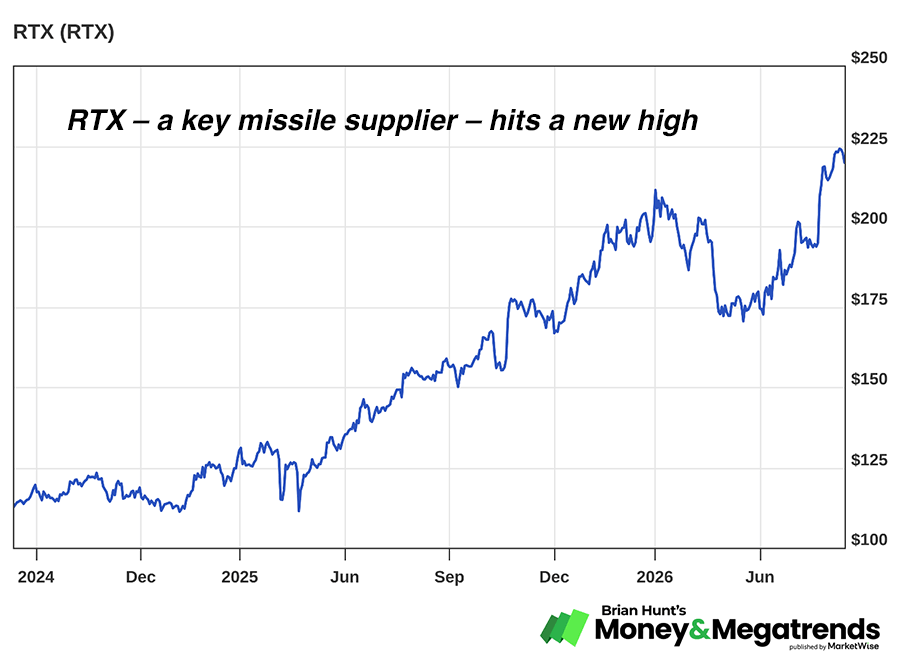
As evidence, we present the new highs in Park Aerospace (PKE), Moog (MOG.A), Ducommun (DCO), and RTX (RTX, formerly Raytheon).
Each of these firms plays a key role in the U.S. missile production industry.
Each hit a new all-time high this week.
Back in March, we detailed how the Iran War was raising all kinds of unanswered questions, but one thing was certain: Missile stockpiles must be rebuilt.
We noted how the Iran War is bullish for missile makers and their downstream component and material suppliers. It’s another facet of the Defense Tech theme we’ve been bullish on for more than two years.
In January, National Defense magazine reported that global defense spending is on pace to reach a colossal $2.6 trillion in 2026. This total would represent an 8.1% increase over 2025. The Iran War is showing us how this tidal wave of money will be spent on bleeding-edge technology.
Unlike the “boots on the ground” wars of the past, the Iran War is being fought by the U.S. almost completely with drones, missiles, and satellites. It’s estimated that the U.S. fired over 400 Tomahawk missiles in the first three days of the conflict. Iran has fired thousands of drones and missiles in return.
The war in Ukraine is another demonstration of high-tech warfare. Ukraine has punched far above its weight class against giant Russia largely because of its mastery of drone warfare. Thousands of drones have been employed during the war.
In this high-tech version of war, the foot soldier is growing less and less relevant… and having more and better high-tech drones, missiles, and satellites than your enemy is critical.
As a result, the U.S. and the Gulf States have used up huge stores of both offensive and defensive missiles during the war. The Wall Street Journal recently reported that Trump Administration officials leaked to the press that the U.S. is running out of missiles. This is the explanation offered by some news outlets for why the U.S. has reduced its bombing of Iran.
Just this week, AP reported that the Pentagon has asked defense manufacturers to produce accelerated production plans within 21 days, amid concerns about stocks of advanced interceptors. The administration is also pushing a giant $1.5 trillion defense budget proposal through Congress. This includes an unprecedented 188% increase in missile procurement funding to stabilize and rebuild the depleted munitions base.
The Pentagon recently locked in a huge contract with Lockheed Martin (LMT) worth up to $58.6 billion, tasked with tripling the production of missiles by 2030.
Rebuilding critical missile stores will add even more demand to already strained global missile supply chains, which should provide a tailwind to the four firms mentioned above (component makers Park Aerospace, Moog, and Ducommun), (giant end manufacturers Lockheed Martin and RTX), plus the following producers of missiles and missile components:
L3Harris (LHX): LHX is a stable large-cap stock play on missiles. It’s a $67 billion company central to the missile-maker story because it makes the engines for America’s missile defense systems. Through its Aerojet Rocketdyne business, it builds the rocket motors that push interceptors into the sky to take down missiles before they reach their targets.
Leonardo DRS (DRS): DRS is a $12 billion European pure-play in missiles and air defense. In a world where Iran-style conflicts rely increasingly on interceptor missiles, DRS becomes a direct beneficiary of any sustained warfare.
Karman Holdings (KRMN): KRMN is an $8 billion aerospace and defense supplier that designs and manufactures systems for missiles, hypersonic weapons, missile defense, and space launch vehicles. Its products fall into three main categories: payload protection and deployment systems, aerodynamic/interstage structures, and propulsion systems, including solid rocket motors, propulsion components, and ablative composites.
In the wake of the Iran War, depleted missile arsenals must be restocked. This is bullish for missile makers, missile component makers, and well-positioned critical metal suppliers such as those in the scandium business. (Click here for our analysis of this critical defense material).
A key AI player soars to a new high. It’s a huge step in the right direction for the AI infrastructure trade
Credit: Victor Golmer
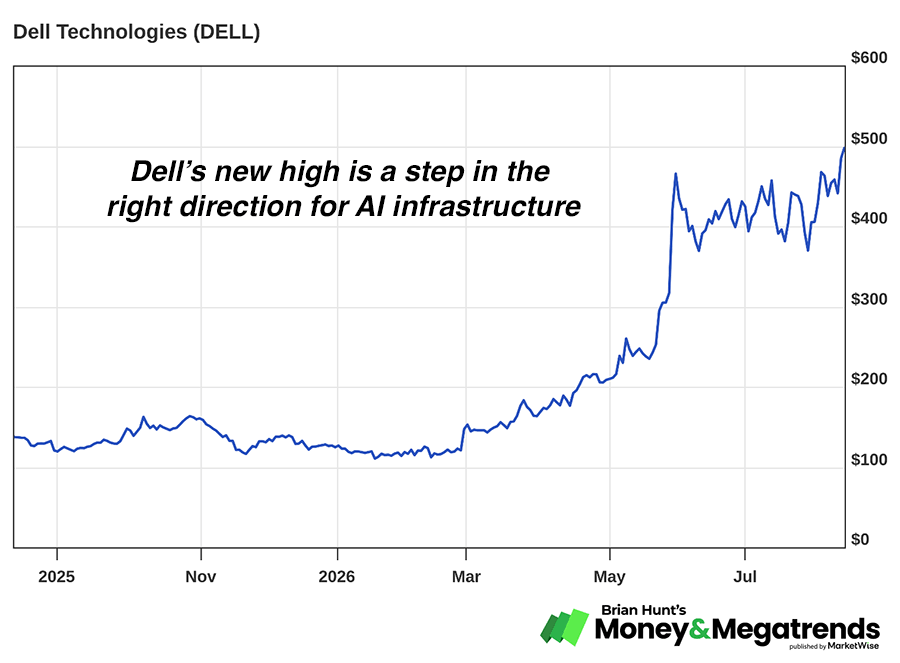
It turns out that being bullish on Dell Technologies (DELL) was a great idea.
This morning, the computer hardware giant climbed 3.3%, reaching a new all-time high. The stock is up an incredible 190% since we highlighted it on April 7.
Those of us over 45 can be forgiven for thinking of 1990s desktop computers when we think of Dell. However, here in 2026, Dell is very much an “AI infrastructure” leader.
Dell still makes traditional computers, but a huge portion of its business is manufacturing AI data center servers and storage devices. In May, management reported a record quarter driven by soaring AI-related demand. It expects AI-optimized server revenue to grow about 144% in the current fiscal year. It expects this year’s overall revenue growth to approach 50%. Dell calls its AI-focused business unit the “AI Factory.”
Dell is another company on the receiving end of the largest capital-expenditure bonanza in recorded history. Given AI’s enormous promise, large tech firms such as Alphabet (GOOG), Amazon (AMZN), and Microsoft (MSFT) have invested over $1 trillion in AI infrastructure. They are on pace to invest over $700 billion this year alone and more than $3 trillion after that.
Both the scale and the velocity of this investment boom are unprecedented. It is the largest collective investment effort in history.
Dell’s recent high is good news for shareholders. It’s a good sign for the entire “AI infrastructure” trade, which includes semiconductors, optical networking firms, neoclouds, and computer memory makers.
The status of the critical AI infrastructure trend has become one of the great sagas of the business and investment world… a source of intense disagreement among industry bulls and bears. How it plays out will have huge effects on the value of your 401(k)
As I’ve detailed in our special series on the semiconductor selloff, companies related to AI infrastructure spending suffered a large selloff in July… but have since staged large rallies to repair much of the damage to market value. Dell has rallied so much from its July low that it’s at a new all-time high.
A proper analysis of any trend as large and pervasive as the AI infrastructure is a “sum of the parts” job. It involves sizing up the fundamentals and price action of many individual themes and key stocks. Dell is one of those key stocks. And its new high is a big step in the right direction for AI infrastructure.
Market Notes
-
Our recommendation to invest in cybersecurity via Palo Alto Networks (PANW) continues to pay off. The stock climbed 1.9% this morning to reach a new high. It’s up 152% since our March recommendation.
-
Our recommendation to invest in the oil and gas pipeline trend continues to pay off. Blue chip operator Energy Transfer (ET) reached a new all-time high today. The stock has returned 29% over the past year.
-
Railroad giant Canadian Pacific Kansas City (CP) reached a new all-time high today. This is indicative of a strong U.S. economy.
-
Refining giants Valero (VLO) and Marathon Petroleum (MPC) reached new highs today. Both firms are benefitting from the Iran War’s constriction of refined petroleum product flows.
-
Coffee giant Starbucks (SBUX) reached a new one-year high today. As we’ve covered recently, this is a sign that the American consumer is spending.
Top Themes to Buy Now
🏭 Business is booming for “Made in America” infrastructure stocks. Are you benefiting?
📈 Hedge funds are about to pile into this stock. You can get in before them
⚡ America’s power grid needs a massive upgrade. These stocks will benefit from a surge of investment
Regards,


Brian Hunt
Editor, Money & Megatrends
An urgent message from our colleagues:
Wall Street Legend: “Stop Trying to Pick AI Stocks”

Larry Benedict is the Wall Street legend with a 20-year winning streak. Now he says the smartest way to profit from AI isn’t buying Nvidia or guessing which company wins the race. It’s by positioning ahead of a strange pattern that repeats every 90 days. The next one hits September 16.
Here’s the ticker he says to trade.