Listen to the audio version of this article (generated by AI).
Today’s issue in preview:
-
These two stocks are unique inflation hedges you probably haven’t considered
-
This leading AI semiconductor stock just did something unusual… and it’s bullish
-
An AI “demand shock” is set to hit this industry and drive stock prices higher
-
Learn our Top Themes to buy now
This leading AI semiconductor stock just did something unusual… and it’s bullish
Credit: ASML
“The only game in town.”
Terrible words to hear as a consumer. But for a business owner in a capitalist economy, being the only game in town is a wonderful thing.
The only dermatologist in town… the only skilled HVAC repairman in town… the only diesel mechanic in town… the only good steakhouse in town.
Being the only game in town is often a license to print money. Your customers and potential customers don’t have any other convenient options, so they are willing to pay your high prices. As long as you don’t price gouge customers to death, you can build a high margin, profitable business as the “only game in town.”
Of course, in a free market, robust or easy profits attract competition like a beach picnic attracts seagulls. But occasionally, fate sees to it that some businesses are incredibly difficult to compete with… to the point that they are essentially the only game in town or something close to it.
This is likely why ASML (ASML) is showing impressive “relative strength” amid the large semiconductor sector selloff we covered on Monday.
Money & Megatrends members in good standing are familiar with ASML. I’ve mentioned it many times as a premier vehicle for investing in the AI infrastructure boom.
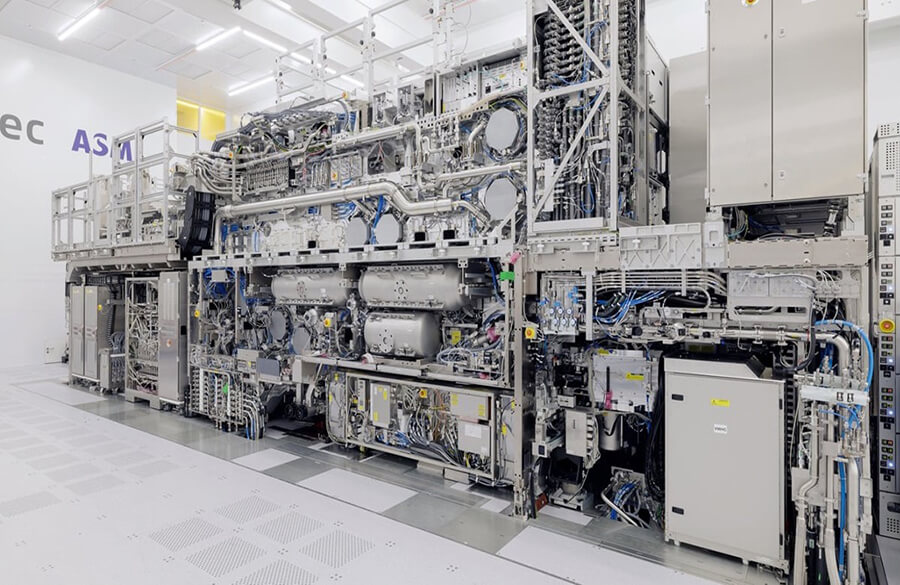
ASML – which originally stood for Advanced Semiconductor Materials Lithography – is the only company in the world that can currently create Extreme Ultraviolet Lithography (EUV) Machines at scale. These EUV machines are used by semiconductor makers to build the world’s most advanced AI chips.
An ASML EUV machine is roughly the size of a school bus, weighs about 180 tons, and contains more than 100,000 parts.
EUV machines are among the most complex, value-creative machines ever made… and their price tags reflect that. Modern EUV machines sell for over $300 million apiece. That’s a product price range typically reserved for U.S. Navy contractors and the builders of mega yachts.
EUV machines are critical components of AI infrastructure. Large semiconductor makers like Taiwan Semiconductor (TSM) buy them to produce advanced AI semiconductors.
No EUV machines, no AI as we know it.
After breaking out of a sideways consolidation pattern in June 2025, the world’s largest semiconductor ETF – the VanEck Semiconductor ETF (SMH) gained 147% in just under a year.
Individual semiconductor leaders AMD (AMD), Marvell Technology (MRVL), and Lattice Semiconductor (LSCC) gained more than 200% during that time. Stock gains of 25% in a month became commonplace.
When a sector gains 50% in a year, that’s considered incredible. Semis returned “triple incredible.”
Given AI’s enormous promise, large tech firms such as Google (GOOG), Amazon (AMZN), Microsoft (MSFT) and Meta (META) have invested over $1 trillion in AI infrastructure. They are on pace to invest over $700 billion this year alone and more than $3 trillion after that.
Both the scale and the velocity of this investment boom are unprecedented. It is the largest collective investment effort in history.
A lot of this money purchased semiconductors, the tiny “engines” that power computers. Semiconductor industry revenue totaled $793 billion in 2025, an increase of 21% year-over-year, according to Gartner, Inc.
Given its AI drivers and big returns, it’s no wonder semis became the world’s “hottest trade.” And when any theme becomes the world’s hottest trade, it becomes a leading candidate to experience a significant correction or something worse.
That’s just how the stock market works. When a bull market grows very popular and attracts a lot of speculation, it likes to “buck off” market participants by going through a sharp correction or something worse.
That’s what has happened to the semiconductor trade over the past month or so. After soaring from June 2025 to June 2026, SMH declined 15.6%. Last week, it reached its lowest point in two months.
Here’s where things get interesting for ASML.
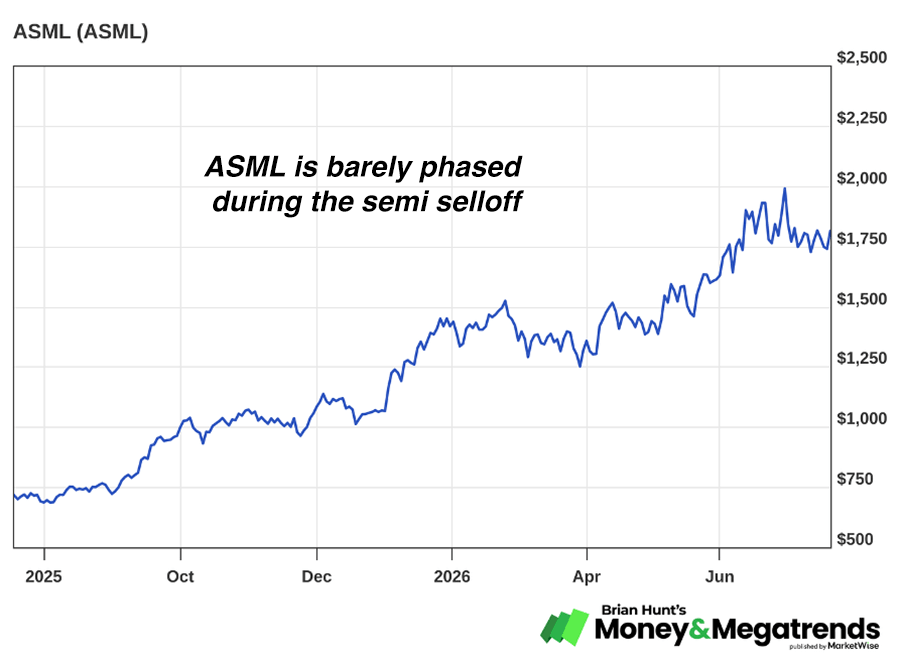
During the semi selloff, ASML declined 10%, or about a third less than SMH. It is now just 9.6% below its all-time high, while SMH is 12.7% below its all-time high. This is impressive “relative strength” on ASML’s part.
During events like this summer’s correction – where a sector experiences a big decline – I like to see what stocks in the sector held steady or even advanced. The big decline serves as a “stress test” of the sector’s constituents.
If the market drops 3%, you want to see what drops just 1%. If the market drops 2%, you want to see what climbs 1%. That sort of thing. This is often called “relative strength.” It allows you to spot the safer, sturdier megatrends for investment.
It’s like looking at a beachfront neighborhood after a hurricane. Some homes lost their roofs, and some homes were blown away. But some homes were unbothered by the storm. Those are safe, well-built homes.
ASML has demonstrated impressive relative strength. It declined less than the sector ETF and recovered faster. This tells us that the fundamental forces working in favor of ASML (like its “only EUV machine maker in town” status) are very strong and large institutional investors recognize it.
If you looked at a chart of ASML and didn’t know a big semi correction occurred in July, you wouldn’t think anything negative of note has happened to semis. Bullish for ASML.
Recommended Link:
AI Breakthrough Could Soon Reorder Stock Market Winners and Losers

For years, we’ve been led to believe the tech firm operating at 500 Howard Street in Silicon Valley is ‘one of the good guys.” But will the advanced form of AI that just emerged from this location change the way we live, work and invest forever? Marc Chaikin reveals the time-sensitive details of this discovery and offers you a FREE 3-part playbook to protect your future. Click here for the details.
These two stocks are unique inflation hedges you probably haven’t considered

Credit: robas
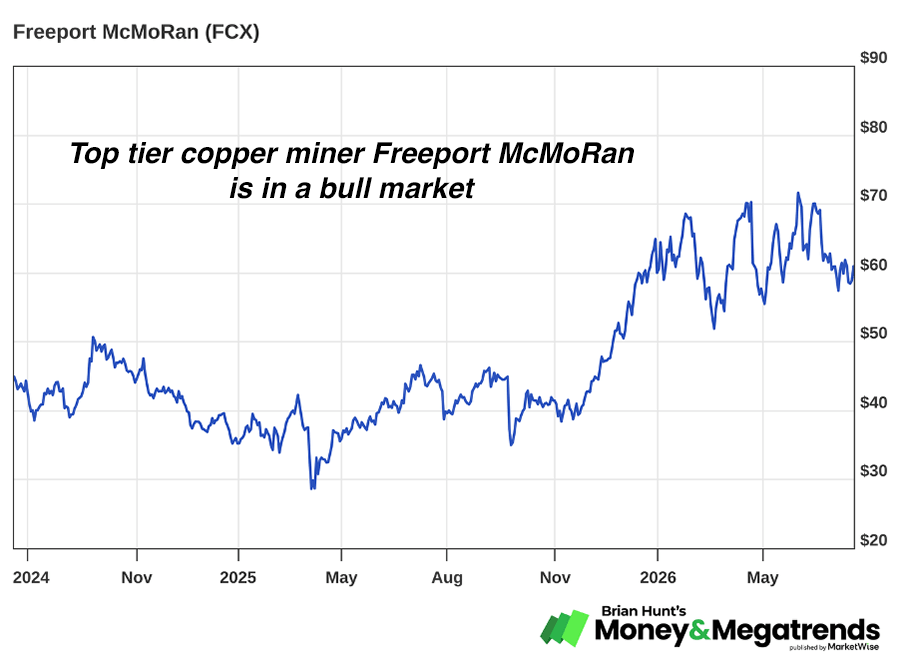
In Monday’s issue, we looked at the powerful “relative strength” in the copper market and came away bullish on the red metal’s prospects.
Copper prices and copper mining stocks are holding up well while most mining industry groups are suffering a large correction.
Does this mean that copper mining stocks qualify as good “inflation defense” assets according to our inflation defense framework?
The answer is yes, and here’s why…
Over the past six months, I’ve written a special series of research notes on publicly traded assets such as timberland giant Weyerhaeuser (WY) that can add a robust “inflation defense” component to your financial life.
You probably know why being vigilant against inflation is important: governments in most Western nations have promised far too many things to far too many people. They are spending far more on social programs, pensions, and wars than they collect in tax revenues.
The related debts and obligations governments have taken on cannot be paid back with sound money. They can only be paid back with debased, devalued money… much of which is created out of thin air. This is driving inflation and significant currency debasement. Prices are going up because the value of our money is going down.
Measured against a basket of widely used raw materials like crude oil, corn, silver, sugar, and soybeans, the U.S. dollar has lost 51% of its value over the past seven years.
Everyone should consider which assets can help them preserve their wealth during periods of inflation.
When I provide recommendations on how to approach this challenge, I urge people to keep my number one rule in mind: own in-demand, useful assets that cannot be easily replaced or replicated.
That is inflation defense in a nutshell.
You want to own businesses and properties that produce in-demand, scarce resources, products, experiences, and services.
This group of assets includes quality farmland, beachfront real estate, timberland, mountain-view properties, great businesses, and oil and gas pipelines.
When a very difficult or impossible-to-replicate business or property produces in-demand, scarce resources, products, experiences, or services, it tends to hold its value no matter what the dollar is doing.
Its price will constantly “recalibrate” to accommodate an increase in currency units. It’s like the difference between slicing a pizza into 6 or 8 pieces. The number of slices changed, but the amount of pizza is the same.
With this framework in mind, we can say that top-tier copper mines and deposits qualify as good inflation defense assets. Copper is a wonderful conductor of electricity with attractive qualities that no other material can currently match. Because of this, it is increasingly in demand thanks to AI data center building, renewable energy projects, and electric vehicles.
However, quality copper deposits and mines are scarce resources. Over the past 20 years, the copper mining industry has discovered or developed few meaningful copper deposits. The industry is “living on” discoveries made more than 50 years ago. Importantly, you cannot “vibe code” a copper mine into existence. A good copper mining business is “AI-proof.”
This is a recipe that makes top-tier copper miners like Freeport-McMoRan (FCX) and Southern Copper (SCCO) strong inflation defense assets. The value of their properties and production rises as the number of dollars in circulation rises. If you’re looking for inflation defense vehicles to add to your portfolio, you’ll find them in the copper business.
An AI “demand shock” is set to hit this industry and drive stock prices higher

Credit: dongfang zhao
In our February 13 issue, I detailed how, for three years, the best way to make money quickly in stocks has been to locate an industry where an AI “demand shock” is about to strike… and then invest there before the shock arrives.
Not a supply shock, mind you, where a war or a pandemic abruptly cuts off the supply of a resource like oil.
Instead, I’m talking about a “demand shock,” where demand for a specific resource or manufactured product suddenly skyrockets… and sends its price hundreds of percent higher. This creates boom times for the companies involved, as their unit sales and per-unit prices skyrocket simultaneously.
Twenty years ago, demand shocks for manufactured goods and natural resources were relatively rare. Businesses had time to anticipate new sources of demand and plan accordingly. For many industries, those days are over.
AI – the fastest-evolving technology in history and the focus of the largest-ever capex spending cycle – has changed the rules.
AI’s power, adoption rates, and capacity are exploding… from just one quarter to the next.
AI is advancing at such a rapid pace… and large tech firms such as Google, Microsoft, and Amazon are spending such huge, unprecedented amounts of money on it (over $700 billion in 2026 alone) that AI-driven demand shocks are now happening every year… and creating the biggest, fastest stock market moves we’ve ever seen.
-
In 2023, just after ChatGPT’s introduction, there was an AI demand shock for Nvidia’s (NVDA) advanced semiconductors. The company’s revenue soared, and so did its stock price. Nvidia advanced 525% in less than two years.
-
Around the same time, there was a demand shock for systems that cool AI data center components. This drove shares of cooling systems maker Vertiv (VRT) up 1,050% in under three years. It sent Comfort Systems’ (FIX) shares up 1,000% in three years.
-
AI data centers require advanced optical systems that allow fast data transfer. This demand shock drove the stock of optics firm Coherent (COHR) up 295% in two years. It drove the stock of optics firm Lumentum (LITE) up 1,164% in two years. It drove shares of optics materials firm AXT Inc. (AXTI) up by 1,035% over two years.
These are among the largest and fastest wealth-creation events in history.
They are happening because Big Tech’s historic investment spree and AI’s breakneck rate of advancement are creating huge demand spikes that traditional manufacturing and resource chains are not equipped to handle. They don’t have enough lead time to adjust to rapid demand shocks. The trends are taking shape and exploding too quickly.
One day, an aggressive demand forecast for AI infrastructure components such as optical lasers or memory or semiconductors is just a spot on the horizon to conventional thinkers… a futurist’s fantastical estimate…
The next day, the demand spike is on us… and we don’t even have blueprints for the new factories we need today. So, prices explode by three, five, or even 10 times or more. The demand shock hits the market like a meteor.
The typical manufacturing industry needs 5-10 years to build operations capable of meeting increasing demand. Same with mining industries that supply critical raw materials.
But our new, lightning-fast technological cycles are now much faster than that. They are hitting our economy like supersonic tidal waves. We now have significant mismatches across the economy’s interlocking, interdependent parts. It’s like we have a rocket engine attached to the drivetrain of a Toyota Corolla.
These factors are creating a market environment where the market values of well-positioned companies can rise 100%… 300%… and 1,000% in less than two years.
An investor should ask: “Where will the next AI demand shock take place? Where will AI take almost everyone by surprise as it did in semiconductors, memory, optics, and cooling?”
One of our leading candidates is in the chemicals industry.
The chemicals sector is often seen as an “old economy” industry that produces products such as plastics, paints, solvents, cleaners, and pesticides. However, some chemical firms are involved in “brand new economy” activities related to AI.
The chemicals industry sits upstream of almost every physical component in the AI stack: from the specialty gases and materials used to manufacture semiconductors to the high‑purity solvents, coatings, coolants, flame retardants, and advanced polymers that make modern data centers possible.
Every AI server relies on a long chain of ultra-specific and ultra-pure chemicals. As AI usage explodes, the need for more chemicals and more sophisticated, higher-purity ones increases.
The companies supplying these chemicals that make all this possible are only just beginning to see the demand wave arrive:
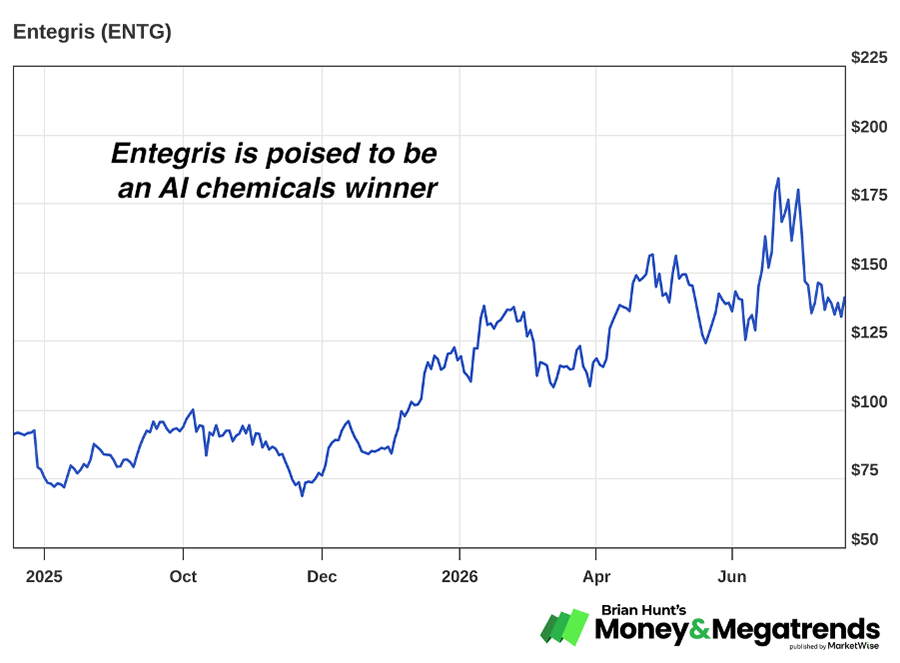
Entegris (ENTG) is a $21 billion giant and the closest thing to a pure-play in the AI chemicals business. It supplies ultra-high-purity chemicals, filtration systems, and materials handling solutions for advanced semiconductor manufacturing. Roughly 40% of revenue comes from advanced logic –the chips that power AI workloads. It is the ENTG’s fastest-growing segment today.
Chemours (CC) is a $2.7 billion chemicals stock that is a play on the data center cooling market. The company recently signed a joint development agreement with 2CRSi to advance two-phase immersion cooling for AI infrastructure – a technology that uses specialty fluids to absorb heat directly from chips, enabling far greater computing density than traditional air cooling, which is becoming very limited today.
Qnity Electronics (Q) is a $29 billion spin-off from DuPont (DD) that supplies materials and chemicals essential for chip fabrication. Two of its business units tied to AI semiconductor production each grew 50% year over year in Q1.
The semiconductor, optics, cooling, and memory plays all had their moment. The investors who made 500%, 1,000%, and 1,500% did so by getting there first. The chemicals sector is where the AI demand shock hasn’t fully arrived yet. The window to get positioned will likely close soon.
Market Notes
-
Oil refining giantsValero Energy (VLO), Marathon Petroleum (MPC), Philipps 66 (PSX), HF Sinclair Corp (DINO) and Delek US Holdings (DK) are up at new highs amid the Iran War, which is constricting refined product supplies.
-
Major global bank HSBC Holdings (HSBC) hit new highs today. This is a bullish economic signal.
-
The Boomer health care theme continues to generate winners. Healthcare REIT giant Sabra Health Care (SBRA) reached a new all-time high today.
-
Pharmacy and health services giantCVS (CVS) just hit a new yearly high. It’s now up 80% in the last year.
-
Our recommendation to ignore the AI bears and stay long the AI infrastructure trade continues to pay off. Data center infrastructure play Super Micro Computer (SMCI) is up 22% today after announcing strong preliminary quarterly results. This is a nice sign for the upcoming quarterly earnings.
Top Themes to Buy Now
🇺🇸 Two stocks that get Donald Trump working to make you richer
🇧🇷 This country is a great AI investment vehicle you never considered
Regards,


Brian Hunt
Editor, Money & Megatrends
An urgent message from our colleagues:
3 Investments in 1 Stock: Income, AI Growth, Inflation Shield

Picture a stock that pays you like a fat pension… Rides the AI boom like a tech stock… And guards your savings from the falling dollar like gold. Retirees usually need 3 separate investments for that. There’s one stock that does all three at once. CNBC’s “The Prophet” says it’s the single most important retirement stock in America right now.
Get the name and ticker, completely free.