
Today’s issue in preview:
-
Here’s how to profit from Elon Musk’s next big business moves
-
A unique inflation hedge that pays you to own it
-
Our extraordinary track record gets even better. Our thematic trades in Pipelines, Cybersecurity, and Oil continue to reward shareholders
Here’s how to profit from Elon Musk’s next big business moves
Credit: Walter Cicchetti
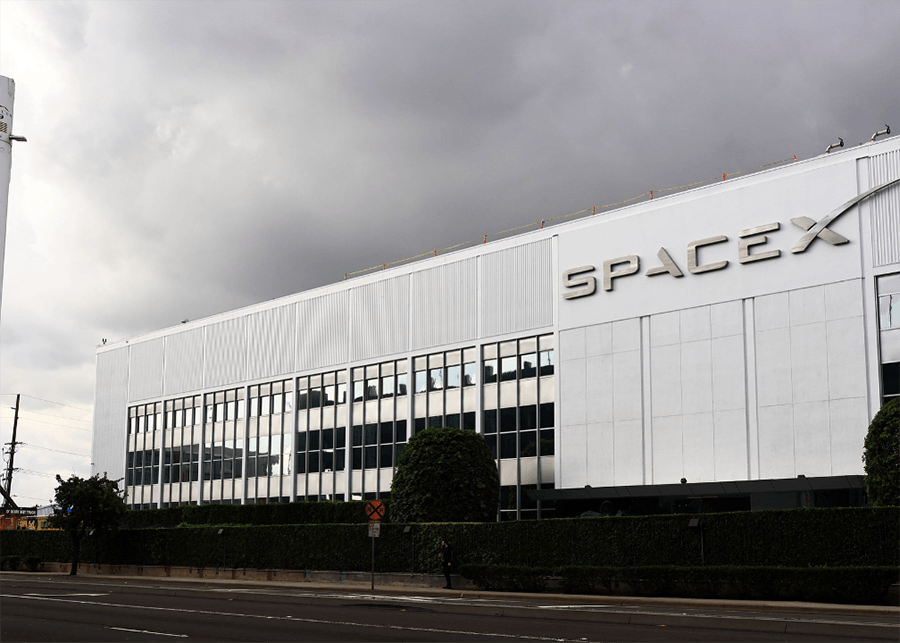
If SpaceX manages to go public in June, as many people expect it will, Elon Musk will have more than $70 billion in cash to fuel the next phase of his storied business career.
Elon is expected to spend this war chest of capital on building an enormous semiconductor complex in Texas, increasing SpaceX’s rocket launch cadence, and on a multi-year program of building, launching, and operating space-based AI data centers.
If Elon pulls off his “AI data centers in space” master plan, he will eventually have many deep-pocketed customers like Google lining up to pay SpaceX tens of billions of dollars to launch their own data centers into space.
Add all that money up… and you get a future where Elon Musk – the fastest-moving, most aggressive, most successful manufacturing mind of our time – is directing Amazon-river-sized money flows into specialized semiconductor, satellite, high-tech materials, and communications equipment industries.
Elon Musk is about to create a series of rolling “demand shocks” that will generate enormous wealth and big stock market moves.
Over the past two years, we’ve seen similar large and fast money flows create “demand shocks” in many industries… which have driven the largest, fastest stock market moves in history.
Not a supply shock, where a war or a pandemic abruptly cuts off the supply of a resource like oil.
Instead, I’m talking about a “demand shock,” where demand for a specific resource or manufactured product suddenly skyrockets… and sends its price hundreds of percent higher. This creates boom times for the companies involved, as their unit sales and per-unit prices skyrocket simultaneously.
Twenty years ago, demand shocks for manufactured goods and natural resources were relatively rare. Businesses had time to anticipate new sources of demand and plan accordingly. For many industries, those days are over.
AI – the fastest-evolving technology in history and the focus of the largest-ever capex cycle – has changed the rules.
AI’s power demands, adoption rates, and capacity are exploding… from just one quarter to the next.
AI is advancing at such a rapid pace… and large tech firms such as Google, Microsoft, and Amazon are spending such huge, unprecedented sums on it (over $700 billion in 2026 alone) that AI-driven demand shocks are now happening every year.
Enormous and “in a hurry” spending flows have recently sent stocks soaring.
-
AI data center energy firm Bloom Energy (BE) is up 2,071% over two years
-
AI data center equipment firm Lumentum (LITE) is up 1,987% over two years
-
AI data center equipment firm Applied Optoelectronics (AAOI) is up 1,645% over two years, and
-
Computer memory leader Sandisk (SNDK) is up 3,382% over the past year.
These are among the largest and fastest wealth-creation events in history.
They are happening because Big Tech’s historic investment spree and AI’s breakneck rate of advancement are creating massive demand spikes that traditional manufacturing and resource chains are simply not equipped to handle. These firms don’t have enough lead time to adjust to rapid demand shocks. The trends are taking shape and exploding too quickly.
One day, an aggressive demand forecast for AI infrastructure components such as optical lasers or memory or semiconductors is just a spot on the horizon to conventional thinkers… a futurist’s fantastical estimate…
The next day, the demand spike is on us… and we don’t even have blueprints for the new factories we need today. So, prices can explode by 3, 5, or even 10 times or more. The demand shock hits the market like a meteor.
The typical manufacturing industry needs 5 to 10 years to build operations capable of meeting increasing demand. Same with mining industries that supply critical raw materials.
But our new, lightning-fast technological cycles now move way, way faster than that. They are hitting our economy like supersonic tidal waves. We now have enormous mismatches across the economy’s interlocking, interdependent parts. It’s like we have a rocket engine attached to the drivetrain of a Toyota Corolla.
With all this in mind, it’s worth looking into what individual companies will get paid a lot of money to help Elon meet his lofty goals.
Elon is known for controlling and owning as much of his supply chains as possible. But even Elon can’t build every component and source every raw material in-house. Behind every Starlink satellite, every Falcon 9 engine, and every Starlink terminal shipped to a customer, there is an ecosystem of specialist suppliers – some of them publicly listed – who are growing revenues in lockstep with SpaceX’s extraordinary expansion.
Here are the three names worth putting on your radar.
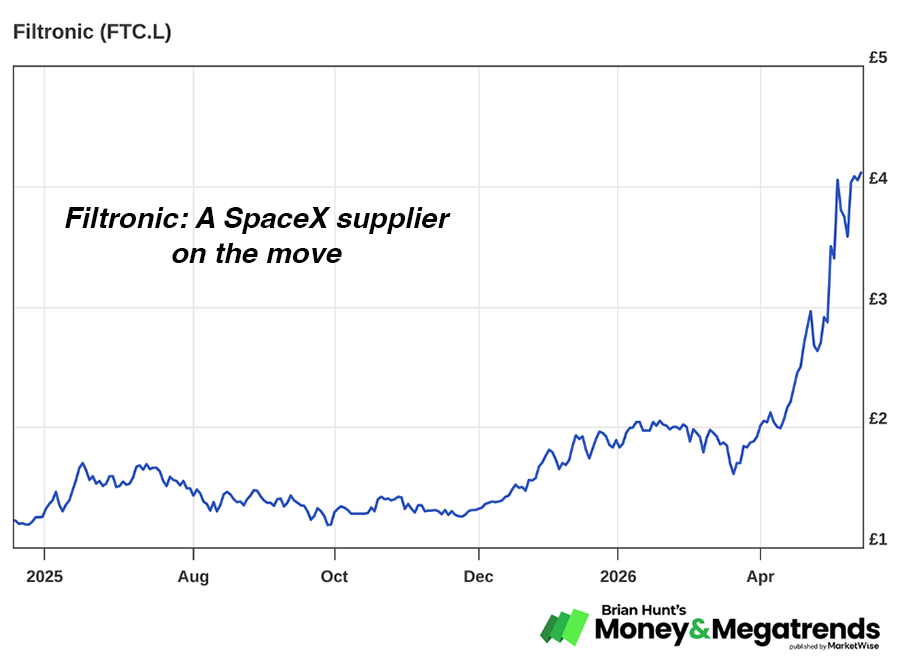
Filtronic (FLTCF, FTC.L) is a $500 million pure-play supplier to SpaceX. It is a UK-based company that designs and manufactures radio-frequency components used in Starlink satellites. This relationship is not speculative. It now has orders worth more than $115 million, and SpaceX even has the right to buy up to 10% of Filtronic’s shares, which is a powerful sign of commitment in both directions.
STMicroelectronics (STM) is a $56 billion supplier to SpaceX with a decade-long relationship. It designs and manufactures semiconductors, including microcontrollers, RF chips, sensors, and power electronics. The relationship with SpaceX is so ingrained in STM’s business that a director has said: “Our numbers are more influenced by our market share in SpaceX rather than the success of another LEO constellation.” STM now supplies SpaceX with over 5 million chips per day. Importantly, STM has significant other business in automotive and industrials, so SpaceX is a meaningful part of the business, but not something STM must rely on.
Sphere Corp (KRX: 007610) is listed on the Korean stock exchange. It’s a $1.6 billion firm that provides SpaceX with high-performance special alloys, including nickel and superalloys. These materials are used in the highest-stress parts of SpaceX’s rocket infrastructure (engines, nozzles, combustion chambers, and launch pads). Sphere has filed a 10-year supply agreement with SpaceX, making it one of the longest-duration supplier agreements in the SpaceX ecosystem.
Elon Musk is about to get control of an extraordinary amount of money. He has huge ambitions and wants to move as fast as humanly (and robotically) possible. This means the future is bright for well-positioned SpaceX suppliers and partners.
Recommended Link:
I Called Black Monday. Now I’m Calling June 1st!

I predicted the 1987 crash six weeks early. I called the fall of the Berlin Wall. I pinpointed the exact bottom in 2009. Now I’m staking my reputation on June 1, 2026 – the day I believe Elon will announce the SpaceX IPO. Bloomberg is calling it “the biggest listing of ALL TIME.” A $1.5 TRILLION valuation… the “wealth-building” moment of the decade. Today, I’ll show you how to get in before the big announcement. Click here to see how to secure your “SpaceX Access Code”
A unique inflation hedge that pays you to own it

Credit: Douglas Rissing
It didn’t take long for the market to come around to my idea of owning sports teams as a “debasement trade.”
This month, Atlanta Braves Holdings (BATRA) – the owner of baseball’s Atlanta Braves – and Madison Square Garden Sports (MSGS) – the owner of the NBA’s New York Knicks and the NHL’s New York Rangers – surged to new all-time highs.
In our January 26 edition, I detailed how owning professional sports teams in the stock market was a unique hedge against the debasement of the U.S. dollar.
You probably know why being vigilant against inflation is important: governments in most Western nations have promised far too many things to far too many people. They are spending far more on taxpayer benefits and wars than they collect in tax revenues.
The related debts and obligations governments have taken on cannot be paid back with sound money. They can only be paid back with debased, devalued money… much of which is created out of thin air. This is driving inflation and significant currency debasement. I estimate the dollar is losing value by at least 6% per year. Put differently, prices are going up because the value of our money is going down.
It’s important to note that the prices of scarce resources are going up. Things that cannot be easily produced or replicated. Things you can’t print. Gold. Copper mines. Oil and gas pipelines. Rolexes. Beachfront homes. These are proving to be sound “debasement” hedges.
And this might sound odd to you, but I include professional sports teams in this group. Like gold and beachfront homes, professional sports teams are valuable, in-demand, scarce resources that cannot be printed or easily produced.
Every year, we hear new superlatives for how the values of professional football, basketball, and baseball teams are rising. CNBC reports that the average NFL franchise is worth $7.65 billion. That figure marks an 18% jump from the year before. CBS reports that Major League Baseball generated a record $12.1 billion in revenue in 2024, and franchise valuations increased 8%. The New York Yankees recently achieved a valuation of $8.2 billion.
Professional sports contests are one of the few television products people still reliably watch. In a world where our attention is pulled away from television, sports become incredibly valuable to big advertisers.
Since my January note, BATRA and MSGS are up 27% and 22%, respectively. These are huge returns for such a short time. The world is catching on to this idea.
“Great, Hunt, but I missed that trade. What’s the debasement trade to make now?”
If you missed Debasement Trade: Sports Team Edition, I’d look at timberland next.
For centuries, quality timberland has been a preferred hedge against currency debasement and an asset class of the wealthy. This is the case for multiple good reasons…
-
Quality timberland is a “living asset.” Your “crop” grows regularly with minimal capital expenditure.
-
Timberland yields in-demand products, such as lumber and paper, which generate income for the owner.
-
These income streams can be augmented by leasing timberland to hunters, campers, and farmers.
-
You can delay timber harvests when prices are low and keep the “crop” growing.
-
Occasionally, a real estate developer will show up at your door and offer you ridiculously high prices for some of your acres.
These qualities make timberland an asset that steadily grows in value and keeps pace with the rate at which voters and their elected representatives debase the currency via profligate spending. Timberland has returned around 10% per year for decades… with low correlation to the stock market.
And here in the AI age, timberland has the treasured quality that, like premier sports teams, beachfront homes, and copper mines, it cannot be coded into existence by AI.
If you like the idea of owning timberland, you can buy it in private transactions and enjoy a walk in the woods.
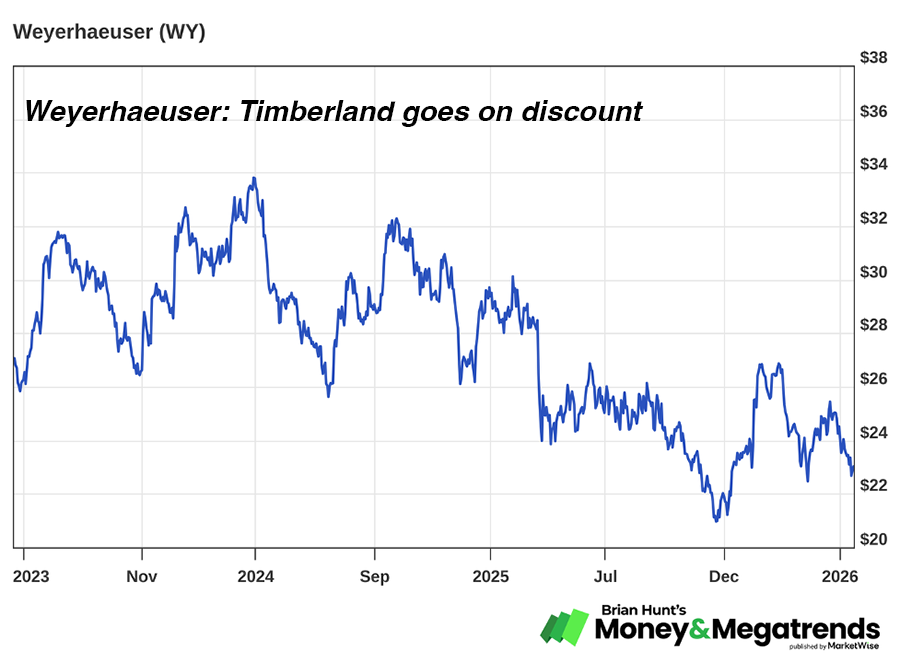
Or, you can buy timberland in the stock market via big timberland REITs Weyerhaeuser (WY) and Rayonier (RYN). These firms own huge tracts of timberland across the U.S. They manage them for investors who understand the benefits of timberland ownership. Since they are structured as REITs, they pay decent dividends. WY’s current yield is 3.67%. RYN’s current yield is 5.24%.
Over the past four years, owning WY and RYN has not been a pleasant walk in the woods. Since these businesses generate significant revenue from lumber sales, they are exposed to the ups and downs of the U.S. housing market, which is struggling with high mortgage rates and affordability challenges. Both stocks are down 30% over the past four years.
Many investors will look at the weak housing market and poor recent returns of housing-related stocks and say to avoid WY and RYN. However, it’s only when sentiment is terrible towards a cyclical sector like housing that you can get good value for your investment dollars. If you’re looking for relative bargains in the “debasement trade” section of the stock market, you’ll find one in timberland.
Market Notes
-
Our recommendation to own U.S. oil and gas pipeline operators remains a huge winner. The Alerian MLP ETF (AMLP) reached a new high today. This sector benefits from both AI power demand and global demand for U.S. natural gas.
-
Our March 27 recommendation to own cybersecurity is doing well. Industry giants CrowdStrike (CRWD) and Fortinet (FTNT) reached new yearly highs today.
-
Our September 2025 recommendation to get long oil stocks continues its winning ways. Oil giants Halliburton (HAL), Cenovus Energy (CVE), and Helmerich & Payne (HP) reached new one-year highs today.
-
The weak U.S. housing market continues to weigh on housing-related stocks. Paint giant Sherwin-Williams (SHW) reached a new one-year low today. Online housing info firm Zillow (Z) reached a new one-year low today. Building material giant Builders FirstSource (BLDR) reached a new one-year low today. Flooring giant Mohawk Industries (MHK) reached a new one-year low today.
Our Top Themes to Buy Now
☢️ Uranium: Four stocks and two ETFs for the bull market in nuclear power
🪙 Silver: AI, Batteries, and Silver: The Market’s Next Big Winners
🦾 Robotics: Six ways to invest in the biggest product of all time
Regards,


Brian Hunt
Editor, Money & Megatrends
An urgent message from our colleagues:
Missed Nvidia’s 44,000%? This is the next big opportunity

In February 2016, Nvidia was trading at $2.51, split-adjusted. The name barely came up in investment circles. But my data had flagged something. A pattern the market hadn’t priced in yet. I sent my readers a single, clear recommendation. And anyone who acted could’ve got in on the biggest investment story of this decade. The company I’ve identified today is in the same position. Same pattern. Same kind of gap. And the window is open right now. I’m revealing it, down to the ticker, in a new free presentation.