

Today’s issue in preview:
-
The commodity bull market could create big winners here
-
Boomers are set to spend billions in this industry. Three stocks to invest in it.
-
Two charts deliver the stock market’s verdict on the Iran War
-
Learn our Top Themes to buy today
Boomers are set to spend billions in this industry. Three stocks to invest in it.
Credit: alfexe
“There will never be another time in history with as many post-Ozempic patients as now and in the near future.”
– Dr. Roy Kim, a San Franscisco plastic surgeon describing what is happening in clinics across America.
Over the past five years, GLP-1 drugs have become the top selling drugs in the world. About 15% of U.S. adults have tried a GLP-1 at some point in their lives, according to a Gallup News poll. GLP-1 giant Eli Lilly (LLY) is on pace to sell over $50 billion worth of the stuff in 2026.
This, of course, is driving a lot of weight loss. But it’s also driving lots of “second-order” effects… like a surge of interest in cosmetic surgery.
Rapid, dramatic weight loss often results in hollow cheeks, sagging jowls, and loose skin. Faces that shed fat look hollow and gaunt, which has led to “Ozempic face” becoming an actual medical term.
Unfortunately, there is no drug to fix this. The answer for many people is a procedure. A Needham survey found that 62% of GLP-1 drug users say they are now more likely to get cosmetic procedures as a result. Considering the tens of millions of Ozempic users, that’s an enormous new addressable market that didn’t exist a few years ago.
And that’s layered on top of one of the most powerful demographic forces in American history that we have mentioned many times at Money & Megatrends. More than 10,000 Americans reach retirement age every day. The US population aged 80 and older is projected to roughly double from 14.7 million in 2025 to 29.4 million by 2045.
This is the Baby Boom generation entering the phase of life when healthcare and longevity spending skyrocket – and Boomers, the wealthiest and most health-conscious aging generation in history, are spending aggressively to look and feel younger. For many of them, a typical month involves at least one doctor’s appointment to have something looked at, lifted, or treated.
Add a third tailwind to the equation. The democratization of cosmetic procedures. What was once reserved for celebrities and the ultra-wealthy is now mainstream. Minimally invasive “tweakments” (injectables, lasers, radiofrequency treatments) have brought price points within reach of millions, and a generation of millennials is booking preventative treatments in their 30s rather than waiting until their 50s.
That’s three forces converging at once. The second-order effects of GLP-1, the demographic Boomer wave, and the democratization of aesthetic treatment.
The cosmetic medicine industry has never seen tailwinds like these. We have a business and investment megatrend on our hands.
Compelling stocks to invest in this boom include:
Galderma (GDERF) is a $45 billion Swiss company that is one of the purest plays on aesthetics. It owns the Restylane filler range and Dysport (a leading Botox alternative).
The numbers back up the trend’s strength, with revenue growing 32% and EPS up 68.5% year over year. Galderma CEO Flemming Ornskov said on the most recent earnings call, “We are seeing stabilization of fillers also in the US market…also driven a bit by what you see with the rapid penetration of GLP-1 usage.”
AbbVie (ABBV) is a $450 billion pharmaceutical giant operating across immunology, oncology, neuroscience, and aesthetics, so it’s not a pure play on this theme. But ABBV owns Botox, the most recognized cosmetics brand on the planet.
Botox generated $728 million in Q2 2026, up 5.2% year over year. For investors who want to play this theme but with more caution than the more pure-play names on this list, ABBV is likely your best bet.
Evolus (EOLS) is a smaller sub $1 billion company that has just broken out to new one-month highs. EOLS makes Jeuveau, which is an FDA-approved neurotoxin, going head-to-head with Botox on price and brand. It is now on the verge of profitability for the first time, making it a higher-risk but potentially disruptive challenger in a huge market.
The Baby Boom generation contains the largest group of wealthy people in all recorded history. Many of them are willing to spend big on anti-aging treatments, longevity, and cosmetic surgery. The GLP-1 boom is adding fuel to this trend. This means the stocks above have serious tailwinds working on their behalf.

Recommended Link:
Musk’s Greatest Embarrassment Could Be His Greatest Success

In 1950, entrepreneur Frank McNamara forgot his wallet and his wife had to pay for dinner. He was embarrassed and vowed it would never happen again. He invented the Diner Club card, the first ever credit card. And every single transaction you’ve ever made on card is because Frank McNamara was embarrassed. Today, the world’s most successful entrepreneur, Elon Musk, is about to do the same, and turn his greatest embarrassment into his greatest success.
The commodity bull market could create big winners here
Credit: Sunshine Seeds
Over the past year, we have posted big wins in critical resource sectors such as oil, copper miners, and oil and gas pipelines. We’ve also posted big wins in resource-rich countries, Canada and Brazil.
We’ve done so by “swimming with a strong current,” that is, the bull market in critical resources. Given this bull market’s enormous momentum, it’s worth noting that it recently sent platinum to a new multi-month high… and more such highs could be on the way.
Platinum is the highest profile member of the “Platinum Group Metals (PGMs). This is a group of rare metals, including platinum, palladium, rhodium, ruthenium, iridium, and osmium. They are typically found together and mined together. The world capital of their production is South Africa’s enormous Bushveld Complex, a large geologic formation rich in PGMs.
PGMs share valuable properties, including high melting points, corrosion resistance, durability, and exceptional catalytic abilities. Their largest use is in automobile catalytic converters, where platinum, palladium, and rhodium help remove pollutants from vehicle exhaust.
PGMs are also important in petroleum refining, chemical production, electronics, glass manufacturing, medical and dental devices, and jewelry. Platinum is used in aerospace alloys and industrial catalysts.
Platinum and its related investments were big losers from 2011 to 2025. This was driven by a well-supplied market and concerns that EVs would supplant gasoline-powered vehicles, thereby reducing demand for catalytic converters and the resources used to build them.
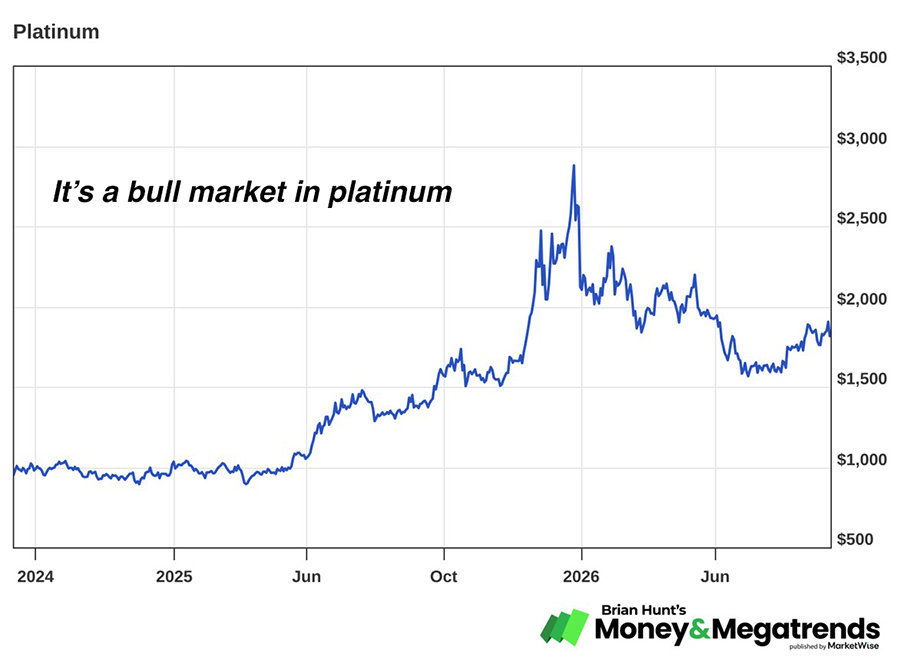
Those lean years and the fact that EVs have not supplanted gasoline-powered cars have led to a tight platinum market and a resurgence in the metal’s price. In 2025, platinum broke out of a sideways base and ran from $1,000 an ounce to $2,850 per ounce.
After this big run, platinum corrected and digested its gains by falling into the $1,600 level this summer. But as you can see in the chart below, that $1,600 level has served as a base from which platinum is attempting a new rally. The price recently hit a three-month high. Plus, leading PGM miners Sibanye Stillwater (SBSW), Valterra Platinum (ANGPY), and Impala Platinum (IMPUY) are starting to move higher in concert.
Could the platinum bull market run higher?
With this question in mind, I’ll remind you that when critical resource markets trend, they often trend big. Their trends often go for hundreds of percent gains and last 5+ years.
This is because major shifts in resource supply and demand play out over years, not months. If the world decides it wants a new copper mine, platinum mine, gold mine, or uranium mine, it will not get that mine for at least a decade.
Given how the tailwinds are blowing strongly for critical resources, the odds favor continued gains for platinum and the miners listed above.
The stock market’s verdict on the Iran War is clear. These two charts deliver the message

Credit: sturti
This week, U.S. government bond yields jumped to multi-year highs as Brent crude futures traded above $105 per barrel. The 10-year Treasury yield climbed to 4.9%, its highest level since October 2023.
President Trump puts on a brave face and brushes off concerns related to high oil prices, high interest rates, and high inflation. However, the market is not brushing off these ugly trends. Two of our most important indicators of U.S. consumer health care are flashing red right now.
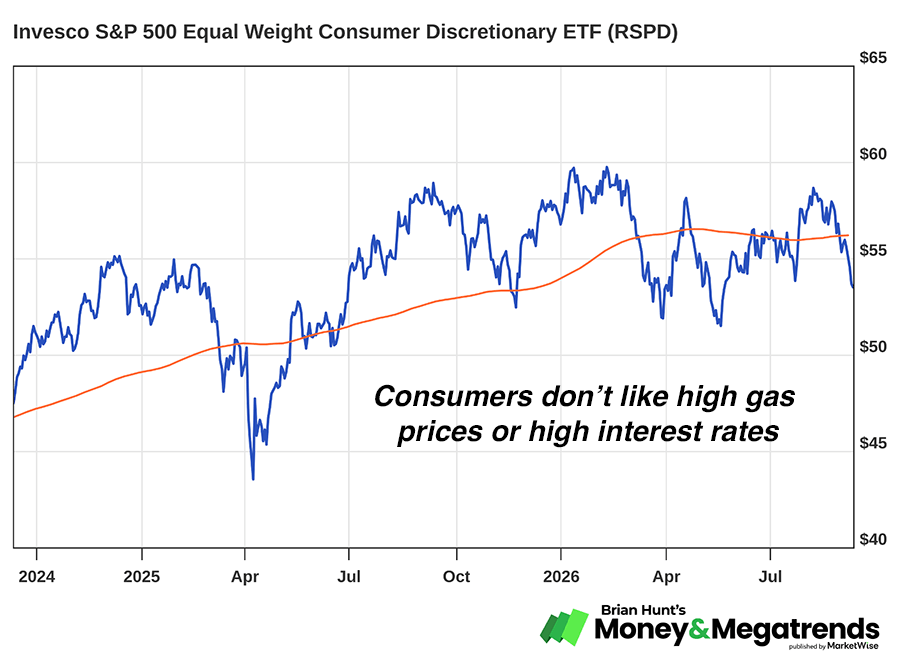
I prefer to be an optimist because that’s what usually pays and that’s what is good for the soul. I cannot, however, ignore the wreckage in the Invesco S&P 500 Equal Weight Consumer Discretionary ETF (RSPD) and the SPDR S&P Homebuilders ETF (XHB).
Today, we look at these key ETFs to get a read on how high oil prices and rising interest rates are affecting consumers and key stocks related to their health.
First off, we have the Invesco S&P 500 Equal Weight Consumer Discretionary ETF. This ETF is full of consumer spending stocks of all types. Its holdings include Carnival Cruise Line, Chipotle, Marriott International, Ulta Beauty, General Motors, Airbnb, Lululemon, Expedia, Amazon, Home Depot, Nike, Starbucks, Ford, Ralph Lauren, and Hasbro.
It’s an equal-weight fund, so no one dominant company skews the return.
Plus, the companies above serve a large segment of mid- to upper-level consumers. It’s not heavily reliant on ultra-wealthy spending… or “ultra-poor” spending. Companies in this fund serve good old-fashioned red, white, and blue American consumers – the ones who drive a $90,000 Chevy Suburban, go on a $5,000 Caribbean cruise, drink a $6 latte, and wear $100 leggings.
Over the past month, high oil prices and rising interest rates have led to a big 8% decline in this key ETF. Plus, it sliced through its 200-day moving average and is now negative on the year. This weak price action in a diversified consumer ETF indicates consumers are pulling back. It’s a major negative for the economy.
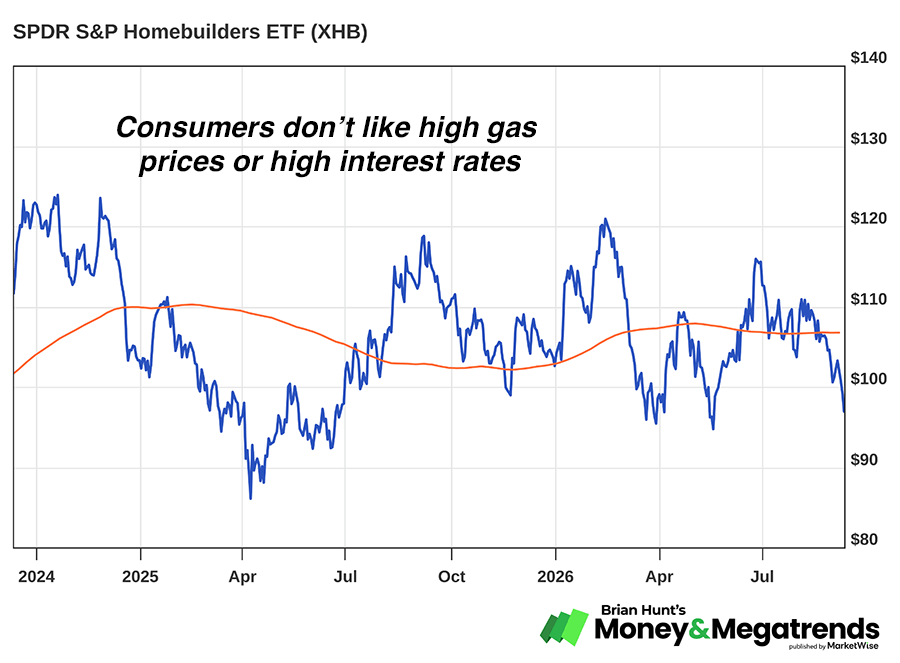
Second, we have the SPDR S&P Homebuilders ETF. Although this fund is labeled “homebuilders,” it is a much broader bet on the U.S. housing market than just companies that build homes. Less than half of it is actual homebuilders. A huge portion of it is in homebuilding materials and services related to plumbing, roofing, tiling, decking, furniture, insulation, paint, lighting and HVAC systems.
Thus, the fund’s fortunes rise and fall with America’s ability to finance home purchases, outdoor projects, kitchen remodels, new roofs, new patios, new bathrooms, and home additions.
Like RSPD, XHB has been hammered over the past month by high oil prices and rising interest rates. And like RSPD, it has sliced through its 200-day moving average.
Remember what we say about the 200-day moving average around here: Securities below their 200-day moving average are on the wrong side of the tracks. It’s the ugly part of town. All the really bad things happen below the 200-day moving average.
The weakness in these two critical stock market representatives of consumer health and happiness sends a loud message: The Iran War and its consequences of high oil prices, high diesel prices, and rising interest rates are harming the consumer and the U.S. economy.
Market Notes
-
Our recommendation to get long oil and gas stocks continues to pay off. Oil giants Chevron (CVX), ConocoPhillips (COP), Shell (SHEL), Cenovus Energy (CVE), and Equinor (EQNR) reached new all-time highs today.
-
Our recommendation to invest in cybersecurity is paying off. Cybersecurity leader Okta (OKTA) just reached a new yearly high now up 96% over the last year.
-
The VanEck Oil Refiners ETF (CRAK) hit a new high today. Individual refining giants Valero Energy (VLO) and Marathon Petroleum (MPC) reached highs, too.
-
Apparel and footwear giant Nike (NKE) reached a new one-year low today.
-
Elevator giant Otis Worldwide (OTIS) reached a new one-year low today.
-
Fast-food giant McDonald’s (MCD) reached a new one-year low today.
Top Themes to Buy Now
⚒️ Here’s why silver could resume its explosive uptrend
₿ Three stocks to invest in the coming revolution in money
🚀 Three Elon Musk suppliers that will benefit from soaring space spending
Regards,


Brian Hunt
Editor, Money & Megatrends
An urgent message from our colleagues:
Louis Navellier: My #1 AI stock for 2026 (name & ticker inside)

“I want to give you a free stock pick today. This company’s sales are up 28% year over year. It holds over 30,000 patents in wireless and video technology. And it just earned an A-rating in my proprietary Stock Grader system. That’s the same system that helped me flag Nvidia back in 2005 — before its 82,000% run. In fact, this system has identified the top-performing S&P 500 stock for 12 years running. Over the years, it has cost me $9 million to build and maintain. And right now, it’s flashing its highest possible rating on this AI play.” — Louis Navellier