Listen to the audio version of this article (generated by AI).
Today’s issue in preview:
-
This unique way to invest in the AI megatrend is soaring
-
The AI revolution could hammer stocks in this industry
-
These huge moves are bad news for AI bears
-
Learn our Top Themes to buy now
This unique way to invest in the AI megatrend is soaring

Credit: zxvisual
It turns out, being bullish on Brazil was a very good idea.
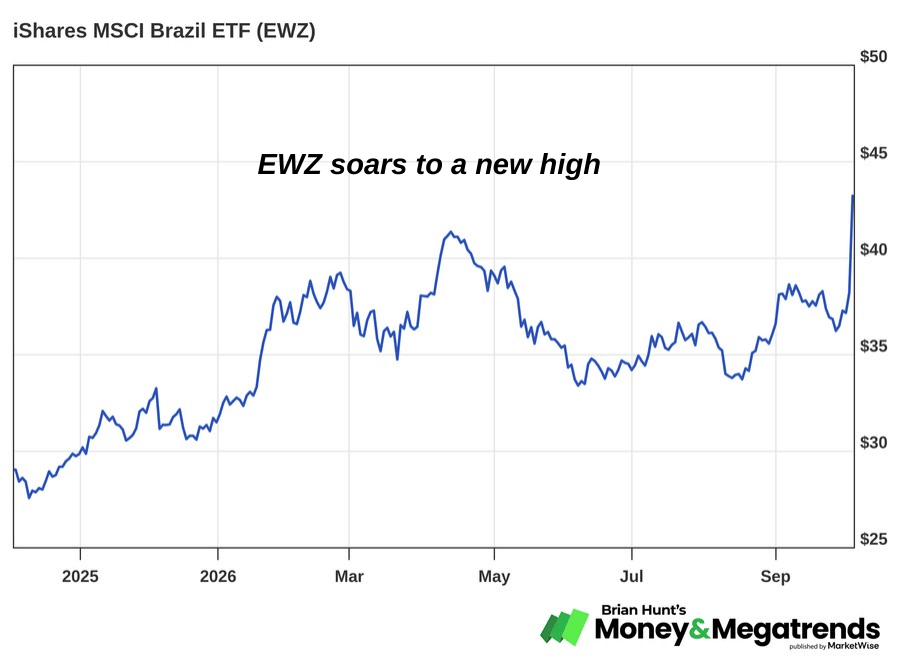
This morning, the most widely followed Brazilian investment vehicle among U.S. investors – the iShares MSCI Brazil ETF (EWZ) surged 13% to reach a multi-year high. This is one of the largest single-day moves of any non-leveraged ETF in 2026.
Brazilian stocks are soaring today because Flávio Bolsonaro unexpectedly finished ahead of President Lula in the first round of Brazil’s presidential election (which is set to be settled by an Oct. 25 vote). Investors view a Bolsonaro win as favorable for business and economic growth.
Regular Money & Megatrends readers are familiar with our bullish stance on Brazil.
Back in September 2025, I detailed the bullish price action in Brazilian stocks and recommended owning them. At the time, I noted that Brazil was a good way to invest in the uptrend in critical resources.
Critical resources are the building blocks of the economy. Think raw materials like crude oil, natural gas, iron ore, copper, corn, and cotton.
Mining, extracting, planting, harvesting, processing, refining, and transporting these critical resources is a multi-trillion-dollar business that affects every aspect of our lives.
With technologies like AI changing the world, it’s easy to forget about critical resources as an asset class. But when they enter uptrends, that momentum tends to last a long time, and carry prices higher than most people think is possible.
For many professional investors, Brazil is a preferred way to play commodities in the stock market. It is a true commodity superpower.
Brazil is the world’s largest producer of soybeans, sugar, and coffee. It’s a major producer of cattle, cotton, corn, and orange juice. It’s a major producer of iron ore and crude oil. This makes the Brazilian economy and stock market heavily “geared” towards resource markets.
Brazil is also a beneficiary of the historic AI infrastructure spending boom.
Given AI’s enormous promise, large tech firms such as Alphabet (GOOG), Amazon (AMZN), and Microsoft (MSFT) have invested over $1 trillion in specialized semiconductors, data centers, and other AI infrastructure components. They are on pace to invest over $700 billion this year alone and more than $4 trillion after that.
Both the scale and the velocity of this investment boom are unprecedented. It is the largest collective investment effort of all time.
Brazil’s extensive river network also makes it a major producer of hydroelectric power. This makes it an attractive destination for power-hungry AI data centers. Brazil also has large reserves of rare earth elements. Demand for these raw materials is soaring, driven by growth in AI infrastructure, robotics, and defense tech.
To add a cherry on top of this bullish cake, Brazil has a big-spending, deep-pocketed trading partner in the United States. U.S. companies can buy all the compute and rare earths that Brazil can bring to market.
Soon after my September note, Brazilian stocks – via EWZ – surged 38% in less than seven months. It then experienced a natural, healthy bull market correction from mid-April to mid-June.
As you can see in the chart below, this correction has ended. Brazilian stocks have paused, refreshed, and surged to new highs. EWZ is now up 47% since our original note. Brazilian oil giant Petrobras (PBR) is up 106%. Banking giant Itau Unibanco (ITUB) is up 51%. A pro-business administration will help keep this bull market going strong.
Recommended Link:
Free AI Demo – 10X Your Money

Keith Kaplan, one of America’s top AI experts, leads a firm that spent $17 million building some of the most advanced AI models around. Today, he’s agreed to publicly demo a brand-new breakthrough, which he says could help you make more than 10X your money. Join Keith here for the demo.
The AI revolution could hammer stocks in this industry

Credit: Althom
Over the past two months, we have published a special research series on the coming AI-powered revolution in money and banking.
AI agents that can work for you, shop for you, negotiate for you, and buy for you are rapidly becoming a huge force in the economy. A whole new blockchain-centric payment system is being built to accommodate the huge volumes AI agents will generate and the speeds at which they can transact.
We believe companies such as Coinbase (COIN) and blockchain networks such as Ethereum will benefit greatly from this trend.
Another driver of this revolution is tokenization. Tokenization is the process of representing an asset – such as a stock, bond, property, or a dollar – as a digital token on a blockchain. The token represents ownership of, or a claim on, the underlying asset.
The big advantage is that tokenized assets can be bought, sold, transferred, and settled almost instantly, 24/7, using programmable software. This makes tokenization useful for AI agents, which can automatically move money, invest money, and rebalance portfolios without relying on traditional financial plumbing.
As with any big business revolution, this one will produce big winners and big losers.
One such loser could be traditional banks.
Traditional banks generate the bulk of their revenue by paying as little as possible on customer deposits and earning higher yields on the money they lend out.
Many people leave large amounts of cash sitting in checking and savings accounts that pay far less than the best available interest rates. They do this largely because of convenience, habit, or the fact that constantly comparing rates and moving money is a hassle. AI agents could eliminate that inertia.
An agent could continuously compare savings accounts, money-market funds, Treasury bills, and other low-risk alternatives, then automatically move cash toward the highest available yields. This will benefit consumers but hurt banks by forcing them to pay higher rates to keep deposits.
This is likely to depress bank profits… which could, in turn, depress the multiples investors are willing to assign to banks… which could act as a “one two punch” that could send the market values of banks much lower.
The types of banks that stand to be harmed the most by this megatrend are conventional, smaller banks… rather than larger banks that offer other services that require a personal touch with the customer. Keep in mind, AI does not need to bankrupt these businesses to make their stocks losers. It needs only to erode their profitability for their stocks to go down.
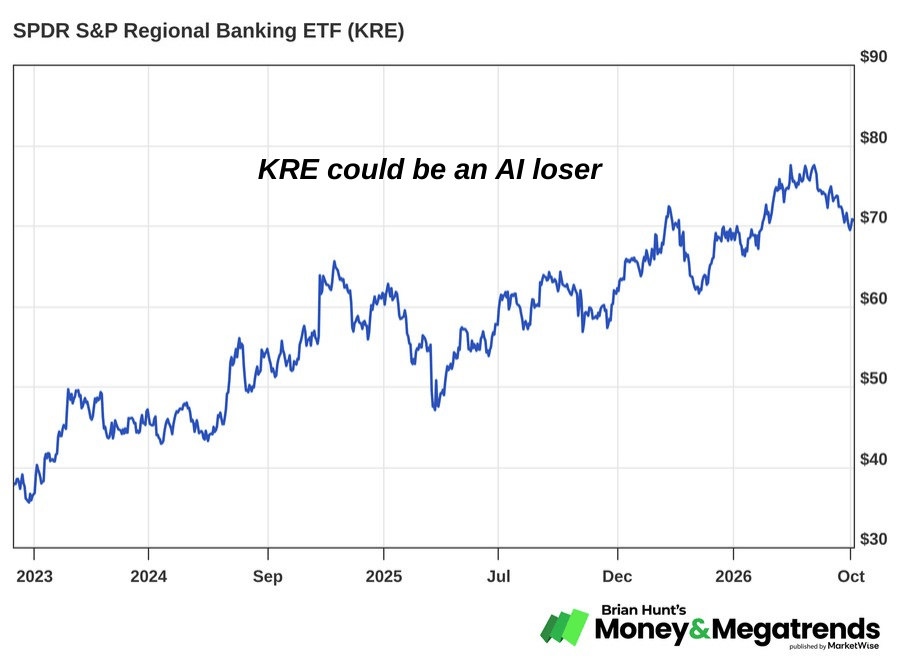
We can monitor this situation with the SPDR S&P Regional Banking ETF (KRE). It is the largest regional bank ETF by assets. It owns a diversified basket of relatively small regional banks, not “megabanks” such as Bank of America (BAC).
If the bull case outlined above has teeth, this fund will suffer a long bear market. The fund is up 88% over the past three years. But that trend could soon reverse. After all, do we really need a physical bank on every other block?
These huge moves are bad news for AI bears
Credit: Just_Super
The bearish “AI is a bubble” crowd is going to have a hard time with these two…
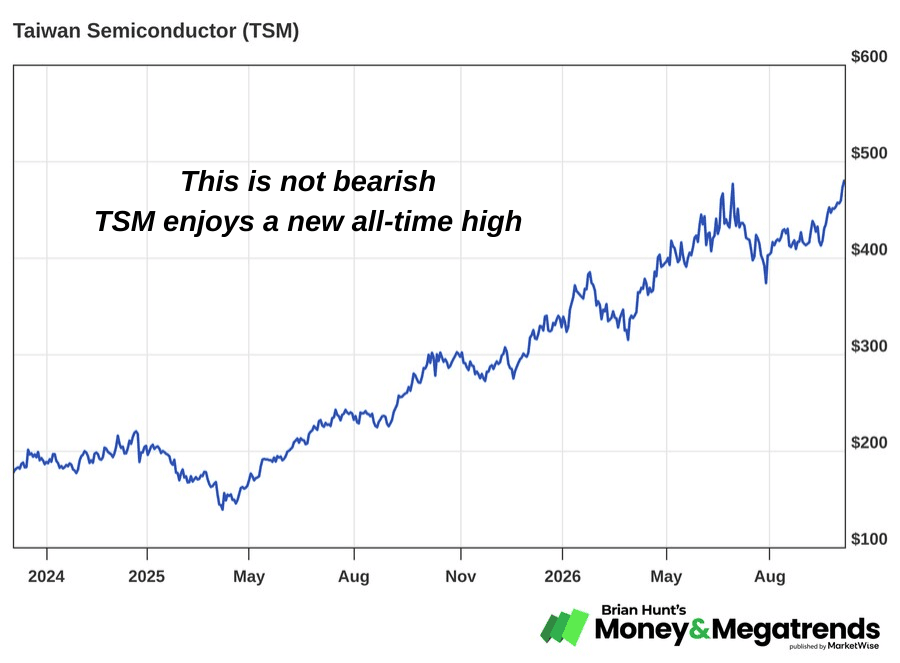
Today, two of the largest and most important players in the AI boom – Nvidia (NVDA) and Taiwan Semiconductor (TSM) – reached fresh all-time highs.
If you have even the faintest idea of “who’s who” in the AI infrastructure supply chain, you know that together, these two all-time highs are a very big deal. This is the market casting its vote with the “AI boom” thesis rather than the “AI bust” thesis.
Over the past three months, we have published a special series of research notes analyzing the AI infrastructure megatrend, which we have called the “world’s most important trend.”
The status of this megatrend has become one of the great sagas of the business and investment world. It is a source of strong disagreement among industry bulls and bears. It’s a trend whose outcome will almost certainly have large effects on your portfolio.
As mentioned above, large tech firms such as Amazon (AMZN), Microsoft (MSFT), and Alphabet (GOOG) are investing trillions of dollars in a race to build the world’s most capable AI applications and computing infrastructure.
Both the scale and the velocity of this investment boom are unprecedented. It is the largest collective investment effort in history.
Big Tech’s historic investment boom has made the entire “AI infrastructure” trend responsible for a large share of America’s GDP growth and stock market returns over the past two years.
It has also drawn the skeptical scrutiny of many widely followed investment analysts who claim the trend is a bubble… one that will soon explode and cause tremendous damage to stock prices and the global economy.
If this hugely consequential trend isn’t the most important trend in the stock market, then it is certainly in the top three.
I believe the AI infrastructure trend has years to run. I believe the world’s smartest, most connected tech insiders who know the true state of bleeding-edge AI development and have real-time stats on AI investment ROI, such as Elon Musk, Jensen Huang (Nvidia), Satya Nadella (Microsoft) and Andy Jassy (Amazon), could possibly… perhaps maybe… just might… know far more about AI and their businesses than outsiders know about it.
As much press as AI gets, let’s remember that less than 1% of the global population pays for top-tier AI programs. And I estimate less than 10% of large companies believe AI has made a meaningful impact on their businesses.
This revolutionary technology hasn’t yet proliferated, achieved mass adoption, or had mass impact.
However, I place much more weight on what the market thinks about this trend (and every other trend) than on what anyone thinks about it, including me.
In the case of AI infrastructure, the market is favoring the bullish case.
Taiwan Semiconductor is the world’s largest AI semiconductor chip maker. It performs little design work of its own. Instead, it produces – on a colossal scale – chips designed by companies such as Nvidia, Apple (AAPL), Amazon, and Broadcom (AVGO).
To say TSM is critical to the AI infrastructure boom is an understatement. It is estimated that TSM manufactures around 90% of the world’s most advanced AI chips. It is one of the few truly “mission-critical” parts of the AI infrastructure supply chain.
Nvidia designs a large portion of the world’s most advanced AI semiconductors. It has also used its enormous cash flows to become a key investor in many AI firms… and to become essentially a “central bank of AI,” capable of financing many very large AI companies and initiatives.
Nvidia is not an 800-pound gorilla of AI… but perhaps an 800,000-pound gorilla of AI. Few companies in history have wielded Nvidia’s awesome combination of power, influence, technological expertise, and vast financial resources. Perhaps zero have.
Today, both Nvidia and TSM dealt a big blow to the “bearish AI” thesis by reaching all-time highs. When we pair these important new highs with the Magnificent 7’s new all-time high and Micron’s new short-term high, we get the weight of the evidence tilting heavily in the bullish direction of the AI infrastructure trade.
Market Notes
-
Our recommendation to invest in the genomics theme continues to pay off “bigly.” The ARK Genomic Revolution ETF (ARKG) reached an all-time high today.
-
Our recommendation to invest in cybersecurity stocks to profit from the Agent Supernova continues to be a huge winner. The Global X Cybersecurity ETF (BUG) reached an all-time high today.
-
Oil tanker giants International Seaways (INSW), Hafnia (HAFN), Torm (TRMD) and DHT Holdings (DHT) all hit new highs today.
-
Our January 28th recommendation to own the AI application layer is paying off. Zeta Global Holdings (ZETA) just hit a new yearly high which means it’s now up 83% since our initial recommendation.
-
Food and beverage giant PepsiCo (PEP) reached a one-year low today.
-
Fast food giant McDonald’s (MCD) reached a new one-year low today.
-
Home improvement and remodeling giant Home Depot (HD) reached a one-year low today.
-
Apparel giant Lululemon (LULU) reached a one-year low today.
Top Themes to Buy Now
🇧🇷 One of the world’s best investors bets on Brazil. Why it’s poised to head higher
📈 The biggest AI news you’re not hearing in the mainstream media… is very bullish
⚡ Four stocks that stand to benefit from AI’s soaring power consumption problems
Regards,


Brian Hunt
Editor, Money & Megatrends
An urgent message from our colleagues:
Elon’s iPhone Killer

Elon Is Quietly Building a Device That Could Kill the iPhone.