
Listen to the audio version of this article (generated by AI).
Today’s issue in preview:
-
Six elite stocks to play the bull market in gold
-
AI will drive a revolution in money and banking. Three stocks for the coming shift.
-
Learn our Top Themes to buy now
Six elite stocks to play the bull market in gold
Credit: Backyard Production
Last week, the U.S. government announced that total U.S. debt topped $40 trillion for the first time.
The government’s debt has more than doubled in less than a decade, from $19.95 trillion when President Donald Trump was sworn in for the first time in January 2017.
Net interest payments on the debt are projected to total more than $1 trillion in fiscal 2026. Interest payments now exceed defense spending and Medicare spending. Servicing debt is now the second-largest item in the federal budget, behind only Social Security. It is expected to cost more than $16.2 trillion over the next decade.
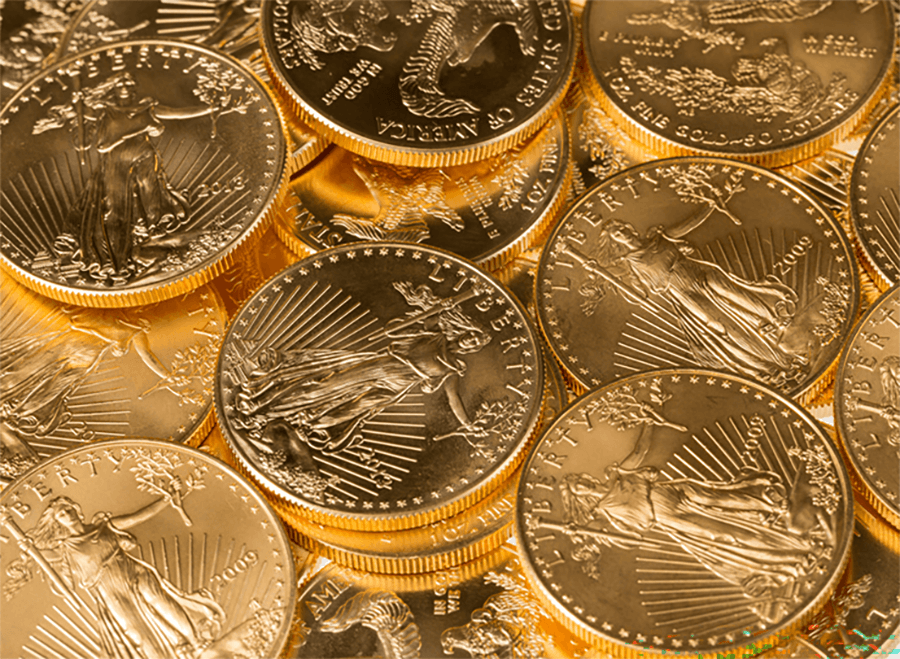
Given all this, it is no wonder gold recently rallied from $4,000 per ounce to $4,600 and resumed its long-term uptrend.
In 2003, I placed over half of my net worth into physical gold. Since making that bet, gold has risen about 1,170%, far outperforming stocks. I haven’t sold one ounce along the way. Over the years, I’ve held huge positions in gold stocks.
And now, all these years later, the best reason I can find to be bullish on gold is the same reason why I bought gold in the first place…
The U.S. government is spending far more money than it takes in and then makes up the difference by borrowing and printing money by the trainload. Every freshly printed unit of currency debases an existing one. This raises the nominal price of real money (gold). Gold has spent the past 23 years constantly revaluing itself to accommodate the huge increase in new currency units.
Here in mid 2026, the problem is worse than ever. In America, millions of people are net tax recipients – meaning they receive more in benefits than they pay in taxes.
No politician can win a major election by promising reduced spending. Too many people are now riding the gravy train. Democrat or Republican, it doesn’t matter. Campaigning on sensible spending is a sure loser.
This makes it a good time to know “who’s who” in the gold royalty business.
In our recent analysis of the unique ETF, Horizon Kinetics Inflation Beneficiaries ETF (INFL), I covered its business model.
Gold royalty firms are a unique type of company. They do not engage in the business of operating gold mines. Instead, they are essentially resource banking/investment firms. They raise investor capital and then invest it in prospective or existing resource projects.
They partner with mine and oilfield operators… buying upfront stakes in projects in exchange for a share of future production. In doing this, the best royalty firms own diversified resource portfolios and enjoy high-margin businesses without doing the day-to-day work of operating mines or oilfields.
This “high margin, asset-lite” business model allows the best royalty firms to generate strong profit margins, consistent cash flow and leverage to rising gold prices. This in turn makes royalty firms the preferred vehicles for many sophisticated investors to invest in gold for the long term.
Compelling gold royalty firms include:
Royal Gold (RGLD): RGLD is one of the largest precious metals companies. Royal Gold has major interests in several large, long-lived mines, including Mount Milligan in Canada, Pueblo Viejo in the Dominican Republic, Cortez in Nevada, Andacollo in Chile and Kansanshi in Zambia. Mount Milligan and Pueblo Viejo are particularly important cash generators. The portfolio is primarily gold-focused but provides meaningful exposure to copper. Market cap: $22.6 billion.
Franco-Nevada (FNV): Franco-Nevada owns one of the industry’s largest and most diversified portfolios, spanning hundreds of mining and energy assets across numerous countries. Major contributors have included Candelaria, Antapaccay, Antamina and various Nevada gold operations. Gold accounts for most of its value, supplemented by silver, platinum-group metals, copper and energy. Market cap $52 billion.
Triple Flag Precious Metals (TFPM): Triple Flag’s important assets include Northparkes and Ravenswood in Australia, Cerro Lindo in Peru, Impala Bafokeng in South Africa, Buriticá in Colombia and Fosterville in Australia. Its portfolio is heavily weighted toward gold and silver and geographically concentrated in the Americas and Australia. Market cap $7.2 billion.
OR Royalties (OR): Formerly Osisko Gold Royalties, OR’s flagship asset is its valuable interest in Agnico Eagle’s Canadian Malartic complex in Quebec, one of Canada’s largest gold operations. OR also has exposure to other producing and development projects, including several Canadian assets. Market cap $7.3 billion.
Gold Royalty Corp. (GROY): Gold Royalty has assembled a large portfolio of interests across the Americas, with particularly significant exposure to gold projects in Canada and the United States. Unlike the industry’s giants, much of GROY’s potential value comes from mines and projects that are still being developed, expanded or explored. That creates potentially substantial production growth over time but also makes future cash flows less certain. Market cap: $815 million.
Versamet Royalties (VMET): Versamet is an emerging player whose portfolio provides exposure to precious and base metals across producing, development and exploration-stage properties. The company’s attraction is largely its growth potential: because it remains relatively small, successful mine developments, expansions and additional acquisitions can materially increase its cash flow and asset value. Market cap $1.2 billion.
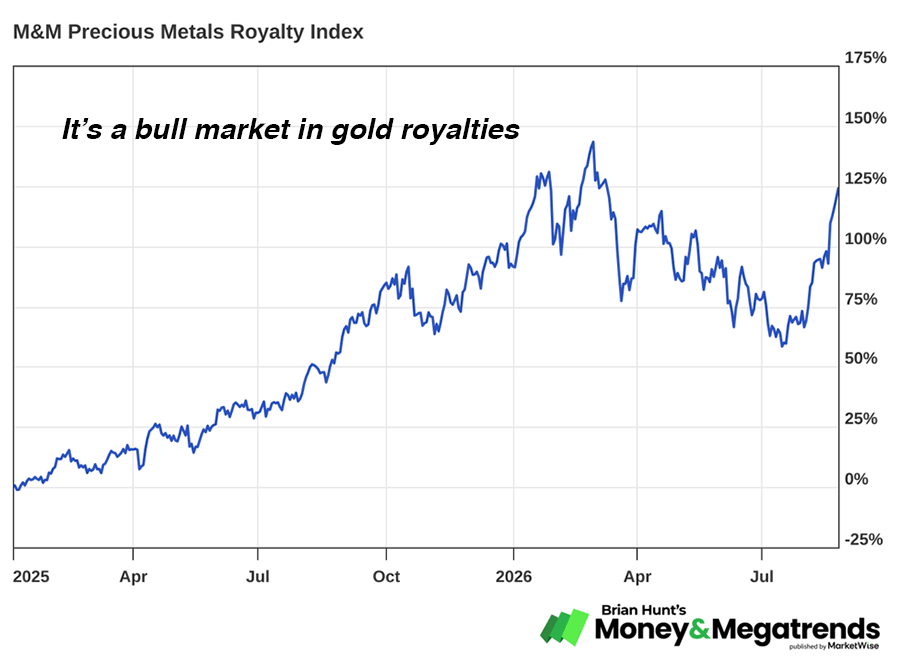
Recent government spending and taxation data tell us the government is going “full speed ahead” with spending, borrowing, and printing. This means owning quality “inflation defense” assets is as important as ever. Gold royalty firms are worthy members of this club. If gold continues its bull market, as I think it will, these stocks will be large winners. As you can see in the chart below, our Precious Metals Royalty Index is poised to reach new highs:
Recommended Link:
“Do NOT buy high flying tech stocks like Nvidia, SpaceX”

One of America’s leading AI pioneers is stepping forward today with this urgent warning… and to reveal exactly where to move your money for a chance at 1,000%+ returns before August 31st. Get the full details here.
AI is poised to drive a revolution in money and banking. Three stocks for the coming shift.

Credit: jroballo
In May, Microsoft said the number of active AI agents in its business software suite (the Microsoft 365 ecosystem) increased 15-fold from March 2025 to March 2026.
This significant increase in agent usage marks the start of a massive AI trend… one that will create many large opportunities for investors. It’s also proof that the Agent Supernova we forecasted is here.
On March 16, we urged readers to prepare for the “Agent Supernova” our nickname for the coming explosion in AI agent usage.
Years of development have made AI advanced enough to perform many everyday tasks people do now… and the list of tasks is only getting bigger.
In the next 12–24 months, AI agents will assist with managing factories… performing financial analysis… managing business inventories… writing software… designing websites… creating legal documents… and thousands of other things.
Within the next two years, the number of AI agents operating in the American economy isn’t poised to increase by 10X… or 50X… or even by 1,000X. Try at least 10,000X.
This is the coming Agent Supernova. Agents working with people. Agents working with other agents. Agents running businesses. Agents negotiating and haggling with other agents.
The Agent Supernova is about to introduce billions of “AI workers” into our economy to perform all kinds of roles… with very little day-to-day human oversight.
The business and investment implications are huge. The Agent Supernova will transform many businesses and industries, and end many as we know them… while creating new ones. The economic deck is about to get reshuffled.
The bigger the impact a megatrend can have on our world, the bigger the capital gains it can generate in your portfolio. This is why the Agent Supernova is such a big opportunity. It’s why we will be writing about and investing in this trend for years.
One compelling facet of this megatrend is how AI will revolutionize money, payments, and banking.
Very soon, there may be more AI agents than humans transferring money and making payments in our economy.
That’s not our claim. That’s what the CEO of Coinbase, Brian Armstrong, said on March 9:
“Very soon, there are going to be more AI agents than humans making transactions. They can’t open a bank account, but they can own a crypto wallet. Think about it.”
Money is about to have far more machine use than human use. And once you understand that machines and AI agents can’t use bank accounts as we know them… the only logical use case will be stablecoins… aka “dollars that computers use without having bank accounts.”
Why do more AI agents mean more stablecoins?
Currently, AI agents can do the following:
-
Talk to other APIs (services)
-
Rent computer power
-
Buy and sell data and
-
Send lots of small payments every day.
That is all programmed in advance and easy for an agent to do.
However, an agent cannot go to a bank, show an ID, sign forms, or open an account. That’s why the traditional banking system as we know it today isn’t agent-friendly.
But an agent can manage a digital wallet protected by a key or code. Stablecoins are simply dollars that live inside these keyed, or coded, wallets that can move dollars instantly, anytime, anywhere. This makes them a natural fit for how agents spend and receive money.
Compelling investment candidates related to this trend include:
Circle (CRCL): CRCL is a $23 billion company that is the issuer of USDC, the #1 stablecoin in transaction volume globally. Unlike Tether (another key stablecoin), which operates predominantly outside the more regulated US industry, CRCL is a fully regulated entity that has created a stablecoin that banks, institutions, and asset managers are regularly using.
The business model is simple. It issues USDC, holds the corresponding dollar reserves in T-bills (for yield), and earns yield on those reserves. This means it’s a simple play on the adoption of stablecoins that CRCL CEO Jeremy Allaire has recently compared to where the internet was in 2002.
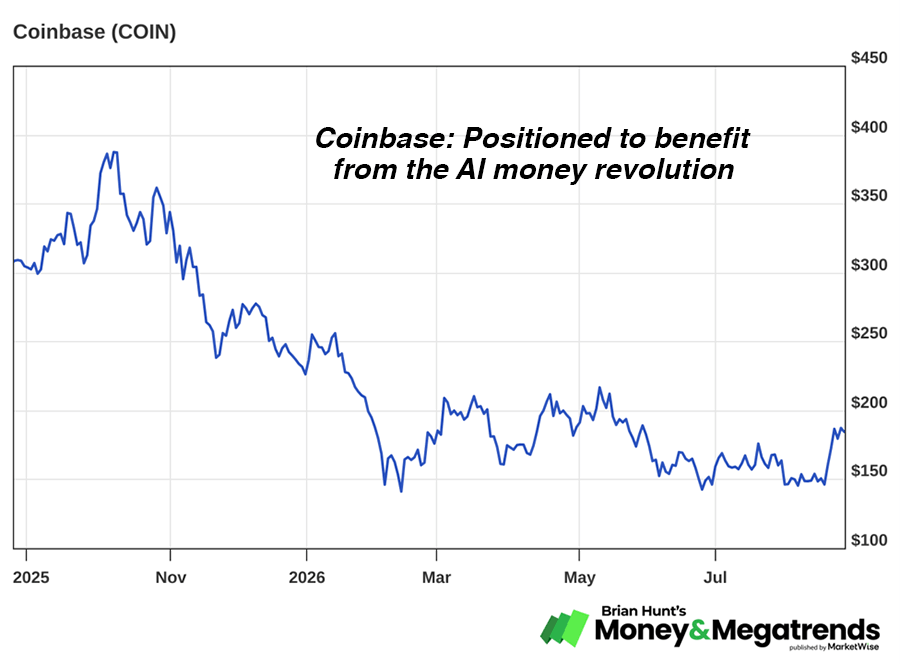
Coinbase (COIN): COIN is a $50 billion company that can be best described as the “everything crypto company,” which includes stablecoins.
COIN doesn’t issue stablecoins the way Circle (CRCL) does, but it has a revenue-sharing partnership, agreed upon until 2029, that allows it to profit from USDC. COIN is now at a level where over 90% of all agentic stablecoin transactions settle through Base, COIN’s own blockchain, which has processed over $32 trillion in stablecoin transfer volume over the last 12 months.
Visa (V): V is a $720 billion payments giant that is quietly also becoming one of the most important plays in the stablecoin infrastructure world. V has been settling transactions in USDC on chain since 2021. This quarter, it launched the Visa Stablecoin Platform, which allows it to issue, move, and manage stablecoins.
V’s CEO Ryan McInerey has been explicit in the recent earnings call that the company is not picking one stablecoin winner. It is connecting clients to the entire ecosystem, meaning V will win as long as the stablecoin market continues to win.
For investors, V can offer a safer exposure to the stablecoin market because the stablecoin segment is wrapped inside one of the most durable, cash-generative business models on earth.
If Brian Armstrong and his fellow bulls on stablecoins are even half right, the next big user of money won’t be humans. It’ll be agents. If that’s true, stablecoins become the default money for machines, and COIN, CRCL, V will enjoy huge tailwinds.
Market Notes
-
The American consumer continues to spend. Credit card giant and emerging stablecoin giant Visa (V) reached a new all-time high this week.
-
U.S. manufacturing giant Nordson (NDSN) reached a new all-time high this week.
-
Steelmaking giant ArcelorMittal (MT) reached a new all-time high today. This is a bullish economic signal.
-
Our recommendation to invest in the genomics megatrend continues to pay off. Genomic testing/analytics giant Illumina (ILMN) reached a new one-year high today.
-
Our recommendation to get long the copper mining megatrend continues to pay off. Ero Copper Corp. (ERO) reached a new all-time high today. The Global X Copper Miners ETF (COPX) reached a new all-time high today.
-
It’s a bull market in Poland. The iShares MSCI Poland ETF (EPOL) reached a new all-time high today.
Top Themes to Buy Now
🔌 This “AI Power” trade is moving higher… are you on board?
Regards,


Brian Hunt
Editor, Money & Megatrends
An urgent message from our colleagues:
These 3 Stocks Could Soar as Sam Altman Announces New Venture After OpenAI

Elon Musk calls it “the most disruptive force in history.” The test staff are sworn to keep it secret – by law. And 3 little-known stocks are poised to take off, as Sam Altman releases what could be the biggest venture of his life – 500 times bigger than ChatGPT.
Click here to learn about the stocks tied to Sam Altman’s NEXT big move after OpenAI.