
Listen to the audio version of this article (generated by AI).
Today’s issue in preview:
-
Six ways to invest in the revolution in money and banking
-
Own these stocks to profit from the coming mass adoption of AI
-
New highs for the Magnificent 7 are sending you a clear signal. Are you listening?
-
Learn our Top Themes to buy now
Six ways to invest in the revolution in money and banking

Credit: ISerg
It looks like the revolution is here.
And it’s starting to move the markets.
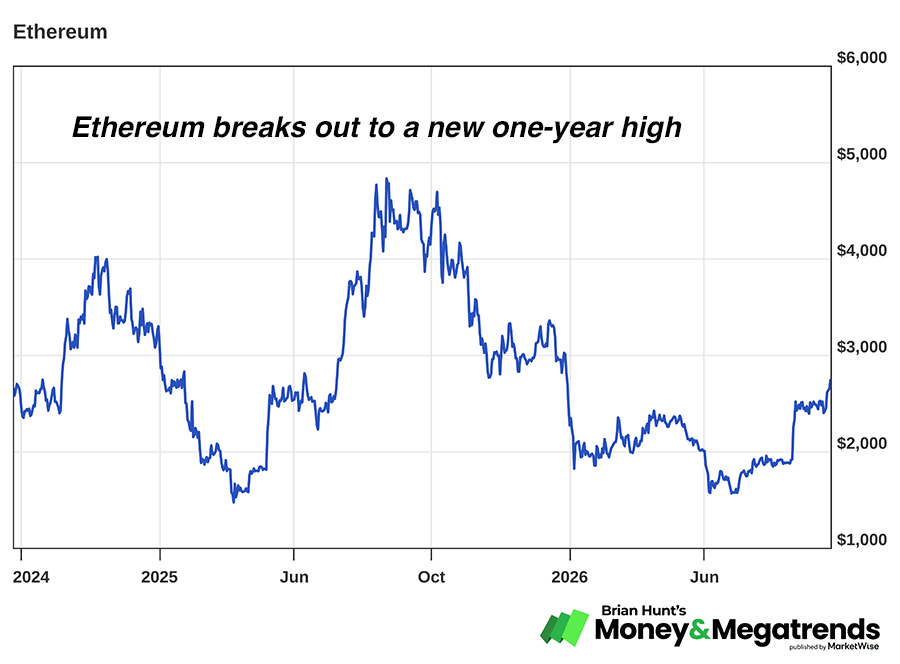
Over the past week, the token representing the leading blockchain network Ethereum broke out to its highest price in eight months. Its fellow leading network/token, Solana, did the same. And leading cryptocurrency brokerage/infrastructure provider Coinbase (COIN) surged 5.4% this morning, reaching its highest level since June.
In other words, the market is beginning to agree with the bullish thesis we laid out in a special series of research notes we published this year… in which we asserted that a revolution in money and banking is at hand.
In our series, we detailed how two megatrends could converge to drive many blockchain-centric stocks and network tokens much higher.
Those two megatrends are:
Agentic payments and money transfers: The number of AI agents at work in the economy is growing rapidly and will continue to do so for years. We will have many millions of agents transferring money and making payments in the economy. These agents will avail themselves of blockchain technology. Often.
Blockchain is a digital record-keeping system that stores transactions across a network of computers rather than in one central location. Once information is recorded, it is extremely difficult to change or erase. This allows people and businesses to securely exchange money or information without relying on a central authority to verify every transaction.
This can make banking systems much faster, much more efficient, and much cheaper.
Money will eventually have more machine use than human use. And once you understand that AI agents can’t use bank accounts as we know them… the only logical use case will be blockchain-enabled stablecoins… aka “dollars that computers use without having bank accounts.”
You can think of dollar-backed stablecoins like dollars you spend online, only faster and more flexible. Stablecoins are digital dollars that can move on open blockchain networks, while conventional dollars in your bank account generally move through closed banking systems.
An AI agent cannot go to a bank, show an ID, sign forms, or open an account. That’s why the traditional banking system as we know it today isn’t agent-friendly.
But an agent can manage a digital wallet protected by a key or code. Stablecoins are simply dollars that live inside these keyed, or coded, wallets that can move dollars instantly, anytime, anywhere. This makes them a natural fit for how agents spend and receive money.
Stablecoin transaction volume more than tripled year over year, rising 229% to $22.4 trillion in Q1 2026.
Visa’s stablecoin settlement volume has risen more than 15X year over year, recently exceeding a $20 billion annualized run rate.
Tokenization: Tokenization is simple. Take any real-world asset – a US treasury bond, a share in a private equity fund, a piece of commercial real estate, a share of Apple (AAPL), a corporate bond – and represent fractional ownership of it as a digital token on a blockchain.
Think of a blockchain as a record book that anyone can verify, but no single bank or government controls. It’s the ledger that makes digital ownership trustworthy without needing the middleman.
Instead of paper certificates of ownership, settlement agents taking a fee, and a multi-day clearing cycle, ownership becomes digital, with no human middleman, and practically instant.
A token of ownership can be transferred in seconds, fractionalized to a percentage of its original size, and plugged directly into a liquid market.
The market for tokenized real-world assets on public blockchains is already nearly $30 billion in 2026. But that number is purely a proof of concept. Forecasts from the likes of Boston Consulting Group and McKinsey assert this market is headed towards the $16-$30 trillion range in the next 5-8 years.
And for even more proof, Larry Fink – the CEO of BlackRock and one of the most powerful figures in finance, with more than $11.5 trillion in assets under management – has consistently advocated for tokenization.
In his 2025 annual letter to investors, he described tokenization as “the next generation for markets.”
“If we could digitize every asset, we could have a more seamless way of going from a digital wallet to ownership of real assets.”
He’s not alone in this view, and some major institutions are already on board. Kinexys, J.P. Morgan’s enterprise blockchain and digital asset business unit, has now processed over $1.5 trillion in tokenized transactions.
A bullish cherry on top of the cake is political power.
For better or worse, the Trump family is heavily invested in blockchain-centric businesses and therefore heavily incentivized to drive friendly regulation. I expect to soon see President Trump speaking and posting about the trends outlined above.
Plus, U.S. Treasury Secretary Scott Bessent has spoken favorably of stablecoins and how they could drive demand for U.S. bonds, which could help the U.S. manage its large debt burden.
In our research on these trends, we’ve highlighted Bitcoin, Ethereum, Solana, Coinbase (COIN), Robinhood (HOOD), and Securitize (SECZ) as compelling investment options.
The market is starting to agree with the bull case for the stocks and tokens listed above.
Below is a one-year chart of Ethereum, one of the world’s most widely used blockchain networks for the commercial activities described above.
As you can see, Ethereum suffered greatly along with the rest of the cryptocurrency world from late 2025 to mid 2026. Since that suffering, it has carved out a bottom and recently reached its highest point in eight months.
This is a bullish development in favor of the coming revolution in money and banking.
Recommended Link:
Tomorrow, “Super AI” Opens New Way of Trading

Beginning at 10 am ET tomorrow, a new form of AI could quadruple your portfolio by foreseeing the future prices of 2,334 stocks, to the penny, with 85% backtested accuracy. It’s opened the most lucrative investment vehicle in our firm’s 21-year history, which has officially crushed the 2026 market by 218%, as of August. You can even chat with it! Try it now, free of charge.
Own these stocks to profit from the coming mass adoption of AI

Credit: imaginima
As we expected, it’s a bull market in securing the world’s AI, computers, and data centers.
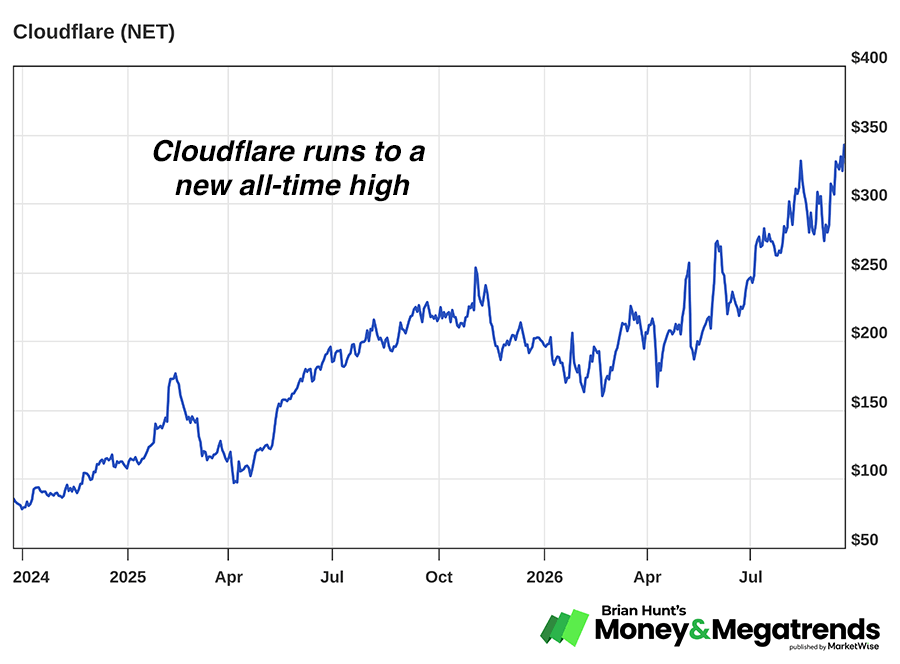
As evidence, I present today’s new all-time high for Cloudflare (NET), the new all-time high for the Global X Cybersecurity ETF (BUG), and the new six-month highs for cybersecurity leaders Zscaler (ZS) and Rubrik (RBRK).
In our March 16 issue, we introduced our Agent Supernova thesis… and how companies such as Cloudflare are positioned to benefit from the trend.
After years of development, AI is now advanced enough to perform many everyday tasks people do … and the list is only getting longer. Over the next 12–24 months, AI “agents” will help manage factories, perform financial analysis, manage inventories, write software, design websites, create legal documents… and thousands of other tasks.
The Agent Supernova is poised to reorder how the world works. It will break and reform many businesses, industries, and societal norms.
Soon, a restaurant could have five different agents working in it. One agent to manage the cooking schedules of meals. One agent to manage accounting. One agent to manage the staff. One agent to manage the ordering and tracking of supplies. One general-purpose agent to manage the specialized agents and interact with the restaurant owner.
At home, another set of agents can perform tasks to help the heroic American mom. A “mom helper” agent could schedule dentist appointments for the kids, pay bills, renew the car insurance, write and send thank-you cards, order groceries, and remind the kids to do their homework.
Meanwhile, another set of agents will transform American factories. They will have agents managing logistics, accounting, production schedules, component part ordering, hiring and firing workers, and other critical functions.
Now, take those three examples and extrapolate that activity across the economy. We are on the cusp of an explosion of agents working 24/7/365 for individuals, businesses, and governments.
In addition to restaurant manager agents, mom agents, and factory management agents, our lives will soon feature legal agents, government agents, tax agents, teacher agents, negotiator agents, airport agents, hospital agents, writing agents, marketing agents, and the list goes on for days.
Within the next two years, the number of AI agents operating in the American economy isn’t poised to increase by 10X… or 50X… or even by 1,000X. Try at least 10,000X.
Of course, the business and investment implications here are huge. The Agent Supernova will transform many businesses and industries. It will end many businesses as we know them… while creating new ones at the same time. The economic deck is about to get reshuffled.
Of all the stocks we’ve covered to profit from the Agent Supernova, few have powered higher than Cloudflare.
Cloudflare is one of the world’s leading Content Delivery Network (CDN) firms. A CDN is a network of physical servers deployed across the country that speeds up the delivery of website content. It reduces latency and bandwidth costs by bringing data and content closer to users.
In addition to this business, Cloudflare provides in-demand cybersecurity services, AI agent management services, and AI agent transaction services. This is a huge component of the business, since nobody will want to use AI if they think it will be used to steal their identity.
This diversified suite of hardware and agent management services makes Cloudflare something of an AI agent “conglomerate,” and uniquely positioned to benefit from the coming agent boom.
Cloudflare’s unique position is driving strong growth. In 2024, its revenue grew 29%. In 2025, it grew 30%. Growth has accelerated in 2026, with second-quarter revenue surging 36%. Wall Street now expects Cloudflare’s revenue to reach approximately $2.87 billion in 2026, up 32%, and climb another 28% to roughly $3.7 billion in 2027.
We first profiled Cloudflare on May 5. Since then, the stock is up 53% and reached a new all-time high today.
Cloudflare is now trading at a very rich 40X expected 2026 revenue, so we’d avoid buying the stock at these levels. However, the stock’s new high sends a loud message. It is yet more confirmation that the Agent Supernova and its security implications are a massive trend we should be following.
New highs for the Magnificent 7 are sending you a clear signal. Are you listening?

Credit: pingingz
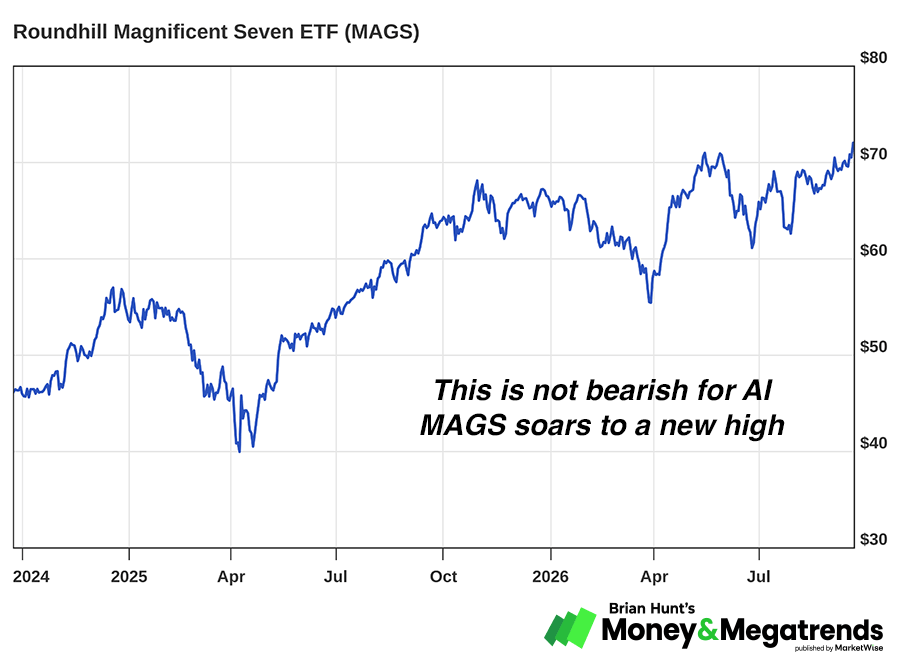
Last week, we looked at the Roundhill Magnificent Seven ETF (MAGS) and noted the positive signals it was flashing for the technology sector.
At the time, MAGS had reached a new three-month high and was pennies away from an all-time high.
Today, MAGS is no longer pennies away from that high. It is beyond it.
That’s bullish for technology… bullish for the AI trade… and bullish for America in general.
MAGS is the largest ETF specifically designed to give investors exposure to the “Magnificent 7,” a group of dominant technology firms comprised of Nvidia (NVDA), Microsoft (MSFT), Alphabet (GOOG), Tesla (TSLA), Amazon (AMZN), Apple (AAPL), and Meta (META).
Together, these firms are worth about $24 trillion and make up roughly 31% of the benchmark S&P 500. No group of companies in history has wielded this group’s awesome combination of power, technological expertise, and vast financial resources. This group includes nearly all of the “hyperscalers” leading the AI revolution.
And the ETF that tracks this group reached an all-time high today.
This is an important development for “the world’s most important trend.”
Over the past two months, we’ve published a special series of research notes analyzing the AI infrastructure megatrend.
The status of this critical trend has become one of the great sagas of the business and investment world… a source of intense disagreement among industry bulls and bears. It’s a trend whose outcome could have large effects on your portfolio.
Given AI’s enormous promise, the firms above have invested over $1 trillion in AI infrastructure. They are on pace to invest over $700 billion this year alone and more than $4 trillion after that.
Both the scale and the velocity of this investment boom are unprecedented. It is the largest collective investment effort in history.
Big Tech’s historic investment boom has made the entire “AI infrastructure” trend responsible for a large share of America’s GDP growth and stock market returns over the past two years. It has also drawn the skeptical scrutiny of many widely followed investment analysts who claim the trend is a bubble… one that will soon explode and cause tremendous damage to stock prices and the global economy.
If this hugely consequential trend isn’t the most important trend in the stock market, then it is certainly in the top three.
I believe the AI infrastructure trend has years to run. I believe the world’s smartest, most connected tech insiders who know the true state of bleeding-edge AI development and have real-time stats on AI investment ROI, such as Elon Musk, Jensen Huang (Nvidia), Satya Nadella (Microsoft) and Andy Jassy (Amazon), could possibly… perhaps maybe… just might… know far more about AI and their businesses than outsiders know about it.
As much press as AI gets, let’s remember that less than 1% of the global population pays for top-tier AI programs. And I estimate less than 10% of large companies believe AI has made a meaningful impact on their businesses.
This revolutionary technology hasn’t yet proliferated, achieved mass adoption, or had mass impact.
Regular readers know I care a lot more about what the market thinks of any stock, trend, or theme than what any one person thinks of it, including me. You can be bullish or bearish on a trend all you like, but if that trend is moving strongly against you, then your idea isn’t worth much in my book.
Over the past few months, we have analyzed price action in critical areas of the AI infrastructure trade – including the VanEck Semiconductor ETF (SMH), computer memory giant Micron (MU), and optical networking stocks – to guide our trading.
Since the Mag 7 plays a central role in AI infrastructure, it is central to our analysis. Several of these firms have been singled out by bears for issuing debt to invest in AI data center construction.
However, right now, the market is saying debt issuance and ROI on AI infrastructure spend aren’t much of a worry… and that things are going quite well for the Mag 7.
As you can see in the two-year chart below, MAGS is in a clear uptrend and just broke out to an all-time high. This is bullish for the AI infrastructure trade, bullish for the tech sector in general, and bullish for America.
Market Notes
-
Good signs for the AI infrastructure trade: AI infrastructure leader Semtech Corp (SMTC) just hit a new yearly high. Semiconductor leader Advanced Micro Devices (AMD) also hit an all-time high.
-
Our recommendation to invest in the genomics megatrend continues to pay off. Genomic analysis firm 10X Genomics (TXG) reached a new all-time high today. The stock is up 553% since our bullish October 2025 note.
-
Food and beverage giant Pepsico (PEP) reached a new one-year low today.
-
Fast food giant McDonald’s (MCD) reached a new one-year low today.
-
Alcoholic drink giant Constellation Brands (STZ) reached a new one-year low today.
Top Themes to Buy Now
₿ Three stocks to invest in the coming revolution in money
⚡ Soaring AI Power Consumption is driving a bull market in this unique technology. How to invest
🦾 The machine sensory perception theme is quietly booming. Are you profiting?
Regards,


Brian Hunt
Editor, Money & Megatrends
An urgent message from our colleagues:
Chaikin: This “White Swan” Could Eat Every Data Center in America starting 9/29/26

Every major AI firm now relies on massive data centers. But these monstrosities suck up our electricity. They drain our water supplies. They steal precious land. Yet AI companies are requesting 700 gigawatts of new electricity – enough to power every home in America! Until now, AI investors have piled trillions into the data-center boom. But according to investing legend Marc Chaikin, a new technology’s coming… called AI “micro clusters.” And they’ll render all current data centers obsolete. The company he believes is behind this $248 trillion “White Swan” event could soar starting Sept. 29th.
Marc reveals his full prediction – and the stock ticker – free, here.