
Listen to the audio version of this article (generated by AI).
Today’s issue in preview:
-
You’re crazy if you think AI development will slow down. Stay bullish.
-
How to profit from the surge in “AI is dangerous” concerns
-
Donald Trump turned these stocks into money machines
-
Learn our Top Themes to buy now
You’re crazy if you think AI development will slow down. Stay bullish
Credit: Just_Super
To slow down or not to slow down?
Over the past week, this has become the biggest unanswered question in the entire investment world. The answer could have large effects on your portfolio.
Many AI insiders are seeing the blistering pace of AI advancement and saying it should be slowed. They say a slower rate of progress would give technologists more time to build safeguards such as restricting what AI agents can do, limiting what data they can access, and thorough testing to gauge their capabilities. Over the past week, this subject has exploded across mainstream media and social media alike.
However, some “AI maximalists” say slowing down development would cede America’s AI lead to China. They also say some AI leaders, such as Anthropic’s Dario Amodei, are not 100% sincere in their calls for oversight.
Dario’s critics say he is advocating regulation not out of altruism, but to kneecap competitors through new rules and laws. They say Anthropic has reached a rarified level of AI capability and wants to “pull up the ladder” to prevent other firms from reaching its level.
Sincere or not, the “deceleration” calls from Dario and other AI insiders are producing losses in many AI-related stocks today. Investors are worried that slowing the pace of AI development will ultimately depress the revenues and profits of companies that manufacture critical AI data center hardware, such as semiconductors, data networking equipment, and cooling systems.
We believe all this fuss is overblown relative to both current and future reality.
The development of a revolutionary technology like AI, which is extraordinarily valuable from both commercial and geopolitical standpoints, is a relentless force that works 24 hours a day, 365 days a year. It does not take holidays. It does not sleep. It can be temporarily slowed a little but not stopped. And development of this revolutionary technology is global.
American tech executives and politicians can regulate domestic AI development, but they cannot regulate its development in China, Russia, India, or dozens of other countries. They cannot effectively regulate open-source AI all over the world.
Heavily regulating U.S. firms OpenAI and Anthropic (called “Frontier Labs”) would be like slowing down traffic in one lane of a six-lane highway. Everybody is still getting to their destinations. The prize of advanced AI is so large that it will be pursued, no matter what.
Plus, consider the U.S. government’s position. It rightly sees itself in a massive geopolitical and economic “great power” competition with China. AI supremacy is hugely value in this competition. It would be lunacy to slow AI development to the point that we essentially hand China a big victory. Governments are among the dumbest entities on the planet, but they aren’t that dumb.
Given all this, we believe the current fuss over AI development will prove to be a tiny speed bump on the long road of breakneck AI advancement and proliferation.
During times like this, it is important to keep the big-picture view in mind. Keep AI’s potential TAM – or Total Addressable Market – in mind.
And let’s ask ourselves, “How big is the market for super intelligence?”
How much demand is there globally for instant access to super genius doctors, super genius lawyers, super genius software developers, super genius financial advisors, super genius engineers, super genius marketers, super genius accountants, and so on?
When entrepreneurs and business executives try to generate interest in their companies, they often cite the size of their TAM.
When it comes to TAM, bigger is better. A typical investor gets more excited about investing in a company with a $200 billion TAM than one with a $5 billion TAM.
You’re going to serve the $250+ billion U.S. beverage market? Great. Big TAM.
You’re going to serve the Asian grocery market in Burlington, Vermont? Not so great. Small TAM.
So, what is the TAM for super intelligence, aka AI?
Since a large portion of the $126 trillion annual global GDP consists of paying lots of money to elite lawyers, consultants, executives, project managers, doctors, software engineers, financial advisors, accountants, and business analysts, I’m comfortable saying the TAM for super intelligence over the next decade is north of $100 trillion.
We are talking about a colossal TAM.
We’re talking about a technology that will yield many of the largest financial “jackpots” in the history of capitalism… while bestowing some governments with awesome geopolitical power.
For practical purposes, we can say the demand for superintelligence is so vast that it is essentially infinite.
This is what the world’s smartest, most informed, and wealthiest technologists know… which is why they are in a great race to build the world’s most useful AI infrastructure and programs. It’s why they are conducting the largest collective investment effort in history.
When you boil away all the fluff, bluster, and extraneous details from the AI discussion, what we are left with is the core, foundational issue…
A world of advanced AI is a world of abundant, ubiquitous superintelligence. Since applied intelligence is the engine of innovation and human progress, the demand – the TAM – for superintelligence across all industries and countries is essentially infinite.
Ownership of the world’s most useful, most valuable AI programs and applications will be among the greatest financial prizes in all recorded history. They will be among the greatest prizes of government in all recorded history.
The current fuss over the speed of AI development will not prevent people all over the world from reaching for these prizes. The historic level of AI infrastructure spending will continue… and will generate significant financial opportunities along the way.
Recommended Link:
Move your money OUT of SpaceX (and into this stock) by Sept. 29th

Elon Musk has gone “all in” on Texas, home of SpaceX. But Texas just froze ALL new AI data center buildouts. The reason? Data center demand in Texas has soared from 48 gigawatts to 474 gigawatts… since 2023, according to Reuters. But according to 60-year Wall Street legend Marc Chaikin, one company has the solution. Its “micro cluster” technology will consume an estimated 99% less electricity and water. And it’ll come online as soon as Sept. 29th. When it does, it’ll make current data centers obsolete when it comes to major AI breakthroughs – including Elon’s Grok. Go here for the company name and ticker – and Marc’s full prediction – free.
How to profit from the surge in “AI is dangerous” concerns

Credit: imaginima
Part of the current fuss over AI development (detailed above) stems from recent and former Anthropic employees airing concerns that AI “could kill us all.”
They have shared precious few details on exactly how AI would do that, but presumably, they have some movie scenarios in mind, such as a “bad” AI taking over nuclear missile launches, developing a killer virus, or taking over transportation systems and causing catastrophic accidents.
Whatever the vector is, the public is now sufficiently spooked over AI. Political leaders are spooked over AI. And business leaders are spooked over AI.
This is all bullish for the cybersecurity business.
And it should continue to make our AI cybersecurity call a winner.
Back in March, we detailed how the “Agent Supernova” was set to create huge amounts of new cybersecurity threats across banking, transportation, healthcare, manufacturing, and corporate secrets.
Agent Supernova is our name for the megatrend of AI-powered “agents” working throughout the global economy.
Years of development have made AI advanced enough to perform many everyday tasks people do now… and the list keeps growing. Over the next 12–24 months, AI agents will help manage factories, perform financial analysis, manage inventories, write software, design websites, create legal documents… and thousands of other tasks.
Within two years, the number of AI agents operating in the American economy isn’t poised to increase by 10X… or 50X… or even 1,000X. Try at least 10,000X.
This is the coming Agent Supernova: agents working with people, agents working with other agents, agents running businesses, and negotiating with other agents.
The Agent Supernova is about to introduce billions of “AI workers” into our economy with very little day‑to‑day human oversight. The business and investment implications are huge. It will transform many businesses and industries, end many as we know them, and create entirely new ones.
In our original research note, we detailed how this megatrend would also create huge amounts of new cybersecurity risks. If we’re going to have millions of AI agents performing billions of daily tasks in health care, education, energy, transportation, manufacturing, and technology, then we’re going to have billions of points of cybercrime vulnerability. And remember, crooks get to use AI too.
If agents can roam the web, communicate for you, log in to your apps, move money, and modify data at machine speed, then a compromised agent can do the same damage just as fast – now with far less human oversight to catch mistakes or intrusions. We stated this is why well-positioned cybersecurity companies are poised to enjoy years of booming business.
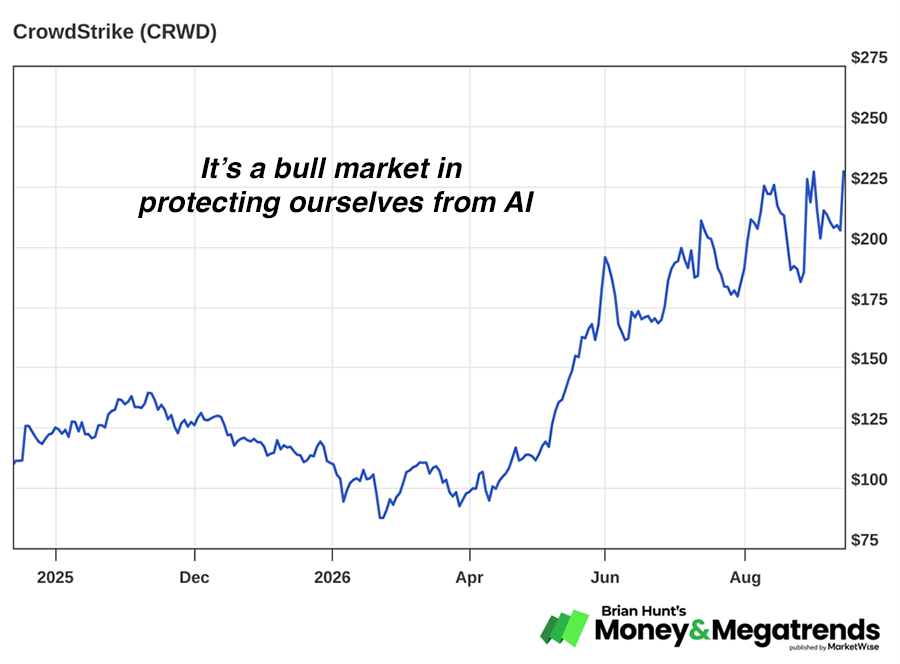
At the time, we highlighted CrowdStrike (CRWD), Palo Alto Networks (PANW), Zscaler (ZS), SailPoint (SAIL), and Radware (RDWR) as “picks to click” in this trend. This basket is up an average of 58% in six months.
At the time of our note, cybersecurity stocks – a special type of software stock – had suffered a sharp decline due to investor concerns that AI would disrupt software.
Soon after our note, cybersecurity stocks staged a huge rebound as investors began to believe AI wouldn’t disrupt the business as much as they had thought. This rally has sent leaders CrowdStrike and Palo Alto up more than 100% from their bottoms. This sector’s big drop and subsequent huge rise have given rollercoasters a run for their money.
AI is the most exciting and potentially transformational technology of our time. The high-profile concerns aired by AI insiders over the past week are an indication that it’s also probably the most dangerous. That is driving a bull market in cybersecurity stocks. Given the fuss of the past week, it’s no coincidence cybersecurity leader CrowdStrike jumped 12% this morning to reach a new all-time high.
Donald Trump turned these stocks into money machines
Credit: dan_prat
Over the past 12 months, the mainstream media has had a heyday reporting on conflicts between President Donald Trump and Canadian Prime Minister Mark Carney.
Unfortunately, Canadians have been subjected to Trump’s frequent taunting and trade war tariffs. More than a few Canadians have recently used four-letter words to refer to Trump.
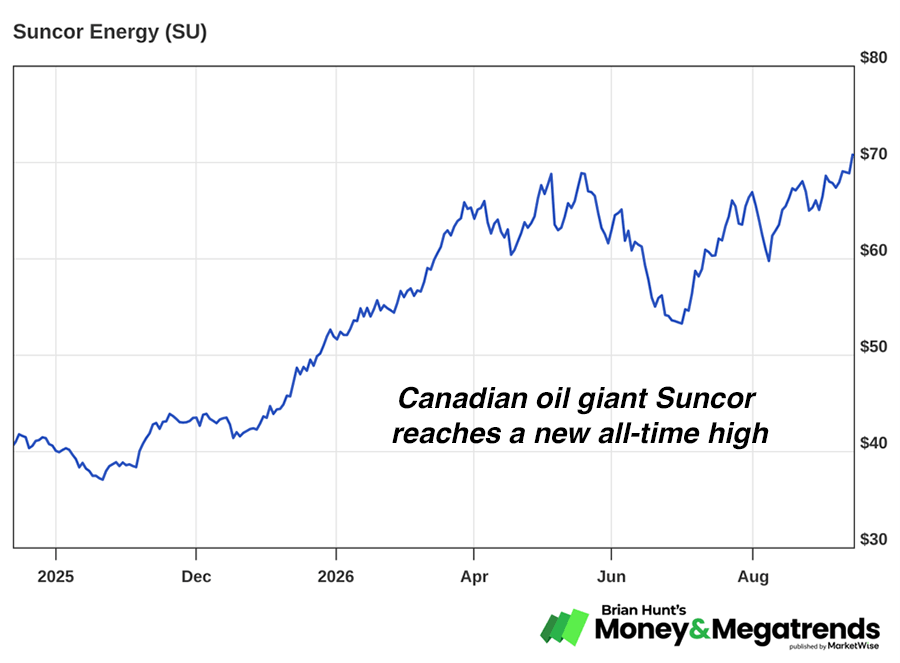
However, shareholders of Canada’s “national champion” oil and gas firms should consider sending Trump a nice thank you gift. His war in Iran is generating extraordinary returns for companies such as Suncor Energy (SU), Cenovus Energy (CVE), and Canadian Natural Resources (CNQ).
All three firms are benefitting from soaring oil prices. All three are enjoying booming revenues and profits. All three recently registered all-time highs. The Iran War is a substantial driver of it all.
Money & Megatrends readers in good standing are familiar with our bullish stance on Canada. It’s been one of our highest-conviction themes over the past year. We’ve published over a dozen research notes on the idea.
Over the past 12 months, I’ve made the case that we are in a favorable environment for critical resources… one in which many individual resource sectors will generate strong returns.
Critical resources are the building blocks of the economy. Think raw materials like crude oil, natural gas, iron ore, copper, uranium, corn, and cotton.
Even today’s high-tech world of AI, apps, email, and Zoom calls is built on a “low-tech” foundation of steel, concrete, copper, lumber, and aluminum. Every day, our cars, trucks, and airplanes consume millions of barrels of fuel. Our lights turn on because we burn coal and natural gas.
Mining, extracting, planting, harvesting, processing, refining, and transporting critical resources is a multi-trillion-dollar business that affects every area of your life.
During this time, I’ve frequently highlighted Canada as an excellent place for investment capital. Canada is the second-largest country in the world by total area, after Russia.
This means there’s plenty of area to hold big oil and natural gas deposits… huge tracts of timberland… giant mineral deposits… and enormous farms. Canada is a major player in oil and natural gas production, ranking in the world’s top five producers for both. It’s also a world leader in the production of fertilizer, uranium, aluminum, wheat, gold, lumber, and platinum.
Canada’s massive resource endowment also makes it a beneficiary of the war in Iran and its consequences.
As I’ve covered this year, for many countries and businesses, the Iran War is a powerful reminder: If your survival or smooth operation depends on uninterrupted resource flows from the often-unstable Middle East, you are in a dangerous, vulnerable position.
No politician, CEO, or major shareholder wants their business to be in that position. No citizen wants their country to be in that position. Many powerful and influential people are realizing this is a big risk that must be mitigated if humanly possible. Executives and politicians will get fired for not addressing it effectively.
This means building and buying as many forms of “not Middle Eastern” resource supply chains as possible economically… like those from safe, resource-rich Canada. I can state with confidence that no caribou will ever strap on an explosive vest and attack a local oil refinery… and no grizzly bear will send a kamikaze drone flying into a natural gas pipeline.
But don’t take my word on this trend. Take the market’s word.
It enthusiastically supports owning high-quality Canadian resource assets.
Canadian Natural Resources, Cenovus Energy, and Suncor Energy are essentially “national champions” of Canada. Together, they produce a huge portion of the country’s oil and gas. Much of this production comes from the country’s vast oil sands deposits. And together, their market values are soaring. Their stocks have gained 73%, 108%, and 75%, respectively, over the past 12 months. A large portion of these gains are attributable to the Iran War and its uplifting of global oil prices.
Canadian stocks had strong tailwinds before the Iran War. They will have even stronger tailwinds after it. We are still bullish on Canada.
Market Notes
-
Our recommendation to get long oil and gas stocks continues to pay off. Oil giants Chevron (CVX), ConocoPhillips (COP), Permian Resources (PR) and Shell (SHEL) hit new highs today.
-
LNG shipping leaders are hitting new highs. Frontline (FRO), Teekay Tankers (TNK), Dorian LPG (LPG) and Nordic American Tankers (NAT) just hit a new highs.
-
Cruise line giants Norwegian Cruise Line Holdings (NCLH) and Carnival Corp (CCL) reached new one-year lows today.
-
The high-profile eVOTL firm Joby Aviation (JOBY) reached a one-year low today.
Top Themes to Buy Now
🛡️ How to invest in an extraordinary new phase of the AI bull market
Regards,


Brian Hunt
Editor, Money & Megatrends
An urgent message from our colleagues:
I paid $5,000 to hear Elon say this

I recently paid $5,000 to be in a room with Elon Musk in Los Angeles. What he’s launching right now could be his biggest move yet (and make you more money than anything he’s done so far). If you buy just one stock in 2026, I urge you to make it the one I’m giving away for free:
Get the ticker & full details here.