
Listen to the audio version of this article (generated by AI).
Today’s issue in preview:
-
Why copper prices could soar… and three stocks to play it
-
If you want to make money in commodities, own these stocks
-
Stock market breadth is terrible, which is… bullish?
-
Learn our Top Themes to buy now
Why copper prices could soar… and three stocks to play it

Credit: tifon images
The case for owning copper just got a lot stronger.
It is enjoying serious relative strength in a weak commodity market. Also, investment bank Deutsche Bank now forecasts copper will reach $10 per pound ($22,050 per metric ton) by the second quarter of 2027. That’s more than 50% above where it trades today.
Before I get to why that call matters, let’s cover the bull case for copper:
For more than two years, I’ve been long the copper mining theme, and I’ve urged others to go long as well. In a September 25, 2025, note, I highlighted the copper mining sector’s bullish price action and reiterated my call to own it.
The bull case here is simple: Demand from AI, power grid builders, renewable energy, and EVs is turbocharging copper demand. Copper is simply a wonderful conductor of electricity with attractive qualities no other material can currently match.
But over the past 20 years, the copper mining industry has discovered or developed few meaningful copper deposits. Add recent mine disruptions in Indonesia, Chile, and Congo, and you get a classic “rising demand, constrained supply” setup.
This is the main reason Deutsche Bank is forecasting a 50% rise in copper prices. They believe a “historic scramble for metal” is taking place. The U.S. is stockpiling copper ahead of possible tariffs, and China is buying copper to fill its strategic reserves. The bank estimates those two countries will have locked up 71% of the world’s above-ground copper inventories by the end of 2026. Therefore, the copper that’s actually free to trade is at its lowest level since 1984.
That’s the bull case. But regular readers know that I care a lot more about what the market thinks of fundamentals rather than the actual fundamentals themselves. But this time, the market clearly agrees with this bull case.
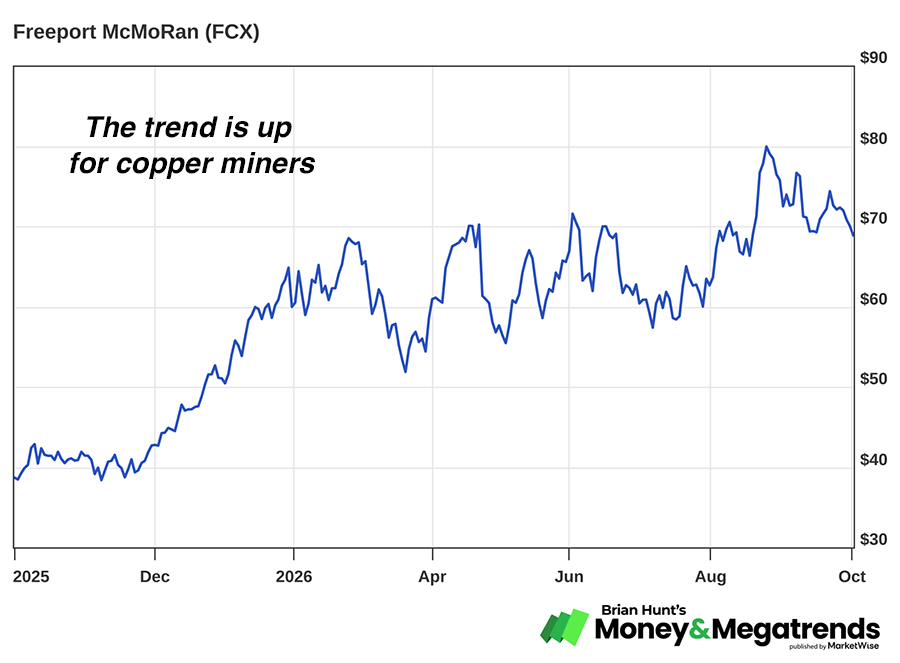
The price of copper is up 34% over the past 12 months. Last month, prices reached all-time highs. The big copper mining ETF – the Global X Copper Miners ETF (COPX) – is in an uptrend and not far from its all-time highs. Leading copper miners Freeport-McMoRan (FCX), Teck Resources (TECK) and Southern Copper (SCCO) are not far from their all-time highs.
These new highs are notable because most mining and commodity-related industry groups are struggling over the past six months. Uranium stocks are trading weakly. So are gold miners, silver miners, and lithium miners.
However, physical copper and copper miners have “bucked” this broad commodity market weakness. This is impressive “relative strength” during a period of weakness for most mining industries.
It’s a sign for us that this bullish momentum is likely to continue. Supply is tight. Demand is rising. And the market is backing the bull case, so we’re staying long copper.
Recommended Link:
Dr. Ron Paul: ‘This Could Be My Final Warning’

Dr. Ron Paul first went to Washington 50 years ago. He warned about the banks before 2008. He spent decades fighting policies he believed threatened Americans’ financial freedom. Now, at 91, he’s stepping forward again. He says a dangerous new experiment is unfolding inside Washington – and you’re running out of time to prepare. See Dr. Paul’s three financial moves here.
If you want to make money in commodities, own these stocks

Credit: isitsharp
Over the past month, the investment world has fixated on trends in AI development, rising interest rates, and the effects of the Iran War.
Given all this, it’s been easy to forget that the Brazilian market is quietly enjoying one of the world’s strongest uptrends.
Back in September 2025, I detailed the bullish price action in Brazilian stocks and recommended owning them. At the time, I noted that Brazil was a good way to invest in the uptrend in critical resources.
Critical resources are the building blocks of the economy. Think raw materials like crude oil, natural gas, iron ore, copper, corn, and cotton.
Mining, extracting, planting, harvesting, processing, refining, and transporting these critical resources is a multi-trillion-dollar business that affects every aspect of our lives.
With technologies like AI changing the world, it’s easy to forget about critical resources as an asset class. But when they enter uptrends, that momentum tends to last a long time, and carry prices higher than most people think is possible.
For many professional investors, Brazil is a preferred way to play commodities in the stock market. It is a true commodity superpower.
Brazil is the world’s largest producer of soybeans, sugar, and coffee. It’s a major producer of cattle, cotton, corn, and orange juice. It’s a major producer of iron ore and crude oil. This makes the Brazilian economy and stock market heavily “geared” towards resource markets.
Brazil is also a beneficiary of the historic AI infrastructure spending boom.
Given AI’s enormous promise, large tech firms such as Alphabet (GOOG), Amazon (AMZN), and Microsoft (MSFT) have invested over $1 trillion in specialized semiconductors, data centers, and other AI infrastructure components. They are on pace to invest over $700 billion this year alone and more than $4 trillion after that.
Both the scale and the velocity of this investment boom are unprecedented. It is the largest collective investment effort of all time.
Brazil’s extensive river network also makes it a major producer of hydroelectric power. This makes it an attractive destination for power-hungry AI data centers. Brazil also has large reserves of rare earth elements. Demand for these raw materials is soaring, driven by growth in AI infrastructure, robotics, and defense tech.
To add a cherry on top of this bullish cake, Brazil has a big-spending, deep-pocketed trading partner in the United States. U.S. companies can buy all the compute and rare earths that Brazil can bring to market.
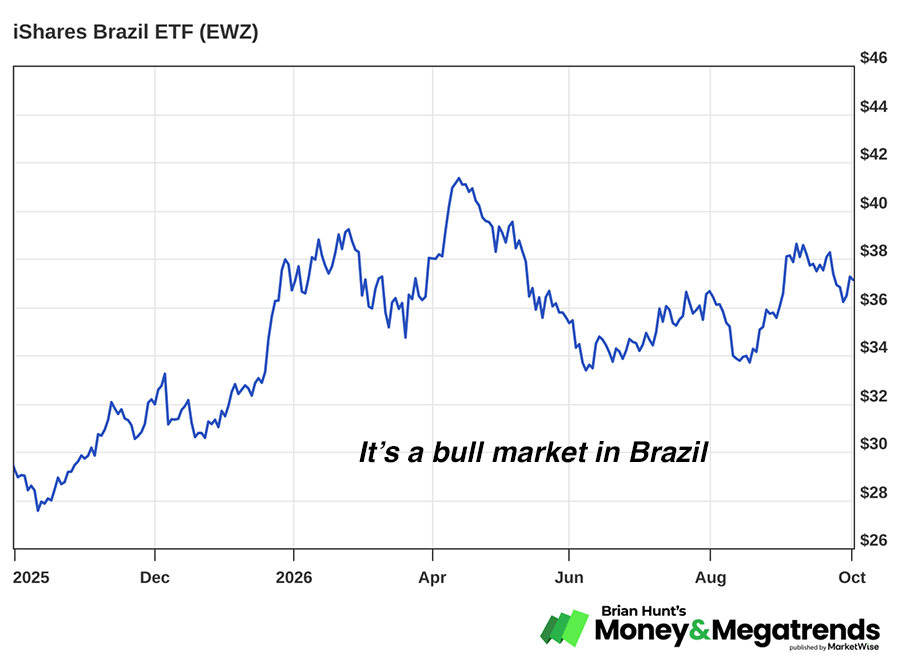
Soon after my September note, Brazilian stocks – via the iShares Brazil ETF (EWZ) – surged 38% in less than seven months. It then experienced a natural, healthy bull market correction from mid-April to mid-June.
As you can see in the chart below, this correction has ended. Brazilian stocks have paused, refreshed, and have advanced 10% off their June low. Given the strong fundamental drivers detailed above, we’re still bullish on Brazil and expect to see higher prices ahead.
Stock market breadth is terrible, which is… bullish?

Credit: roman_slavik
Stock market breadth is terrible.
You can’t read the financial media for five minutes this week without hearing about terrible stock market breadth.
What does that mean for your portfolio?
Not what you might think…
“Breadth” is Wall Street’s preferred term for how widely a stock market’s gains or losses are spread across individual stocks.
Rather than focusing solely on the movement of a major index like the S&P 500, breadth reveals how many stocks are participating in the trend.
Common breadth indicators include the percentage of stocks above their 50- or 200-day moving averages, advancing versus declining stocks, and new highs versus new lows.
Strong breadth suggests widespread participation, while weak breadth indicates that relatively few stocks are driving the market.
Over the past month, stock market breadth has plummeted. Rising interest rates and several smaller market forces have hammered many key market sectors including real estate, utilities, defense, financials, and consumer spending-related stocks.
Meanwhile, the strength in technology stocks we’ve been covering has supported the broad market averages. The S&P 500 is less than 2% off its all-time high.
Many investment professionals look at the weak breadth readings and say it’s bearish. They say it means “time to sell.”
However, a look at the past three years of “breadth and price” shows that weak breadth readings are not reason to sell. In fact, they have proven to be good contrarian buy signals.
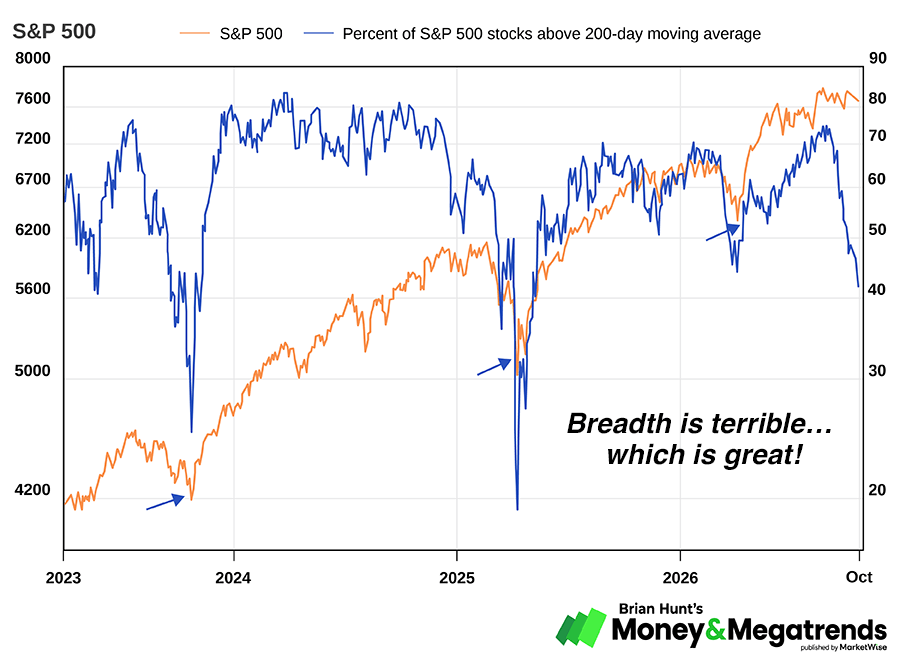
Below is a chart that plots the percent of S&P 500 stocks above their 200-day moving average (blue line). This is one of the most widely followed and cited breadth gauges. Alongside this breadth gauge is the S&P 500 (orange line).
As you can see, breadth readings were terrible in late 2023, spring 2025, and spring 2026. Each of these extreme readings (marked by arrows) coincided not with the start of a bear market, but with meaningful stock market bottoms that were followed by large rallies.
By itself, this relationship between breadth and future stock market performance does not mean “buy as much stock as you can,” but it does show that the “common wisdom” many have in mind while getting alarmed about breadth declines is not wisdom at all.
Market Notes
-
Our June 3rd recommendation to own the Electronic Design Automation duopoly of Cadence (CDNS) and Synopsys (SNPS) is getting interesting. SNPS is up 12% today and CDNS is up 7%.
-
AI infrastructure names Keysight (KEYS), Lam Research Corp (LRCX), Applied Materials (AMAT), Tower Semiconductor (TSEM), and Onto Innovation (ONTO) all hit one-month highs today. This is a bullish sign for the AI infrastructure trade.
-
Electrical and renewable energy giant NextEra Energy (NEE) just hit a new one-year low today.
-
Professional services giant Accenture (ACN) is up 23% today after beating on earnings. This is its single largest one-day gain ever.
-
High interest rates continue to hammer the housing stock industry. Home Depot (HD) reached a new one-year low today.
Top Themes to Buy Now
₿ Six ways to invest in the revolution in money and banking
⚡ We’re revealing our top AI trade of the month…
🔬 This stock sector is starting to boom. We bet it has years to run. Are you on board?
Regards,


Brian Hunt
Editor, Money & Megatrends
An urgent message from our colleagues:
$15 STOCK INVESTMENT ALERT

It involves orbital data centers, autonomous drone warfare, artificial superintelligence… and a $126 trillion plan to irreversibly upgrade human civilization. Former VC insider who recommended 40 1,000% (or higher) winners says, “If you’re only going to buy one more stock in 2026, you should make it this one.”
Get the full story before it hits the mainstream…