
Listen to the audio version of this article (generated by AI).
Today’s issue in preview:
-
Seven stocks that could explode as AI goes mainstream
-
AI’s hidden income opportunity: How to earn large income streams from the boom
-
Why the U.S. dollar is plummeting in value… and how to protect yourself
-
Learn our Top Themes to buy now
Seven stocks that could explode as AI goes mainstream

Credit: Petrovich9
In June, Nvidia (NVDA) CEO Jensen Huang stood on stage next to Marvell Technology (MRVL) CEO Matt Murphy and predicted Marvell would be the “next trillion-dollar company.”
As a result, MRVL shares jumped 32% in a single day, which was the largest one-day gain in the company’s history. Plus, Marvell became one of the most widely followed companies in the tech world.
Why is Jensen – the “Michael Jordan of AI” – so bullish on Marvell?
Marvell is one of the world’s leading suppliers of optical networking semiconductors, particularly the chips that enable high-speed data transmission inside AI data centers. Market cap is $241 billion.
Jensen believes Marvell could become the next trillion-dollar company because it solves one of AI’s biggest challenges: moving enormous amounts of data between chips.
As AI data centers grow to include hundreds of thousands of processors, connecting those chips quickly and efficiently becomes critical. Marvell specializes in high-speed networking chips, optical connections, and custom processors that enable this.
Jensen sees these technologies becoming increasingly valuable as AI infrastructure spending explodes. Nvidia is so bullish on Marvell’s future that it invested $2 billion in the company and formed a strategic partnership to develop next-generation AI infrastructure.
Over the past two months, we’ve published a special series of research notes analyzing the AI infrastructure trend.
The status of this critical trend has become one of the great sagas of the business and investment world… a source of intense disagreement among industry bulls and bears. It’s a trend whose outcome could have large effects on your portfolio.
Given AI’s enormous promise, large tech firms such as Alphabet (GOOG), and Microsoft (MSFT) have invested over $1 trillion in AI infrastructure. They are on pace to invest over $700 billion this year alone and more than $3 trillion after that.
Both the scale and the velocity of this investment boom are unprecedented. It is the largest collective investment effort in history.
Big Tech’s historic investment boom has made the entire “AI infrastructure” trend responsible for a large share of America’s GDP growth and stock market returns over the past two years. It has also drawn the skeptical scrutiny of many widely followed investment analysts who claim the trend is a bubble… one that will soon explode and cause tremendous damage to stock prices and the global economy.
If this hugely consequential trend isn’t the most important trend in the stock market, then it is certainly in the top three.
Recently, we’ve detailed how new highs for Nvidia, AI chip leader Nvidia (NVDA), semiconductor manufacturer Taiwan Semiconductor (TSM) and the Roundhill Magnificent 7 ETF (MAGS) indicate the market is enthusiastically endorsing a continuation of the AI infrastructure megatrend.
This of course, is also bullish for Marvell.
Although bleeding edge semiconductors from the likes of Nvidia get most of the headlines, those chips are only as good as the connections between them.
As AI data centers grow more complex and more powerful, the number of chips connected inside them increases. A modern AI cluster, for example, ties together hundreds of thousands of chips that all must act together. If that data between chips moves too slowly, these expensive processors just sit there idle.
Traditionally, these data connections have been made from copper. But at the speeds required today, copper can’t keep up. It loses signal and burns power too quickly.
The fix is to slowly replace electrical signals traveling over copper with light signals traveling over fiber-optic cables. That’s what optical networking does. And it’s what Marvell is a world leader in.
Recently, Marvell put a huge spotlight on this technology at its investor day, held on October 6.
Until MRVL’s investor day, we knew optical networking gear had at least two years of solid demand ahead. But we never saw forecasts through to 2030 and beyond.
Marvell’s investor day just changed that.
Here’s is big news:
-
Management estimates its total market opportunity will expand to approximately $400 billion, growing around 45% annually from 2025.
-
Management forecasts annual revenue to climb from $8.2 billion in fiscal year 2026 to $80 billion in fiscal year 2031.
In other words, Marvell has made one of the most aggressive industry forecasts in the technology world… and one of the most aggressive company growth forecasts.
This forecast – plus the word of Jensen Huang – makes optical networking stocks like Marvell and fellow industry players Coherent (COHR), Lumentum (LITE), Ciena (CIEN), Credo Technology (CRDO) and Applied Optoelectronics (AAOI) one of the most compelling technology trends to monitor and consider as an investment candidate.
It is one of the highest leverage ways to invest in the mass adoption of AI.
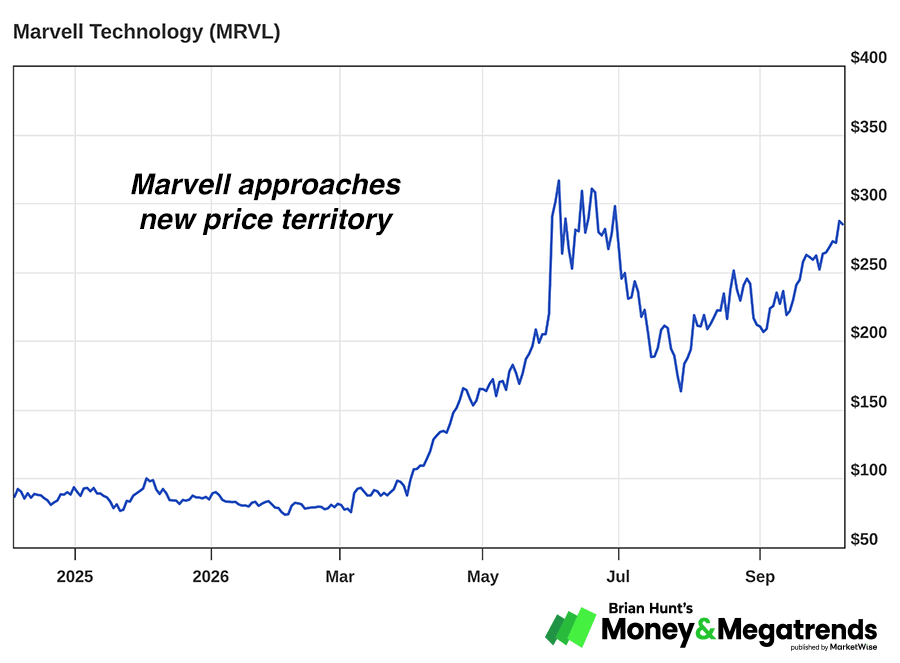
Like most components of the AI infrastructure trade, Marvell enjoyed a big spring rally this year and a significant summer correction. It has since digested this correction, rallied, and is closing in on an all-time high. A break above that high would be a very bullish signal for the optical networking theme. We will keep you apprised of the situation.
Recommended Link:
10 Doubles in 12 Months, or He Works for Free

On October 14, Master Trader Jonathan Rose is putting his reputation on the line by promising at least TEN 100% recommendations over the next 12 months. He’ll reveal the specifics during his $10k to $100k Challenge. Details here.
AI’s hidden income opportunity: How to earn large income streams from the boom
Credit: stanley45
In yesterday’s issue, we highlighted how both large tech firms such as Google (GOOG) and the U.S. government are making huge investments in nuclear energy.
As more individuals and businesses leverage the power of “super intelligence,” more demands are placed on AI infrastructure… which means more demands on our national electric power system.
Since that overloaded system is already straining, AI has a “power problem.” We don’t have enough electric power plants. We don’t have enough connections to existing power plants. We don’t have enough high-voltage transmission lines.
A big part of the solution to this problem is nuclear energy. According to a 2026 analysis by energy consulting firm KeyLogic, annual U.S. nuclear power investment could reach $80 billion to $94 billion by 2035 under an ambitious expansion scenario designed to quadruple the nation’s nuclear generating capacity by 2050.
However, nuclear is only part of the solution to AI’s power problem.
Natural gas – and America’s natural gas transportation network – is a huge part of the solution as well.
Although building large amounts of nuclear power generation capacity is a compelling long-term solution to AI’s power problem, it is not a short-term solution.
Getting permits and project financing for a nuclear power plant typically takes years. And with permits in hand and financing secured, the industry expects build times of 7-10 years.
A nuclear plant is a gigantic, extraordinarily complex construction project. It requires huge reactor vessels, steam generators, coolant pumps, heat exchangers, and miles of specialized piping. Many of these components are frequently custom-built or produced in tiny quantities. There is nothing resembling the mass-production supply chain for conventional industrial equipment.
Once these often enormous, often highly specialized components are built, they must be installed in a precise sequence, inspected, tested, and integrated into a single safety-critical system.
Because the safety stakes are so high, nuclear power plant components are subject to rigorous testing. A problem with one component can hold up several downstream construction activities.
You typically cannot throw more workers at a nuclear power plant project to speed it up. You often cannot even throw more money at it to make it go faster. And so, it takes 7-10 years to build a new nuclear plant.
All this has made my recommendation of energy pipelines a big winner… and should keep it winning for years.
In early 2024, I began to see the oil and gas pipeline industry as the best way to generate substantial passive income from the AI boom.
The U.S. has enormous reserves of clean-burning natural gas. Plus, it has over 2,000 natural gas-fired power plants. An additional natural gas power plant can be built in less than a third of the time it takes to build a new nuclear plant.
However, all the natural gas reserves in the world aren’t worth much if you can’t get the gas from the wellhead to the plants.
This is where America’s vast natural gas transportation, processing, and storage industry comes in.
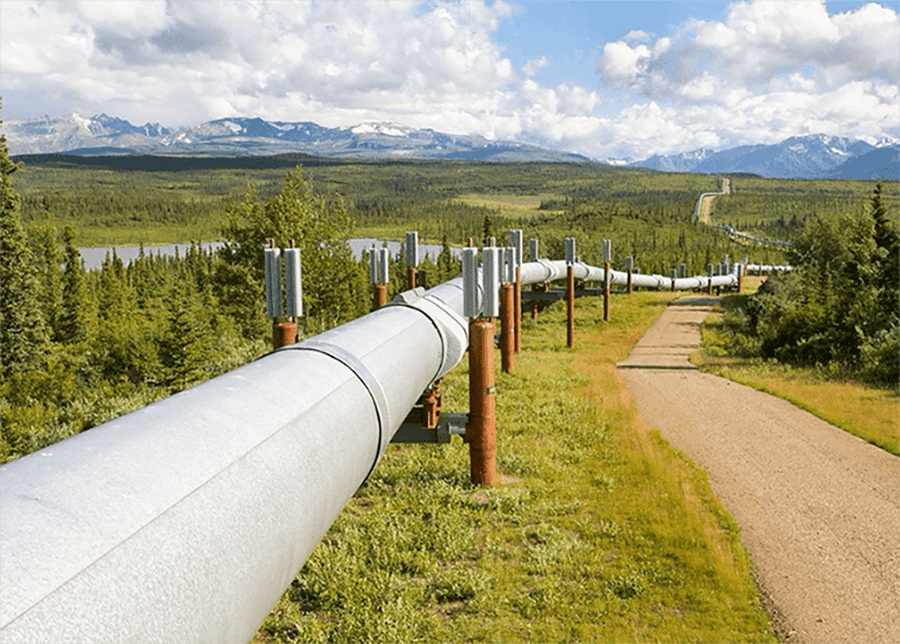
An extensive network of pipes crisscrosses America that allows energy companies to transport natural gas from prolific fields in Texas, Pennsylvania, New Mexico, West Virginia, and Louisiana to the nation’s power plants.
A boom in AI-related electricity demand by default means a boom in demand for natural gas transportation services.
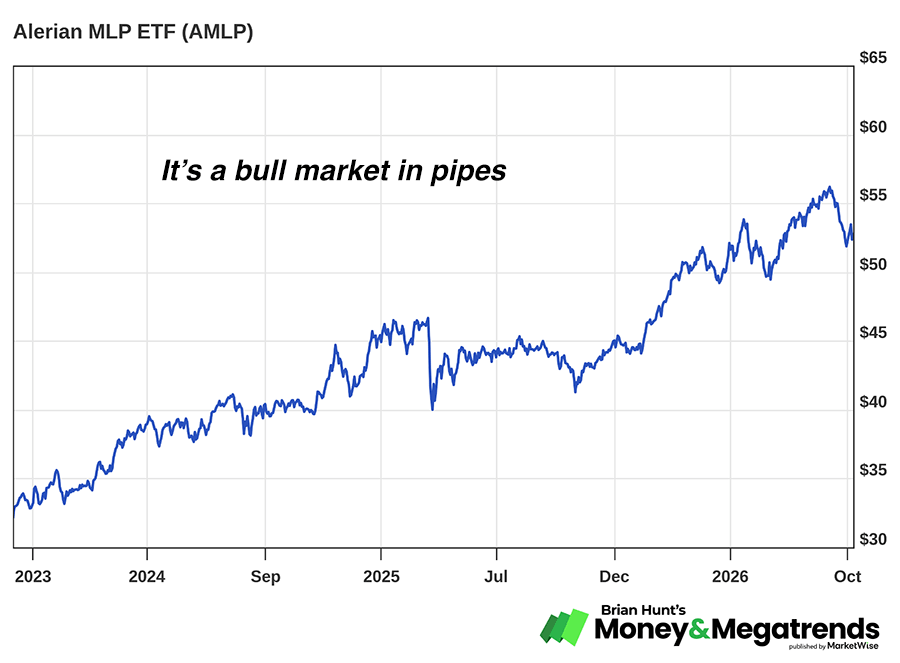
Since 2024, the market has enthusiastically supported our bull case for energy pipelines. Blue chip pipeline operator Enterprise Products (EPD) has returned 67%. Fellow blue chip operators Energy Transfer (ET) and Kinder Morgan (KMI) have returned 92% and 129%, respectively. Each of these firms is enjoying terrific growth in volumes and revenue.
These individual stock gains have powered the energy pipeline-focused Alerian MLP ETF (AMLP) to a 64% total return since 2024. Despite AMLP’s big run and shares being near all-time highs, it still yields around 7.75%.
The typical pipeline operator is not your conventional “high-risk, high-reward” AI play. Instead, it’s a boring, predictable business that generates steady cash flows and shareholder distributions.
But the AI megatrend is giving natural gas a boost that will last for years. Plus, the Iran War and its constriction of Middle Eastern energy flows have made U.S. natural gas exports increasingly more valuable to customers in Europe and Asia. The Russia/Ukraine war is doing the same with its constriction of Russian natural gas exports.
Generating stable cash flows by transporting oil and gas isn’t as exciting as some high-tech industries, but business is booming… and will most likely do so for years. It’s a bull market in pipes!
Why the U.S. dollar is plummeting in value… and how to protect yourself

Credit: Backyard Production
Every day across America, people complain about high prices.
The price of gasoline is high.
The price of groceries is high.
Young people can’t afford homes because their prices are high.
We all know the prices of many things we buy a lot of are way up over the past seven years.
But do we all know why?
I’ll answer that for you: No.
Most people have a vague, nagging feeling that soaring prices may have something to do with runaway government spending, the U.S. deficit, and inflation. They know something isn’t quite right… But they don’t fully understand what is happening.
Here is what is happening in simple terms anyone can understand…
Over the past 50 years, the U.S. and state governments have made many promises to many people. Social security payments. Medicare. Medicaid. Pensions. Defense contracts. Veterans’ benefits. Government employment contracts. Unemployment benefits. Food stamps. Federal education programs. Plus, you have the day-to-day costs of things like roads, bridges, police, and regulatory enforcement.
And over those same 50 years, a dangerous trend has taken root. More and more people have grown very comfortable voting themselves benefits paid by their fellow taxpayers. This trend has become so strong that our government has promised far too many things to far too many people. They are spending far more on social programs, pensions, and wars than they collect in tax revenues.
The related debts and obligations governments have taken on cannot be paid back with sound money. They can only be paid back with debased, devalued money… much of which is created out of thin air. Every freshly printed unit of currency debases an existing one.
This is driving inflation and significant currency debasement. Prices are going up because the value of our money is going down.
Measured against a basket of widely used raw materials like crude oil, corn, silver, sugar, and soybeans, the U.S. dollar has lost 48% of its value over the past eight years.
Here in mid 2026, the problem is worse than ever. In America, millions of people are net tax recipients – meaning they receive more in benefits than they pay in taxes. Plus, according to the U.S. Bureau of Labor Statistics, about 15% of all jobs in America are government jobs (federal, state, local). These folks aren’t voting for fewer benefits or fewer jobs.
No politician can win a major election by promising reduced spending.
Too many people are now riding the gravy train.
Democrat or Republican, it doesn’t matter.
Campaigning on sensible spending is a sure loser.
So, what stops the insanity?
How can we get spending under control?
Sorry – bad news. Too many voters either work for the government directly or indirectly or are net tax recipients. They will flat-out not vote for someone who promises to cut benefits, handouts, and spending. This crazy spending is a runaway train.
We will only “get religion” after a financial market crisis forces us to get it.
It’s like how most alcoholics won’t make a change until they’ve almost killed themselves in a car crash or something… or how someone that doesn’t exercise and has a horrible diet won’t change their ways unless a health crisis forces them to.
It’s just human nature. We tend not to change unless we get hit with a metaphorical 2×4 to the head.
So, keep all this in mind next time you see high prices or think about inflation. Sure, you can think of it as prices going up. Or, you can think of it as the value of the money is going down.
This phenomenon shapes all kinds of things and distorts many concepts people hold. For example…
*People like to make a big deal about the massive market values of giants like Nvidia (NVDA) and Apple (AAPL). But keep in mind that since the value of the dollar has declined by about 50% over the past eight years, today’s $5 trillion is worth about $2.5 trillion in 2018 dollars.
*People like to point out that oil prices are very high, but today’s $90 barrel of oil is worth about $45 in 2018 dollars.
*People who recently sold a house for a lot more than they paid for it 10 years ago aren’t actually any wealthier. The value of the money plummeted, so the home’s price went way up. They essentially treaded water, minus all the insurance costs, maintenance costs, and taxes. They can’t take the “profits” are largely an illusion: The money they pocketed doesn’t buy any more food, gas, or housing than it did 10 years ago.
*If a company generated $1 million in profits in 2018 and generated $2 million in profits in 2025, it didn’t grow in real terms.
*A $250,000 salary in 2018 is worth roughly a salary of $125,000 in 2026.
You get the picture.
It’s easy to get tripped up or mistaken by the great “money illusion”
The government wants you to see rising wages, rising home prices, and rising stock prices and then feel richer and happier.
That would mean you’re more likely to support the status quo and less likely to agitate for change.
But it’s an illusion.
We’re all “earning” more money… and we’re all “making” money in the housing and stock markets…
… But those gains are a mirage.
The money we’ve been making at our jobs, in our homes, and in our stocks aren’t buying us any extra food, fuel, or free time.
We aren’t increasing our level of real wealth because the price of everything is going up.
The value of our money is going down.
You can think of prices for everything in America – homes, cars, gasoline, food, insurance, medical care – as boats on a lake.
And our money supply is the water level in the lake.
As the water level rises and rises, all the boats go up. But your real wealth doesn’t increase a bit. Every vessel on the water goes up with the water level.
And remember…
More water has been pumped into America’s “money supply” lake in the past five years than was pumped over the previous 100 years.
Sure, the price of your home is rising, but the price of everything you buy is rising.
You can think about “cashing in” and banking some profits produced by the rising price of your home, but remember that if you sell your existing house, you must buy a different house at a greatly elevated price!
You can think of the price going up, but you should also know the value of our money is going down.
This is all why it’s more important than ever to be vigilant against inflation and own many of the “inflation defense” assets we’ve covered, such as oil and gas pipelines, gold, timberland, copper mines, gravel pits, and solid, growing businesses.
Market Notes
-
Medical device giant Boston Scientific (BSX) reached a new one-year low this week.
-
Casino giant Las Vegas Sands (LVS) reached a new one-year low this week.
-
The Iran War and its constriction of oil and refined product supplies continues to work in favor of oil shipping firms. Industry leaders Frontline (FRO), International Seaways (INSW), and Hafina (HAFN) reached new one-year highs this week.
-
Software leader Atlassian (TEAM) reached a new one-year high this week.
Top Themes to Buy Now
🇧🇷 One of the world’s best investors bets on Brazil. Why it’s poised to head higher
📈 The biggest AI news you’re not hearing in the mainstream media… is very bullish
⚡ Four stocks that stand to benefit from AI’s soaring power consumption problems
Regards,


Brian Hunt
Editor, Money & Megatrends
An urgent message from our colleagues:
Blue Origin… DOOMED

Jeff Bezos should be terrified. He will be down on his knees, begging Elon for mercy. Because Elon is set to: Cut Amazon out of the AI race ENTIRELY…Completely DESTROY Blue Origin…And take control of the potential $25 TRILLION DOLLAR PER YEAR AI INDUSTRY. And in his wake, potentially create 1,806,000 NEW millionaires over the coming years… Starting December 8. And this is your chance to be one of them. Legendary tech investor, James Altucher, shows why a single FCC filing proves it.
Click here to see why.