
Listen to the audio version of this article (generated by AI).
Today’s issue in preview:
-
Four stocks to invest in an industry with exploding demand
-
How to trade the AI infrastructure boom from here
-
Eight stocks to invest in soaring AI electric power consumption
-
Learn our Top Themes to buy now
How to trade the AI infrastructure boom from here

Credit: pingingz
This week, the bull case for “the world’s most important trend” got a little stronger. And it’s increasingly looking like the “AI bulls” are right.
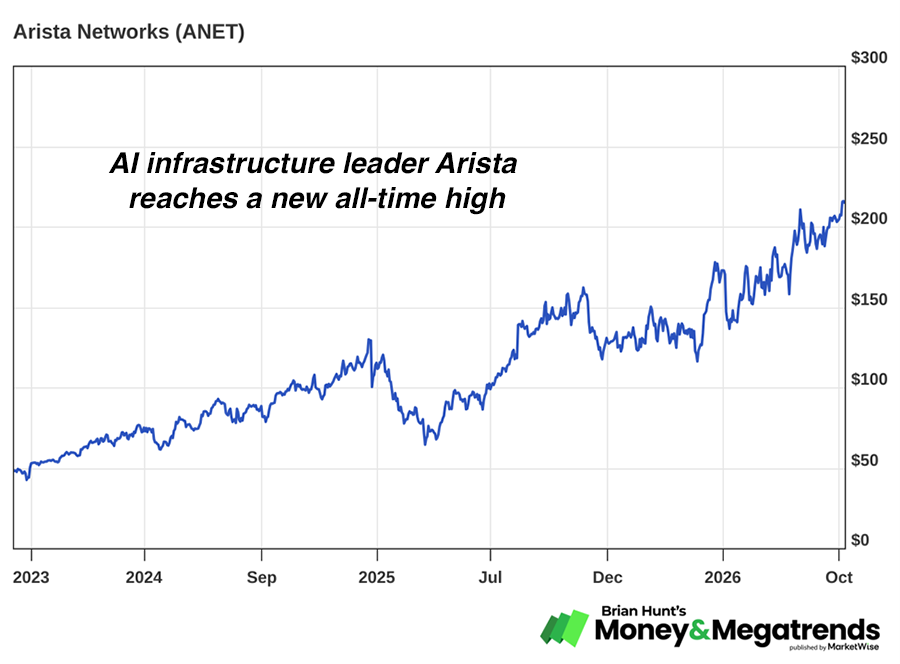
As evidence, we cite the new all-time highs reached yesterday by Everpure (P), Arista Networks (ANET), NetApp (NTAP), and Hewlett Packard Enterprise (HPE).
Each of these tech firms has heavy exposure to the AI infrastructure buildout.
-
Arista makes high-speed networking switches connecting GPUs and servers in AI data centers.
-
Hewlett Packard Enterprise supplies AI servers, networking equipment, storage systems, and advanced data center cooling.
-
Everpure provides high-performance flash storage enabling rapid data access for AI workloads.
-
NetApp makes enterprise data storage and management systems that support AI training and inference.
This round of new highs for companies heavily leveraged to the AI infrastructure boom is yet another positive signal that indicates a healthy megatrend.
Over the past month, we’ve published a special series of research notes analyzing the AI infrastructure trend.
The status of this critical trend has become one of the great sagas of the business and investment world… a source of intense disagreement among industry bulls and bears. It’s a trend whose outcome could have large effects on your portfolio.
Given AI’s enormous promise, large tech firms such as Alphabet (GOOG), and Microsoft (MSFT) have invested over $1 trillion in AI infrastructure. They are on pace to invest over $700 billion this year alone and more than $3 trillion after that.
Both the scale and the velocity of this investment boom are unprecedented. It is the largest collective investment effort in history.
Big Tech’s historic investment boom has made the entire “AI infrastructure” trend responsible for a large share of America’s GDP growth and stock market returns over the past two years. It has also drawn the skeptical scrutiny of many widely followed investment analysts who claim the trend is a bubble… one that will soon explode and cause tremendous damage to stock prices and the global economy.
If this hugely consequential trend isn’t the most important trend in the stock market, then it is certainly in the top three.
I believe the AI infrastructure trend has years to run. I believe the world’s smartest, most connected tech insiders who know the true state of bleeding-edge AI development and have real-time stats on AI investment ROI, such as Elon Musk, Jensen Huang (Nvidia), Satya Nadella (Microsoft) and Andy Jassy (Amazon), perhaps maybe… just might… know far more about AI and their businesses than outsiders know about it.
As much press as AI gets, let’s remember that less than 1% of the global population pays for top-tier AI programs. And I estimate less than 10% of large companies believe AI has made a meaningful impact on their businesses.
This revolutionary technology hasn’t yet proliferated, achieved mass adoption, or had mass impact.
Regular readers know I care a lot more about what the market thinks of any stock, trend or theme than what any one person thinks of it, including me. You can be bullish or bearish on a trend all you like, but if that trend is moving strongly against you, then your idea isn’t worth much in my book.
In the case of AI infrastructure, the market is favoring the bullish case.
Not only are the companies above reaching new highs, but we’re seeing tremendous strength in AI chip leader Nvidia (NVDA), semiconductor manufacturers Taiwan Semiconductor (TSM) and the Roundhill Magnificent 7 ETF (MAGS), which owns the “hyperscalers” that are spending big on AI data center construction.
On the stock market’s “scales of justice,” the weight of the evidence continues to heavily favor the bulls.
Recommended Link:
Can $10,000 Become $100,000 in the Next 12 Months?

On Wednesday, October 14 at 8 pm ET, legendary trader Jonathon Rose will reveal how you could turn every $10,000 into $100,000 or more by using the same strategy that produced 959% in one month from Albemarle Corp. Click here to reserve your spot.
Four stocks to invest in an industry with exploding demand

Credit: yacobchuk
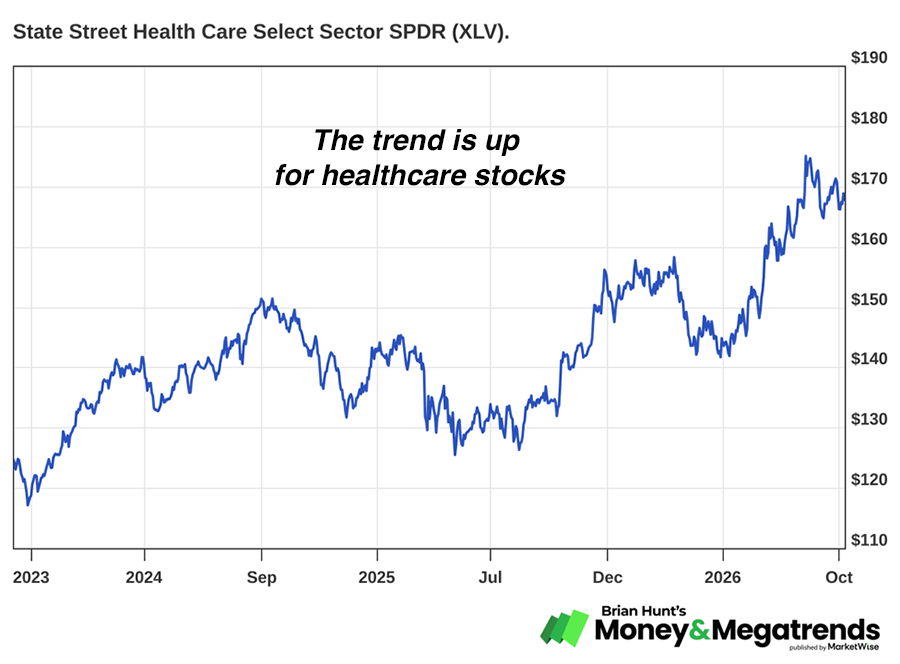
In yesterday’s issue, we detailed how strong fundamentals are powering a big bull market in the world’s largest healthcare stock ETF – the State Street Health Care Select Sector SPDR ETF (XLV).
This key investment fund is up 35.4% over the past three years, 17.8% over the past 12 months, and is trading near its all-time high.
XLV owns a “who’s who” of big-time healthcare firms. It holds a diversified basket of drugmakers (Merck, Eli Lily), healthcare tools and services firms (Thermo Fisher, Danaher), medical device firms (Intuitive Surgical, Medtronic), and other assorted components of the healthcare industry.
These high-profile firms are benefitting from a “superboom” in health care spending… which is driven by the enormous Baby Boom generation entering the period of life where spending on healthcare skyrockets.
However, a large and varied ecosystem of smaller but critical health care businesses is worth knowing about and owning. They comprise a huge – yet usually unseen – infrastructure layer of equipment and service providers that enable doctors, nurses, clinicians, and executives to do their jobs.
This is the world of CT scanners, hospital software, surgical tools, stents, catheters, wearable medical devices, endoscopes, artificial hips, X-ray machines, MRI machines, lab service providers, syringes, and the list goes on.
The U.S. spends more than $5 trillion on health care annually, or about 18% of GDP. This means the world of Healthcare Equipment & Services is large, varied, and full of opportunity.
Compelling “off the radar” healthcare stocks that are positioned to benefit from the trends detailed above include:
Dexcom (DXCM) is a $33 billion company that makes continuous glucose monitors (CGMs). These are wearable sensors that have replaced the traditional fingerstick testing for millions of diabetics.
DXCM has historically only competed in the type 1 diabetes market, but it is expanding into type 2 diabetes to compete with the likes of Abbott (ABT). Management has noted that about 500 million people have diabetes worldwide, and only 2% of them are on a CGM, which frames the massive addressable market ahead for DXCM.
Edwards Lifesciences (EW) is a $50 billion company that is the leader in transcatheter heart valves. This is the product needed in minimally invasive replacement procedures that have made open heart surgery unnecessary for hundreds of thousands of patients. The company benefits from aging populations, rising diagnosis rates, and the growing adoption of less invasive cardiac procedures.
West Pharmaceutical Services (WST) is a $26 billion manufacturer of specialized packaging and drug-delivery components used by drug companies. Its products include rubber stoppers, seals, syringe components, and systems for safely storing and administering injectable drugs.
West is a key player in biologics, vaccines, and GLP-1 weight-loss medications. Its products must meet strict regulatory and quality standards, creating high switching costs and durable customer relationships. Once a component is approved for use with a drug, manufacturers are reluctant to change suppliers. Over the past 12 months, revenue has grown by 12.4%.
TransMedics Group (TMDX) is a $2.8 billion medical technology company specializing in organ transplantation. Its flagship Organ Care System (OCS) keeps donated hearts, lungs, and livers functioning outside the body by circulating warm, oxygenated blood through them, unlike traditional cold-storage methods.
This technology can extend organ preservation time, improve organ assessment, and increase the number of viable organs available for transplantation. TransMedics also operates its National OCS Program, providing organ retrieval, transportation, and logistical services, including its own aircraft fleet.
The enormous Baby Boom generation has long moved through the economy like a pig through a python, creating massive surges in demand for products and services at each stage of life. Now, the generation is fueling what could be the biggest and most profitable boom yet: healthcare. We recommend staying long.
Eight stocks to invest in soaring AI electric power consumption
Credit: RelaxFoto.de
Alphabet’s (GOOG) latest AI investment isn’t a new kind of semiconductor chip or a data center. It’s nuclear power.
This week, Google and nuclear power giant Constellation Energy (CEG) agreed to a massive 20-year power deal that will boost output at 11 existing nuclear reactors.
The agreement calls for at least $4 billion in upgrades to Constellation’s plants, ultimately adding roughly the same amount of electricity-generating capacity as an entirely new nuclear reactor.
Shares in Constellation jumped 12.2% after the news was released. Shares of fellow nuclear power generator Talen Energy (TLN) rose 12.4%.
The Google/Constellation deal isn’t the only big news in nuclear power. On Monday, the U.S. Department of Energy (DOE) said it has conditionally committed up to $4.2 billion in financing to upgrade and expand nuclear power firm Vistra’s (VST) nuclear fleet.
Most of the money would go toward the Beaver Valley plant in Pennsylvania and the Perry and Davis-Besse plants in Ohio. Vistra shares climbed 11% on Tuesday.
These new deals serve as a reminder: It’s going to take an enormous amount of electric power to keep the AI boom running.
Over the past year, we have written more than a dozen research notes on AI’s soaring power needs and its “ripple effects” on stocks of electric grid builders, uranium miners, and power producers such as Constellation and Vistra.
As detailed above, large tech firms are investing trillions of dollars to build the best AI applications and infrastructure. They are on pace to invest over $700 billion this year alone and more than $4 trillion after that. A huge portion of that money will go into data centers.
All those data centers are consuming increasingly large amounts of electric power. Goldman Sachs estimates that data-center electricity demand will rise 170% between 2025 and 2030. Goldman says the incremental electricity required by AI alone by 2030 will be roughly equivalent to adding the entire electricity consumption of Japan to the global power system.
Given this outlook, AI companies and their power providers are spending heavily to expand nuclear power capacity. The deals detailed above are the latest examples of this trend at work. Nuclear provides “always on” carbon-free baseload power. Bloomberg reports that surging nuclear demand will drive $350 billion in U.S. spending by 2050.
You can get long on this theme in several ways. In the past, I’ve mentioned nuclear power equipment and service companies such as BWX Technologies (BWXT, specialized manufacturing), Mirion Technologies (MIR, nuclear facility monitoring), Centrus (LEU, uranium enrichment), and Solstice Advanced Materials (SOLS, uranium processing).
I’ve also mentioned Independent Power Producers such as Constellation and Vistra. These two are not traditional, heavily regulated utility firms. Read here for more on their unique positions in the market.
You can also take the “one-click, and you’re done” route with a uranium miner fund such as the Global X Uranium ETF (URA) or the Sprott Uranium ETF (URNM). Both funds own diversified baskets of uranium miners and hold large positions in the blue-chip uranium miner Cameco (CCJ).
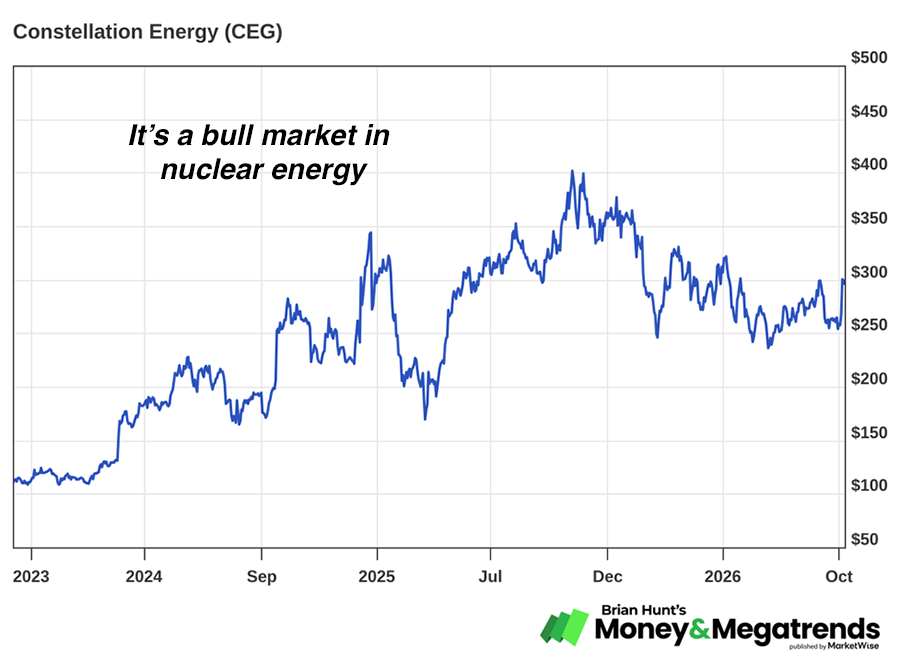
As you can see in the three-year chart of Constellation below, the nuclear power uptrend is alive and well. Given AI’s growing power demands and nuclear energy’s bullish demand outlook, I’m confident this uptrend will continue.
Market Notes
-
Our September 2025 recommendation to invest in oil and gas stocks continues to pay off. Oil and gas giants Shell (SHEL) and Petrobras (PBR) reached new one-year highs today.
-
The Iran War and its constriction of oil and refined products continues to benefit U.S. refiners. Refining giants Valero Energy (VLO) and Marathon Petroleum (MPC) reached new one-year highs today.
-
AI-centric defense giant Palantir (PLTR) reached a new six-month high today.
-
Oil shipping giant Frontline (FRO) reached a new one-year high today.
Top Themes to Buy Now
🇧🇷 One of the world’s best investors bets on Brazil. Why it’s poised to head higher
📈 The biggest AI news you’re not hearing in the mainstream media… is very bullish
⚡ Four stocks that stand to benefit from AI’s soaring power consumption problems
Regards,


Brian Hunt
Editor, Money & Megatrends
An urgent message from our colleagues:
Elon + Trump… BACK TOGETHER!?

James Altucher believes Elon Musk just filed a plan with the FCC to take over the AI industry… from outer space. Around the same time, Trump signed an order gutting the red tape around commercial space launches… and signed the second order pushing NASA to hand its work to private companies (aka SpaceX). It’s clear Washington is clearing the runway for Elon’s biggest project to date… And James Altucher predicts it could create 1,806,000 NEW millionaires over the next decade starting December 8. This FREE millionaire maker masterclass describes why you should get positioned in the $100 company at the center of it all.
It’s critical that you view it NOW.