Image Credit: Associated Press
Listen to the audio version of this article (generated by AI).
Key Points
- SpaceX reported its first quarterly earnings as a public company, with revenue climbing 92% year over year, driven by strong growth at Starlink and its AI business.
- Several insider lock-up periods are set to expire soon, potentially releasing a large number of shares into the market and creating opportunities for short-term traders.
- Long-term investors should remain cautious, given Elon Musk’s history of overpromising and underdelivering relative to the company’s lofty valuation.
SpaceX (SPCX) reported its first quarterly earnings as a public company on Tuesday. The headline numbers looked good: sales surged 92% in the quarter to $7.8 billion, while the company lost $541 million, a substantial improvement from the year-ago quarterly loss of $1 billion.
Starlink was a real bright spot in the quarter, with sales up 66% year over year, to $4.3 billion. The satellite-based telecom hit 12 million subscribers by the end of the quarter, on the way to lifting the unit’s operating income 79%, to $1.7 billion.
While SpaceX’s rocket unit might get the headlines, it’s one of the company’s smaller divisions, generating just $962 million in sales and an operating loss of $542 million. The real unit to pay attention to is the artificial intelligence (“AI”) business, which houses the AI infrastructure segment as well as the stealth financial play via the social-media site X.com.
The AI unit posted sales growth of 247% year over year, as the AI infrastructure unit signed contracts to provide computing capacity through its Memphis-based Colossus 1 data center. This growth wasn’t enough to turn a profit, leading to a $1.3 billion operating loss. The revenue increase here is part of $14.1 billion in data-center contracts signed during the quarter.
The announced acquisition of coding startup Cursor at a hefty $60 billion price tag should make SpaceX a more competitive player in the enterprise AI space, though it is poised to increase cash burn.
The build-out in AI infrastructure will quickly consume the company’s $100 billion in cash raised from the initial public offering (“IPO”) in June and plenty more besides. That’s where the addressable market is largest and what SpaceX CEO Elon Musk is betting heavily on for growth.
Given SpaceX’s future focus, investors should be thinking of SpaceX as a rival to hyperscalers such as Amazon (AMZN), Alphabet (GOOGL), and Microsoft (MSFT). But like those players, SpaceX is spending big on AI and not yet seeing the big revenues that are supposed to roll in from those investments.
Musk again repeated his claim that SpaceX will hit $1 trillion in sales by 2030, a claim that has virtually no chance of happening (more below). But it keeps investors waiting breathlessly for more.
One of the biggest near-term issues with SpaceX, however, has nothing to do with operations. Instead, it’s all about the end of an investor lockup period that could see insiders inundating the market with shares. As the market works through this issue, the stock has a chance to see a 50% bounce higher for short-term traders looking to play it.
SpaceX Could Still Have Serious Upside
SpaceX’s high volatility since its IPO indicates that there’s a significant disagreement among investors over what the stock is worth. And when a stock hits a patch of volatility, it often signals that it’s about to make a more significant move higher or lower, as the market works out whether the bulls or bears will take control of the stock’s movement.
While long-term investors may be concerned about SpaceX’s rich valuation, short-term traders are looking at the stock’s nearly 50% decline from $225 per share in just weeks. After such a plunge, traders may be looking for a strong rebound that propels the stock much higher.
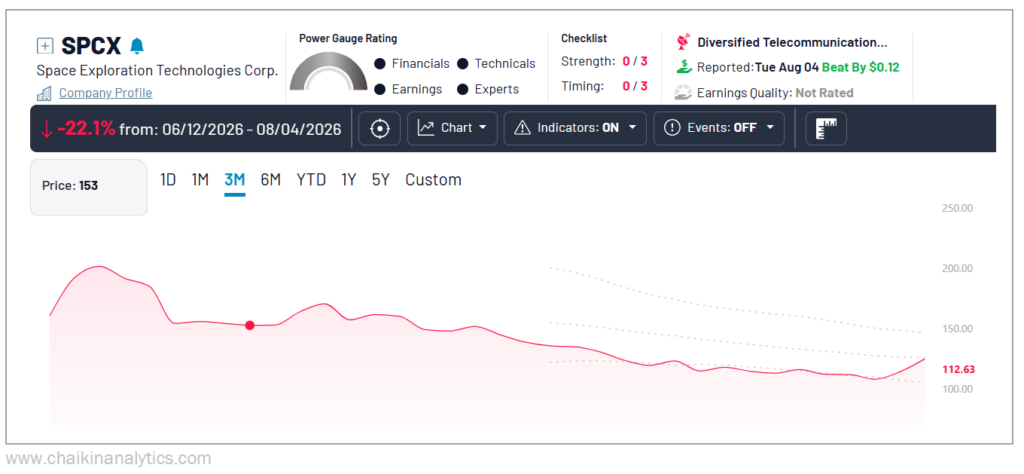
Traders are also concerned about the massive flood of shares that may come to market in the coming weeks. The stock price has already begun reflecting this potential new supply of shares that are being released from a series of lockup expirations:
- August 6, 2026: Two days after SpaceX’s second-quarter earnings are reported, about 20% of eligible shares can be sold.
- August 21, 2026: About 7% of shares become eligible for trading.
- September 10, 2026: About 7% of shares become eligible for trading.
- September 25, 2026: About 7% of shares become eligible for trading.
- October 10, 2026: About 7% of shares become eligible for trading.
- October 25, 2026: About 7% of shares become eligible for trading.
That’s an incredible rise in the number of shares that could be sold in the market, potentially hitting the stock price. Of course, the market has been anticipating this decline, with sellers accepting a lower price to avoid a wave of selling and short sellers more actively profiting on the stock’s decline. About one-third of the stock’s limited float is already short, according to market analytics firm S3 Partners.
But with the stock already well below its all-time high and even its IPO price of $135 per share, short-term traders may find the old adage “buy the rumor, sell the news” to be particularly apt.
Meaning that as the market gets comfortable with new shares hitting the market, it may start to reprice SpaceX higher. Negative expectations may subside, and the excess selling may slow or even end, reducing the downward pressure on the stock as investors move past this issue.
That could lead to some serious short-term upside. Would 50% higher from the stock’s recent $110 per share be outrageous to imagine? The stock was trading there just weeks ago.
This catalyst looks like the next best chance for traders to make money on SpaceX. Long-term fundamental investors will likely find the stock remains too overvalued, especially with major governance issues continuing to put the stock off-limits and Musk’s history of making promises he won’t keep.
Musk Keeps Making Big Promises About SpaceX’s Growth
Musk peppered the quarterly earnings call with his trademark “overpromise and underdeliver” approach. This is where Musk makes a big promise that has little chance of being achieved on the timeline he’s named (or maybe ever). For example, Musk has been promising self-driving cars “next year” for at least a decade or so, and here we are.
While the SpaceX prospectus was littered with this kind of overpromising – 1 million people on Mars! – it’s also come out in Musk’s recent pronouncements of SpaceX hitting $1 trillion in sales.
Here’s Musk on the latest earnings call:
It’s probably also worth mentioning that our internal projections for reaching $1 trillion in revenue, not ARR, but revenue, have moved up from 2031 to 2030. Prior to the IPO, the financial projections we had were reaching $1 trillion in revenue in 2031. We now expect that to be in 2030. There’s a non-zero chance of that being in 2029.
It’s a classic Musk overpromise, but this has virtually zero chance of happening on this timeline.
To reach this kind of milestone – which would put the company well above the 2026 sales of retail giants Amazon and Walmart (WMT) – SpaceX must rely heavily on its AI unit. Neither the rocket business nor Starlink has this kind of upside on an expedited timeline.
But supply chains are already crimped as the hyperscalers make the world’s largest AI infrastructure investment push ever. Memory-chip capacity is already booked and sold through 2027 at key players Micron Technology (MU), Samsung, and SK Hynix (SKHY), and that’s a key component for AI data centers. The memory that gets sold in 2027 can be expected to go into the data centers of 2028 and 2029.
Beyond this obvious blocker, the long timeline to build AI data centers means that construction must begin in the very near future. To get going, permits must be secured (often against intense public outcry), the rights to physical resources (water, electricity, etc.) must be negotiated, and SpaceX must lock down the work crews and human resources for future years – all while four other hyperscalers themselves are spending trillions of dollars in the same time period to scale up AI infrastructure.
That’s just not happening.
Beyond these issues, SpaceX simply doesn’t have the financial resources to build this level of infrastructure. Unlike hyperscalers with profitable core businesses – Microsoft, Amazon, Alphabet, and Meta Platforms (META) – SpaceX lost $541 million in the quarter.
Analysts have already been fretting about its post-IPO debt issuance of a mere $25 billion. Reaching $1 trillion in sales will require investments in the hundreds of billions at a minimum. SpaceX has no ability to raise this kind of financing – even with Nvidia’s help – on this timeline.
So, it’s just another case of Musk making promises that he almost certainly cannot keep. And Musk’s terrible reputation here means you shouldn’t be quick to trust any projection he makes. That alone should make SpaceX – despite its potential for a short-term bounce – uninvestable.
Regards,
James Royal, PhD
Editor’s Note: The biggest IPO in history, SpaceX, is now public. And almost nobody who read the S-1 filing understood what was really inside it. Rob Spivey – whose institutional research is followed by Goldman Sachs, JPMorgan Chase, BlackRock, and Fidelity – says buried inside the S-1 is a hidden AI empire worth more than the entire rocket business. He’s giving away his No. 1 stock pick at the center of it, free, in this presentation.