Image Credit: Associated Press
Key Points
- Spirit Airlines ceased operations on May 2 as surging jet fuel prices have nearly doubled since late February, squeezing margins and threatening budget carriers like Frontier, Allegiant, and Sun Country.
- The Association for Value Airlines has requested a $2.5 billion federal fuel-relief package in exchange for equity stakes, underscoring the severity of the crisis.
- While a bailout may offer short-term relief, long-term stability for low-cost airlines likely depends on lower fuel prices and easing geopolitical pressures on global oil supply.
Fuel prices are out of control. Not that this is news to anyone who has recently filled their gas tank or purchased airline tickets.
In fact, the fuel-price increase has gotten so bad that the Association of Value Airlines (“AVA”) – a trade group representing budget airlines such as Spirit Airlines, Frontier Airlines (ULCC), Allegiant Travel (ALGT), Sun Country Airlines (SNCY), and Avelo Airlines – asked President Donald Trump and his administration for $2.5 billion in fuel relief in exchange for equity stakes on April 27.
In a statement, AVA said,
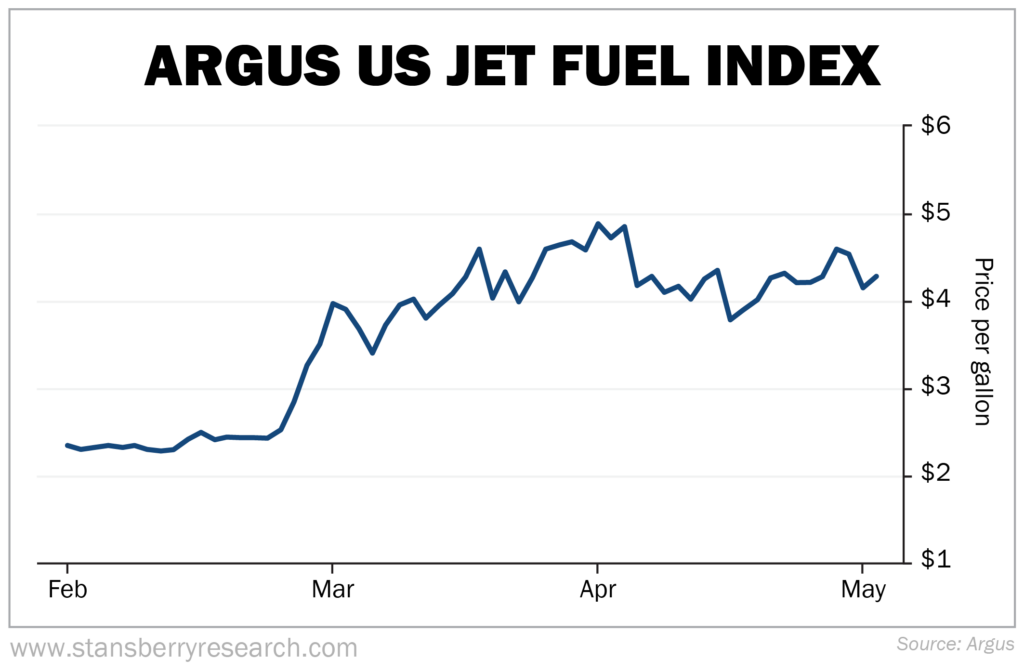
Since February, jet fuel prices have increased by nearly 100% and are placing significant financial pressure on value airlines. AVA and its members are committed to working collaboratively with the federal government to find solutions that protect both the industry and the traveling public.
As of May 4, the White House had not accepted (or rejected) these terms, meant to provide the struggling airlines with a desperately needed lifeline.
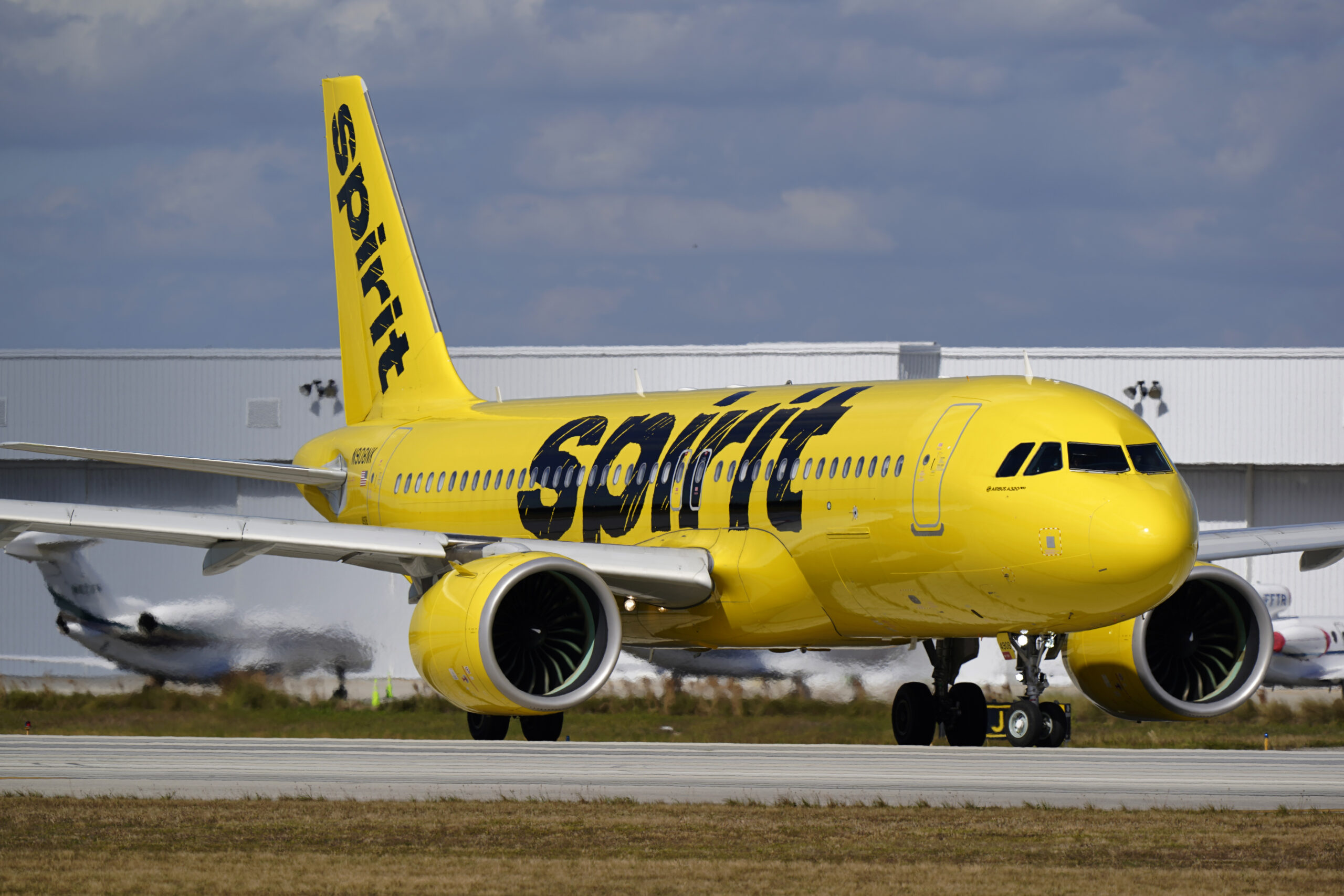
And any decision on this bailout will be too late for Spirit Airlines, which has had a rough few years. On Saturday, May 2, the troubled airline ceased operations, leaving passengers stranded and forcing roughly 17,000 employees out of work.
Will other budget airlines soon meet their demise? The situation is certainly worth monitoring for airline investors with already-low margins being heavily pressured by high fuel prices.
Fuel Prices Soar as the War in Iran Continues
On May 4, the national average price for a gallon of regular gasoline was $4.457, according to the American Automobile Association (“AAA”). That’s 34 cents higher than the prior week. In California, gas prices are averaging more than $6 per gallon.
Jet fuel prices are following a similar trajectory. The average price per gallon on April 30 was $4.51 compared with $3.99 per gallon just nine days earlier.
The ongoing war in Iran and the subsequent closure of the Strait of Hormuz, through which 20% of the world’s oil supply travels each day, are hammering commuters and travelers with surging fuel prices that are growing increasingly unaffordable.
On February 27, the day before the war began, jet fuel was averaging $2.50 per gallon. At that price, the cost to fuel a Boeing 737-800 jet was around $17,000. On April 30, at $4.51 per gallon, fueling that same jet would cost nearly $31,000 – a roughly 80% increase.
By the end of the first quarter, the six biggest domestic carriers – American Airlines (AAL), Delta Air Lines (DAL), United Airlines (UAL), Southwest Airlines (LUV), Alaska Air (ALK), and JetBlue Airways (JBLU) – spent a combined $1.2 billion more on fuel than in last year’s first quarter.
And this year’s first quarter included only one month of the war in Iran… imagine what that cost will be in the second quarter.
United CEO Scott Kirby, who made recent headlines when his desire for a United merger with American Airlines went public, said this to the company’s employees in March:
The reality is, jet fuel prices have more than doubled in the last three weeks. If prices stayed at this level, it would mean an extra $11 billion in annual expense just for jet fuel. For perspective, in United’s best year ever, we made less than $5 billion.
So, United’s best year earned less than half of what it could cost to pay for one year’s worth of jet fuel at these prices.
Unbelievable.
As a logical course of action, most airlines are hiking fares and bag fees, implementing fuel surcharges, and reducing flight schedules to save money. With jet fuel accounting for up to 40% of a flight’s operating cost, price hikes may be the only way to salvage carriers’ margins, which are being slaughtered by soaring fuel prices.
According to airline industry estimates, a seemingly insignificant one-cent-per-gallon increase can cost carriers an additional tens of millions of dollars per year. Well, per-gallon jet fuel prices have increased $2 over the past two months. The math is not pretty.
As Meelad Aslam wrote for Airways, a leading commercial aviation publication, “Today, with international jet fuel prices about to hit $5 per gallon, [the price fluctuation] has ceased to be incremental and has become structural.”
That’s a potential death knell for the airlines that exist almost solely because they can offer super-low fares.
If the major airlines, all with market capitalizations in the multibillions (JetBlue’s market cap is roughly $1.79 billion, the lowest of the “Big Six” airlines), are having trouble combating skyrocketing fuel prices, how are the budget airlines – one of which has been in bankruptcy for roughly two years – going to survive this crisis?
That’s why they’re hoping (praying, perhaps) that the Trump administration bails them out with temporary relief.
What the Future Holds for Budget Airlines
Most major airlines operate with paper-thin net profit margins. The International Air Transport Association (“IATA”) projected a 3.9% global aviation net profit margin for 2026.
The Big Six carriers’ operating margins more or less bear that out.
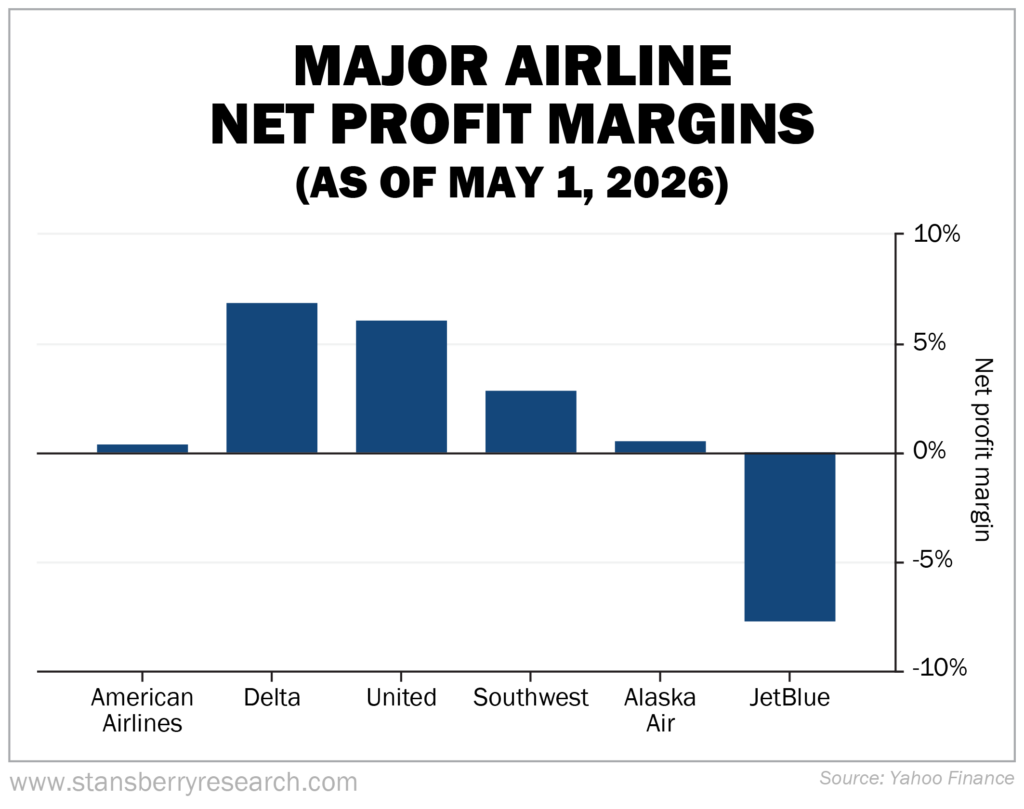
Compare those with the operating margins of budget airlines:
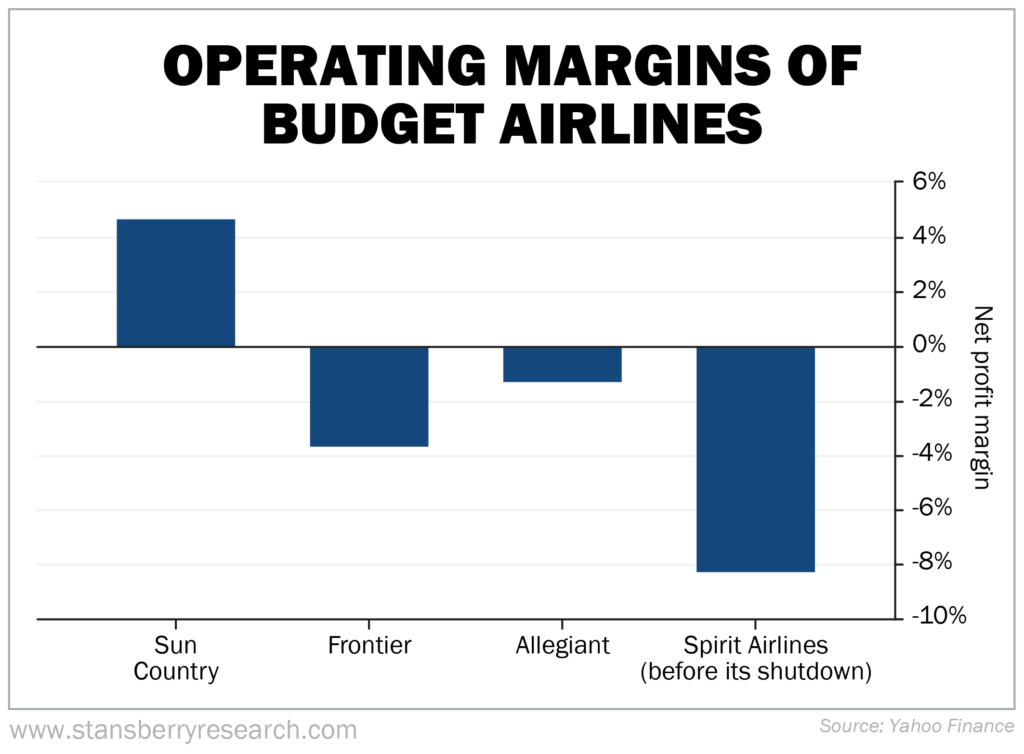
With margins like these (aside from Sun Country), it’s extremely difficult for low-fare carriers to turn a profit without substantially raising their fares and/or fees. And at that point, would they even be considered ultra-low-cost carriers anymore?
Frontier Airlines (ULCC)
Frontier finds itself in better shape than Spirit, though that’s not saying much.
The company reported revenue of roughly $3.72 billion in 2025, a 1% year-over-year decrease. That was offset by around $3.87 billion in operating expenses, resulting in a net operating loss of $149 million and a net income loss of $137 million. And Frontier’s earnings per share (“EPS”) plunged from $0.37 to negative $0.60.
And these disappointing results came despite Frontier actually spending 11% less on jet fuel in 2025 than it did in 2024. When you consider that Frontier paid an average of $2.47 a gallon last year and that jet fuel now costs more than $4 per gallon… well, you can see how the math doesn’t work in Frontier’s favor.
That helps explain why, in February, Frontier ended leases for 24 aircraft and deferred delivery of 69 fuel-efficient Airbus A320neo family aircraft for three to four years.
Frontier did launch 23 new routes in March and April, and it added first-class seating options for the first time.
But is it enough to push the carrier back into profitability? Jet fuel costs tell us no.
Here’s a look at Frontier’s Stansberry Score, a proprietary tool that helps determine the quality and long-term value of thousands of stocks. It’s not pretty.
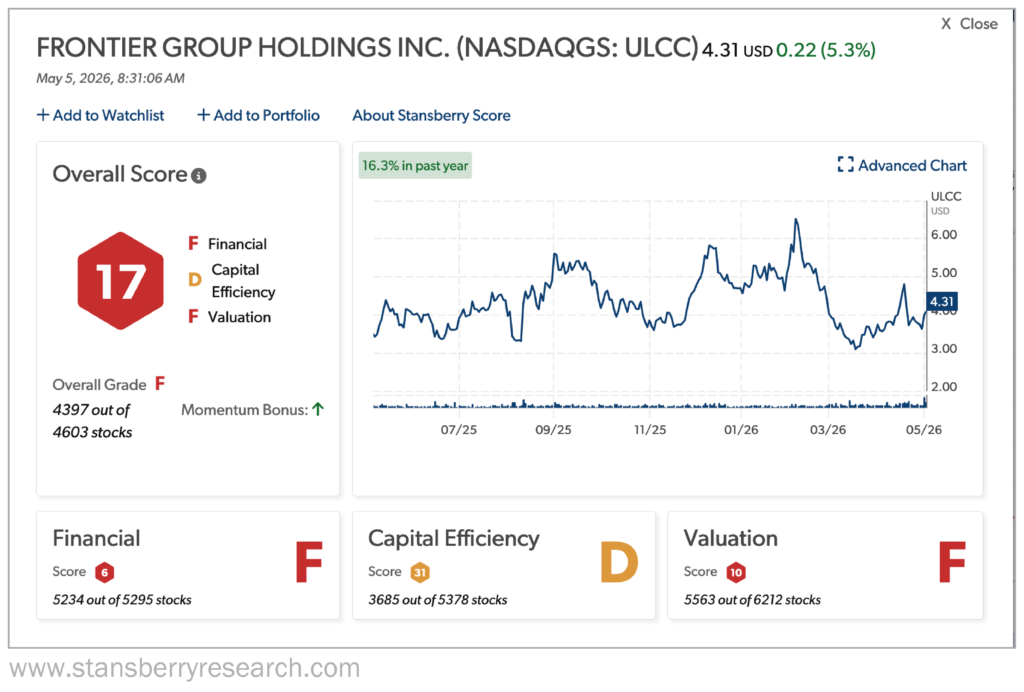
The stock ranks near the very bottom in the Financials and Valuation categories. It’s lost more than one-third of its value (roughly 37%) since early February, and the fact that it’s asking for a bailout to help cover fuel costs is not a good sign.
Allegiant Travel (ALGT) and Sun Country Airlines (SNCY)
These two airlines are grouped together because Allegiant is finalizing a $1.5 billion acquisition of Sun Country Airlines on May 13.
Both airlines will operate under the Allegiant brand but will continue operating separately until the Federal Aviation Administration issues a single operating certificate.
This deal seems like a major win for Allegiant, which focuses on routes to smaller cities. Bringing Sun Country into the fold expands routes to larger cities as well as Mexico and other international destinations. In total, Allegiant will soon offer more than 650 routes.
Allegiant appears to be in better financial shape than its competitors. It earned roughly $2.61 billion in revenue in 2025, a 3.7% year-over-year gain. And the airline brought in $37.2 million in operating income – a massive jump from 2024, when it lost $240 million.
Another positive sign for Allegiant was its $1.1 billion available liquidity at the end of 2025, as well as its nearly $390 million in cash from operations.
Allegiant still posted a $44.7 million net loss. Though that was a big improvement over the $240.2 million it lost the year before.
Allegiant started 2026 on a high note. Year over year, its first-quarter revenue (a company record $732.4 million) increased 4.8%, operating income was up 24.8%, its net income jumped 32.4% to $42.5 million, and its adjusted net income more than doubled to $69.6 million. Allegiant also set a quarterly company record with $268.1 million in cash from operations.
The Sun Country acquisition should also help Allegiant’s bottom line as it brings aboard roughly 22 million annual Sun Country passengers plus around $1 billion in revenue and $135 million in free cash flow (as of September 30, 2025).
However, Allegiant’s stock performance, while markedly better than Frontier’s, is still suffering from skyrocketing jet fuel costs. Throughout most of February, the stock traded above $100. Then Operation Epic Fury launched in Iran at the end of the month, and you can see what happened to Allegiant’s stock from there.
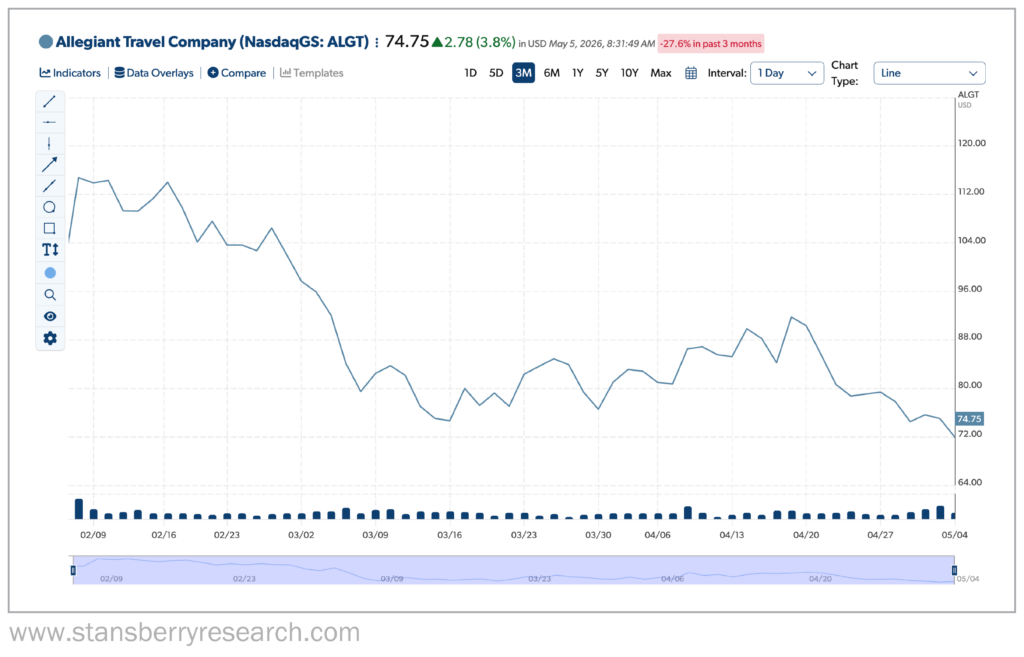
On February 27, the day before the war started, Allegiant closed at $102.15. By March 6, the price had plummeted to $79.50. It made a brief comeback in mid-April, but as of May 4, Allegiant is back down to around $72. In all, the stock has dropped about 30% in a little more than two months.
That explains why Allegiant joined its competitors in seeking fuel expense relief from the federal government.
The Fate of Budget Airlines Is in the Government’s Hands
These low-cost airlines are at the mercy of the federal government right now… and not because the White House hasn’t yet decided whether to subsidize the airlines with gas money.
The war in Iran is the clear problem. Whether the U.S. military is actively dropping bombs or conducting peace talks during a ceasefire, airlines of all sizes are being held hostage as long as the Strait of Hormuz remains effectively closed and as long as the U.S. blockades Iranian ports and vessels.
The longer this goes on, the more fuel prices are expected to stay sky-high. It’s that simple.
Would a $2.5 billion bailout help these struggling airlines? Temporarily. But it will cost taxpayers who are already paying more at the pump and in stores. And for investors, the relief would be like putting a Band-Aid over a severed artery.
Airlines go out of business. Dozens – if not hundreds – have since the turn of the millennium. Unfortunately, the relentless rise in fuel costs led to the same fate for Spirit Airlines. And it could prompt more American budget airlines to follow suit. A $2.5 billion bailout would only stave off bankruptcy or liquidation for so long.
The best option for survival in the low-cost airlines space? Hope and pray for a swift end to the war. Whenever that time comes, however, it’ll have been too late for Spirit.
Regards,
David Engle
Editor’s note: Gas prices are already soaring across America. But one of the most respected forecasters in our country just warned we’re about to be hit by a nightmare scenario that could push gas past $10 and bring chaos to America. You don’t have long to prepare – get up to speed here.