
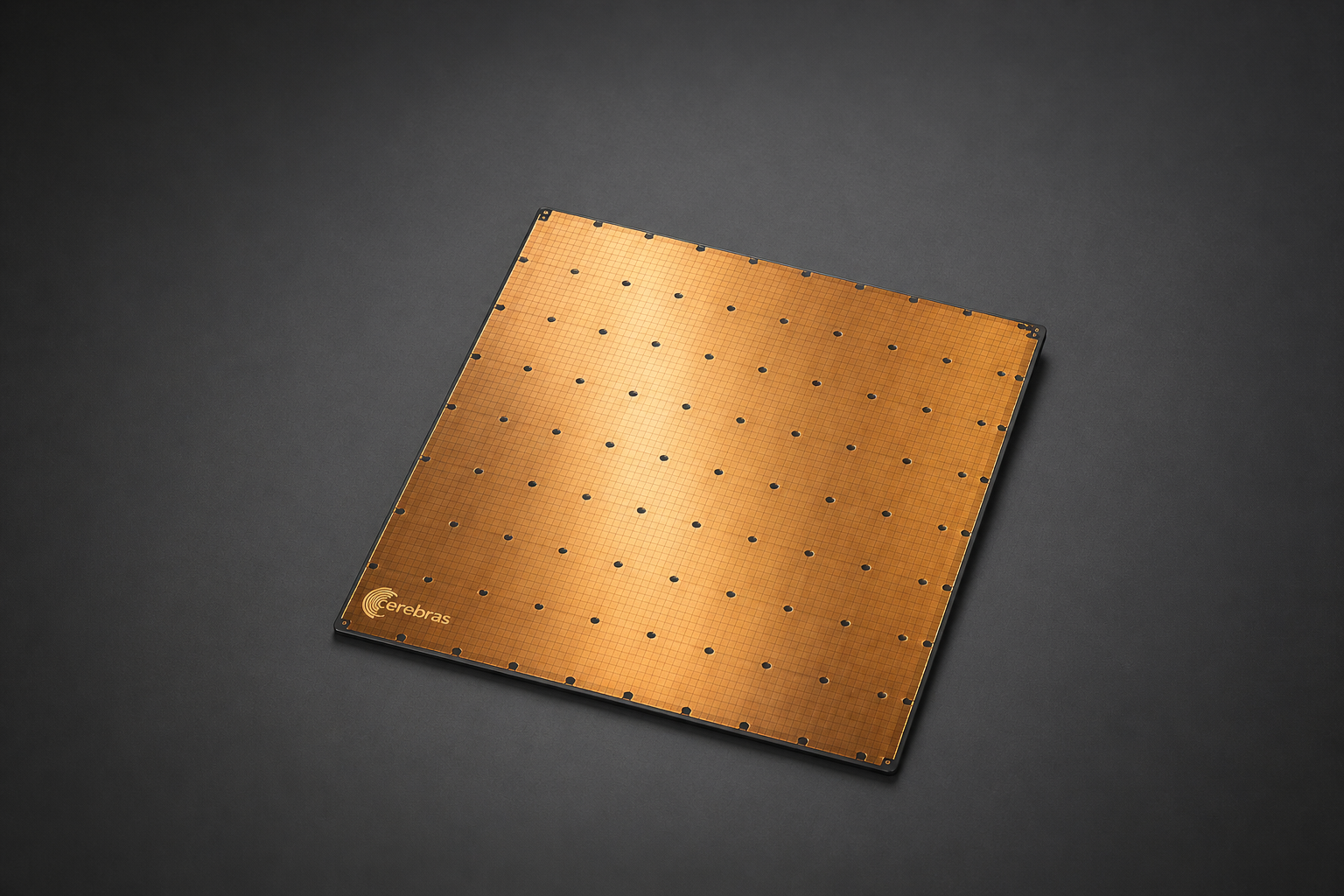
Image Credit: Cerebras
Key Points
- Cerebras Systems filed its IPO prospectus on April 17, signaling plans to go public later this year, though the timing and valuation remain undecided.
- Market conditions are favorable for AI and semiconductor companies to go public, with high valuations and strong investor demand.
- Cerebras says its wafer-scale chips offer a key advantage by accelerating AI model performance, often outperforming industry leader Nvidia.
Semiconductor firm Cerebras Systems looks set to begin trading on the market this year, after filing its prospectus with the Securities and Exchange Commission (“SEC”) in mid-April under the ticker symbol CRBS. Cerebras is likely to be among the hottest initial public offerings (“IPOs”) of 2026 in a market of red-hot IPOs.
While the timing and target valuation of a Cerebras IPO are not yet clear, the company has a strong record of growing its valuation. It was most recently valued at $23 billion in a February capital raise.
It’s hard to imagine a more favorable time for the debut of an AI chipmaker – and even more so for one that says its products run faster than market leader Nvidia’s (NVDA). Valuations on firms such as Micron Technology (MU) have skyrocketed over the past 12 months, with some analysts expecting the surge higher to continue.
Cerebras says its wafer-scale chips can process inference workloads much faster than Nvidia’s graphics processing units. Inference is the artificial intelligence (“AI”) process that creates answers for users based on a set of training data.
The process of inference is becoming more important as many AI workloads move from the training stage to the inference stage. Companies using AI have trained their models and are now deploying them in their day-to-day operations, meaning they need more inference capacity.
A November 2025 Deloitte study estimates that inference will comprise around two-thirds of all AI workloads in 2026, up from about 50% in 2025. The inference figure has climbed from just 20% a few years back. The consultancy McKinsey thinks inference’s share could hit 80% by 2027.
So, the growing importance of inference may be an extra boost for companies focused on this area, such as Cerebras. That has sent Cerebras’ revenue and stock soaring in recent years, priming the company for an IPO while investors are willing to enthusiastically fund AI projects.
MORE: Best AI ETFs: 7 Top Funds for Artificial Intelligence
Cerebras’s Key Advantages Over Nvidia
Cerebras takes a fundamentally different approach with its processors than its much larger rival, Nvidia. Cerebras develops wafer-scale processors that are about the size of a dinner plate and stuffed with processing power to drive hungry AI apps.
For instance, its WSE-3 chip includes about 4 trillion transistors divided into 900,000 cores and 44 gigabytes (“GB”) of memory. The relatively large memory supply allows the chip to run AI models on-chip, avoiding the slower off-chip data transport.
Cerebras says that the key advantage of this design is that it increases the speed of AI models, enabling them to provide inference even faster. The higher speed corrects one of the drawbacks of AI models: users are often waiting around for AI to finish processing their query.
As the company says in its prospectus, “Cerebras Inference delivers answers up to 15 times faster than leading GPU-based solutions as benchmarked on leading open-source models.”
On the Llama 3.1 8b model, Cerebras can process 1,800 tokens – basically individual pieces of data – per second. That’s compared with Nvidia’s 90 tokens or so per second. That’s 20 times the speed, and Cerebras says it’s more cost-effective, factoring in hardware and operating costs.
This chip is sold as part of a larger device that Cerebras calls the CS-3, which includes a cooling system and other related hardware for use in AI data centers.
Cerebras uses the CS-3 in its own data centers and also rents out its capacity on a per-use basis. It also sells the CS-3 for users who want their own inference capability.
Cerebras is expanding its data-center footprint, following a late 2025 funding round, including a build-out of six new data centers that will feature thousands of CS-3 devices.
Cerebras IPO: Extreme Customer Concentration Risk
Cerebras’ customer base has been narrow, though some of the concentration is due to its low sales volume. Only relatively recently has Cerebras ramped up its sales.
In a prior 2024 IPO filing, Cerebras said that the Emirates-based company G42 accounted for 87% of the chip company’s revenue in the first half of 2024.
This level of concentration hasn’t changed much, according to the latest April 2026 IPO filing. While G42’s share of revenue dropped to 24% in 2025, Mohamed bin Zayed University of Artificial Intelligence accounted for 62%.
This extreme level of customer concentration may sound scary at first, but Cerebras started from just $6 million in sales in the second quarter of 2023. In the same quarter of 2024, it hit $70 million in sales, and for the full year of 2025, Cerebras recorded sales of $510 million.
Concentration looks to become less of an issue in the near future. A January agreement with OpenAI should soon quickly make that company one of Cerebras’ largest customers.
Cerebras will provide 750 megawatts of computing power to OpenAI through 2028 for an estimated deal value of more than $10 billion. The companies called the deal “the largest high-speed AI inference deployment in the world.”
Then in April, the companies upsized their January deal with an additional $10 billion in spending commitments from OpenAI, according to The Information.
Cerebras also offers remote computing services to heavyweights, including IBM (IBM), Meta Platforms (META), and Mistral AI, among others. In March, Cerebras signed a deal with Amazon (AMZN) that will see its chips offered on Amazon’s cloud services.
Cerebras pulled a planned IPO in 2025, after U.S. regulators were concerned about the “leakage” of its chips to China. This issue has been cleared up, however.
Is Cerebras Stock Overvalued?
Cerebras’ valuation has soared over the past couple of years, as the company’s sales took off and valuations on publicly traded semiconductor companies soared. Its capital raises have come at increasing valuations, indicating the growing confidence investors have in the company:
- In November 2021, the company raised $250 million at a $4 billion valuation.
- In September 2025, Cerebras raised $1.1 billion at an $8.1 billion valuation.
- In February 2026, Cerebras raised $1 billion at a $23 billion valuation.
The move from an $8.1 billion valuation to $23 billion – a rise of almost 184% – in a span of five months shows just how powerful the AI and semiconductor supertrends are right now.
Naturally, investors will be drawn to anything that could capture some of the massive margins enjoyed by Nvidia. But Cerebras’ revenues are not quite there yet, though they’re soaring.
The company reported sales of $510 million in 2025, up from about $290 million in 2024. With sales increasing about 76% year over year, that’s stunning growth regardless of the company’s size.
And while the company reported GAAP earnings of about $238 million last year, the swing to profitability from 2024’s loss of almost $482 million is largely due to accounting. But both years had non-operational items that whipsawed profitability – to a profit in 2025 and a loss in 2024.
When you consider operating profit, however, Cerebras is still not moving in the right direction. Its loss of about $101 million widened to nearly $146 million in 2025.
Since the company is not yet profitable – hardly a demerit in the IPO world – let’s turn to valuing the company on its price-to-sales ratio. On that basis, its last valuation put it at 45 times trailing sales. But for fast-growing companies, it can be more accurate to look at forward sales.
To do that, we’ll need to make a few assumptions, but Cerebras does offer some mileposts. At the end of 2025, the company had a revenue backlog of $24.6 billion. Management expects to recognize 15% of this amount in the two years ending December 2027.
So, let’s average the expected revenue of the two years, assuming no more business comes in the door in the interim. This puts average revenue across the two years at almost $1.85 billion.
Against the valuation of $23 billion, the price-to-sales ratio becomes a much more manageable 12.5 times. Plus, it doesn’t include the expanded agreement with OpenAI signed in April.
This figure doesn’t look too high when factoring in how hot the AI and chip-making spaces are now. Of course, the IPO valuation will likely rise, and a first-day IPO pop would push share prices even higher. So, investors will want to consider the price-to-sales ratio in light of that repricing.
But investors who saw Nvidia’s rapid rise in recent years can easily recall how fast that stock rose. So, investors should keep a close eye on Cerebras when it debuts.
MORE: Best Semiconductor ETFs for the AI Boom
Regards,
James Royal, Ph.D.
Editor’s note: Elon Musk reinvented the auto industry, sparked a new era of space exploration, and built the world’s largest satellite network. But his new initiative – “Project Apex” – could become the crown jewel of his career. And, like Tesla, it could make early investors incredibly wealthy. Click here for the details.