

Image Credit: Associated Press
Key Points
- The Trump administration says the U.S. government will invest $2 billion in quantum-computing grants, including $1 billion for IBM to help build America’s first dedicated quantum chip foundry and strengthen the domestic quantum supply chain.
- While quantum computing remains an early-stage technology, government funding could accelerate advances that eventually impact industries such as AI, healthcare, finance, energy, and cybersecurity.
- IBM appears well positioned to benefit, given its leadership in quantum systems, growing ecosystem, and plans to expand domestic quantum-chip manufacturing.
The Trump administration revealed on May 21 that it would award $2 billion in CHIPS and Science Act grants to nine quantum companies – two foundries and seven quantum-computing companies. In exchange, the U.S. government will receive equity stakes, according to the U.S. Department of Commerce.
That same day, International Business Machines (IBM) CEO Arvind Krishna made this quantum chip foundry announcement on social media platform X:
Suddenly, quantum computing went from mid- to long-term future development to front-burner priority. But some experts are skeptical about whether we’ll see “mainstream” quantum computing anytime soon.
In January 2025, Nvidia (NVDA) CEO Jensen Huang had this to say about quantum computing:
If you kind of said 15 years for very useful quantum computers, that would probably be on the early side. If you said 30, it’s probably on the late side. If you picked 20, I think a whole bunch of us would believe it.
Well, 18 months later, quantum computing appears to be much closer to reality than Huang initially believed.
What does this government investment mean for the quantum-computing industry, the companies receiving the federal grant money (specifically IBM), the Trump administration, and investors?
Government Funding Should Expedite Quantum Computing
Of the $2 billion in grant money, IBM will receive half for Anderon (more on that in a moment), with smaller portions going to eight other pure-play quantum companies working to advance the technology.
These include:
- GlobalFoundries (GFS): $375 million
- D-Wave Quantum (QBTS), Rigetti Computing (RGTI), Infleqtion (INFQ), PsiQuantum, Quantinuum, and Atom Computing: $100 million each
- Diraq: $38 million
In exchange, each company is offering the federal government some form of equity. For IBM, it’s up to $1 billion minority equity in its new Anderon foundry. For GlobalFoundries, it’s a roughly 1% stake in the company. For the rest, it’s likely either an equity investment, a minority equity exchange, or a minority equity stake.
The purpose of the funding? To boost research and development of quantum-computing technology, a burgeoning sector that can potentially solve complex problems that today’s supercomputers either can’t or take too long to solve.
It’s important to note that quantum computing is still in the developmental stage. And quantum computers haven’t yet been used for anything practical – although the potential is clearly there. Quantum computers could someday help revolutionize the fields of medicine, energy, and AI, enabling breakthroughs no one thought possible.
Last year, Google’s Willow quantum processor “performed a standard benchmark computation in under five minutes that would take one of today’s fastest supercomputers 10 septillion (that is, 1025) years – a number that vastly exceeds the age of the Universe,” according to Google.
That’s 10,000,000,000,000,000,000,000,000 years. Mind-blowing.
But there are still significant logistics to work out.
For one, quantum computers operate on superconducting qubits (quantum bits).
Side note: A qubit is the basic unit of information in quantum computing, like a 0 or 1 in classical computing. But, unlike classical bits that can only be 0 or 1, qubits use quantum mechanics to exist as both 0 and 1 simultaneously.
Think of it this way. You’re standing in front of 1,000 lockboxes, one of which holds a million dollars. Classical computing is like the equivalent of using a single key to check all 1,000 boxes. Quantum computing would be like having a single key that opens every box at once. This is what allows quantum computers to process unthinkable amounts of complex data at once.
Anyway, qubits require some very harsh conditions to operate – as in temperatures near absolute zero, which is colder than deep space. So, they must be stored in cryogenic refrigerators.
Quantum computers, and qubits specifically, are also extremely delicate and must be shielded from electromagnetic interference and vibrations, which means they require storage in secure areas. Any type of interference can lead to calculation errors, which has proven to be an enormous hurdle to clear for practical quantum computing.
While Google has succeeded in creating a quantum processor within (actually, below) the error threshold, this would need to be done at a scale that’s exponentially larger than the 100-qubit chips being tested to be put into actual practice.
So there are issues to fix. But tens or hundreds of millions of dollars in government funding will go a long way toward resolving those challenges and potentially bringing quantum computing closer to reality.
How Federal Funding Impacts Quantum Computing Companies
IBM already has plans for the $1 billion it will receive from the government. The tech titan plans to match those funds with $1 billion of its own money to build a new company, Anderon, which will be America’s first pure-play quantum chip foundry, based in Albany, New York.
Anderon will start by making qubit wafers and other quantum components before eventually manufacturing more advanced quantum technologies. More importantly, it establishes an American quantum supply chain rather than relying on foreign manufacturers to build the chips.
IBM CEO Krishna believes this will introduce quantum computing into the mainstream far earlier than most others do.
At the IBM Think event in early May, Krishna stated:
We believe quantum advantage will be reached this year. That’s not 20 years away. That’s not 10 years away. That’s within this year. The gap is closing faster than most people realize or appreciate.
We’ll see if that prediction is accurate.
Meanwhile, the other quantum companies receiving government grant money have plans of their own.
GlobalFoundries used its $375 million to launch Quantum Technology Solutions, “a new quantum business to scale the manufacturing capabilities the quantum industry needs to achieve utility-scale quantum computing,” according to the company.
D-Wave Quantum, Rigetti Computing, Atom Computing, PsiQuantum, Quantinuum, and Infleqtion will invest their $100 million in solving the many technical challenges that are keeping quantum computers from becoming more practical and commercially viable.
And startup Diraq will put its $38 million toward tackling “key technical hurdles holding back more powerful systems,” according to the Commerce Department.
What the Government (and Trump) Gets Out of These Deals
There are a few key benefits for the U.S. in these deals.
- First, the government’s equity stakes help ensure that these quantum companies have reliable, long-term funding in the form of government equity.
- Second, these agreements give the American government some control (though its stakes are minority and non-controlling) over quantum technology by maintaining a strong corporate presence in the U.S. With the government owning minority stakes in these companies, it can help prevent foreign governments or businesses from acquiring them. And the U.S. clearly views quantum technology as a key to the future of national cybersecurity and AI.
- Third, as I covered earlier, these deals create a domestic quantum technology infrastructure and supply chain, helping mitigate the risk of offshoring the industry. The clearest example is the Anderon foundry in New York. This gives America a massive advantage in a nascent industry that will likely be worth billions – if not trillions – in the future.
- Finally, if these quantum companies succeed, the government stands to profit by selling its stakes in the businesses. The Commerce Department also stated that taking a minority stake in the quantum companies will “enhance the return for the U.S. taxpayer.”
If any of this sounds familiar, it’s because this is just the latest in a long line of deals the Trump administration has forged with private businesses.
Within the past year or so, the federal government took stakes (or negotiated the right to take them down the road) in these companies:
- Intel (INTC): roughly 10% stake
- U.S. Steel: “golden share” that gives the president special governance rights
- MP Materials (MP): 15% stake
- Vulcan Elements: $50 million equity stake
- USA Rare Earth (USAR): 10% stake plus the ability to purchase another 17.6 million shares
- Lithium Americas (LAC): 5% stake plus another 5% stake in Thacker Pass joint venture with General Motors (GM)
- Westinghouse Electric Company: option to take an 8% stake, entitled to receive 20% of any cash distributions by Westinghouse above $17.5 billion
- Nvidia (NVDA): 25% of revenue from H200 chips/15% of revenue from H20 chips sold to China
- Advanced Micro Devices (AMD): 15% of revenue from MI308 chips sold to China
There are valid reasons for the government to take minority ownership in these companies, as well as in the quantum industry. When they make money, the U.S. taxpayer benefits through the government’s use of tax revenue, discounts to the current market price, gains that go back into the U.S. Treasury to reduce federal debt, and more.
These deals also bolster American manufacturing and infrastructure in an intriguing, up-and-coming sector.
How IBM (and Quantum) Benefits From Government Backing
The news of the $2 billion government grants immediately impacted the companies receiving the funding. At market open on May 26, IBM was trading at $246.39. Within 15 minutes, it jumped by nearly $6 per share. By 10:00 a.m. on May 27, the stock was up to $257.57 – a gain of 4.5%.
By June 2, IBM had reached an intraday high of $332.46 before dipping to $301.77 at market close on June 4. So, between the May 26 announcement and June 4, IBM was up roughly 20.4%.
GlobalFoundries opened May 26 at $83.28 and closed at just under $90, an 8% increase.
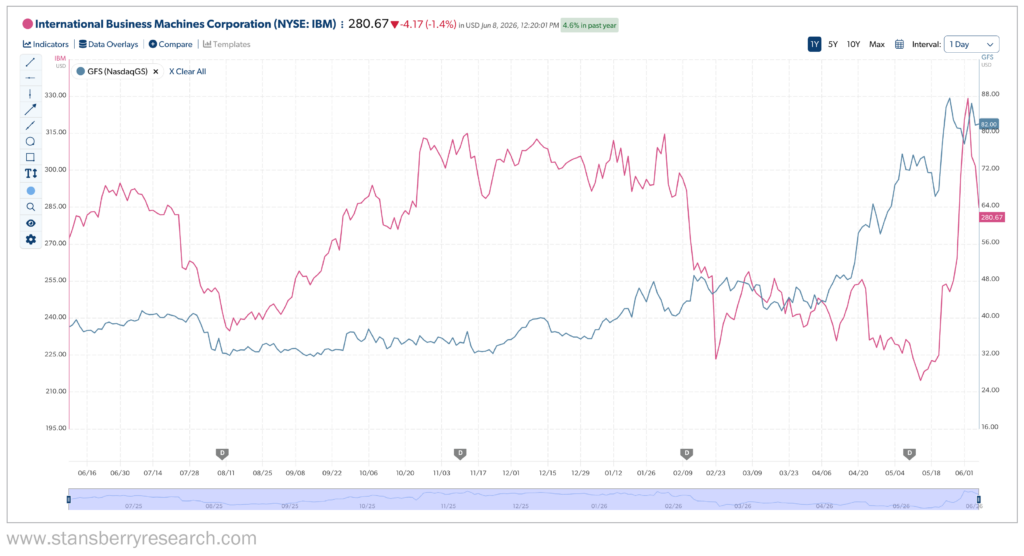
The rest of the publicly traded companies also saw surges during morning trading on May 26.
It was predictable that these stocks would see immediate gains after news of government funding. But what can investors expect in the long term?
The Commerce Department is fully aware that it could be years before these investments in quantum computing come to fruition.
But, as I noted earlier, IBM CEO Krishna believes the timeline is much shorter.
He said:
The quantum era is no longer ahead of us, it has started. Our clients, partners, and users around the world are tapping into IBM quantum computers to do work that was impossible a few years ago. The pace of discovery with quantum computers is accelerating rapidly and this investment powers our ability to deliver the next generation of quantum hardware, software, and manufacturing.
According to Krishna, quantum today is where AI chips were roughly 10 years ago. He’s expecting IBM’s quantum business to generate billions in high-margin profits for the company by the mid-2030s.
Based on IBM’s current quantum output, it’s difficult to disagree with Krishna’s assessment.
Consider the following:
- IBM already has more than 90 quantum systems operating today, more than all other quantum businesses combined.
- IBM’s current quantum ecosystem comprises more than 300 businesses, including Fortune 500 companies, universities, government agencies, and more.
McKinsey research projects that the automotive, chemicals, life sciences, and financial services industries will benefit the most from quantum computing. And that those industries could gain up to $1.3 trillion in value by 2035.
With that kind of data, it’s easy to see why Krishna and IBM are ready to take quantum computing to the next stage by controlling the manufacturing and supply chain, possibly by 2029. The $1 billion government grant certainly helps expedite that process.
If you already invest in IBM, that investment could look even better in the next five to 10 years, when the company expects to move the quantum computing needle. If you’re thinking of investing in IBM, it’s a historically strong stock with a solid dividend above 2%.
IBM’s Stansberry Score, a tool that helps determine the quality and long-term value of thousands of stocks, reflects its strength with an overall “A” grade.
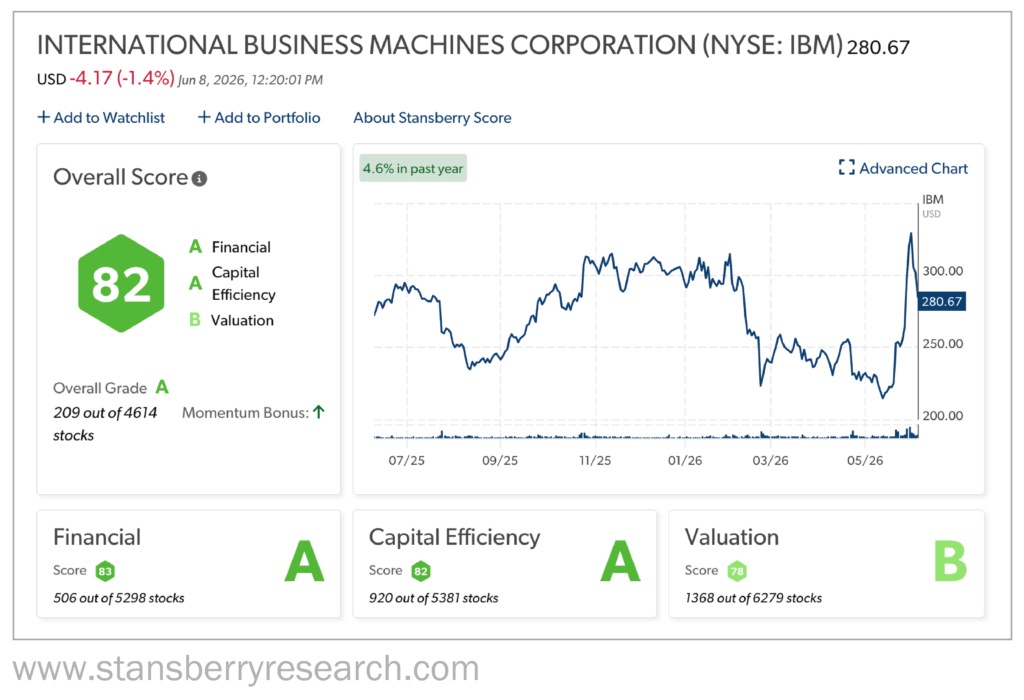
Through its high-margin, subscription-based software model, its enterprise AI platform integration services, and automated workflows, IBM is extremely capital-efficient.
It’s also consistently profitable. IBM may not make splashy headlines like Anthropic, OpenAI, or Nvidia, but it’s quietly a reliable money maker that generates billions in net income and turns that into a healthy free cash flow.
If there’s one potential downside to IBM stock, it’s that opinions are divided over whether the stock is overvalued. IBM’s current price-to-earnings (P/E) ratio of 24.45 is above its five-year median P/E of 24.35, indicating that the stock is trading a bit higher than its historical valuation. Another bear argument is that IBM’s quantum computing and AI developments have inflated its stock price.
But those same massive quantum computing breakthroughs that are on the horizon can be considered bull arguments as well. Because if IBM successfully advances quantum technology, it certainly won’t be considered overvalued for long.
Regards,
David Engle
Editor’s Note: While the financial media tells you what to buy, legendary Wall Street analyst Louis Navellier has spent 46 years tracking where billionaires and institutions actually position their money. His proprietary stock grading system — the same one wealthy firms paid $24,000 per year for me to evaluate stocks with — measures the three factors that predict institutional buying before it happens. Right now, his system is detecting something he’s only seen twice before in his career: massive money flows that signal the largest wealth transfer in American history. And most investors are positioned on the wrong side. See what Navellier’s system is revealing — including the specific sectors where institutional money is flooding in while retail investors look elsewhere — in his urgent presentation here.