
Image Credit: Associated Press
Apple (AAPL) got a boost earlier this week when analysts at Bank of America (“BofA”) raised the price target for Apple shares to $325 from $320 and reiterated a buy rating on the iPhone maker. The stock trades well below $300 per share.
The bank is forecasting second-quarter 2026 revenue of $113 billion and earnings per share (“EPS”) of $2.00, up from consensus estimates of $109 billion and $1.93. Apple is scheduled to report earnings on April 30. Bank of America is also expecting third-quarter 2026 year-over-year (“YOY”) revenue growth of 10% to 15%.
Apple has long been established as a blue-chip stock, but the Bank of America forecast is obviously great news for Apple and its investors. And it continues Apple’s scorching start to fiscal year (“FY”) 2026.
Its FY 2026 first-quarter revenue increased to roughly $143.8 billion from $124.3 billion a year prior. And its gross margin jumped to roughly $69.2 billion from $58.3 billion the prior year.
Apple’s first-quarter 2026 net income also improved, landing at roughly $42.1 billion versus around $36.3 billion the year before. Its diluted EPS grew from $2.40 to $2.84 YOY as well.
While the numbers are excellent, we may not have seen the best of Apple in 2026 quite yet. The company has plenty of excitement in store, both product-wise and behind the scenes.
iPhone 18, Foldable iPhones, and New Macs Highlight Apple’s Upcoming Launches
Anytime Apple releases details about a new product before it launches – whether it’s an iPhone, iPad, Mac, or AirPods – it generates a ton of buzz.
And that often pushes Apple stock higher.
iPhones, especially, move the needle. But there’s an interesting pattern that develops in the lead-up to an iPhone launch.
In the days before a new iPhone model is announced, Apple stock tends to surge. But when the actual announcement is made, the stock often dips or underperforms because the market has already priced in expectations ahead of the product launch. This is called the “buy the rumor, sell the news” effect.
But, after that first dip, Apple stock generally rebounds on the strength of its new products once consumers have begun purchasing and using them.
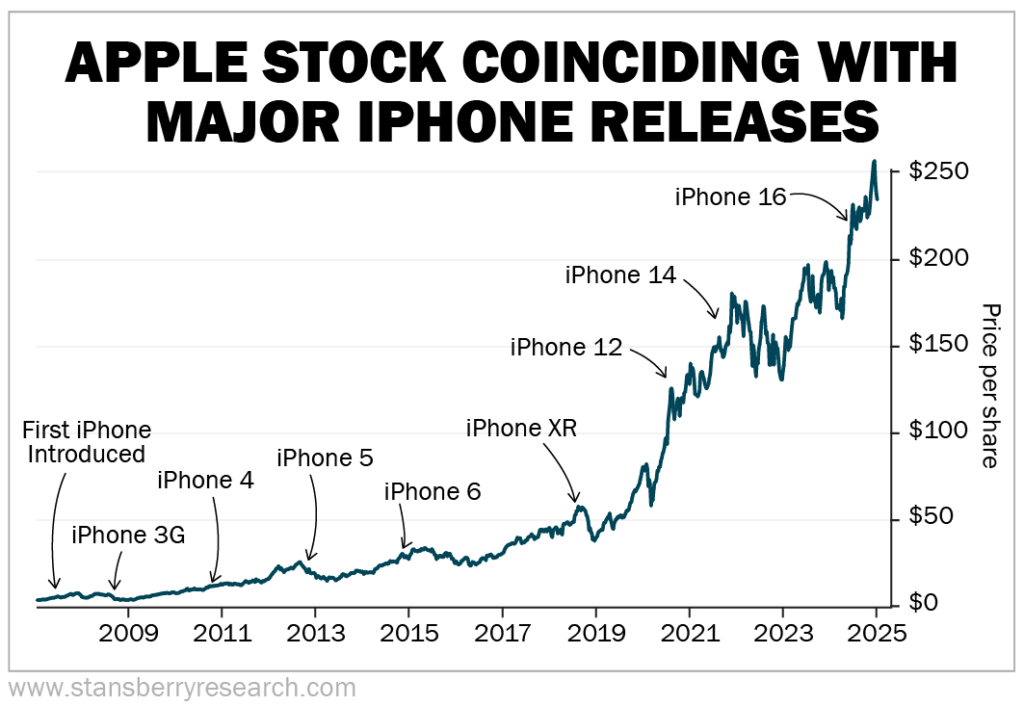
Expect more of the same in 2026, as the hype surrounding the new iPhones grows. Later this year, we could see the iPhone 18 Pro and the iPhone 18 Pro Max.
Meanwhile, anticipation may be the highest for the rumored foldable iPhone. Designed to compete with the Samsung Galaxy Z Fold7 and Flip7, the Google Pixel 10 Pro Fold, and the Motorola Razr Ultra, the foldable iPhone is believed to be equipped with a 7.7-inch inner display, a 5.3-inch outer display, two rear cameras, a front camera, a Touch ID power button, and more features.
The foldable iPhone doesn’t have a firm release date yet, but it may drop with the iPhone 18 in September. So, there should be tons of hype around Apple during the summer.
Beyond the iPhones, Apple is planning to roll out plenty of other exciting products.
These include:
- A new MacBook Pro (possibly called MacBook Ultra) with an organic light-emitting diode (“OLED”) touchscreen display, M6 Pro and M6 Max chips, and a thinner design, plus updated iMacs, Mac minis, and Mac Studio computers
- Smart glasses, expected to be announced in late 2026, with a planned release in 2027
- Apple Watch Series 12 and Apple Watch Ultra 4
- The iPad 12 and updated iPad mini
- Updated Apple TV with support for newer Siri
- A full-sized HomePod with updated Siri support
- Home Hub, with an up to 7-inch square display, FaceTime, and wall-mountable design
- A face ID doorbell
With this roster of products potentially rolling out in 2026, it’s easy to see why Bank of America is bullish on Apple’s performance in the coming months. And when that foldable iPhone is released, it could be yet another game changer for Apple.
But will it be enough to divert analyst and investor attention from what has been brewing within Apple’s headquarters?
An Executive Shake-Up Is Happening at Apple. Will CEO Tim Cook Retire?
Apple’s C-suite has resembled a merry-go-round for more than a year now. Since the start of 2025, Apple has announced that:
- Jeff Williams retired from his role as chief operating officer and was replaced by Sabih Khan, Apple’s senior vice president of operations.
- Chief Financial Officer Luca Maestri took on a smaller role, fueling speculation that he is leaning toward retirement.
- Apple’s senior vice president of machine learning and AI strategy, John Giannandrea, retired and was replaced by Amar Subramanya, a former Microsoft (MSFT) executive and Google researcher.
- AI models chief Ruoming Pang left the company to join Meta Platforms (META).
- Kate Adams, former Apple general counsel, retired and was replaced by Jennifer Newstead.
- Alan Dye, head of user interface, also left Apple to join Meta. He was replaced by Stephen Lemay.
That’s a lot of turnover to endure in just over a year, even for a company as strong as Apple. And much of it appears to stem from Apple’s struggles to adopt its own AI features for its products.
Apple Intelligence, the company’s intelligence system that combines generative AI models with user-specific context, has been an overall failure. It certainly didn’t help that Apple’s foray into generative AI was months, if not years, behind its competitors.
The result was unimpressive features, underwhelming Siri functionality, and generally inaccurate AI summaries. Apple’s internal AI crisis got so bad that it turned to rival Google to fix its AI applications and integrate Google’s Gemini AI into Apple’s products.
This turmoil has done nothing to quell the rumors that CEO Tim Cook may be nearing retirement. In fact, the C-suite reshuffling has only added more fuel to the fire. Cook is 65, after all.
AI woes aside, it’s tough to argue the fact that Cook’s job performance during his tenure as Apple’s CEO has been nothing short of stellar – perhaps even better than his predecessor, Apple co-founder Steve Jobs.
Consider: When Cook was appointed CEO in 2011, Apple was worth roughly $300 billion. Today? Apple’s market capitalization is around $3.9 trillion.That’s an increase of 1,200% in 15 years.
And, despite Apple’s AI issues, the company is still in outstanding shape and remains one of the most iconic brands in the world.
It’s worth noting that there hasn’t been any actual news of an imminent retirement announcement by Cook. He’s even shot rumors down himself. But the time will come. And when it does, it seems as if he may have a potential successor in mind – current Senior Vice President of Hardware Engineering John Ternus.
Keep an eye on that situation. Because you can bet that any CEO change at Apple will make waves in the market.
Despite the BofA Price-Target Increase, Apple Faces Some Challenges
Like any company, Apple has challenges to overcome, even as it celebrates its 50th birthday this year.
It’s still struggling with AI, though its partnership with Google should help solve that problem.
Apple may also have a China problem. In FY 2025, Apple’s revenue from Greater China (which includes Taiwan and Hong Kong) totaled $64.4 billion, an 11% decrease over two years.
Plus, President Donald Trump’s tariffs certainly haven’t helped. To date, Apple has paid roughly $3.3 billion in tariff costs.
But there were positive signs. Apple’s first-quarter 2026 results saw Greater China sales bounce back by 38%, driven by a surge in iPhone demand. And Trump’s tariffs were deemed illegal by the U.S. Supreme Court, so Apple could be in line for tariff refunds – though that process will likely take years, if Apple even sees a refund at all.
Apple, like many other consumer-electronics companies around the world, is also facing rising costs on product components – especially dynamic random-access memory (DRAM) and NAND memory, whose average prices have increased 237% and 70%, respectively, since the second quarter of 2025.
So, it’s worth keeping an eye on the company’s margins, which are still strong right now, because those memory costs will make an impact.
At the product level, Apple has a strong portfolio of flagship devices, like the iPhone, iPad, MacBook, Apple Watch, and AirPods. And we know updated versions are on the way in 2026.
But Apple is at something of a crossroads: Will the company continue to settle on updates of existing products to satisfy its loyal followers? Or will it release something revolutionary and exciting – like the iPod in 2001 or the iPhone in 2007 – to attract new customers and fold them into Apple’s vast ecosystem?
New smart glasses, though Apple certainly wouldn’t be the first company to sell them, could help. Same with the foldable iPhone. There’s also talk of a Siri-equipped pendant as well as AirPods built with cameras.
We’ll see if they move the needle.
Analysts Remain Generally Bullish on Apple
Despite its challenges, Apple stock is considered at least a moderate buy by most analysts. Along with its 2026 product releases, Apple has high expectations for its Services segment, driven by the integration of the improved, Gemini-infused Siri into its devices.
That, combined with growth in iCloud, Apple Music, and Apple TV+ streaming subscriptions, a promising game portfolio, and increased adoption of Apple Pay and Apple Card, has some analysts projecting double-digit percentage growth in Apple’s Services division.
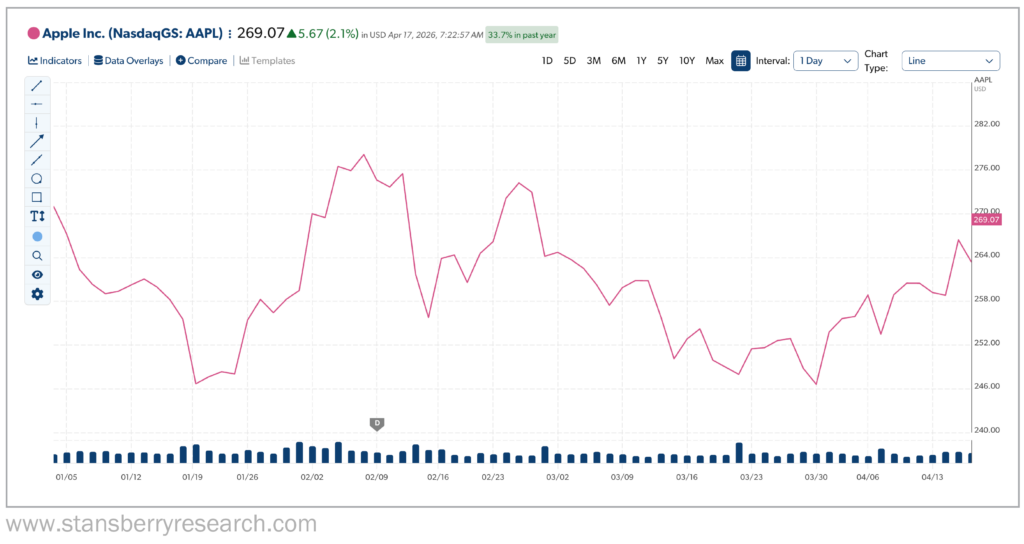
Year to date, Apple stock has been a bit of a roller coaster. It opened 2026 priced at $272.26 per share and is currently hovering around the $263 mark. There were several peaks and valleys in between – like Apple’s closing high of $278.12 on February 6 and closing low of $246.63 on March 30. The roughly 3.5% year-to-date decline isn’t earth-shattering, but it’s still a loss.
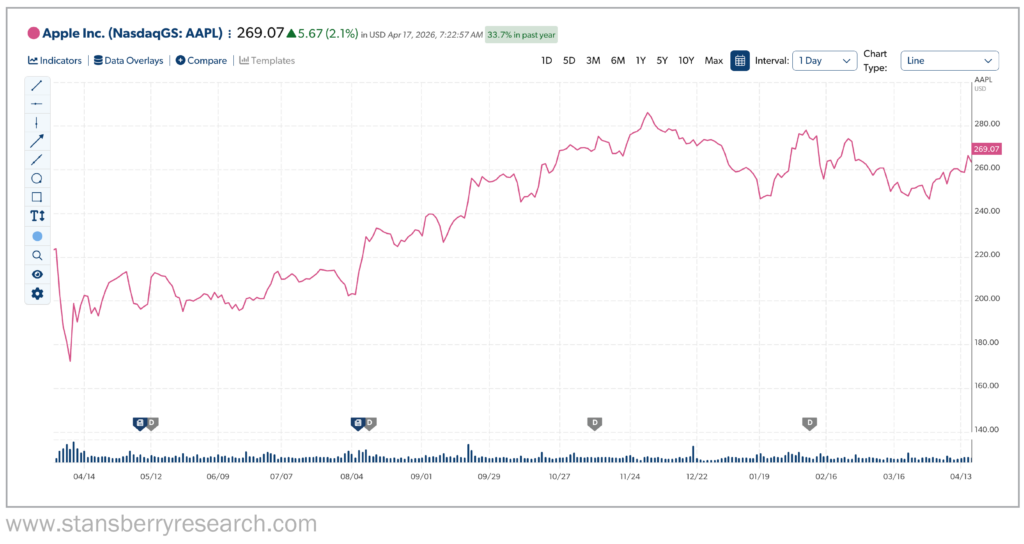
Take a step back, however, and you’ll see Apple made significant gains over the past 12 months. On April 15, 2025, Apple closed at $202.14. Apple closed at $263.40 on April 16, 2026. That’s a solid gain of around 30%.
If you’re considering investing in Apple stock, take special note of its return on equity of roughly 152% over the past 12 months. And while Apple’s annualized dividend of $1.04 is a bit soft, the company has increased its dividend payout for 14 straight years. Plus, Apple returned nearly $91 billion in capital to its investors through share repurchases during FY 2025.
That explains why Apple earns an “A” for capital efficiency on its Stansberry Score, a tool that helps determine the quality and long-term value of thousands of stocks.
In fact, its capital efficiency ranks in the top 40 out of nearly 5,400 stocks graded in that category.
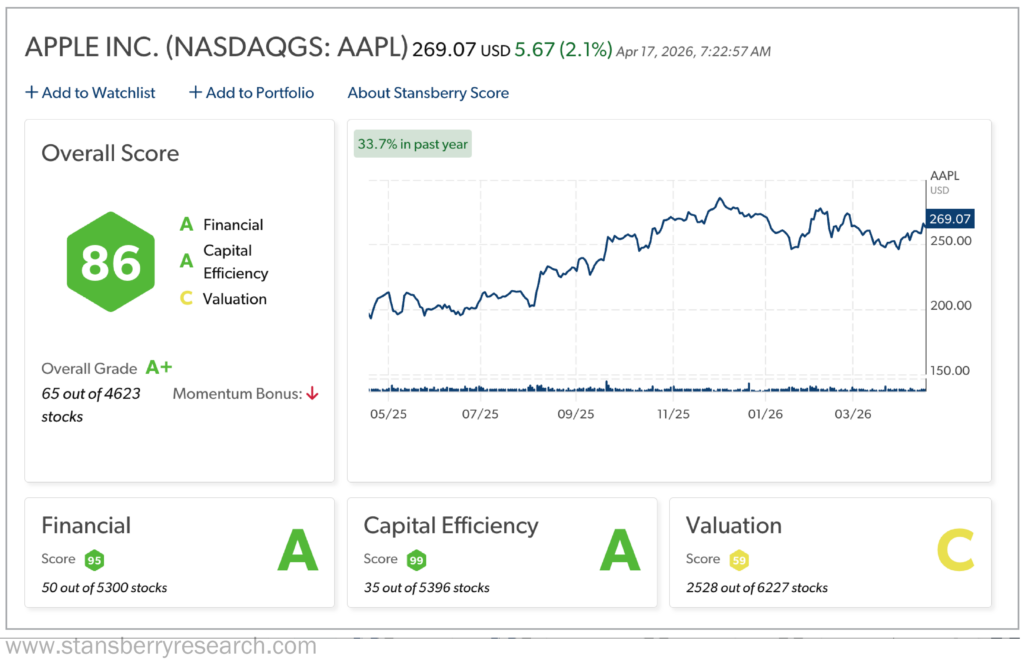
Apple’s financials (“A”) speak for themselves, with the company earning $416.16 billion in revenue in 2025, up 6.4% YOY. Valuation, however, is where Apple falters a bit. Its price-to-earnings ratio of roughly 33 is high, meaning the stock is already priced at a premium and that investors and analysts – like Bank of America – have high expectations for Apple stock.
Will Apple execute on its 2026 initiatives and increase its earnings enough to justify those expectations? We’ll find out soon enough.
Regards,
David Engle
Editor’s note: Here’s what most investors don’t understand: The biggest gains don’t come from being in “the market.” They come from being in the right sectors at the right time.
For 46 years, Louis Navellier has used a quantitative grading system to track where institutional billions flow before anyone else sees it – the same system wealthy firms have paid $24,000 per year to evaluate stocks with.
His system identified companies like Palantir Technologies (PLTR) at $13, before it hit $186… AppLovin (APP) at $38, before it reached $622… and Carvana (CVNA) at $24, before it hit $340. His system detected institutional accumulation months before these stocks exploded.
Right now, Navellier’s grades are changing across entire sectors – patterns he’s only seen twice before. See which sectors are lighting up with institutional buying in his presentation here.