
Today’s issue in preview:
-
The “biggest product of all time” is close to going live. How to invest in it
-
This bet on AI power consumption is poised to run higher. Are you on board?
-
We’re asking AI chips to get more powerful. That’s bullish for this duopoly
-
Our thematic trades in AI Semiconductors, Robotics, and Solar Energy generate more gains.
The “biggest product of all time” is close to going live. How to invest in it
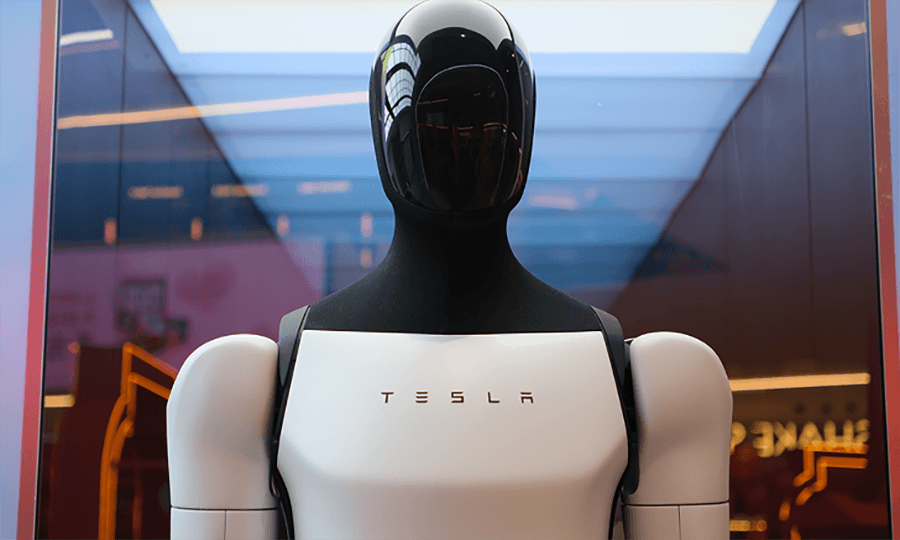
The humanoid robots are coming. And if you’ve been following our stock recommendations related to this trend, you know it can make you a lot of money.
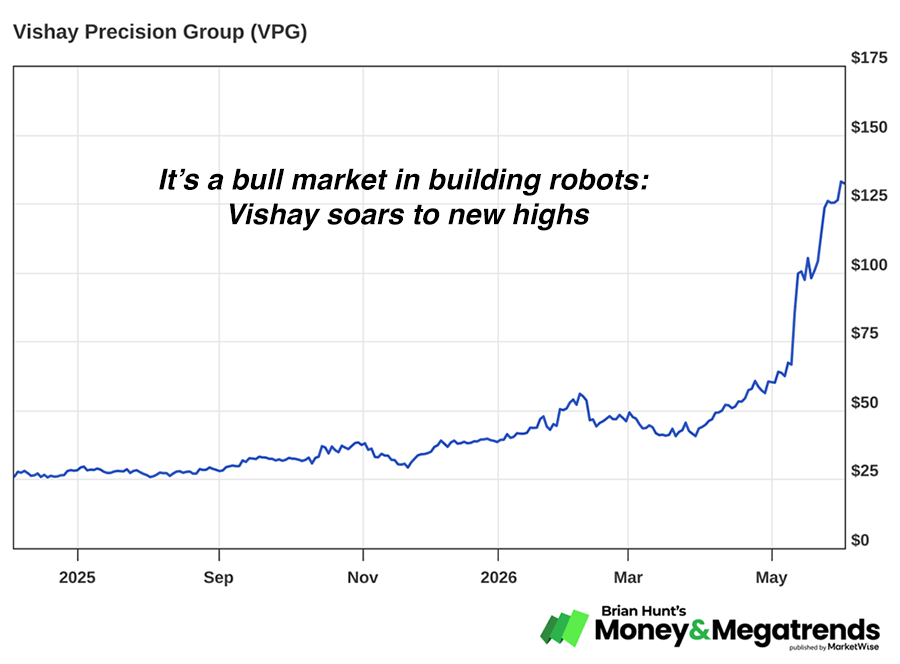
As evidence, we present the soaring market value of Vishay Precision Group (VPG). The stock surged 6% yesterday, reaching a new all-time high. It’s up 155% since we recommended it in February.
On February 5, we analyzed the emerging humanoid robot megatrend and presented a six-stock basket to play it. This technology is one of Elon Musk’s biggest business bets right now.
In January, Musk announced Tesla would phase out two car models to free up factory capacity to build its Optimus humanoid robots.
Humanoids are poised to become one of the most impactful, most popular innovations in history. Imagine millions of robots in our homes, factories, mines, and fields doing work most of us consider to be dirty, dangerous, and tedious.
The futurist I put the most stock in – Musk – says humanoids will be “the biggest product of all time.” Point taken.
In pursuit of humanoid market dominance, venture capitalists and large tech firms such as Tesla, Google, Amazon, and Microsoft are pouring billions of dollars into humanoid factories and related R&D. Over a dozen humanoid makers are competing for the title of “king of the humanoid market.”
In short, this is an enormous emerging megatrend… and a huge investment opportunity.
If I had to bet on one humanoid maker, I’d pick Tesla. Because Elon is Elon. He is the greatest high-tech manufacturer of all time. Making this bet requires zero courage or insider knowledge. It’s just common sense. It’s like betting on prime Michael Jordan to win that year’s NBA title.
However, rather than trying to pick a single winner of the humanoid war, I’d rather sell arms to all combatants… aka “sell highly specialized component parts to all robot makers.” This strategy is a safer, surer bet than trying to pick a single winner.
Producing humanoid components is a difficult business. Robot joints, frames, gears, batteries, motors, and sensors must possess a very-hard-to-achieve balance of lightness, precision, durability, and functionality. This is ultra-high-tech manufacturing.
Plus, any big league humanoid component maker must be able to fill gigantic orders from the likes of Tesla. Producing 10,000 precision components is one thing. Producing 1 million of them is a different thing. Operating on this scale requires not only technical expertise but also sourcing expertise for vast amounts of raw materials.
Back in February, we detailed that most of the world’s key robotics component makers are based in China. Many U.S. investors are justifiably reluctant to buy China-listed stocks. However, we detailed six U.S. companies with exposure to the humanoid market poised to benefit from this emerging megatrend (and the broader robotics trend). They were Regal Rexnord (RRX), RBC Bearings (RBC), Ambarella (AMBA), Allient (ALNT), Teradyne (TER), and Vishay Precision Group (VPG).
At the time, Vishay was the smallest stock on our list. Its technology is what gives humanoids a sense of touch and is embedded in their joints, feet, and hands, providing the feedback loops for delicate manipulation. Some analysts believe VPG is involved in Optimus robots, which, if true, would make VPG’s robotics revenue increase dramatically based on Musk’s vision for Optimus being “the most valuable product of all time.”
So far, the market is enthusiastically supporting our “long humanoids” position. Our basket is up 50%, and as mentioned above, VPG has skyrocketed since our recommendation. We recommend staying long humanoids. This trend will persist.
Recommended Link:
Why is Elon giving away money?

Elon Musk wants to send you money. It’s a free bonus if you sign up for his new bank. Lots of people are already flocking to the bank — including Star Trek star William Shatner. Banking insider, Luke Lango, reveals how you can join them here — also the much bigger opportunity connected to this.
This bet on AI power consumption is poised to run higher. Are you on board?
Credit: RelaxFoto.de
In March, President Donald Trump and Japanese Prime Minister Sanae Takaichi announced a joint initiative for a massive $40 billion nuclear power project in the southern U.S. The plan calls for energy infrastructure leader GE Vernova (GEV) and Japanese nuclear power leader Hitachi to build a group of reactors in Tennessee and Alabama.
This venture will be one of the world’s largest electricity generation projects… and it confirms the megatrend in nuclear energy is alive and well.
That’s bullish for stocks operating inside our Nuclear Renaissance theme.
Regular readers know the Nuclear Renaissance is one of our highest conviction megatrend trades.
In 2022, I sent a bullish note to colleagues, highlighting the emerging uptrend in uranium miners such as Cameco (CCJ) and Uranium Energy (UEC).
Since my original call, uranium miners have generated massive returns. Cameco is up 320%, and Uranium Energy is up 209%. This big trend will likely continue.
One of the highest impact facets of the AI megatrend is electric power consumption. Thanks to AI’s enormous promise, giants like Google (GOOG), Meta (META), Microsoft (MSFT), and OpenAI are conducting the largest collective investment effort in history. They’ve already spent more than a trillion dollars on AI data centers, AI chips, and other infrastructure components. They are on pace to spend over $700 billion in 2026… with more than $3 trillion to follow.
All that AI infrastructure is poised to consume colossal amounts of electricity. Goldman Sachs forecasts global data center power demand will surge 220% by 2030 compared to 2023 levels. U.S. data centers already account for 7% of U.S. electric power consumption, a figure that is expected to rise significantly.
Given this outlook, AI companies and their power providers are spending heavily to expand nuclear power capacity. Nuclear provides “always on” carbon-free baseload power. Bloomberg reports that surging nuclear demand will drive $350 billion in U.S. spending by 2050.
This “Nuclear Renaissance” theme depends on uranium as fuel. Demand for uranium is soaring, but supplies are constrained right now and will be for years to come.
You can get long on this theme in several ways. In the past, I’ve mentioned nuclear power equipment and service companies such as BWX Technologies (BWXT, specialized manufacturing), Mirion Technologies (MIR, nuclear facility monitoring) , Centrus (LEU, uranium enrichment), and Solstice Advanced Materials (SOLS, uranium processing).
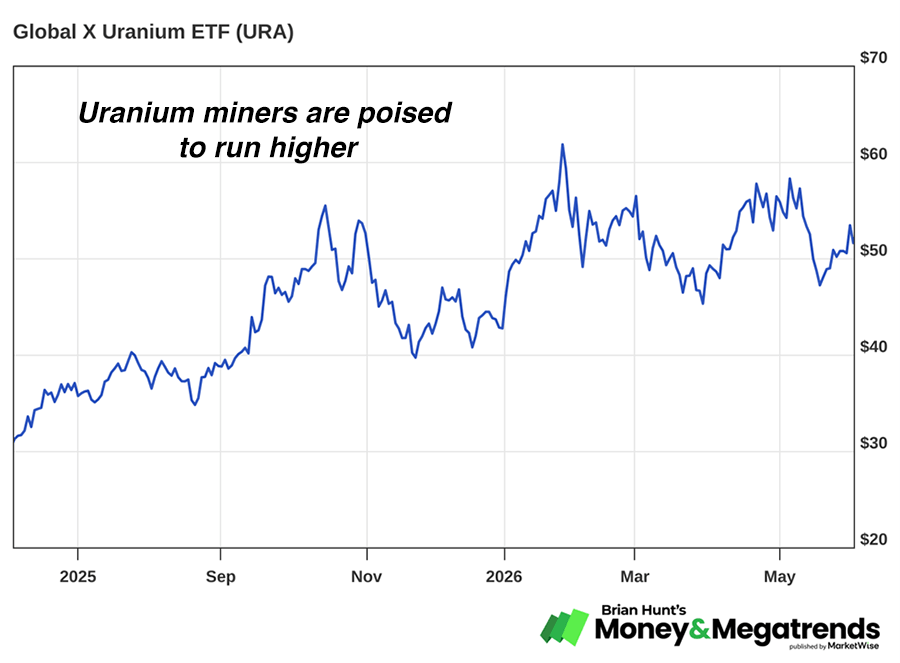
You can also take the “one click, and you’re done” route with a uranium miner fund such as the Global X Uranium ETF (URA) or the Sprott Uranium Miners ETF (URNM). Both funds own diversified baskets of uranium miners, and both hold large positions in blue-chip Cameco.
As you can see in the URA chart below, uranium miners suffered a sharp selloff during the height of Operation Epic Fury. However, the fund has rallied off its lows and is poised to reach new highs. Given nuclear energy’s bullish demand outlook, I’m confident those new highs will arrive soon.
We’re asking AI chips to get more powerful. That’s bullish for this duopoly
Credit: BlackJack3D
In our June 1 issue, I highlighted that ASML (ASML) and Taiwan Semiconductor (TSM) are both enjoying strong revenue growth and have recently reached new all-time highs.
These two members of the semiconductor supply chain are among the most important, most irreplaceable companies in the AI infrastructure boom. Their new highs tell us this megatrend is alive and well.
I expect it to continue for years. Although Big Tech has spent over a trillion dollars over the past three years on AI infrastructure, it plans to spend an additional $4 trillion more by 2030. As the Agent Supernova transforms our economy, demand for specialized semiconductors should continue to boom.
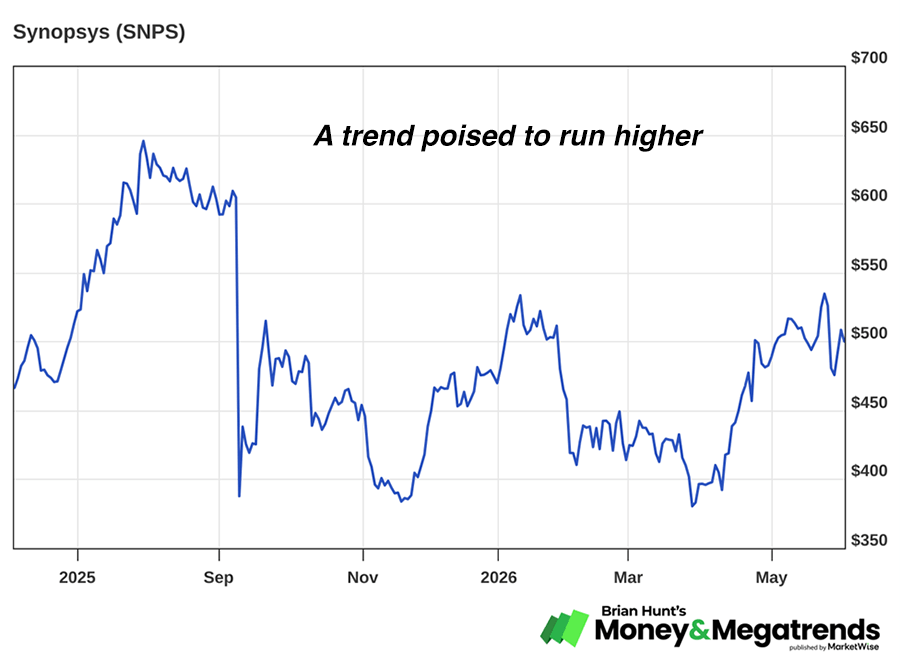
That’s a bullish outlook for Cadence Design Systems (CDNS) and Synopsys (SNPS).
Cadence and Synopsys occupy a unique place in the semiconductor boom. They form a duopoly in EDA (Electronic Design Automation), which is the software used to design, simulate, and test the complex semiconductors that power AI, smartphones, Edge Computing devices, and the rest of our digital devices.
Cadence and Synopsys are essentially architecture and testing firms that ensure complex semiconductors operate efficiently and economically. Their customers are the “who’s who” of the industry: Nvidia, Intel, Apple, AMD, Samsung, and Microsoft.
Before a single chip can be manufactured, someone has to design it. Every transistor, every connection, every circuit pathway. Cadence and Synopsys make the software that engineers use to do exactly that: design, simulate and verify chips before they ever reach a factory.
In practice, that means an engineer sits down with Cadence or Synopsys software and essentially designs the entire chip digitally – testing whether it works, whether it runs fast enough, and whether it can actually be built before a single physical component is ever produced.
Bell, Texas Instruments and Intel all built their own internal design tools in the early days of the industry. Over time, every single one of them abandoned those efforts as the complexity outgrew what any single company could sustain on its own. That’s how specialized this software has become.
Think of them like Visa and Mastercard. They don’t compete with the chip makers any more than Visa competes with your bank. They simply sit in the middle and collect a toll on every chip design that flows through their software, regardless of who wins the AI chip race. Every chip that gets designed pays the toll. That’s the business model.
The design problem has also become dramatically harder than it was just a few years ago. If building a chip five years ago was like designing a house, today it’s like designing an entire smart city where every building has to communicate perfectly with every other one, in real time, without failure. AI chips have grown so ambitious in what they’re trying to do that the design work behind them has grown equally complex. That complexity flows directly into Cadence and Synopsys’ revenue.
Yet both stocks have lagged the broad semiconductor group over the past year. SNPS is only up 5% over the last year. CDNS is up 41%. This is during a time when their underlying businesses have done well and stocks in other bottlenecks of the AI supply chain have run hundreds of percent.
Cadence is expected to deliver 17% growth in 2026. Synopsys is tracking at 37% growth. Synopsys alone reported $7.1 billion in revenue with its backlog now exceeding $11 billion… a measure of the pent-up demand sitting in front of these businesses right now.
An investor in this trend has good company. In December 2025, semiconductor giant Nvidia (NVDA) invested $2 billion directly into Synopsys common stock as part of a strategic partnership. Nvidia CEO Jensen Huang does not write $2 billion checks to companies that are peripheral to his roadmap. That investment is a clear signal of the importance of these firms to the future of AI.
The case for owning both names is simple. AI semiconductors are becoming increasingly complex. They are being asked to do more things than ever. This powerful trend is bullish for the Cadence/Synopsys duopoly.
Market Notes
-
Our recommendation to ignore the AI bears and stay long AI infrastructure continues to pay off. Semiconductor supply chain leaders AMD (AMD), ASML (ASML), Lam Research (LRCX), Applied Materials (AMAT), KLA (KLAC), and ON Semiconductors (ON) advanced to new one-year highs today.
-
Our recommendation of AI chipmaker Marvell Technology (MRVL) generated higher returns today. The stock is up 183% since we recommended it less than two months ago.
-
Our recommendation to invest in the booming solar energy theme continues to pay off. Industry giant First Solar (FSLR) advanced 2.4% this morning to reach a new all-time high.
-
Trucking giant J.B. Hunt (JBHT) reached a new all-time high today. This is a bullish economic signal.
-
Fast food giant Chipotle Mexican Grill (CMG) reached a new one-year low today. The company was trading at a premium valuation, yet growth is sluggish.
Top Themes to Buy Now
🧬 This bleeding-edge technology has huge upside and is poised for a breakout
Regards,


Brian Hunt
Editor, Money & Megatrends
An urgent message from our colleagues:
Critical SpaceX IPO Update: Do this now

Jeff Brown believes the SpaceX IPO (which is set for June 12)… Will unlock the single most explosive artificial intelligence opportunity of this decade. Which is why he’s having an urgent online strategy session tonight at 8 p.m. ET. Click here to save your seat because he’s going to share details on THREE new recommendations… All with the potential to make up to 50 times more money than SpaceX.