
Listen to the audio version of this article (generated by AI).
Today’s issue in preview:
-
This unique inflation hedge is soaring in value
-
One of the world’s most important AI stocks is about to reach a critical level
-
New lows for Home Depot tell us the housing sector has good potential, but horrible price action
This unique inflation hedge is soaring in value

Credit: TarheelBornBred
It turns out, owning stock in sports teams was a good idea.
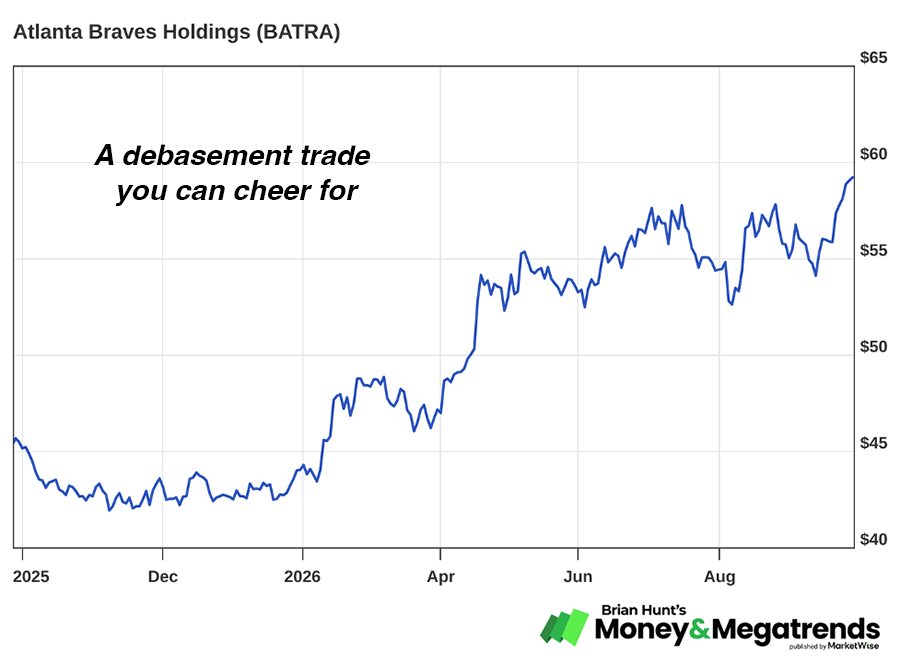
Today, shares of Atlanta Braves Holdings (BATRA) reached a new all-time high.
Atlanta Braves Holdings is one of the few publicly traded stocks that allows investors to own a stake in a top professional sports team. The company owns the Atlanta Braves baseball franchise and assets around Truist Park, where the Braves play.
Back in January, we published a bullish research note that covered how owning professional sports teams is a compelling and unusual way to hedge against inflation and the debasement of the U.S. dollar, a financial strategy that is being called the “debasement trade.”
You probably know why being vigilant against inflation is important: The U.S. government has promised far too many things to far too many people. It is spending far more on taxpayer benefits and wars than it collects in tax revenues. Many other large countries are in the same situation.
The related debts and obligations governments have taken on cannot possibly be paid back with sound money. They can only be paid back with debased, devalued money… much of which is created out of thin air. This is driving inflation and significant currency debasement.
Prices are going up because the value of our money is going down.
When I provide guidance on inflation defense, I urge people to keep my number one rule in mind: own in-demand, useful assets that cannot be easily replaced or replicated.
That is inflation defense in a nutshell. You want to own businesses and properties that produce in-demand, scarce resources, products, experiences, and services.
This group of assets includes quality farmland, beachfront real estate, timberland, mountain-view properties, great businesses, and oil and gas pipelines.
When a very difficult or impossible-to-replicate business or property produces in-demand, scarce resources, products, experiences, or services, it tends to hold its value no matter what the dollar is doing.
Its price will constantly “recalibrate” to accommodate an increase in currency units. It’s like the difference between slicing a pizza into 6 or 8 pieces. The number of slices changed, but the amount of pizza is the same.
And this might sound odd, but I include professional sports teams as inflation defense assets. Like oil pipelines and beachfront homes, professional sports teams are valuable, in-demand, scarce resources that cannot be printed or easily produced.
Every year, we hear new superlatives for how the values of professional football, basketball, and baseball teams are rising. CNBC reports that the average NFL franchise is worth $7.65 billion. That figure marks an 18% jump from the year before. CBS reports that Major League Baseball generated a record $12.1 billion in revenue in 2024, and franchise valuations increased 8%. The New York Yankees recently achieved a valuation of $8.2 billion.
Professional sports contests are among the few television programs people still reliably watch. In a world where our attention is pulled away from television, sports become incredibly valuable to big advertisers.
Plus, sports team valuations are benefiting from the K-shaped economy and soaring asset values. The ultra-rich love to buy and own sports teams.
Back in January, I detailed how BATRA and Madison Square Garden Sports (MSGS) – which owns the NBA’s New York Knicks and NHL’s New York Rangers – were two ways to express this trade.
Since that note, MSGS is up 41% and recently reached a new all-time high. BATRA is up 39% and just hit an all-time high. This debasement trade is working wonderfully.
Recent government spending and taxation data indicate the government is going “full speed ahead” with spending, borrowing, and printing money. This means owning quality “inflation defense” assets is as important as ever. Since BATRA and MSGS have risen so much since our original note, we don’t recommend buying these stocks here. Better bargains can be had now in companies that own world-class collections of timberland and gravel pits.
Recommended Link:
Watch this before September 30th

While everyone piles into Nvidia and SpaceX, one AI insider says you’re about to get crushed. His AI system has identified a small group of stocks positioned to surge as this big-name AI trade breaks down. Backtests show his tools would’ve helped followers navigate every major crash since 1998. Watch his free briefing now before September 30th.
One of the world’s most important AI stocks is about to reach a critical level

Credit: Just_Super
Good news for “the world’s most important trend.”
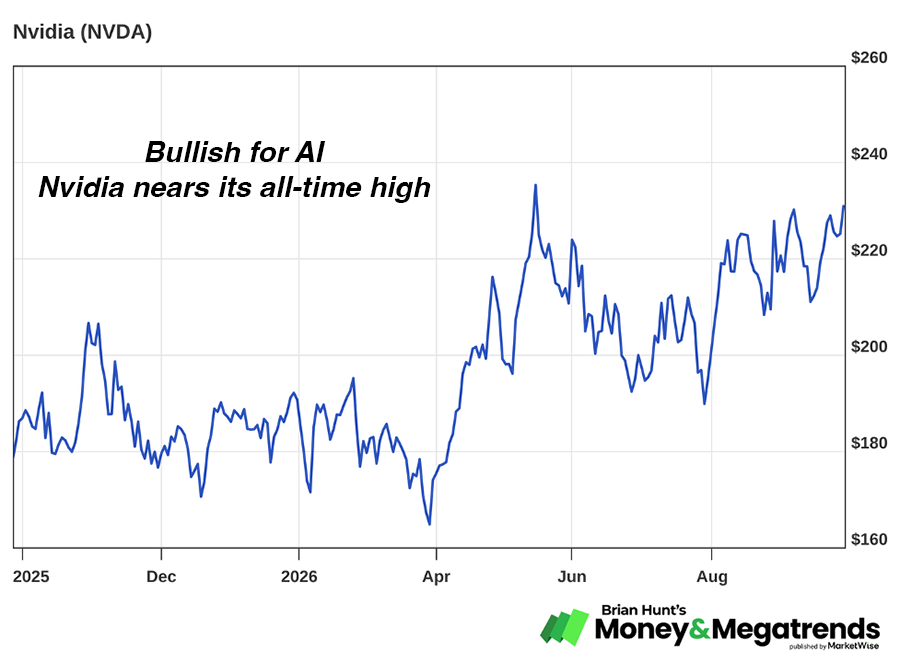
Today, shares of Nvidia (NVDA) jumped 2.7% to reach their highest point since May. The stock is less than 2% from its all-time high.
This is an important win we can mark in favor of the AI infrastructure trade.
Over the past month, we’ve published a special series of research notes analyzing the AI infrastructure trend.
The status of this critical trend has become one of the great sagas of the business and investment world… a source of intense disagreement among industry bulls and bears. It’s a trend whose outcome could have large effects on your portfolio.
Given AI’s enormous promise, large tech firms such as Alphabet (GOOG), Amazon (AMZN), and Microsoft (MSFT) have invested over $1 trillion in AI infrastructure. They are on pace to invest over $700 billion this year alone and more than $3 trillion after that.
Both the scale and the velocity of this investment boom are unprecedented. It is the largest collective investment effort in history.
Big Tech’s historic investment boom has made the entire “AI infrastructure” trend responsible for a large share of America’s GDP growth and stock market returns over the past two years. It has also drawn the skeptical scrutiny of many widely followed investment analysts who claim the trend is a bubble… one that will soon explode and cause tremendous damage to stock prices and the global economy.
If this hugely consequential trend isn’t the most important trend in the stock market, then it is certainly in the top three.
I believe the AI infrastructure trend has years to run. I believe the world’s smartest, most connected tech insiders who know the true state of bleeding-edge AI development and have real-time stats on AI investment ROI, such as Elon Musk, Jensen Huang (Nvidia), Satya Nadella (Microsoft) and Andy Jassy (Amazon), could possibly… perhaps maybe… just might… know far more about AI and their businesses than outsiders know about it.
As much press as AI gets, let’s remember that less than 1% of the global population pays for top-tier AI programs. And I estimate less than 10% of large companies believe AI has made a meaningful impact on their businesses.
This revolutionary technology hasn’t yet proliferated, achieved mass adoption, or had mass impact.
Regular readers know I care a lot more about what the market thinks of any stock, trend or theme than what any one person thinks of it, including me. You can be bullish or bearish on a trend all you like, but if that trend is moving strongly against you, then your idea isn’t worth a hell of a lot in my book.
Over the past few months, we have analyzed price action in critical areas of the AI infrastructure trade – including the VanEck Semiconductor ETF (SMH), computer memory giant Micron (MU), and optical networking stocks – to guide our trading.
Since Nvidia plays a central role in AI infrastructure, it is central to our analysis. Nvidia designs a large portion of the world’s most advanced AI semiconductors. It has also used its enormous cash flows to become a key investor in many AI firms… and to become essentially a “central bank of AI,” capable of financing many very large AI companies and initiatives.
Nvidia is not an 800-pound gorilla of AI… but perhaps an 800,000-pound gorilla of AI. Few companies in history have wielded Nvidia’s awesome combination of power, influence, technological expertise, and vast financial resources. If you wanted to argue that zero companies have, I wouldn’t protest.
As you can see in the two-year chart below, Nvidia reached an all-time high of around $235 per share back in May. Since then, it has corrected with the rest of the AI infrastructure trade.
Today, the stock broke out of a sideways consolidation pattern to get very close to its May high. This is a very positive development for the world’s most important trend.
By itself, Nvidia’s strength is not an “all-clear full speed ahead” signal for the world’s most important trend. But when you pair it with the Magnificent 7’s new all-time high and Micron’s new short-term high, you get the weight of the evidence tilting bullish for the AI infrastructure trade.
We will continue to monitor Nvidia, Micron, and other key components of the world’s most important trend for guidance on how to trade it.
New lows for Home Depot tell us the housing sector has good potential but horrible price action

Credit: Sundry Photography
Over the past five months, the yield on the 10-Year Treasury note has soared from 4.4% to 5.23%. It’s one of the fastest interest rate increases in recent history.
There are several forces driving the move. First, as mentioned above, the U.S. government is spending, borrowing, and printing money with great enthusiasm. Bond investors are demanding higher rates to compensate them for the corresponding risk of increased inflation.
Second, the Iran War and its constriction of crude oil and refined petroleum products are raising the prices of many goods, so interest rates are responding by moving higher.
The big increase in rates is having a dampening effect on many forms of economic activity, but few sectors are getting hurt as much as the housing market.
I am among the disappointed investors who, early this year, expected the housing stock sector to be a good contrarian buy and a potential rebound candidate in 2026.
In 2025, most housing-related stocks badly lagged the broad market. Some were down more than 25%. This underperformance was driven by two factors:
One: A lack of new home supply means most newly built homes are unaffordable to most people.
Two: Existing home sales have stalled because current homeowners have low mortgage rates they don’t want to lose after selling. This dynamic has “frozen” many housing markets.
This situation brought doom upon the housing trade in 2025. Stocks such as Trex (TREX, decking), Whirlpool (WHR, appliances), Owens Corning (OC, insulation), JELD-WEN (JELD, doors & windows), Lennox (LII, HVAC), American Woodmark (AMWD, cabinets), and Builders Firstsource (BLDR, diversified building products) all declined in 2025. The S&P Homebuilders ETF (XHB) was one of the worst-performing funds in 2025.
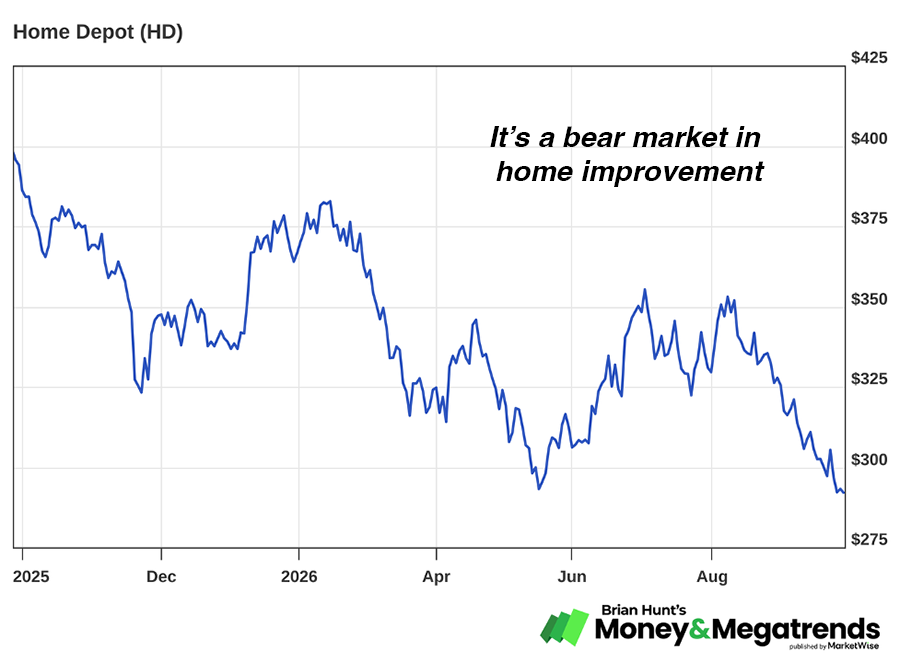
Anyone expecting the beaten down housing industry to rebound in 2026 has been disappointed. Instead of rebounding, it has gone from “beaten down” to “more beaten down.”
There is hardly a better stock to track and trade this sector than home improvement and building materials giant Home Depot (HD).
With a market cap of $291 billion, Home Depot is the largest housing industry stock by a wide margin. Home Depot benefits from a busy home market, where both buyers and sellers undertake large remodeling projects to either prep homes for sale or make changes after transactions.
Unfortunately, the current housing market is still struggling… and rising interest rates continue to batter the housing stock sector. Home Depot is down 27% over the past year and down 14.8% over the past two months. Shares hit a new one-year low today. The housing sector remains a trade with good potential… yet horrible price action. For now, we remain hopeful and interested, but on the sidelines.
Market Notes
-
Our recommendation to invest in the genomics megatrend continues to pay off. Sector leaders Grail (GRAL) and 10X Genomics (TXG) reached new all-time highs today. Tempus AI (TEM) also hit a three-month high.
-
Electrical infrastructure supplier Atkore (ATKR) just hit a new high, which is a bullish sign for the AI infrastructure trade. It’s now up 56% over the last year.
-
Defense giant L3Harris (LHX) just hit a new one-year low.
Top Themes to Buy Now
₿ Three stocks to invest in the coming revolution in money
⚡ We’re revealing our top AI trade of the month…
? This stock sector is starting to boom. We bet it has years to run. Are you on board?
Regards,


Brian Hunt
Editor, Money & Megatrends
An urgent message from our colleagues:
Wall Street veteran goes ALL in on Bank of Elon

A 20-year Wall Street veteran – who worked at a $10 billion hedge fund – is putting ALL his money in Elon Musk’s new bank. He says he can see the writing on the wall for traditional banks. And he’s not the only one.