
Today’s issue in preview:
-
Remember the acronym UPW. It could be the next hot AI trade
-
Big Tech will pay almost any price for more compute. Here’s how you can profit.
-
A profitable trade you’re probably missing out on. Why oil stocks could run a lot higher from here.
Big Tech will pay almost any price for more compute. How to get your share of the money.
Credit: Oselote
On Wednesday, AI data center operator Nebius Group (NBIS) reported extraordinary first-quarter earnings… and they confirmed the Neocloud theme has strong momentum.
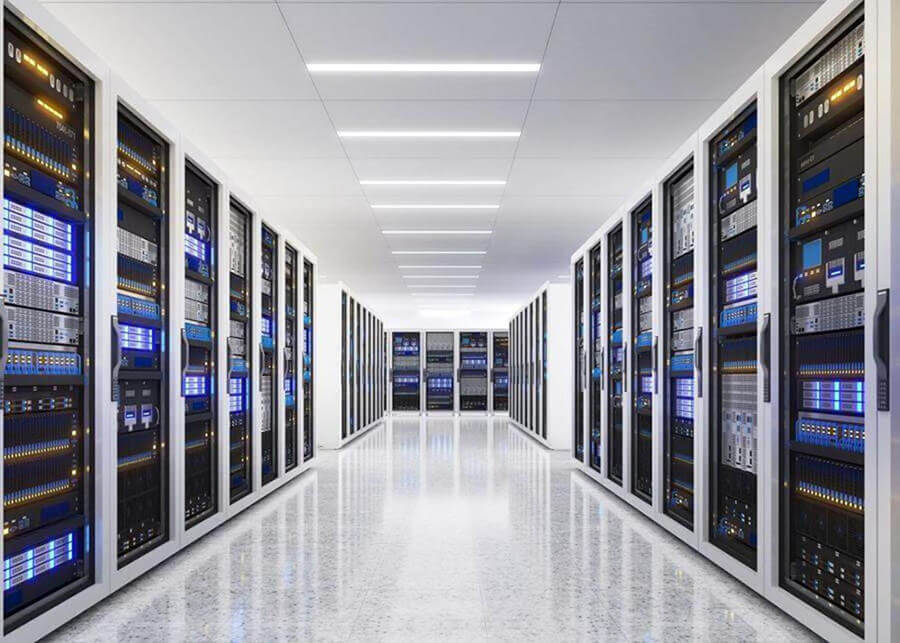
Back in April, I pointed to the emerging breakout in the M&M Neocloud Basket. Neocloud companies own and operate AI data centers. Traditional cloud providers (AWS, Azure, Google Cloud) are general-purpose platforms built to serve every computing need. Neoclouds are purpose-built to serve AI companies with enormous computing needs.
Big customers such as Meta use neocloud data centers to train and operate bleeding-edge AI models. Neocloud businesses do all the logistical work of securing, building, and operating AI data centers so AI model builders can focus on building models. In industry speak, neoclouds provide “compute” to big tech.
As we’ve recently covered, demand for AI-related services such as Anthropic’s Claude Code is exploding… but big tech firms don’t have enough “compute” – or fully powered AI data centers operating – to meet the soaring demand.
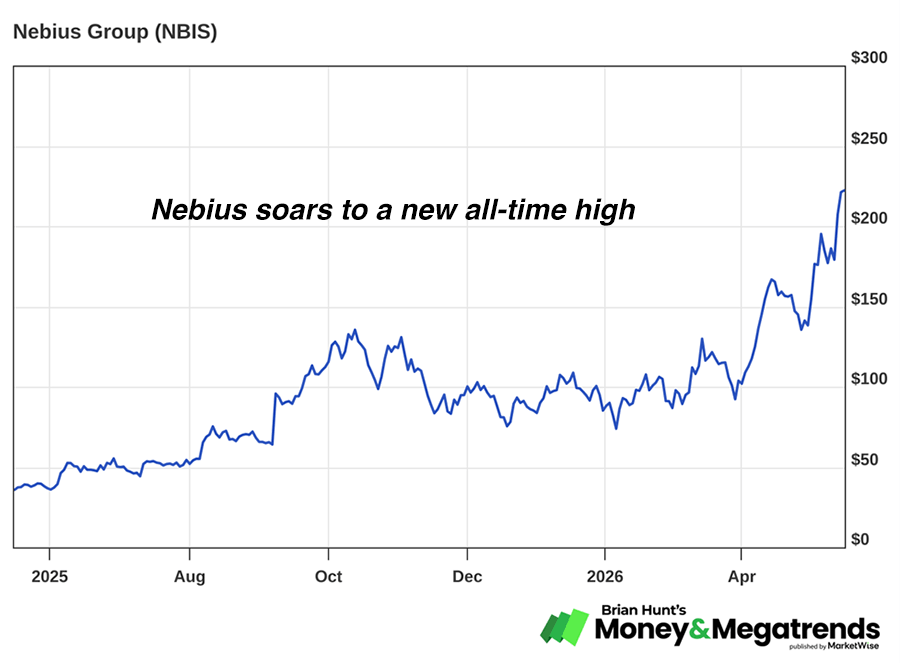
Nebius confirmed the “bull case” for neoclouds by reporting a huge 684% year-over-year revenue increase. Thanks to rising demand from big customers like Microsoft (MSFT) and Meta (META), the company announced expansion plans to provide more compute capacity in the future.
“We continue to see unprecedented demand across the market,” Nebius wrote in its report. “Compute and cloud needs are vastly exceeding capacity as more industries embrace AI.”
After the earnings report, Nebius’ stock jumped 18% to reach a new all-time high. The stock is up 40% since we published our note just one month ago (a blistering 480% annualized pace). Fellow neocloud stocks CoreWeave (CRWV) and Iren (IREN)… plus the “soon-to-be-neoclouds” theme we detailed on May 5 look poised to follow suit.
Big tech is spending more than $700 billion on AI this year and still can’t get enough compute. Demand is overwhelming their current capacity. This is long-term bullish for companies that provide solutions to the problem.
Recommended Link:
OFFICIAL REPLAY NOW LIVE: Jeff Clark’s 12 Trades to $1 Million

Jeff Clark just went live to reveal what could be the most profitable strategy he’s ever released to the American public in his 42-year career. And he says it could grow just $5,000 into $1 million this year – in 12 trades or less. Click here to watch the official replay of this historic launch event.
A profitable trade you’re probably missing out on. Why oil stocks could run a lot higher from here.

Credit: very good
We were bullish and long oil before it was cool. Our trade is a huge winner.
But what comes next?
On September 29, we highlighted the emerging leadership of oil and gas stocks and stated it was time to be long this sector.
The bull case I made for oil stocks back then was simple. If the global economy is growing, oil demand will remain solid. However, importantly, U.S. shale oil production growth appears to be peaking. This would remove a critical and reliable source of production growth that has been in place for over a decade. Plus, oil is very cheap relative to gold and other assets, indicating good value in oil.
Soon after our note, oil stocks embarked on a giant rally, which was eventually boosted by the Iran war. This rally has driven the SPDR S&P Oil & Gas Equipment & Services ETF (XES) up 75%. It has generated a 60% gain in Suncor Energy (SU), one of our top ideas. The “Big Oil” ETF – the Energy Select Sector SPDR Fund (XLE) is up 28%. These are terrific returns in less than nine months.
Great, Hunt, but how do we trade oil and gas stock from here?
I think there are three key factors to keep in mind here… and they say, “Stay bullish.”
One: Although the Iran War is likely to fade from the front pages over the coming months, critical oil infrastructure in the Middle East has been damaged. Oil flows will not return to pre-war levels for months… possibly for over a year. This supports oil prices north of $80 per barrel, which supports large cash flows for oil and gas firms.
Two: Above-ground “buffer” supplies that countries hold in case of oil flow disruptions, like the Iran war, have been drawn down over the past two months. They must be replenished. This also supports oil prices north of $80 per barrel… which, again, supports large cash flows for oil and gas firms.
Three: Although oil stocks have had a heck of a run since our September call, they aren’t up much over the past ten years.
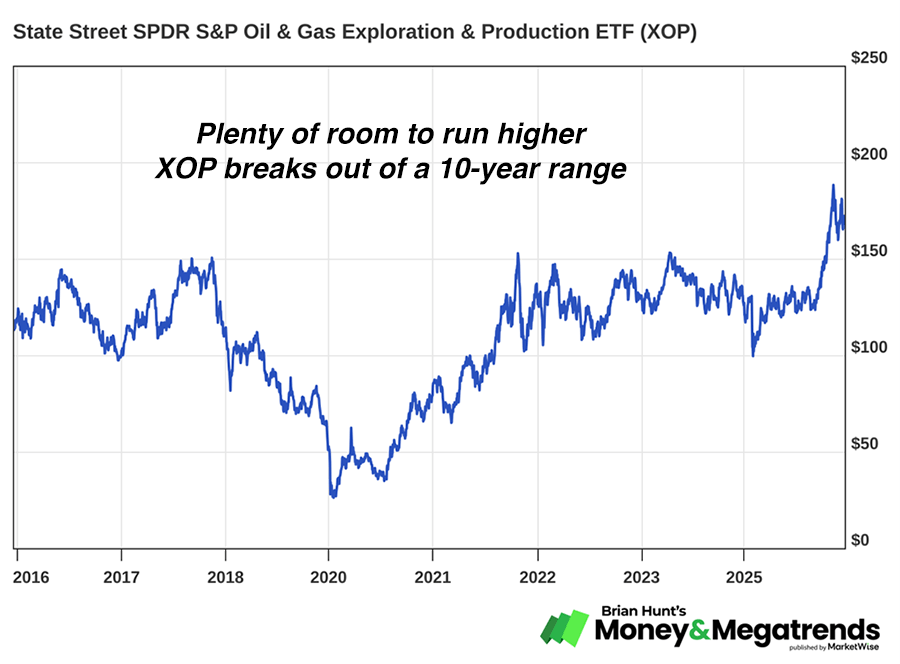
The State Street SPDR S&P Oil & Gas Exploration & Production ETF (XOP) is one of my favorite funds for tracking and trading U.S. oil and gas stocks. It holds more than 45 oil and gas firms, with an emphasis on U.S.-based producers.
The 10-year chart below shows that XOP only recently broke out of a decade-long consolidation phase. XES, mentioned above, only recently broke out of its multi-year consolidation. Adjusted for dollar debasement over the past decade, these funds are down significantly.
In other words, this theme has not performed well over the past decade. This is not an investment theme the public likes or is involved in. This makes the oil and gas sector relatively cheap… and it means there’s lots of money that could enter this trade if it starts moving.
We were bullish on oil stocks before it was cool. Our trades are up substantially. But this trend has a lot farther to run. Still bullish.
Remember the acronym UPW. It could be the next hot AI trade

Credit: SimonSkafar
In late 2022 – before ChatGPT was released to the public – I told friends and colleagues that AI was about to explode into public awareness.
Shortly after, AI did just that, marking the beginning of one of the biggest investment themes of our lives… one that has produced dozens of 100%+ stock winners.
Now, more than three years into this huge boom, big tech firms Meta (META), Google (GOOG), Amazon (AMZN), OpenAI, and Microsoft (MSFT) are racing to build the world’s best AI models and infrastructure. They’ve already spent more than a trillion dollars. This year, they are on pace to spend over $700 billion on AI infrastructure, with more than $3 trillion expected to follow. It’s the largest collective investment effort in history.
We’ve “surfed” on this tsunami of investment to score big wins in E&C stocks, semiconductor stocks, optical networking stocks, semiconductor equipment stocks, Marvell Technology (MRVL), and Dell Technologies (DELL).
Given how so many AI-infrastructure themes and stocks have run so far, finding unloved AI-related investments here in May 2026 has become difficult.
But there’s one AI-infrastructure theme that hasn’t yet turned investors’ heads … and is trading at reasonable valuations. It’s a critical cog in the AI machine. The AI boom can’t live without it.
This theme is water.
Specifically, “ultrapure” water.
Ultrapure water (UPW) is the purest form of water. It undergoes a rigorous set of treatments designed to remove virtually all contaminants, such as microorganisms, dissolved gases, and minerals.
Standards require UPW contaminant levels to be below one part per trillion. This process means creating 1,000 gallons of ultrapure water requires roughly 1,500 gallons of regular water.
The industries that need UPW are industries we are bullish on. This makes it an indirect trade on some of the best themes in the world right now.
The main industry is semiconductor production. Semiconductor plants that build chips that power AI, defense systems, and everything in between use 10 million gallons of ultrapure water every day. At every stage of chip manufacturing, wafers must be rinsed between processes to remove microscopic residues left behind by chemicals, gases, and etching. A single spec of contamination can cost a manufacturer millions of dollars.
The more advanced AI chips get, the more UPW is needed to make them. This is because smaller and more complex chips require more layers, more rinse cycles, more chemicals, and ultimately, therefore, more UPW.
But the fastest-growing demand driver of UPW is pharmaceuticals and biotech. In semiconductors, UPW does not end up in the finished product. In pharma, it does. It’s inside vaccines. Inside biologics. Inside gene therapies. It’s the solvent that active pharmaceutical ingredients are dissolved in.
The purity standards in medicine are even more stringent than those in data centers. And as pharmaceutical manufacturing spreads into Asia, Latin America, and the Middle East, new facilities need more modern water purification systems from day one.
The global UPW market was worth around $8.5 billon in 2024. Meticulous Research estimates it will reach over $19 billion by 2035.
Companies poised to benefit from rising UPW demand include:
Xylem (XYL) is a $25 billion water technology firm. It designs, manufactures, and services products for water and wastewater applications, including pumps, smart meters, filtration systems, and reverse osmosis solutions. XYL provides advanced monitoring systems and cloud-based analytics for the ultrapure water systems. Revenue growth is currently low, but AI-related demand for XYL’s products is soaring, according to management. Related orders in Q1 alone in data centers exceeded 2025’s annual figure.
Energy Recovery (ERII) is a $428 million company that makes pressure-exchange devices. This technology reduces the energy required to run reverse osmosis systems. Reverse osmosis is simply one of the processes used to strip out salts, chemicals, and contaminants from water. The problem with reverse osmosis is that it requires a lot of energy, which is a massive cost. ERII built a device that dramatically reduces the energy required to run the whole operation. This is a much higher-risk play on the theme with lumpy revenue growth.
Ecolab (ECL) is a $70 billion company that recently bought water treatment firm Ovivo for $1.8 billion. It’s probably the purest and safest bet on this theme with blue-chip customers. The CEO flagged that roughly one new semiconductor fab is opening per month through to 2030. They believe Ovivo is positioned as the most advanced system to serve them all.
Kurita Water Industries (TSE, 6370, U.S. over-the-counter KTWIF) is a $6 billion Japanese water treatment company. It is one of the world’s largest producers of UPW. It operates across two segments – Electronics Industry and General Industry – providing water treatment chemicals, ultrapure water systems, membrane technologies, ion exchange systems, and full facility maintenance to many industrial customers.
Now that we are more than three years into the AI infrastructure boom, finding unloved infrastructure plays that haven’t shot higher is difficult. But UPW is one such theme. We expect it to get a lot more press over the coming years.

Market Notes
-
Our recommendation to own oil and gas pipeline operators continues to pay off. The Alerian MLP ETF (AMLP) reached a new all-time high today.
-
Life sciences equipment and services giant Danaher (DHR) reached a new one-year low today.
-
The yield on the benchmark 10-year Treasury note reached its highest level in nearly a year today – 4.54%.
-
Homebuilding giants NVR (NVR) and Lennar (LEN) reached new lows today. The housing market is weak thanks to stubbornly high mortgage rates and weak consumer sentiment. Home supply retailer Home Depot (HD) and building supply giant Builders FirstSource (BLDR) also reached new one-year lows.
-
Apparel giant Lululemon (LULU) reached a new one-year low today.
Regards,


Brian Hunt
Editor, Money & Megatrends
An urgent message from our colleagues:
A new Fed Chair changes everything

Jerome Powell is out. A new rate-cutting era begins. Louis Navellier called this same window in ’95, ’01, ’08, and ’20. His latest prediction?
Watch the replay now.