
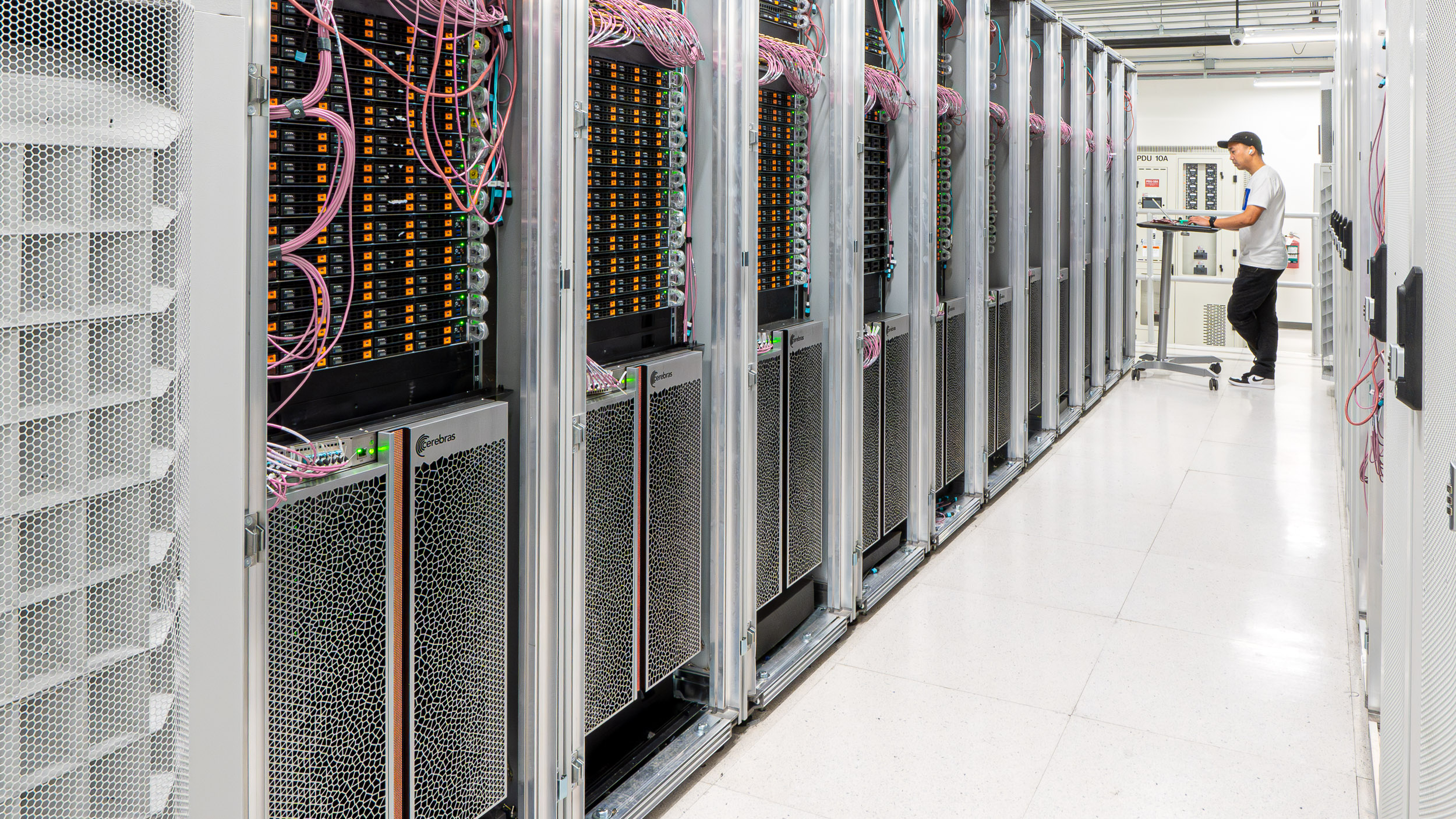
Image Credit: Cerebras
Listen to the audio version of this article (generated by AI).
Key Points
- Cerebras Systems reported 94% first-quarter revenue growth and projected 69% annual sales growth, exceeding Wall Street expectations on both metrics.
- Despite the strong top-line performance, the stock sold off as investors focused on weak gross margins and concerns about profitability.
- Cerebras remains heavily dependent on OpenAI for future revenue growth, highlighting the need to diversify its customer base and reduce concentration risk.
Shares of Cerebras Systems (CBRS) tumbled on Tuesday after reporting its earnings for the first time since going public. The maker of semiconductors for artificial intelligence (“AI”) narrowed its first-quarter net loss to $0.22 per share, but it missed consensus forecasts calling for a loss of $0.16 per share.
Cerebras saw sales nearly double in the quarter, reaching a record $193.4 million.
It also came out with rosy 2026 sales projections: 69% year-over-year growth, blowing past analysts’ estimates.
There were a few troublesome signs in its projections, such as falling gross margins, and those were what investors focused on as the stock plunged following the results. Cerebras’ shares are now down more than half since its May 14 IPO day high.
Cerebras’ First-Quarter Earnings Highlights
- First-quarter sales grew 94%, to a record $193.4 million.
- Sales beat analysts’ estimates of $180.8 million, according to Koyfin.
- An operating loss of $15 million narrowed from $28.5 million in the year-ago period.
- A net loss of $0.22 per share was larger than the consensus estimate of a $0.16 loss, however.
- Cerebras raised $6.4 billion in May, in the largest semiconductor IPO ever.
Even much of Cerebras’ near-term and annual forecast growth looked strong:
- Second-quarter sales are projected at $194 million, ahead of analysts’ estimates of $177.7 million.
- Full-year sales are projected between $855 million and $865 million, for annual growth of 69%.
- Full-year projections exceeded analysts’ estimates of $828 million.
This kind of growth is attractive, but it’s also necessary given the expectations for the company, which boasts that it’s the “maker of the world’s fastest AI infrastructure.”
But digging deeper into the results shows that a few other issues may be nagging at investors, particularly that the stock is priced for perfection and therefore already volatile.
3 Key Reasons Why Cerebras’ Stock Is Falling
While Cerebras’ sales growth looks strong, other factors helped put pressure on the stock price.
1. Cerebras Is Feeling Near-Term Pressure on Gross Margins
Part of the company’s guidance concerned its expectations for gross margins (i.e., the price of its product minus the direct cost of making it). Management said that the second-quarter gross margin would come in between 36% and 38% – well below the 47% estimated for the first quarter.
But that margin decline will extend beyond just the second quarter. Management predicted a full-year gross margin of 38% to 41%, suggesting the third and fourth quarters wouldn’t be much better than the first-quarter figures on average.
Cerebras blamed the slumping margin on the need to temporarily rent back its own infrastructure from a customer to meet near-term demand while it develops additional data-center capacity.
Cerebras’ 47% gross margin already falls well below that of industry leader Nvidia (NVDA), which reported a huge 74.9% margin in its first quarter. Meanwhile, the figure for Advanced Micro Devices (AMD) sits somewhere in the mid-50% range.
2. Cerebras’ 2026 Sales Forecast Was Not High Enough
Management’s projections for the second quarter and full year topped analysts’ expectations, but investing is all about expectations. Given the high expectations built into its stock price, Cerebras didn’t deliver sales growth high enough for investors’ tastes, at least for now.
Even taking the high end of the full-year sales target of $865 million, the stock still trades at almost 49 times sales, with an estimated market capitalization of $41 billion.
That didn’t stop investment bank Morgan Stanley from boosting its price target from $250 to $273. The stock fell well below $200 following its earnings report.
3. Cerebras Remains Heavily Reliant on OpenAI
In 2025, Cerebras had two major clients that comprised about 86% of its total sales. The United Arab Emirates-based company G42 comprised 24% of sales, while the Mohamed bin Zayed University of Artificial Intelligence accounted for 62%. For the full year, Cerebras had sales of $510 million.
Then, in early 2026, Cerebras inked a deal with OpenAI worth $20 billion over the next few years. Of course, the size of this contract dwarfs the firm’s existing revenue, meaning that while Cerebras has other major clients, it’s still highly reliant on one key customer.
And while that customer is central to the AI ecosystem, it’s running almost unfathomable losses for the foreseeable future.
OpenAI’s Massive Cash Burning Is a Big Risk for Cerebras
Cerebras relies heavily on OpenAI, which is one of the risks we highlighted in recent coverage of the company. While Cerebras has added clients to its sales roster in the last year to diversify its exposure, that has led to Cerebras relying almost as heavily on one huge, new client: OpenAI.
Here’s why that’s a problem: OpenAI is burning cash at a furious pace. The company recorded an operating loss of $20.9 billion in 2025, exploding 138% higher year over year. The latest figures from the first quarter don’t look any better: an estimated loss of some $7 billion, according to the Information.
The bigger OpenAI grows, the more money it’s losing – and the losses put Cerebras in a tough spot. The size of OpenAI’s losses should call into question its ability to make good on spending commitments – of which it has an estimated $1.4 trillion in the next few years, per Barron’s.
So, Cerebras’ investors would love to see the company land sizable contracts with other clients. It already offers services to IBM (IBM), Mistral AI, and Meta Platforms (META). The company also signed a multiyear deal with Amazon (AMZN) to offer its solutions on Amazon Web Services, with revenue beginning to flow in over the next year.
Cerebras must maintain its strong revenue growth to keep its stock price up, but AI’s poor economics are a real threat. So too is the potential for firms to downshift to AI models, such as DeepSeek, that are less processor-intensive, reducing the clear advantage of Cerebras’ high-speed chips.
But all of it – the need for strong sales growth, dealing with emerging threats, and handling uncertainty – is part of what makes growth tech stocks so volatile. With the potential to gain a growing share of the market from Nvidia, Cerebras will continue to attract investors’ attention.
Regards,
James Royal, PhD
Editor’s Note: As America celebrates its 250th birthday, a Wall Street legend is sounding the alarm. Whitney Tilson (the hedge fund manager CNBC dubbed “The Prophet”) says the AI revolution is rewriting the rules of wealth faster than most people realize. Some investors are already seeing extraordinary gains. Others are being wiped out. Tilson says the next six months will determine which side you end up on — and he’s sharing exactly what to do about it in his free presentation here.