
Image Credit: Associated Press
Key Points
- Backlash against data centers is intensifying nationwide, with new moratorium efforts, canceled multibillion-dollar projects, and mounting community opposition in several major markets.
- Public support for AI infrastructure has fallen sharply across party lines, creating growing political resistance to large-scale data-center expansion.
- As AI-driven layoffs accelerate and concerns about the industry deepen, the idea of moving data-center infrastructure off-planet is shifting from speculative to increasingly plausible, supporting Jeff Brown’s “Orbital AI” thesis.
Late last month, supporters of the nation’s first statewide ban on data centers crowded the Maine State House.
The 18-month ban had passed with a strong bipartisan majority in both legislative chambers. But Governor Janet Mills vetoed it a few days later. And the veto-override vote came up just short of the two-thirds majority needed.
As the Maine Morning Star reported, supporters of the ban have made it clear the data-center debate is just getting started:
“Go outside this building and read the room,” [Rep. Daniel Ankeles] said. “The public is not happy that we are in this position, and it is not because anyone in here riled them up. It is because they are smart and they know better.”
I warned three weeks ago that the rebellion against the artificial intelligence (“AI”) data-center build-out was about to get more volatile, more bipartisan, and more violent.
On one side, tech giants are pouring hundreds of billions of dollars into data centers so they can run the AI models that will ultimately replace human workers.
On the other side, the communities where those data centers are being built aren’t convinced the benefits from AI are worth the higher electricity prices and tax-incentive giveaways.
And of course, all this is happening before millions of white-collar workers wake up to layoff notices.
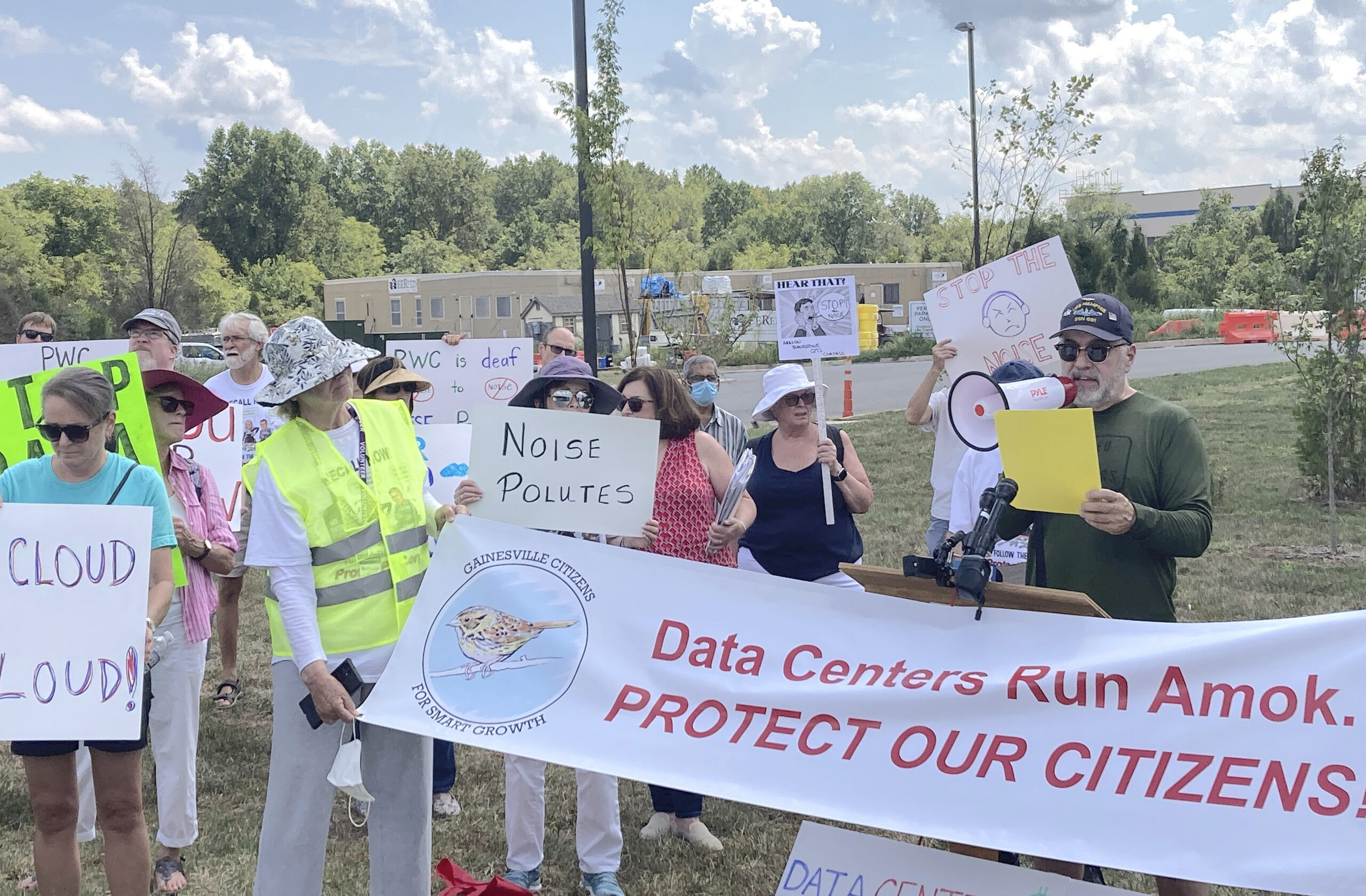
Maine’s data-center debate is an early skirmish ahead of this coming war… with residents in Northern Virginia, Seattle, and Michigan all recently delivering sharp rebukes.
Northern Virginia Just Said ‘No Thanks’ to $25 Billion
Hours before Maine lawmakers sustained the veto, the largest data-center developer in Northern Virginia walked away from one of the biggest AI projects in the world.
Compass Datacenters announced it was abandoning the Prince William Digital Gateway, a 2,100-acre corridor that, at full build-out, would have hosted 37 buildings and 23 million square feet of server space.
Total investment in the data-center cluster was estimated at nearly $25 billion… an amount dwarfed only by the vitriol the project sparked. As Bloomberg reported:
Almost immediately, the project faced pushback for its location – parts of the 2,100-acre site abutted a Civil War battlefield. Soon, residents who wanted to sell their land – criss-crossed by transmission lines – were clashing with neighbors who didn’t want industrial development that could hurt their home prices.
There was other fallout for advocates of the project. The chair of a key policymaking panel, the board of county supervisors, was unseated in 2023 by a political outsider who campaigned against data centers’ unchecked growth.
Ahead of a leadership shift, county officials scheduled a meeting that December to grant the data-center companies the approval to build. Hundreds showed up ahead of the zoning vote, with supporters and opponents lobbying for 27 straight hours.
This represents a near-total defeat for a hyperscale data-center project. The question is, as some data-center executives worried anonymously to Bloomberg, will it spread?
Those in favor of fighting it out in court said quitting would embolden political opposition to data centers. They expressed concern about the prospect of setting a legal precedent on the back of an administrative blunder.
And keep in mind, this happened in Northern Virginia… the unparalleled heart of data-center infrastructure in the U.S. The region hosts more than 600 operational data centers and plenty more in planning and construction stages.
And yet, a Washington Post-Schar School poll released April 15 found that Virginia voters have turned sharply against the facilities. Only 35% of voters now say they would be comfortable with a new data center in their community, down from 69% in 2023. Support for state tax breaks for data centers also fell from 61% to 37% over the same period.
Half of Virginia’s voters changed their minds on data centers in two years. What will happen over the next two years?
The Same Story Across the Continent in Seattle
A few days later, a similar story played out on the West Coast.
Two different developers withdrew their plans to build data centers in Seattle, amid a massive public outcry…
Seattle elected officials received more than 54,000 messages raising “intense public alarm” about the proposed data centers. Mayor Katie Wilson posted on her Facebook account that her team was working to identify a range of long-term policy approaches, including exploring a moratorium on siting new facilities.
The same day the developers walked, three Seattle City Council members announced legislation for a one-year moratorium on new data centers.
The remaining two developers are still pursuing a few large data-center projects that could draw a combined 249 megawatts… for now.
But now, the city’s electric company is rewriting its contract terms for large-load customers… and one likely requirement will force data-center operators to secure their own power generation rather than tap the city’s existing supply.
That alone could kill the projects. (It’s also exactly what Joel Litman is warning about with his “Dark Energy” prediction.)
AI Backlash Is Spreading Across the Country
These incidents are spreading across the nation, and they’re growing fast.
In Michigan, energy provider DTE Energy (DTE) is pushing for a 9.7% residential electric-rate hike. All the more galling for residents, this comes just months after a 4.1% increase in rates.

The utility did offer to pause future rate-hike requests for two years… but only if a not-yet-approved data center opens on schedule.
All that’s missing from DTE’s “ransom note” – as Michigan’s attorney general called it – are a few sloppily cut-and-pasted letters from a magazine.
In New Jersey, several data-center regulation bills are advancing through legislation… including requiring large data centers to pay for at least 85% of the electricity they request for at least 10 years… ban nondisclosure agreements between data-center developers and local elected officials… and file regular reports on their energy and water consumption.
Dozens of states have bills to restrict or eliminate new data-center construction and power access working their way through the lawmaking process. Government-relations company MultiState rounded up a few in mid-April, concluding:
Critically, these efforts are not driven by a single political persuasion. Local resistance to data center development has emerged in both heavily Democratic and Republican-leaning jurisdictions.
It’s hard to overstate how quickly the political ground has shifted. Even in business-friendly Texas, there is bipartisan support for tighter regulation.
According to Data Center Watch, at least 142 advocacy groups across 24 states are now organizing to block new construction. And residents have already blocked or delayed at least $64 billion worth of projects over the past two years.
Sound familiar?
We’ve seen this kind of grassroots fury before in America. And it didn’t end with letters and ballots.
Samuel Butler Predicted This 150 Years Ago
Most folks think about the dot-com bubble when they want a parallel for what’s happening with AI today.
But I believe the infrastructure build-out of the railroads in the late 1800s is a better analogy. As I noted a few weeks ago:
Railroads were the AI data centers of the Gilded Age… a transformative technology controlled by giant companies, subsidized by the seemingly captured government, and physically imposed on communities with little say in the matter.
And unlike the dot-com crash, it’s a lot easier to take a sledgehammer to a railroad track than to a delisted stock ticker.
Back then, roughly five years before the Great Railroad Strike that resulted in more than 100 deaths, a 19th-century writer named Samuel Butler wrote the dystopian novel Erewhon. It’s set in a fictional, isolated society where citizens grew so alarmed by the runaway evolution of machines that they went to war to destroy them… all of them.
The novel contains a three-chapter section that largely does away with narrative and explores the ideas behind the machine rebellion, titled “The Book of the Machines.” And in it, an Erewhonian philosopher worries about the extraordinary rapidity with which the machines are becoming something very different than they were before.
“True, from a low materialistic point of view, it would seem that those thrive best who use machinery wherever its use is possible with profit; but this is the art of the machines – they serve that they may rule. They bear no malice towards man for destroying a whole race of them provided he creates a better instead; on the contrary, they reward him liberally for having hastened their development. It is for neglecting them that he incurs their wrath, or for using inferior machines, or for not making sufficient exertions to invent new ones, or for destroying them without replacing them; yet these are the very things we ought to do, and do quickly; for though our rebellion against their infant power will cause infinite suffering, what will not things come to, if that rebellion is delayed? (emphasis added)
The conclusion of the book’s argument? Mass destruction. Every advanced machine in Erewhon, smashed.
Of course, Erewhon was a satire of Victorian society and the Industrial Revolution. But it was also a warning…
Shortly after Butler wrote his novel, rioters across America burned hundreds of railroad depots, locomotives, and railcars. As I wrote a few weeks ago when describing the parallels between AI and railroads:
Marxism as a political philosophy was rising in the U.S. at the time, but the riots were fueled by more than ideology – including workers’ economic desperation, a visible and vulnerable physical target, and a political system that seemed captured by the dominant “tech giants” of the time.
Sound familiar?
Those forces are again converging today.
The data centers going up across America are the new railroad depots – the AI systems training inside them are likely to destroy far more jobs in the short term than will be created for years, if not decades. And the tax-incentive packages that lure these projects often mean local residents see few direct benefits, if any.
American workers are already feeling the early tremors of an AI doom loop. Companies cut jobs, invest the savings in AI infrastructure, and watch Wall Street reward them for it.
Oracle (ORCL) announced cuts of up to 30,000 roles in what may be the largest AI-attributed layoff in tech history.
Meta Platforms (META) is now installing tracking software on its U.S. employees’ computers to capture every keystroke, every click, every mouse movement. The explicit goal is to train AI agents capable of doing white-collar work. Elon Musk is racing to deploy Macrohard, his own version of the same idea.
In other words, the same workers being asked to subsidize multibillion-dollar data centers through their electric bills and tax dollars are also the workers whose jobs those data centers are being built to eliminate.
What could possibly go wrong?
Why the AI Race Is Heading to Space
The AI race isn’t slowing down. As my colleague James Royal noted earlier this year:
Capital expenditures (“capex”) are projected to rise from about $380 billion in 2025 to an estimated $650 billion this year, according to Bloomberg.
This figure includes capital spending from just four hyperscalers: Amazon, Microsoft, Alphabet, and Meta Platforms (META). Hyperscalers are companies that build massive data centers for cloud computing and AI. They’re the largest of the large.
This figure doesn’t include other AI-related capital spending from some of the world’s largest companies, such as Apple (AAPL), or chipmakers like Nvidia (NVDA) and Broadcom (AVGO). Spending from these businesses and many smaller players will add hundreds of billions more still.
And as long as energy prices are heading higher, we don’t expect that the backlash from regular Main Street folks will die down. Goldman Sachs just released a research note on Tuesday warning that AI is raising costs for U.S. households in several ways:
First, strong demand for AI infrastructure has raised the prices of some key electronic components, which, in turn, has increased the prices of computer accessories and will probably boost smartphone and computer prices in the coming months.
Second, the addition of new AI features to existing software has put some upward pressure on software prices over the past couple of years.
And third, higher electricity demand to power data centers is increasing electricity prices in some US regions.
Goldman expects AI will keep boosting inflation for at least the next few years.
So where will AI infrastructure ultimately get built?
My colleague Jeff Brown, founder of Brownstone Research, believes the answer is obvious… he calls it Orbital AI.
[For the full story: Watch Jeff Brown’s prediction here.]
And as I discovered when I did a deep dive into his prediction, this science-fiction-sounding possibility is a lot more likely than it seems:
For decades, sending a kilogram to low Earth orbit has cost tens of thousands of dollars. SpaceX’s Falcon 9 already dragged that figure down to about $2,500. Starship Version 3, which began commercial operations this year, aims to push the cost below $200 per kilogram by 2027 and below $100 by 2028.
That’s the price point at which it becomes cheaper to put a server farm in orbit than to build one in Northern Virginia.
Stacked together, these three shifts are what Jeff calls a $12.8 trillion opportunity.
The data-center rebellion is growing. The AI doom loop will be here soon.
And the more difficulties the AI hyperscalers have on Earth, the more likely they will start looking toward space.