
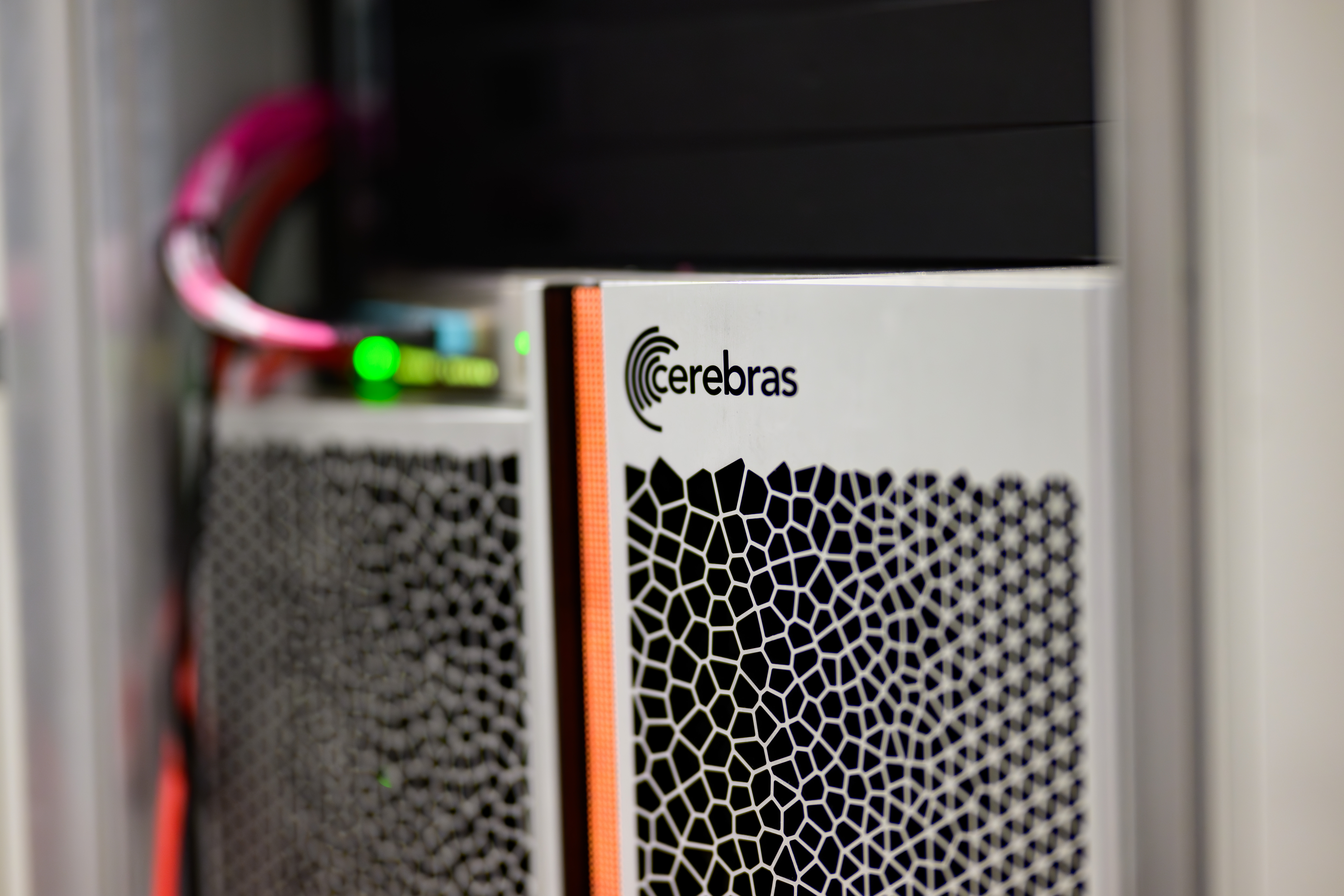
Image Credit: Cerebras
Key Points
- Cerebras Systems sharply increased its IPO price range from $115–$125 per share to $150–$160 per share as investor demand accelerates.
- The IPO is reportedly 20 times oversubscribed, signaling exceptionally strong appetite for the AI semiconductor company.
- Even at the revised pricing range, Cerebras trades at extremely high price-to-sales multiples, though investor enthusiasm could continue pushing valuations higher.
Cerebras Systems is fielding utterly enormous demand for its stock from investors in the run-up to its initial public offering (“IPO”). The IPO has attracted orders that are 20 times the number of shares available, according to Reuters, indicating robust demand for the semiconductor maker.
This intense interest led underwriters to boost the IPO price from its initial $115 to $125 range. Bloomberg News reported that the investment banks leading the deal considered lifting the range to $125 to $135. It has now officially risen to $150 to $160 a share, according to a Monday filing.
On top of that, the company increased the number of shares it’s selling from 28 million to 30 million. All told, a Cerebras IPO at the higher range could raise about $4.8 billion in cash.
With an estimated 215 million shares outstanding after the IPO, Cerebras would have a market capitalization of around $34 billion. That’s quite a move since the company’s $1 billion capital raise in February put its valuation at $23 billion – a near triple from its prior round four months before.
Cerebras would be the hottest IPO to make its way to market so far this year, in what could be the largest year ever for IPOs. This kind of surging market interest in artificial intelligence (“AI”) is exactly what we’ve seen over the past year or so, as valuations of key players such as OpenAI and Anthropic have soared. Valuations have risen 5, 6, 7 times or more in less than two years – and may rise more!
So, it’s a smart move for AI companies such as Cerebras to go public and raise huge amounts of capital while not giving away the store. But is the new stock a smart move for investors?
Cerebras’ Advantage: Wafer-Scale Chips for AI Inference
The Cerebras IPO is set to hit the market just as AI is undergoing a sizable shift in its needs. AI work is increasingly moving from the training stage, where AI creates models from available data, to the inference stage, where it produces outputs based on user prompts. Cerebras’ semiconductors slide right into this trend, since they’re designed to quickly process inference workloads.
That’s the key pitch: Cerebras’ chips are much faster than industry leader Nvidia’s (NVDA) graphics processing units (“GPUs”) on inference tasks, making them a good solution as workloads shift. The company says it can deliver answers “up to 15 times faster than leading GPU-based solutions as benchmarked on leading open-source models.”
Cerebras processors are wafer-scale, about the size of a dinner plate, packing in tons of processing power for AI apps. The company’s WSE-3 chip consists of 4 trillion transistors across 900,000 cores and uses 44 gigabytes of memory. This large memory allocation means the chip can run AI models directly, avoiding the slower process of moving data off-chip for computing.
The key benefit of Cerebras’ wafer-scale chip is that it increases the output speed of AI models. Instead of waiting for minutes while AI processes a prompt, users get their answer faster. It should be a huge advantage for Cerebras if its chips can meaningfully speed up AI inference.
On top of this, Cerebras says its chips are more cost-effective than leading GPUs when you factor in hardware and operation costs. The combination of cost and speed offers a powerful one-two punch here.
The WSE-3 chip is part of a larger installation, the CS-3, which Cerebras says can be used in AI data centers. The CS-3 includes related hardware and a cooling system. It sells the CS-3 primarily to users who want their own inference capacity, though other customers can rent capacity in Cerebras’ data centers at a per-use fee.
One major risk Cerebras faces right now is its extreme customer concentration, though a recently signed deal with OpenAI will help expand its customer roll. In 2025, just two customers accounted for 86% of sales.
Some of this concentration is simply due to Cerebras being small. In the second quarter of 2023, Cerebras had just $6 million in sales. In all of 2025, the figure was still just $510 million.
A January agreement with OpenAI significantly boosted Cerebras’ business, while making OpenAI its largest customer. Cerebras is set to provide 750 megawatts of computing power to OpenAI through 2028 in a deal valued at more than $10 billion. The companies then supersized their deal, adding an additional $10 billion in April, per The Information.
Is Cerebras Stock Too Expensive?
As always, the big question for investors is: What are you paying for this business?
Cerebras stock has been riding a megatrend for a couple of years, so it’s not surprising how fast it has soared. But the speed of its recent rise is still breathtaking:
- In November 2021, the company raised $250 million at a $4 billion valuation.
- In September 2025, Cerebras raised $1.1 billion at an $8.1 billion valuation.
- In February 2026, Cerebras raised $1 billion at a $23 billion valuation.
- In May 2026, a Cerebras IPO price of $160 implies a $34.4 billion valuation (at the top end of the range).
While the company technically earned a profit last year, it was all GAAP accounting. Earnings swung from a loss of $482 million in 2024 to a gain of $238 million in 2025.
Skip through these figures to operating earnings, however, for a clearer picture of the business. In a year-over-year comparison, operating loss increased from -$101 million in 2024 to -$146 million in 2025.
Because the company is not profitable, let’s turn to sales and value the stock on that basis. This metric is often a “go to” when valuing early-stage companies, given their lack of profits.
On this basis, the IPO valuation implies about 67 times trailing sales of $510 million. A tall drink of water, to be sure… But Cerebras is growing quickly, and we have some additional insight into its near-term sales.
In its prospectus, the company reported a revenue backlog of $24.6 billion at the end of 2025. Management estimates it will recognize 15% of this total in the years 2026 and 2027. Let’s average the expected revenue of the two years, assuming that no new business arrives. The annualized revenue comes in at nearly $1.85 billion – more than triple the 2025 level.
Using an estimated market cap of $34.4 billion, the price-to-sales ratio comes in at less than 19 times. Is this expensive? Yes. But that likely won’t keep investors on the sidelines in the days after the IPO.
Of course, this price is for the big investors who get to participate in the IPO and perhaps sell on a likely first-day surge in the stock. Given that Cerebras sits in one of the hottest market sectors, the stock could easily pop 30% to 50% on the first day or soon after, sending its multiple higher.
For example, a 30% run-up would put the stock at about 24 times sales, while a 50% bump would put it around 28 times sales. The stock might go even higher than that in the early days.
The prize for many companies and investors is getting a piece of the pie from the $5 trillion behemoth Nvidia. That company’s meteoric ascent is still fresh in investors’ minds. So, don’t be surprised if Cerebras comes screaming out of the IPO gate, regardless of valuation.
It’s too rich for me, but short-term traders could have a field day.
Regards,
James Royal, PhD
Editor’s note: Elon Musk reinvented the auto industry, sparked a new era of space exploration, and built the world’s largest satellite network. But his new initiative – “Project Apex” – could become the crown jewel of his career. And, like Tesla, it could make early investors incredibly wealthy. Click here for the details…