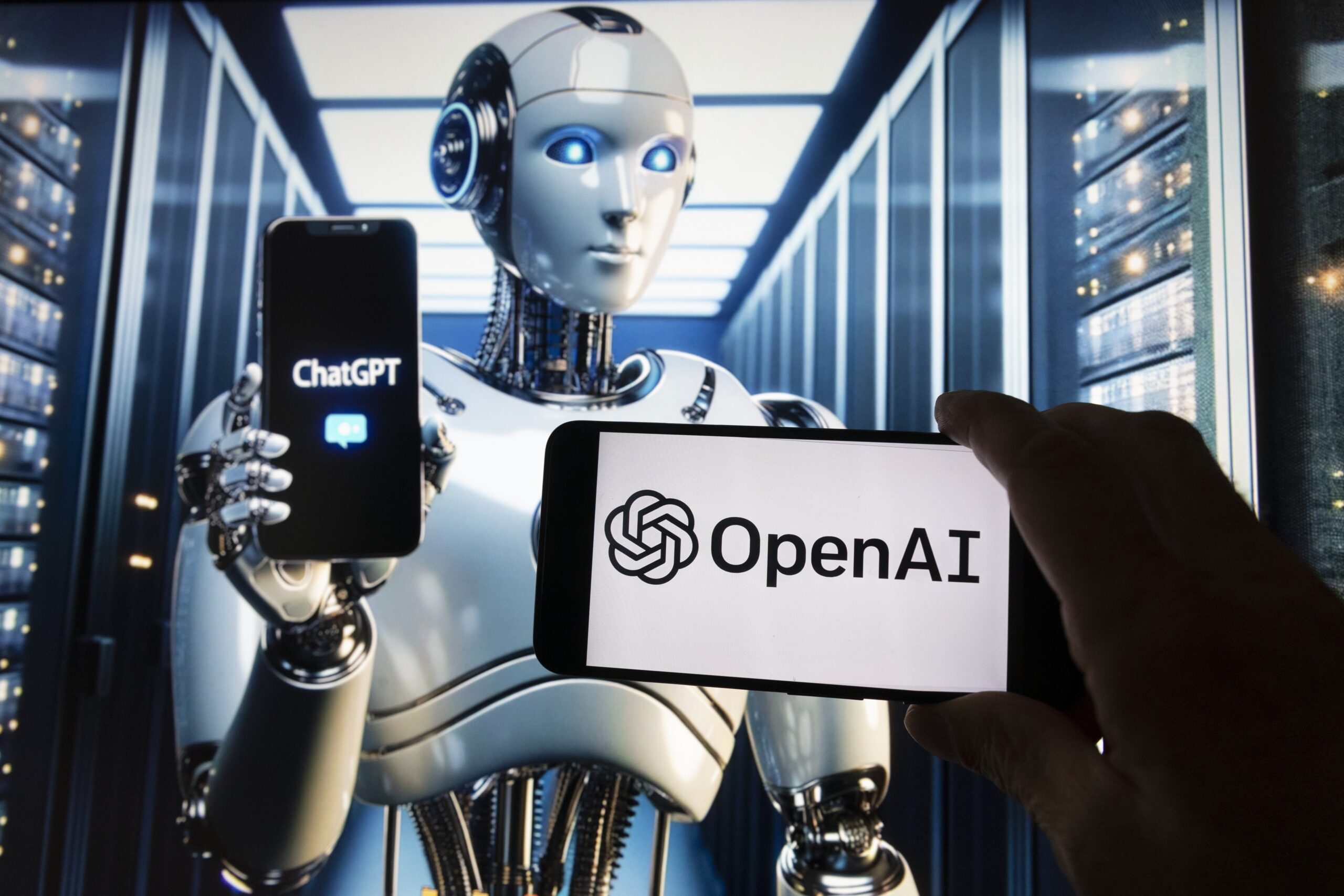
It was only a matter of time before private equity got in on artificial intelligence. Now it has – and OpenAI is leading the charge.
The recently announced OpenAI private equity deal, according to Reuters, would launch a joint venture with four major private-equity firms at a pre-money valuation of roughly $10 billion.
Around $4 billion in equity capital would come from private-equity investors. And OpenAI is offering preferred equity to the investing private-equity firms. This important distinction includes priority returns and some downside protections not available with common shares. In short, preferred equity investors get paid back before common shareholders if the venture underperforms.
Through this partnership, the portfolio companies owned by private-equity firms TPG (TPG), Bain Capital, Advent, and Brookfield Asset Management (BAM) would adopt OpenAI’s enterprise tools across their operations.
These private-equity investors, as part of the venture, may also receive seats on OpenAI’s board as well as a say in how the venture spends and invests its money. And, importantly, how OpenAI’s enterprise AI technology is deployed across their businesses.
The reasons for OpenAI’s courtship of private-equity firms are fairly obvious.
- Deployment of OpenAI’s technology among the 1,200-plus businesses within the four firms’ portfolios would fast-track AI adoption across a vast corporate economy. This is critical, as the enterprise AI software market was roughly $75.6 billion in 2025.
- For OpenAI, deeper penetration into that enterprise ecosystem should lead to more – and recurring – revenue. After all, the global private-equity sector manages more than $13 trillion in assets.
- This partnership could signal a huge shift in AI strategy… not just for OpenAI, but for all AI tech companies. Yes, deals with consumer and individual clients remain necessary and important. But forming ventures with private-equity firms is basically the equivalent of closing hundreds – if not thousands – of deals at a time.
It’s worth noting that OpenAI rival Anthropic is also engaged in talks with private-equity titan Blackstone (BX), as well as firms Permira and Hellman & Friedman, on a joint venture. But the differences between OpenAI’s potential deal and Anthropic’s are significant.
Anthropic’s potential private-equity partners are only committing around $1 billion in capital. And Anthropic is offering common equity, which carries none of the protections that OpenAI’s preferred equity does.
These private-equity engagements demonstrate that we may be on the brink of a brand-new AI strategy. One that prioritizes large-scale distribution and global integration rather than incremental AI innovations.
And OpenAI might have drafted the blueprint.
The Advantages of the OpenAI Private Equity Deal
As noted above, there are inherent advantages in OpenAI taking the private-equity route rather than seeking several individual enterprise software deals.
For example, it often takes months – at a minimum – to close typical enterprise deals. Between procurement, legal review, compliance, and actual implementation, negotiations tend to drag.
Taking its business through private-equity firms, however, gives AI companies access to thousands of companies at once. This would allow OpenAI to roll out its AI tools and technologies across entire sectors simultaneously.
Healthcare, financial services, consumer goods, tech… these are just a handful of the industries in which private-equity firms hold tens of thousands of portfolio companies worldwide.
The appeal of distributing its services and technologies to potentially 1,200-plus businesses at once, rather than going through the sales process one client at a time, is undeniable.
OpenAI’s enterprise business numbers back that up. Of its $25 billion in total annualized revenue, $10 billion comes from its enterprise business. With that in mind, why wouldn’t OpenAI want to exponentially grow its distribution options?
OpenAI isn’t entirely new to this type of venture. It actually has a good idea of what it’s getting into with this potential private-equity partnership.
That’s because, in February, OpenAI’s enterprise business launched Frontier Alliances. This program pairs OpenAI with consulting firms like McKinsey, Boston Consulting, and Accenture (ACN) to help companies integrate OpenAI technology into their core enterprise processes.
The proposed private-equity deal would substantially grow this type of program, distribution-wise.
Why Private-Equity Firms Are Racing Into AI
Private-equity firms’ primary goals are for the businesses in their portfolio to:
- Deliver maximum returns to their investors
- Increase the businesses’ profitability and exit value so they’re eventually sold at a much higher value than the initial investment
And they achieve this through a combination of revenue growth and operational optimization.
That’s where OpenAI comes in.
Its AI tools are designed to improve cost savings and operational productivity. This may include supply-chain forecasting through analytics, customer service automation through agentic AI, and internal training tools through generative AI.
And, according to Nvidia’s (NVDA) 2026 State of AI in Telecommunications report, AI is doing its job.
- 88% of survey respondents stated that AI has had an impact on increasing annual revenue in some or all parts of their businesses.
- 87% said AI helped reduce annual costs.
When productivity improves (or when companies cut costs), their earnings before interest, taxes, depreciation, and amortization (“EBITDA”) improve as well. And higher EBITDA generally results in increased operational profitability and better business valuation.
That makes AI adoption a useful tool for private-equity firms. With AI, their portfolio companies can better boost profits and elevate their values before the private-equity firms sell them or take them public.
OpenAI Versus xAI: Competing Strategies for AI Dominance
As the U.S. and China vie for supremacy in the global “AI arms race,” there’s another competition brewing within the AI industry itself…
Which platform will dominate AI enterprise adoption and infrastructure?
It may come down to either OpenAI or xAI.
Anthropic and its AI system Claude will certainly have something to say about this. Especially considering the company is quickly expanding into the enterprise sector and offering new tools that allow Claude to work within corporate software workflows.
Hyperscalers like Alphabet (GOOGL), Amazon (AMZN), and Meta Platforms (META) are stiff competition as well.
But it could boil down to Sam Altman versus Elon Musk. And their strategies couldn’t be further apart.
As we covered, OpenAI is wooing private-equity firms as part of a horizontal strategy. Meaning, OpenAI is looking to distribute its enterprise AI tools and solutions across a very wide range of industries through the private-equity firms’ hundreds of portfolio companies.
xAI? It’s going vertical.
Musk’s distribution strategy for xAI relies on integration with X (née Twitter). That integration instantly puts xAI at the fingertips of hundreds of millions of X users every day.
The heart of this strategy is embedding Grok, xAI’s AI model, into the larger X ecosystem. To do this, Musk needs the infrastructure to support the massive amounts of power and speed required for xAI to:
- Train Grok to deliver real-time data and analysis (rather than responses gathered from web searches), an ability other AI models can’t currently provide.
- Run at the speed Musk desires… which is very fast.
So, he decided to just build that infrastructure himself.
Rather than depending on cloud companies and their data centers, xAI is constructing its own data centers at a rapid clip. Its Colossus data center in Memphis houses nearly 200,000 Nvidia graphics processing units (“GPUs”). And it was built in a little more than four months.
But Colossus was just the beginning. Colossus 2, down the road from Colossus in Memphis, has roughly 550,000 Nvidia Blackwell GB200 and GB300 chips and is shooting for up to 2-gigawatt (“GW”) capacity. It’s the first gigawatt training cluster in the world.
But it won’t be the last.
In January, Mississippi Governor Tate Reeves announced that xAI plans on building a $20 billion data center in the state. The data center, named Macrohardrr by Musk, will train xAI’s large-scale AI models.
And it will specifically support Macrohard (cleverly named with a tongue-in-cheek jab at Microsoft), the company’s project with Tesla that seeks to create an AI agent smart enough to perform the complex tasks of some white-collar workers.
(My colleague Steven Longenecker wrote an excellent piece explaining Macrohard and why white-collar American workers should be nervous right now.)
This hyper-aggressive initiative to build data centers requires ungodly amounts of power. So xAI is simply buying power plants to solve that problem.
In July 2025, xAI purchased a natural gas turbine power plant from overseas. Then Musk had it shipped to Memphis because local power options weren’t sufficient. That same month, xAI acquired a former Duke Energy (DUK) power plant in Mississippi.
The company has also been actively installing and running natural gas turbines on-site at its Memphis and Mississippi data centers. And it just received permits to construct a new natural gas-fired power plant in Mississippi, near its data centers.
Yes, all this activity by xAI is part of its overall vertical integration into Musk’s vast ecosystem. The aim is to share resources, capital, and data with Tesla and SpaceX.
In fact, SpaceX invested $2 billion in xAI. And Grok is already embedded into customer support operations for Musk’s satellite internet company, Starlink as well as Tesla vehicles. Grok will also appear in Optimus humanoid robots sometime soon.
So, while OpenAI moves to expand its distribution horizontally through private-equity firms’ portfolio companies, xAI is taking the opposite approach by distributing vertically through the X ecosystem.
And this is a competition among just two AI innovators. The rest of the AI world is also racing to capture necessary capital, build critical infrastructure, and expand their distribution lanes.
We’ll see who comes out on top.
The Next Phase of AI Is About Distribution
For the past few years, we’ve been hearing exciting (and sometimes nerve-wracking) news about the latest developments in AI. The semiconductors, chatbots, autonomous technology, and data centers.
We’ve also read about the critical “pick and shovel” industries supporting AI and thriving because of it, like the ones supplying the massive amounts of energy AI and data centers need to operate. And the ones providing the high-bandwidth memory and storage capacity AI requires. Not to mention all the materials and services involved in building enormous AI data centers.
Now it’s time for the distribution wave of AI.
And it’s rather simple from an AI company’s perspective. Put together a win-win deal with private-equity firms, and you instantly have 1,200-plus businesses around the world ready to integrate your enterprise AI tools.
Using this “deployment arm” rollout model, AI adoption within the corporate ecosystem could spread way faster than many analysts anticipate.
With OpenAI in advanced talks with four private-equity firms, Anthropic similarly engaging their own potential private-equity partners, and xAI rapidly deploying Grok across the enormous X ecosystem, the direction AI companies are heading is becoming clearer by the day.
For investors, the best opportunities may not be the AI models or technologies themselves. Rather, they might lie in the mass distribution channels that private-equity partnerships make possible through their various portfolio companies.
Stay tuned over the next few months to see whether – or when – OpenAI’s agreement comes to fruition. Anthropic’s as well. If and when they’re finalized, other AI companies may follow suit and begin negotiating with private-equity firms, having the knowledge that those firms are the gateway to AI enterprise adoption and distribution.
Regards,
David Engle
Editor’s note: Amazon slashed 30,000 jobs last year – the largest layoff in its history – and almost no one’s talking about the real reason why.
Former hedge-fund manager Whitney Tilson says it’s part of a much bigger shift. One that could reshape how we all work, invest, and build wealth in the years ahead.
He has spent the last decade preparing for this moment… And he released something that could help everyday Americans get ahead.
Click here to learn more about this market move while there’s still time.