
Image Credit: Associated Press
Listen to the audio version of this article (generated by AI).
Key Points
- GE Vernova’s new medium-voltage uninterruptible power supply expands its data-center offering, adding a stability layer to its existing power-generation and electrical infrastructure for a more integrated, end-to-end power solution.
- Medium-voltage uninterruptible power supplies and solid-state transformers could significantly increase revenue per gigawatt, with CEO Scott Strazik saying the company’s expanded power stack could potentially boost that figure by 2 to 3 times.
- Record orders, a massive backlog, and surging data-center demand support GE Vernova’s bullish case, but investors will be watching execution and whether the stock’s premium valuation already reflects its expected growth.
Massachusetts-based energy giant GE Vernova (GEV) revealed its new medium-voltage uninterruptible power supply (“MV-UPS”) on August 24, which the company says is “designed to keep data centers, AI factories and other energy-intensive facilities running on stable, continuous, high-quality power around the clock.”
This could revolutionize how data centers are powered. Let’s look at the potential impact on the artificial-intelligence (“AI”) industry, and how this new technology could possibly triple GE Vernova’s per-gigawatt (“GW”) revenue in what seems like a bullish sign for the stock.
Why GE Vernova’s MV-UPS Is So Important to Data-Center Power Infrastructure
By now, most of us know how much energy AI data centers require to operate. Their appetite for power is virtually limitless. But it’s not just the amount of power data centers need that is crucial for AI operations – it’s also the continuity of power. Even a brief interruption in electric flow can derail critical workloads.
Another electrical challenge data centers face is the quick shift in electricity demand based on workload size. Larger workloads require more power, which strains an already overtaxed electrical grid and impacts connection quality.
That makes uninterruptible power supply (“UPS”) a critical component in every data center worldwide. Right now, according to GE Vernova, “UPS protection is typically applied at low voltage, after electricity has been stepped down. This means smaller sections of the facility are protected separately, while sudden changes in electricity demand can still be passed back to the grid or generation sources supplying the facility.”
In other words, low-voltage UPS applications can create all types of strain on large-scale facilities and the power grid. Why is this important?
GE Vernova says its MV-UPS can alleviate that strain by moving the protection to medium voltage, which forms “a stability block between the facility and its power supply. This allows one coordinated system to protect a much larger part of the facility, while also helping prevent sudden changes in electricity demand from being passed directly back to the grid or generation sources.”
Medium-voltage protection lets the electrical system support larger critical load blocks than low voltage can. That lets AI workloads of all sizes flow smoothly and more efficiently while easing strain on the grid or other power sources.
MV-UPS is a win for data centers… but it’s an even bigger win for GE Vernova.
GE Vernova Can Now Offer an End-to-End Data-Center Power Solution
Here’s what GE Vernova currently offers data centers:
- Gas turbines to generate power
- Substations, high- and medium-voltage transformers, and switchgear to connect facilities to the power grid
- Energy-management systems that coordinate power supply with facility demand changes
- Power-conversion technology to manage and deliver electricity within a data center
The missing piece? The stability block provided by the company’s new MV-UPS protection, which is expected to ship in mid-2027 and be implemented in its first project later in the year.
The MV-UPS literally gives GE Vernova end-to-end control of a data center’s power cycle, something that few, if any, other companies can offer. These power-to-rack capabilities provide the necessary electrical infrastructure that starts with grid connection and power generation and ends with power delivery within a data center.
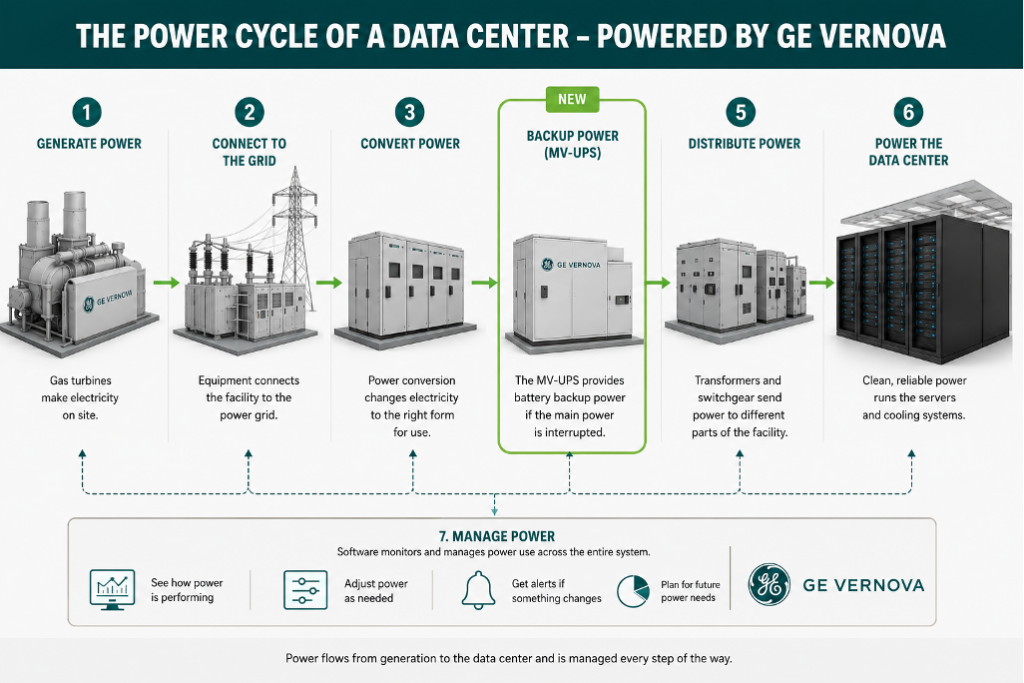
The result is essentially a fully integrated, self-contained, on-site power company that operates “behind the meter.” That’s an extremely appealing option for a hyperscaler or data-center operator as it could save them years of waiting to connect to the standard power grid.
And it represents a massive market – and revenue – opportunity for GE Vernova.
How GE Vernova Could Double or Triple Per-GW Revenue with MV-UPS and Solid-State Transformers
As of this year, GE Vernova brings in roughly $200 million to $300 million in total electrification content – including substations, grid software, and transmission equipment – for every GW of data center capacity it serves. During the company’s second-quarter 2026 earnings call on July 22, GE Vernova CEO Scott Stazik responded to a question about data-center orders, saying:
If you include the MV-UPS, if you include the SST [solid-state transformer] and some of the other things we’re working on, we certainly think… with the things we’re already investing in is 2 to 3 times what our scope per gigawatt is today..
Stazik is saying that GE Vernova’s end-to-end power stack/bundled services – with its new MV-UPS and solid-state transformer components – could help the company double or triple the current $200 million to $300 million per-GW value it generates from its typical sales of gas turbines and connection equipment.
And the key to unlocking that revenue is the MV-UPS, the layer of protection (so to speak) between the grid and the data center that stabilizes electrical flow and prevents grid infrastructure and on-site gas turbines from having to handle unforeseen – and potentially damaging – energy spikes or dips.
But another important, overlooked component is the solid-state transformer (“SST”). GE Vernova completed its 5-megawatt (“MW”) SST prototype in July and is scheduled for its first delivery to an unnamed hyperscaler client later this year.
The SST, according to GE Vernova, supports “more compact and efficient power conversion closer to the rack”. Put plainly, the SST bridges power generation (like GE Vernova’s gas turbines, for example) and computing infrastructure, such as racks based on Nvidia’s (NVDA) Blackwell architecture.
The company says that, combined with its MV-UPS, SST technology enables precise control of power distribution throughout an entire data center, allowing operators to automatically adjust power levels as AI tasks speed up or slow down.
This helps create a strong power-to-rack approach that can efficiently and effectively meet the growing and constantly evolving needs of data centers.
GE Vernova Stock Outlook
GE Vernova’s second-quarter numbers were exceptional, especially its revenue, orders, margins, backlog, and free cash flow.
The Numbers Behind the AI Power Business
Quarterly revenue hit $11.1 billion, a 22% year-over-year increase. And the company’s orders reached $24.2 billion, which contributed to a $13 billion backlog increase – that backlog now stands at roughly $176 billion, which includes a $40.6 billion backlog from the company’s Electrification segment alone.
The company’s gas-equipment backlog and slot reservation agreements grew by 16 GW to 116 GW. GE Vernova expects that number to hit at least 125 GW by the end of the year.
Looking specifically at data-center orders in the first half of 2026, those orders have exceeded $5 billion – more than double the total of 2025’s orders. That segment was a huge driver of GE Vernova’s business in the quarter, as Electrification segment revenue soared 68% to $3.6 billion and orders hit $6.3 billion.
Most importantly, GE Vernova generated consistent profit. Its adjusted EBITDA (earnings before interest, taxes, depreciation, and amortization) rose 62% to $1.2 billion, and the adjusted EBITDA margin was 11.3% for the quarter, up 340 basis points. Again, Electrification led the way, posting a segment EBITDA of $671 million (more than double from a year ago), and margins grew by 390 basis points to 18.4%.
On the strength of those numbers (and despite the soft quarter for the company’s Wind segment, which saw orders decrease by 40% and revenue drop by 10%), GE Vernova increased its 2026 full-year revenue guidance range to $45.5 to $46.5 billion, a $1 billion increase. Its 2026 free-cash-flow guidance also jumped significantly, from a $6.5 billion to $7.5 billion range to an $11.5 billion to $12.5 billion range.
The second quarter was clearly a very strong one for GE Vernova. With the company’s full-service data-center power offering on the horizon, it could take performance to another level.
What Investors Should Watch
There are never guarantees when it comes to investing. But GE Vernova is challenging that statement right now. The numbers don’t lie.
Consider the company’s stock growth, as of August 27:
- Year to date: 45.9%
- Year over year: 53.3%
- Five years: 1,343%
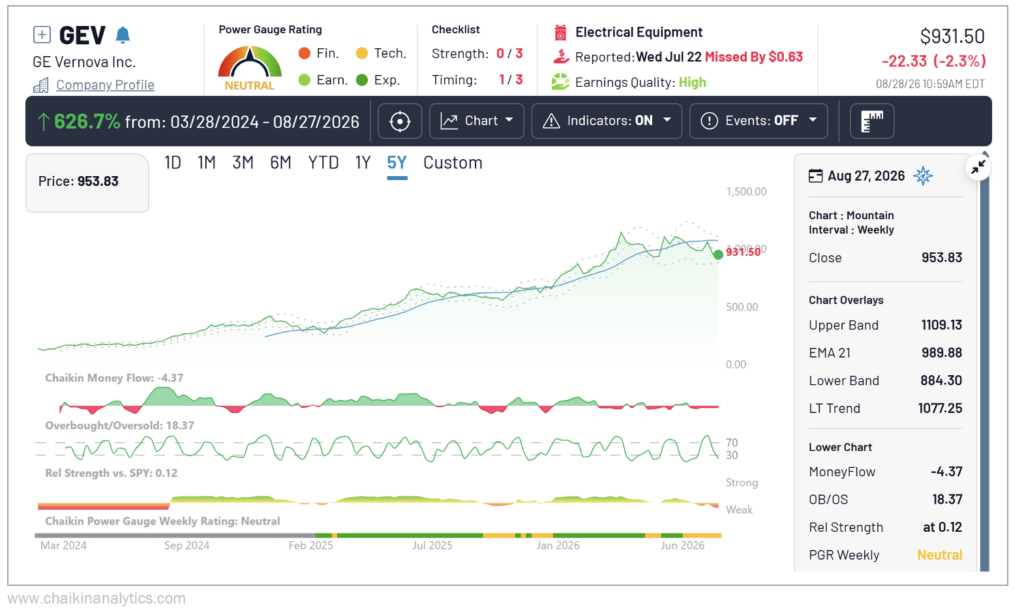
Yes, 1,343%. And, given the company’s surging revenues, sold-out order books, massive backlogs, the upcoming SST and MV-UPS rollouts, and AI’s seemingly never-ending thirst for energy, there’s little reason to believe a downturn looms ahead.
But it’s important to look at GE Vernova from all angles. Its second quarter was a rousing success by nearly any measure. But its earnings per share (“EPS”) did take a big hit, as its reported $2.47 EPS missed analysts’ estimates of roughly $3.10.
And, as I covered earlier, GE Vernova’s Wind segment underperformed. So, the company isn’t bulletproof.
But it’s pretty close.
Moving forward, investors should watch how GE Vernova handles the execution of its end-to-end power stacks as the final pieces – the MV-UPS and SSTs – ship over the next few quarters. And let’s see how the company’s third-quarter earnings look in late October.
The real question, however, is whether GE Vernova stock has more room to run or if its future plans (such as its backlog and its on-site power plants for data centers) are already priced into its valuation.
I would argue that the answer for both scenarios is yes. Why? Because GE Vernova stock is trading as high as roughly 49 times its forward earnings as of August 31. Some analysts believe investors are overpaying for future growth. And, if GE Vernova doesn’t execute that growth to near-perfection, the stock could be in store for a major sell-off.
Plus, there’s the reality that the company’s backlog – while staggering – won’t translate to actual revenue until closer to the decade’s end and into the start of the 2030s.
The flip side to that argument is that GE Vernova’s backlog is very real and very large. While that revenue won’t be realized immediately, it guarantees a steady stream of cash for years to come. Remember, the company has effectively sold out all its gas-turbine reservation slots through 2030. And it could see a $200 billion backlog by the end of this year. That’s not hypothetical.
So, both things are true with GE Vernova. Its stock carries a high premium today, but its underlying business and strong earnings potential back that valuation.
The Next Chapter in the ‘Dark Energy’ Story
In late June, my colleague Steven Longenecker wrote a piece about GE Vernova’s South Carolina gas-turbine plant and the company’s role in the larger “Dark Energy” prediction. This was laid out by Professor Joel Litman, who has consulted for the Department of Defense and lectured at the University of Pennsylvania’s Wharton School and Harvard Business School.
Steven wrote about Dark Energy, saying:
He’s referring to an on-site solution perfectly suited for the companies going “behind the meter” to generate their own data-center power.
Dark Energy is a clean, reliable power source. Specifically, it’s a class of natural-gas turbines… essentially a jet engine adapted into an electric generator. They start in minutes, run on natural gas instead of jet fuel, and can produce tens of megawatts of power per unit. Stack enough of them together, and you have a private power plant.
These devices have been around for decades. They’ve powered tanks, ships, and remote oilfields.
But until recently, no one was using them at scale to power the world’s most advanced AI labs. Now that they are, the suppliers building them are sold out for years.
And that’s why the companies that supply this technology… the ones building the turbines, the small modular reactors, the cooling, the switchgear, and everything else needed to make a private power campus run… are positioned to deliver incredible returns reminiscent of past tech booms.
If I hadn’t already mentioned that this was about GE Vernova, it would still be pretty clear. And what Steven described above, as well as in his other articles about Dark Energy, is exactly what GE Vernova is on the verge of achieving – an end-to-end, mini on-site power plant that generates all the energy data centers need.
GE Vernova’s gas turbines, which are sold out through 2030, were just the first act. With the company’s MV-UPS and SSTs, the second (and possibly final) act – the full electrical stack – should be completed sometime next year.
And hyperscalers – like SpaceX (SPCX), for example – are why GE Vernova’s gas turbines are sold out for years. And why are hyperscalers buying entire power companies? To give themselves their own sources of energy that don’t rely on the grid.
GE Vernova is in a great position for sustained growth as long as the AI build-out continues to march on.
Regards,
David Engle
Editor’s Note: A highly secure site in West Texas now houses an emerging potential $10 trillion technology backed by Elon Musk and Sam Altman. This breakthrough could completely replace our need for foreign oil – and send one small group of stocks soaring in the process. Click here to learn how you can invest in Elon’s next $10 trillion move.