
Image Credit: Associated Press
Listen to the audio version of this article (generated by AI).
Key Points
- Rising electricity prices and capacity charges are prompting more U.S. businesses to consider off-grid “Dark Energy” power solutions.
- Baker Hughes and Kodiak Gas Services signed a multiyear agreement to supply up to 1.8 gigawatts of behind-the-meter gas turbines for U.S. data centers, reinforcing Professor Joel Litman’s “Dark Energy” thesis.
- The cost of building gas-fired power plants has climbed 66% since 2023, while utility filings for new gas capacity have surged 570%, highlighting growing power constraints and strong demand for suppliers.
For 140 years, the Belden Brick Company has been firing bricks in Sugarcreek, Ohio…
You’ll walk on an acre of its clay pavers at the Alamo in Texas… its masonry makes up the walls of dozens of schools around the Midwest… and Belden has even provided some 1.7 million bricks for more than 100 structures at the University of Notre Dame.
It’s the largest family-owned brick manufacturer in the U.S. Five generations of the Belden family have run the company. It survived the Great Depression… two world wars… and the collapse of Rust Belt American manufacturing.
But it may not survive artificial intelligence (“AI”)…
Last year, as the company made some 200 million bricks, its electricity costs surged 90%, according to Reuters. It’s all thanks to the wave of AI data centers sweeping across Ohio and the 13-state region covered by grid operator PJM Interconnection, where capacity prices have exploded more than 1,000% in two years. As Reuters reports:
“That capacity charge just jumped off the page,” said company president Brad Belden, part of the fifth generation working at the company.
Despite such capacity-charge hikes, PJM was forced to take emergency steps last week, including asking some users to curb electricity use, to prevent rolling blackouts as searing temperatures pushed peak demand to a new record.
Belden is now considering installing its own on-site power generation to escape the grid entirely.
Sound familiar? It’s the same playbook that the tech giants are already running. And it’s exactly what my colleague Professor Joel Litman predicted with his “Dark Energy” thesis…
The ‘Dark Energy’ Boom Continues
Yesterday, Baker Hughes (BKR) and Kodiak Gas Services (KGS) announced a multiyear agreement to deliver gas turbines supporting up to 1.8 gigawatts of new power capacity for U.S. data centers. The initial order alone targets roughly 1 gigawatt by 2030.
Baker Hughes’ CEO said the deal reflects “the growing need for flexible power generation technologies” as data centers demand new capacity faster than the grid can deliver it. Those turbines aren’t going on the grid…
They’re designed for behind-the-meter installations… power produced directly at the data center, bypassing the public transmission network altogether. Joel calls it Dark Energy, which I broke down in our deep dive here:
Dark Energy is a clean, reliable power source. Specifically, it’s a class of natural-gas turbines… essentially a jet engine adapted into an electric generator. They start in minutes, run on natural gas instead of jet fuel, and can produce tens of megawatts of power per unit. Stack enough of them together, and you have a private power plant.
And the buyers keep lining up…
- Elon Musk’s SpaceX (SPCX) disclosed in its IPO filing that its xAI division will spend more than $2.8 billion on gas turbines over the next three years, a story I covered last month.
- GE Vernova’s (GEV) turbine order book is sold out through 2029, with new orders extending into 2031 as hyperscalers race to secure off-grid power.
- Chevron (CVX) struck a 20-year deal to feed natural gas to Microsoft’s massive Project Kilby data center, as my colleague Nick Koziol recently detailed.
- And these Dark Energy turbines are now even a national-security priority… with the government willing to defend them in court.
However, as Joel argues in his prediction, the biggest upside for investors likely isn’t in the big AI labs building the data centers…
The 66% Problem
As Bloomberg noted earlier this year, the cost to build a U.S. gas-fired power plant surged 66% between 2023 and 2025.
U.S. utilities filed for almost 24 gigawatts of gas-fired power capacity with state commissions in 2025, up 570% since 2023, as they turn to gas to replace retiring generation and meet the new U.S. demand, according to BNEF. A gigawatt is roughly the output of a large nuclear reactor and can power about 750,000 homes.
The average combined-cycle project now runs $2,157 per kilowatt, up from less than $1,500 two years earlier. And build times stretched 23% longer over the same period.
Meanwhile, demand is going vertical. As Joel discussed in May:
Data centers requiring about 183 gigawatts (“GW”) of electricity have already signed agreements with utility companies. Projects requiring 600 GW of power are still trying to pin down their supply.
Gas turbines are essential in securing that power. And, importantly, they can provide data centers with electricity around the clock.
Right now, all eyes are on three turbine producers that dominate the industry… GE Vernova (GEV), Siemens Energy (SMERY), and Mitsubishi Heavy Industries (MHVIY).
The normal grid simply can’t keep up.
In central Ohio, American Electric Power has warned that the biggest power line in the Midwest will run out of transmission capacity by 2028. Dominion Energy is rationing power in Virginia, the largest data-center market on Earth. Silicon Valley Power has stopped taking new data-center service requests until the early 2030s.
In addition, anger around data centers is only growing. According to Gallup, 7 in 10 Americans oppose data centers in their local area… To put that into perspective, only about 5 in 10 Americans would be opposed to a nuclear power plant in their backyard.
That data-center backlash is likely to accelerate the Dark Energy trend.
Buy the Dark Energy Suppliers
Every moratorium, every lawsuit, and every angry town hall pushes the AI hyperscalers toward the same conclusion… Rather than fighting for a grid hookup, just build your own Dark Energy power plant.
And the winners will be the suppliers of the boom.
For example, Bank of America’s global research team recently noted the massive transfer in free cash flow between the AI hyperscalers at the bleeding edge of the AI race and the semiconductor companies making the chips that power that AI…
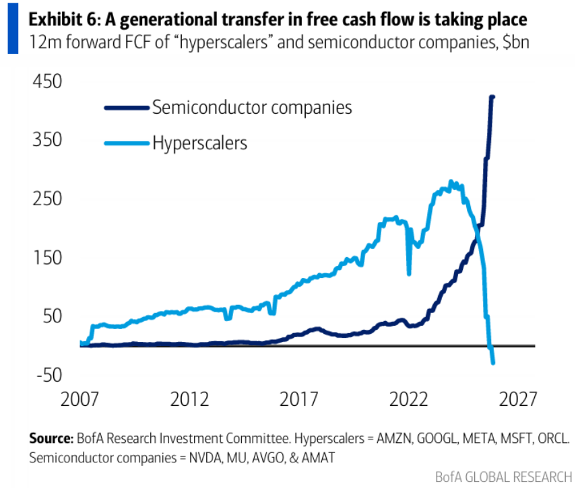
That free-cash transfer is also benefiting Dark Energy suppliers, especially the companies that Joel is focusing on.
He specifically calls out four opportunities in depth in his “Dark Energy: Stocks That Could Soar as AI Goes Off the Grid” special report…
- Dark Energy Opportunity No. 1 is at the heart of the tremendous Dark Energy investment wave. It simply can’t happen without this company.
- Dark Energy Opportunity No. 2 builds the infrastructure supporting the AI revolution… from gas pipelines to power plants to fiber-optic networks.
- Dark Energy Opportunity No. 3 helps connect data centers to either the grid or a Dark Energy turbine with a plug-and-play product that doubled this company’s revenues last quarter… and the market is still underestimating its growth potential.
- Dark Energy Opportunity No. 4 is a one-stop shop for hyperscalers that need large, specialized equipment as they build out their data centers and off-grid power plants.
And the fact is, Dark Energy could even ultimately save the U.S. economy…
Why This Matters for Every Retiree
If you’re an investor, you can’t avoid thinking about the AI race and how it will all be powered.
If the AI build-out falters, the U.S. economy and stock market will likely plunge. Fortune reports that total global AI-related capital expenditures will reach $5.5 trillion through 2030… and hyperscalers are expected to exceed $1 trillion in annual expenditures by 2027.
If the power to run these data centers isn’t available, the whole thing stalls out. And as I wrote in my “AI doom loop” warning, the downside scenario is brutal:
The Magnificent Seven, which make up more than a third of the S&P 500 Index, get cut in half – destroying upward of $10 trillion in market value. And we would expect the broader S&P 500 to ultimately decline somewhere between 30% and 50% over time… a $20 trillion to $35 trillion loss.
The alternative is that America builds its way through the power bottleneck… and that’s the optimistic core of Joel’s Dark Energy prediction.
Either way, the companies supplying the turbines, generators, and grid-bypass infrastructure win. They get paid whether AI ultimately delivers on its promises or not… the same way the pick-and-shovel suppliers got paid in every previous boom.
The grid is cracking across America… and Dark Energy is the solution.
That’s why Joel has pinpointed the companies he thinks will capture the biggest gains for his tens of thousands of subscribers. You can join them today. Watch his full Dark Energy interview here.