

Image Credit: Unsplash
Key Points
- Bitcoin is increasingly behaving like a safe-haven asset, with global instability and geopolitical tensions pushing investors toward alternatives outside traditional financial systems.
- Institutional demand, especially through Wall Street-backed Bitcoin ETFs, is playing a major role in supporting prices and driving broader mainstream adoption.
- Despite strong inflows, Bitcoin remains volatile and range-bound, with future price movement dependent on continued institutional buying and broader market catalysts.
Something unusual is happening in the crypto market right now…
Over the past two weeks, geopolitical tensions have surged after failed U.S.-Iran talks.
Ultimately, Iran refused to stop enriching uranium (the key element in nuclear weapons) and dismantle its nuclear facilities. The temporary ceasefire is still in place, but the U.S. is intensifying its naval blockade and discussing tighter sanctions.
Markets have turned choppy. Oil has spiked even higher. And yet, the crypto market – and bitcoin in particular – has barely flinched.
The world’s largest crypto by market cap is holding in a tight range between $65,000 and $78,000.
For most assets, that’s considered volatile. For bitcoin, that’s stability.
But that alone isn’t the whole story. The real story is why it’s staying there.
Bitcoin Isn’t Reacting Like It Used To
Historically, bitcoin doesn’t sit still during global stress. It drops, spikes, and overreacts to even the mildest news.
For example, in 2020, during the COVID-19 panic, it fell nearly 50% in a matter of days.
In 2022, during the Federal Reserve’s aggressive rate hikes, bitcoin dropped more than 60%.
Even as recent as October of last year, when President Donald Trump announced a new 100% tariff on Chinese imports, it triggered a 10% drop and roughly $19 billion in liquidations across the crypto market in a single day.
That shock set the tone going into 2026. Bitcoin has continued to drop from its all-time high of $124,753 in October 2025 to a low of $62,853 by this past February.
But this time, bitcoin is absorbing the shock and holding its ground.
That’s not normal behavior. And it’s raising a big question across Wall Street right now…
What exactly is bitcoin becoming?
Bitcoin has long been called “digital gold” due to its scarcity, durability, and decentralization. But analysts are now debating whether bitcoin is evolving into something entirely different… an asset that behaves independently of both risk markets and traditional safe havens.
Even mainstream news sites like MarketWatch recently argued that the Iran conflict is pushing investors to rethink bitcoin’s role beyond the usual digital gold label.
That’s a major tone change.
But while headlines are focused on geopolitics, the real story for bitcoin was happening underneath the surface…
Crypto funds saw $1.37 billion in inflows during the week ending April 17 – the strongest weekly total since early January.
And there’s another factor most investors aren’t paying attention to…
Bitcoin’s supply isn’t expanding to meet this demand.
As of April 2026, roughly 20 million bitcoins have been mined. With a maximum supply of 21 million bitcoins, that means most are already in circulation.
And after the most recent halving event almost exactly two years ago, the number of new bitcoins entering circulation was cut in half. Now, only about 450 new bitcoins are mined every day.
So bitcoin’s inflation rate is lower than ever. And the amount of bitcoin on the market will get cut in half again in 2028.
This means institutional inflows are competing over a shrinking pool of available supply.
And when demand rises and supply tightens at the same time, it doesn’t take much to move prices higher.
All of this signals institutional positioning, preparing for a broad crypto market recovery.
And it’s not happening in isolation.
Wall Street Is Rapidly Expanding Into Crypto
Last week, Charles Schwab (SCHW) announced that it will roll out direct bitcoin and Ethereum trading to its massive client base.
This puts a traditional brokerage with tens of millions of customer accounts directly in contact with crypto investments.
Charles Schwab manages trillions of dollars in assets and will now be competing directly with other large brokerages that offer crypto investing, like Robinhood Markets (HOOD) and Coinbase Global (COIN).
Meanwhile, BlackRock (), the largest asset manager in the world, has quietly shifted direction. After weeks of selling, BlackRock’s bitcoin exchange-traded fund (“ETF”) – the iShares Bitcoin Trust Fund – has swung back to sizable inflows… including roughly $505 million over two sessions this past week.
That’s not a coincidence. It’s what coordinated accumulation looks like.
A Price Floor Is Forming Through Institutional Buying
For years, bitcoin traded like a momentum asset. When buyers disappeared, prices collapsed. But that’s no longer the case.
Now, every dip is met with institutional inflows, ETF demand, brokerage expansion, and large-scale accumulation.
Even during geopolitical stress, the market holds, as we’ve seen.
That’s how a price floor forms. Not from hype… but from consistent, large-scale buying.
This matters because many investors are still reacting to headlines.
War risk, inflation, interest rates… they all play a role in crypto investing sentiment.
As of April 20, the Crypto Fear & Greed Index, which measures broad investor sentiment in the space concerning bitcoin, is in a state of “Fear”…
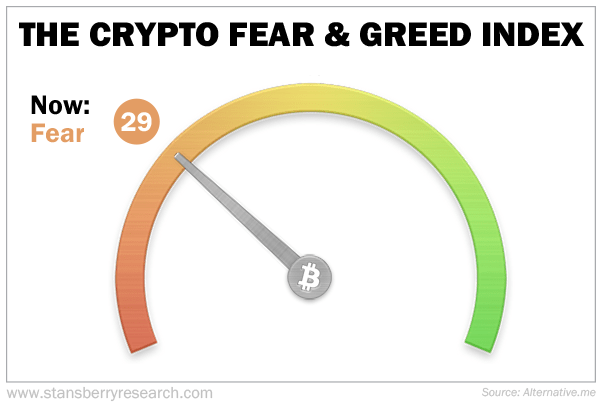
But the crypto market is starting to decouple from moving on headlines alone. It’s moving more on positioning now. And positioning is telling a very different story.
Wall Street is expanding access, institutional money is flowing in, and price is stabilizing under pressure.
It’s a rare combination that, so far, is keeping the crypto market stable… but, historically, we know can’t last long.
What This Means for Bitcoin’s Next Move
We’ve seen this pattern before.
In late 2020, bitcoin traded sideways for weeks while institutional money quietly accumulated in the background.
At the time, its price action looked boring.
But under the surface, companies like MicroStrategy – which now goes by Strategy (MSTR) – and Square – which now goes by Block (XYZ) – were aggressively buying.
Then, bitcoin broke out and ran from around $10,000 to more than $60,000 in less than a year.
The key wasn’t the breakout itself, but the accumulation phase before it.
And that’s what we may be seeing again right now…
There are two realistic paths from here.
First, if tensions escalate further, volatility will increase, bitcoin may dip in the short term, and institutional buyers are likely to step in again.
Second, if tensions ease even slightly, risk appetite will return among investors, capital will accelerate into crypto, and bitcoin will break higher.
Either way, the takeaway from here is simple: The market isn’t weak. It has support.
Importantly, bitcoin isn’t reacting like it used to. And that may be the most important signal of all. Because when an asset stops behaving like a speculative trade, and starts behaving like something institutions are quietly accumulating, the next move isn’t sideways… It’s way up.
How to Position for the Next Crypto Move
The Crypto Capital publication, led by crypto expert Eric Wade and supported by myself, focuses on the next wave of opportunities in crypto beyond just bitcoin and Ethereum. We look at under-the-radar assets that institutions are integrating and accumulating before the rest of the market finds out.
We also have plenty of step-by-step guides on how to buy your first bitcoin, as well as how to navigate self-custody wallets and exchanges safely.
Whether you’re just getting started or looking to go deeper, we lay it all out for you from start to finish… with recommendations as basic or complex as you want, so you can ease in at your own pace.
Good investing,
Stephen Wooldridge II
Editor’s Note: Whitney Tilson — the hedge fund manager CNBC called “The Prophet” — says America has reached its “Ripping Point.” The old financial order is being torn apart, and he believes most investors have no idea what’s coming in the next six months. He’s named the stocks he thinks will be destroyed in the chaos — and the ones he believes will soar. Watch his free presentation while it’s still available.