Image Credit: Associated Press
Listen to the audio version of this article (generated by AI).
Key Points
- Tesla held its Cybercab Launch Event in Austin, Texas, on September 3, but the event helped demonstrate just how far the Elon Musk-led company may still be from launching a fully self-driving car.
- Tesla stock fell more than 9% the day after the underwhelming event, which featured no livestream, no major financial reveal, Cybercab rides limited to a geofenced area of the city, and, perhaps most tellingly, no Elon Musk.
- If SpaceX acquires Tesla, don’t be surprised if Tesla’s self-driving vehicle program becomes deprioritized in favor of more ambitious projects such as AI data centers.
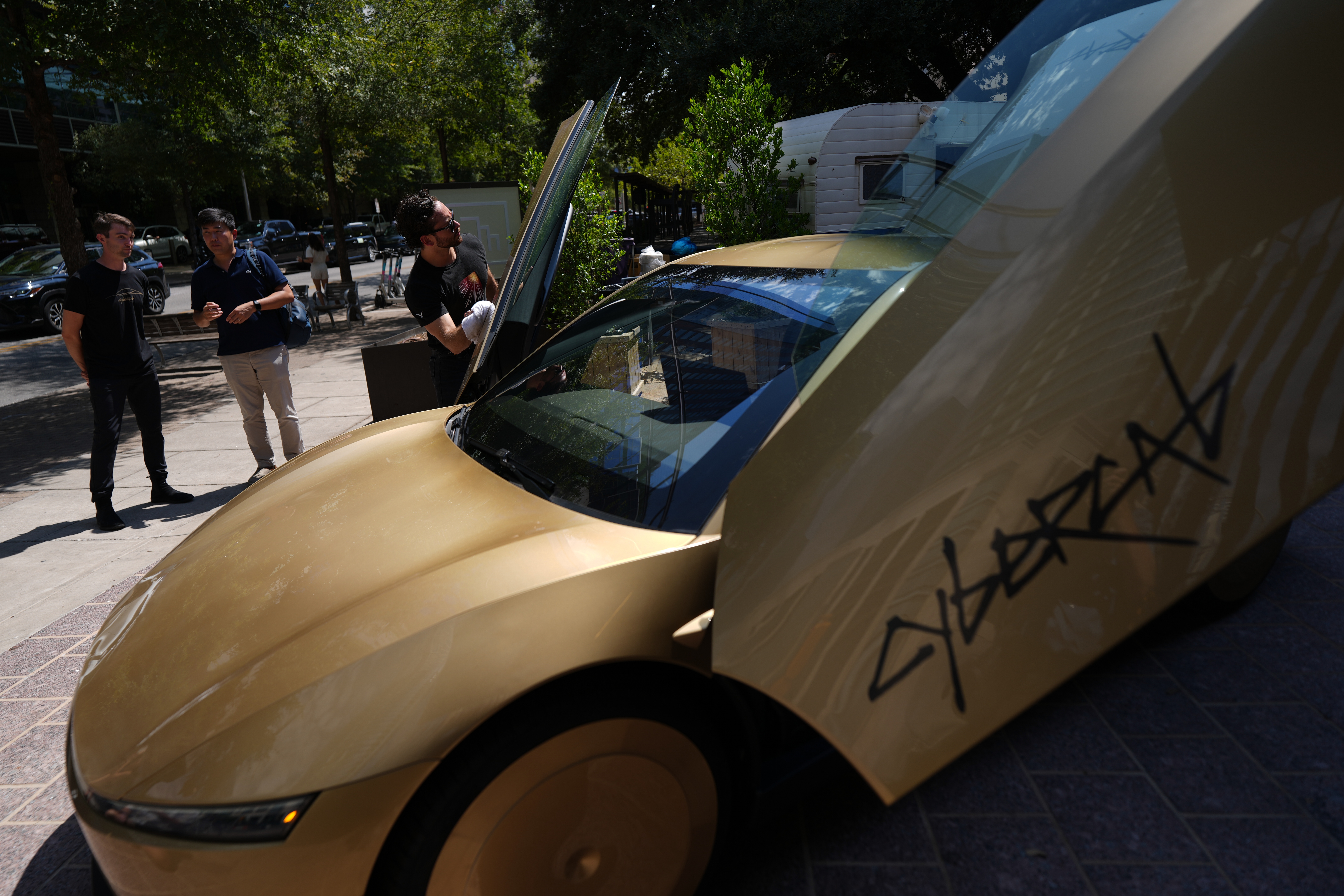
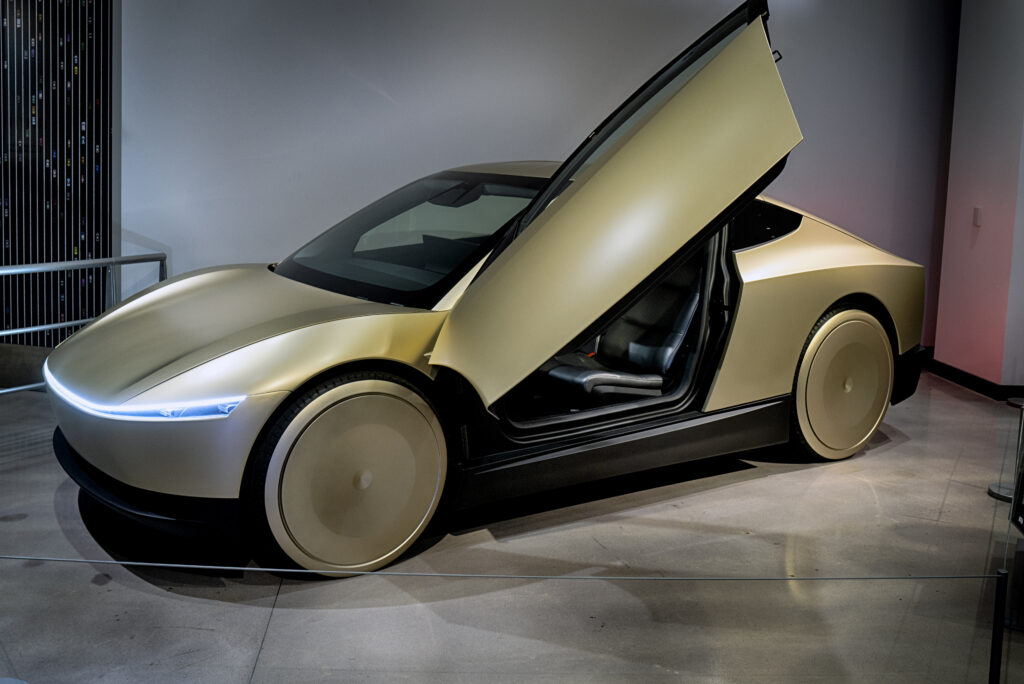
Tesla (TSLA) held what it called its Cybercab Launch Event on September 3 in Austin, Texas. But the highly anticipated reveal showed how far the Elon Musk-helmed firm actually is from launching a self-driving car in any real sense, with federal regulators announcing an investigation of the car in the event’s wake.
The invitation-only event brought social-media influencers to Austin to test the car, which has no steering wheel or pedals. Musk hailed the Cybercab as “the first vehicle specifically built for unsupervised full self-driving,” and it is expected to be the centerpiece of Tesla’s robotaxi network.
Investors learned little that they didn’t already know. Tesla didn’t offer a livestream of the event; there was no big financial reveal; the company offered Cybercab rides in only a geofenced area of the city – and perhaps most tellingly, there was no Elon Musk. The day after the event Tesla stock fell by more than 9%, and it’s now trading about 25% below its 52-week high.
If this were an actual big event, Musk himself would have been there to bring his cachet as the “world’s wealthiest man.” Instead, Tesla treated viewers to the mostly warmed-over promises we’ve seen for years, including Cybercab braggadocio such as “the future has arrived in Austin.”
Yes, it was the launch of public Cybercab rides, but getting any further details on a rollout was tough. Tesla didn’t indicate which cities were next on the rollout calendar or offer an official retail price or delivery timeframe. Still, as limited as the progress was, it was progress.
It’s probably what many Tesla investors have become used to by now – big promises with little actual follow-through, after a decade or so of Musk promising autonomous vehicles “next year.”
Ironically, the Tesla event was punctuated by an actual launch: Federal regulators from the National Highway Traffic Safety Administration (“NHTSA”) kickstarted an investigation into the company’s self-certification process for its autonomous vehicles. The probe is the latest sign that the Cybercab may be farther away than it appears, with the potential for regulators to slow the rollout.
When Will Tesla Really Launch Its Robotaxi?
Of course, investors and many consumers would like to know when Tesla will be able to officially – and really – launch its Cybercab with access in major cities across the United States. But Musk’s years of jawboning and posturing have made it all but impossible to go by what he says. Instead, we’re left to judge by what Tesla is doing.
For example, back in July 2025, Musk said that Tesla’s robotaxi network would be available to half of the U.S. population by the end of 2025. Yet, we’re nearly three-quarters of the way through 2026, and Tesla has had only a modest robotaxi rollout in just a handful of cities.
On that basis, Tesla’s robotaxi still looks far off, even if the company is slowly moving toward it.
The most recent chicane is the NHTSA investigation into whether the company is fully compliant with federal law since its Cybercab lacks a steering wheel, mirrors, or brake pedals. While Tesla self-certified that its vehicle complies, the feds aren’t quite as sure. The NHTSA will now conduct a thorough audit of the technical data Tesla used in its certification.
This investigation joins other federal investigations on the safety of Tesla’s self-driving software.
Still, Tesla is expanding its self-driving fleet on the roads, as it rolls out robotaxis to more cities. But the number of vehicles on the road overall remains quite small. Just 45 Cybercabs have been registered for use in Texas, out of a total of 420 Tesla autonomous vehicles in the state, as of September 2, according to Reuters. Musk’s continued references to drug culture – “420” is a reference to marijuana – provide more evidence of his lack of seriousness as a businessman.
In contrast, autonomous driving leader Waymo, a subsidiary of Alphabet (GOOGL), has a total of 988 vehicles registered in the state.
Waymo and Tesla differ in another key respect. Waymo uses cameras, radar, and lidar – laser imaging, detection, and ranging – as the “eyes” of its vehicle. In contrast, Tesla uses cameras and onboard artificial intelligence (“AI”), a cheaper approach that Musk believes can scale faster.
As we continue to watch how fast Tesla can launch robotaxis, keep an eye on Las Vegas. The Nevada Transportation Authority approved Tesla for up to 5,000 fully autonomous vehicles over the next 12 months in Sin City and the surrounding Clark County. Meanwhile, Waymo currently has authorization for just up to 1,000.
Investors want to see Tesla make real progress on key initiatives, especially given its lousy second quarter, when it was forced to discount heavily to sell more cars.
Tesla’s Failures Will Be Concealed With a SpaceX Takeover
SpaceX (SPCX) is likely to acquire Tesla in the not-too-distant future, a move that could help obscure the lack of progress on self-driving vehicles. An acquisition of Tesla may also let Musk sweep a failing program, such as self-driving, under the rug.
This process is effectively what happened to the once-hyped solar roof, a concept that came over as part of Tesla’s acquisition of SolarCity in 2016. Tesla stopped taking orders for the solar roof on August 20 and told its supplier network it would no longer offer it, according to Elektrek. Some members of its third-party installer network complained of six-figure losses from investments they made to support the program.
As part of the larger Tesla, it was easier to sideline non-core projects in favor of investing in core products such as self-driving cars, before ultimately shuttering them. So, it’s not hard to imagine a more ambitious goal like self-driving cars, being pushed to the wayside as part of an even more audacious program at SpaceX, such as reusable rockets or orbital data centers.
Tesla could benefit if outside investors partnered with the carmaker, and it’s already trying to figure out how to use other companies to expand its reach. It’s asking for responses on a robotaxi interest form for firms that might be interested in buying Cybercab fleets or offering infrastructure for its network. That’s no guarantee it will sell them, however.
Offloading some of the capital investment to third parties can make financial sense, relieving Tesla of some burdens while pushing more risk onto those parties. If Tesla eventually shutters its Cybercab program, those third parties would likely bear some of the costs.
As part of a post-merger SpaceX, Tesla projects would need to compete with other projects that have a voracious need for capital, including AI data centers, both terrestrial and orbital. The Cybercab must already compete with Terafab and Optimus robots. It will be all too easy for Tesla executives to deprioritize a failing program out of existence if capital needs tighten.
That’s one of several key reasons why SpaceX may step in and buy the struggling carmaker, but it’s important to understand that Musk stands to make a huge payday on a Tesla acquisition, too.
While Tesla has certainly made some advances on its Cybercab, investors should not expect much impact on the company’s bottom line for a while, if ever. We’ll need to see real action from Tesla, not simply Musk’s words.
Regards,
James Royal, PhD
Editor’s Note: Elon Musk revived the electric car, pioneered reusable rockets, and beamed down internet to the four corners of the Earth. But his new initiative – “XPANSE” – could be bolder… more transformative… and far more lucrative than all of these innovations combined. And, like Tesla and SpaceX, it could make early investors incredibly wealthy. Click here for the details…