Image Credit: Unsplash
Listen to the audio version of this article (generated by AI).
Everybody’s crowding into the same handful of AI chip names. Meanwhile, the actual bottleneck in the entire AI buildout is a metal that’s been around since the Bronze Age — copper. (Yes, the Chester Copper Pot metal, for my fellow Goonies fans. It always sneaks into my presentations.)
And this week copper did something it hasn’t done in a very long time: it printed a brand-new all-time high while the physical supply underneath it keeps getting thinner. As I’m writing this, three-month copper on the LME just tagged a record near $14,700 a ton (an intraday high around $14,694), capping its longest weekly winning streak since 1994. One of my favorite copper stocks is Freeport-McMoRan (FCX), and it’s up better than 7% on the day and roughly 44% on the year.
I’ve been pounding the table on the copper trade on Masters in Trading LIVE for weeks — and I put a real, defined-risk version of it (a specific FCX options play) in our free portfolio, live on the show, which I’ll show you the exact structure of below. Let me walk you through why first.
AI Runs on Copper, and There Isn’t Enough of It
Here’s the part Wall Street keeps glossing over. An AI data center uses roughly 10 times the copper of a traditional data center. All that compute, all that power delivery, all that cabling — it runs on copper. And a new copper mine takes seven to ten years to build. Supply simply cannot catch up to this demand on any timeline that matters.
Now stack that AI demand on top of a supply chain that’s genuinely cracking:
- One year ago this week, a wet-material flood hit Freeport’s Grasberg mine in Indonesia — the world’s second-largest copper source — triggering a force majeure. Freeport has cut its 2026 output guidance at the complex by roughly a third, and a full recovery isn’t expected until 2027 or 2028.
- Chile, the world’s largest producer, just logged its weakest second quarter in at least 19 years and has cut its full-year forecast twice.
- Global mine output actually fell in the first half of the year. Morgan Stanley started 2026 expecting supply to grow and now sees it flat-to-down — which would be the first annual decline in mine supply since 2017.
As Evy Hambro, BlackRock’s Global Head of Thematic and Sector Investing, put it, existing copper operations are “tired, very, very old assets.” That’s the backdrop: warehouses draining, grades falling, and the biggest demand story of the decade just getting started.
The Copper Tariff Catalyst Nobody’s Fully Pricing In
This is where the edge lives. I don’t just want to be long a strong commodity — I want a known catalyst with a date on it. Copper has one.
Remember: a tariff is just a tax. Back in 2025, Washington slapped a 50% tariff on semi-finished copper products — pipes, wires, rods, sheets — plus copper-intensive derivatives like cables and connectors. But read the fine print: they didn’t tax raw input material or refined copper (cathode) itself. Not yet.
Here’s the timeline that matters:
- The Commerce Department’s deadline to recommend action on refined copper passed on June 30, and more than two months later the White House still hasn’t ruled.
- The recommendation on the table is a phased tax on refined copper — 15% in 2027 (possibly as soon as January), stepping up to 30% in 2028.
- Traders aren’t waiting for the ink to dry. Roughly 200,000 tons of refined copper flooded into the U.S. in July alone — the largest monthly inflow on record — pushing Comex inventories past 1 million tons as buyers race to beat that possible January duty.
When big money moves ahead of a known date, it tips its hand. That’s the footprint I follow. I learned that on the floor — I spent twenty-eight years as a market maker at the CBOE and a floor trader at the CME and CBOT, and all any trader is ever doing is positioning in front of the biggest players in the room. Copper is flashing that exact signal right now.
The Edge: Only Two Copper Smelters Are Left in America
Here’s the nuance that separates the pros from the crowd. A tax on imported refined copper is a gift to the very few companies that turn raw material into finished copper on U.S. soil. And there are barely any left.
Industry testimony to Congress this year put it starkly: the U.S. ran 16 primary copper smelters in 1976. Today, just two are operational, with a third (Grupo México’s Asarco Hayden in Arizona) mothballed. That’s the entire domestic backbone for refining copper in the world’s largest economy — which is why the U.S. ships roughly a third of the copper it mines overseas to be processed, then buys it back as finished metal. Put a tariff on that finished metal, and you hand enormous pricing power to the two companies that still run a smelter here:
- Freeport-McMoRan (FCX) runs one of them (its Miami smelter in Arizona). It’s the largest U.S.-listed copper producer, it trades with deep, liquid options, and it’s my single favorite name in the space. The leverage is the story: by management’s own math, every 10-cent move in copper is worth about $390 million in annual EBITDA. It models ~$13 billion in EBITDA at $5 copper and ~$20 billion at $7 copper. Copper’s already trading north of $6.60 a pound. You do the math.
- Rio Tinto (RIO) owns the other (its Kennecott smelter in Utah). It’s a much bigger, more diversified major — so it’s a steadier, more indirect way to get exposure. Think of Rio as the lower-beta version of the same idea.
That’s the concentrated bet. Now let’s talk about the rest of the group — because not all copper stocks play this story the same way.
The Best Copper Stocks for AI (and the Ones to Approach With Caution)
Copper’s 2026 run has turned the big producers into what basically looks like one trade — the year-to-date returns are clustered in a tight band, which tells you this is a commodity move, not a company-execution move. Names to know:
- FCX (Freeport-McMoRan) — my top copper stock pick. Most direct U.S. smelter play, deepest options, biggest earnings leverage to the copper price.
- RIO (Rio Tinto) — the other U.S. smelter; bigger, steadier, more diversified.
- SCCO (Southern Copper) — a pure-play copper heavyweight, up roughly 45% on the year with monster EBITDA margins. Riding the same wave as FCX.
- TECK (Teck Resources) — also up ~45% YTD, part of that same tight cluster.
And then there’s the be-careful bucket. Plenty of copper names are just miners — they dig up raw copper and ship it overseas. A U.S. refined-copper tax doesn’t really touch them, and the foreign refiners can actually be hurt by it. That group includes names like Ero Copper (ERO), Hudbay (HBM), First Quantum, Ivanhoe, Capstone, plus the big overseas majors like Vale (VALE) and BHP. Great companies, plenty of them — but they don’t sit on the right side of this specific catalyst. Know what you own and why you own it.
What About Copper ETFs?
If you’d rather not pick a single name, the sector has clean ETF wrappers — just understand what each one actually gives you:
- COPX (Global X Copper Miners ETF) — a basket of copper miners worldwide. Great for broad exposure to the theme. The trade-off: it dilutes the U.S.-smelter edge, because it holds a lot of those overseas miners the tariff doesn’t help.
- CPER (United States Copper Index Fund) — tracks copper futures directly. This is your cleanest exposure to the metal itself rather than the equities. If your whole thesis is that the price of copper goes higher, this is the straightforward vehicle.
- COPJ (Sprott Junior Copper Miners ETF) — smaller, higher-beta junior miners. More torque, more risk.
The way I look at it: the copper ETFs are the easy button for just being in copper. But the edge — the concentrated, catalyst-driven bet — lives in the two American smelters, FCX and RIO. That’s the difference between owning the theme and owning the trade.
The Exact FCX Copper Trade I Shared Free on MiT Live
Here’s what makes our show different: I don’t just talk about copper — I put on a real trade in front of you, live, in our free portfolio — no paywall required to watch me do it. So let me show you exactly how I structured the FCX trade when I shared it on the show.
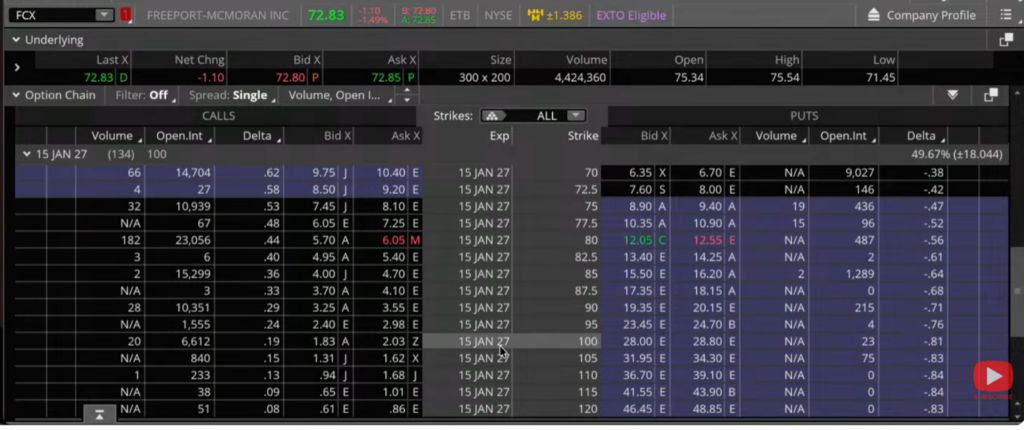
The setup was a vertical call spread in the January 2027 expiration:
- Buy the FCX 80 call
- Sell the FCX 105 call
At the time, that spread cost roughly $4.50 to put on — paying about $6 for the 80s and collecting about $1.50 for the 105s. And that number is your risk: in a defined-risk spread like this, the most you can lose is what you pay for it. So one spread risked about $450 — and you can never lose a dollar more than that, no matter what FCX does.
Now the reward. The spread is worth its full width — the 25 points between the 80 and 105 strikes, or $2,500 — if FCX finishes above 105. Subtract the $450 you paid, and the most you can make is about $2,050. That’s better than 4-to-1 — risk $450 to make $2,050 — with about 134 days for the thesis to play out. And it scales cleanly: a 10-lot risks about $4,500 to make about $20,500. Same ratio, just add a zero.
A few things I say every single day on the show:
- This is one trade, not two. Two legs, one position — a vertical call spread. Don’t manage it as a separate long option and short option.
- Options are just a derivative of the stock. Think of it as long from 80 and short from 105. If FCX is above your strike at expiration, you’re long from there; if it’s below, you’re not. That’s it — the internet loves to overcomplicate this.
- New to options? Paper-trade it. Write the trade down, follow FCX, and let your confidence build before you risk a dime.
Options prices move, so the fills above reflect the session when I shared it — and with copper and FCX both pushing to fresh highs since, the picture keeps evolving. But the structure is the lesson: a known catalyst, a strictly defined risk, and a reward that’s several times what you put up.
The Bottom Line on Copper Stocks
AI can’t run without copper. The world is running short of it. And Washington is sitting on a decision that could put a tax on it as soon as January. That’s a supply squeeze, a demand supercycle, and a known catalyst all stacked in one place — and the cleanest way to play it is the two companies that refine copper on American soil, starting with FCX.
Editor’s Note: Forbes calls $1 billion fund manager Louis Navellier “the king of quants.” Today, he’s stepping forward to reveal why he’s investing $358 million of his own firm’s money in the next stage of Artificial Intelligence… a technological sea-change that could erase millions of jobs, solve humanity’s biggest mysteries, and spark a wave of moneymaking opportunities — both in and outside the stock market. Click here for the details…
Copper Stocks FAQ
Why are copper stocks going up?
Copper just printed a record near $14,700 a ton on the LME, capping its longest weekly winning streak since 1994, while the physical supply underneath keeps thinning. An AI data center uses roughly 10 times the copper of a traditional one, and a new mine takes seven to ten years to build. Demand is surging while supply stalls.
What does the copper tariff mean for copper stocks?
In 2025, Washington put a 50% tariff on semi-finished copper products but left refined copper untaxed, for now. A phased duty on refined copper is on the table, possibly 15% as soon as January 2027 and 30% in 2028. That would hand pricing power to the few companies that refine copper on U.S. soil.
What are the best copper stocks for AI?
The cleanest plays are the two companies that still refine copper on U.S. soil: Freeport-McMoRan (FCX), the largest U.S.-listed producer and the top pick, and Rio Tinto (RIO), a steadier, more diversified option. Southern Copper (SCCO) and Teck Resources (TECK) ride the same commodity wave, both up roughly 45% this year.
Is FCX a good copper stock to buy?
Freeport-McMoRan runs one of only two operational U.S. copper smelters, and its earnings leverage is the story. By management’s own math, every 10-cent move in copper is worth about $390 million in annual EBITDA, and it models around $20 billion at $7 copper. Copper is already trading north of $6.60 a pound.
Are there copper ETFs for the AI trade?
Yes. COPX (Global X Copper Miners) gives broad exposure but dilutes the U.S.-smelter edge with overseas miners. CPER (United States Copper Index Fund) tracks copper futures directly, the cleanest bet on the metal itself. COPJ (Sprott Junior Copper Miners) holds smaller, higher-beta names with more torque and more risk.
What are the risks of copper stocks?
Copper’s 2026 run is largely a commodity move, so the big producers trade like one bet and would fall together if copper retreats. Many copper names just mine raw metal and ship it overseas, so a U.S. refined-copper tariff does not help them and can even hurt foreign refiners. Know what you own and why.
Want to see the next setup like this before it goes on? I break down real, defined-risk trades live every weekday at 11 AM ET on Masters in Trading LIVE — real trades, real time, real community. Come hang out.