Image Credit: Associated Press
Listen to the audio version of this article (generated by AI).
Key Points
- Investors will closely watch upcoming earnings from Alphabet, Meta, Microsoft, and Amazon, with AI capital spending expected to be the biggest focus.
- Oracle’s recent sell-off after raising capital-expenditure guidance has heightened concerns that surging AI infrastructure costs could pressure hyperscaler profits.
- If the hyperscalers indicate AI infrastructure supply is catching up with demand and capital spending begins to moderate, it could provide a catalyst for Big Tech stocks and the S&P 500 to reach new highs.
Investors will begin receiving earnings results from four of the world’s most important technology companies on July 22.
Alphabet (GOOGL), the parent company of Google, will report second-quarter earnings after the market closes on Wednesday.
A week later, Meta Platforms (META), whose social media apps – including Facebook, Instagram, and WhatsApp – are used by billions of people each day, is expected to report its latest results on July 29. Windows operating-system developer Microsoft (MSFT) is also scheduled to report fiscal 2026 fourth-quarter results on the same day.
Finally, on July 30, look for the latest financials from Amazon (AMZN), the world’s top cloud-service provider through its Amazon Web Services subsidiary.
Back in May, we explained that a subtle but powerful shift had occurred in the U.S. economy… Growth in capital expenditures (“capex”) for new assets – like manufacturing plants, software, and equipment – has overtaken consumer spending as the primary driver of U.S. economic growth.
And the massive spending on AI by the four major hyperscalers, plus database-management leader Oracle (ORCL), is what’s fueling that boom.
We first outlined those investments in the table below on May 20. Now, we’ve added a fourth column: analyst estimates for these companies’ capex over the next 12 months (“NTM”). Take a look…
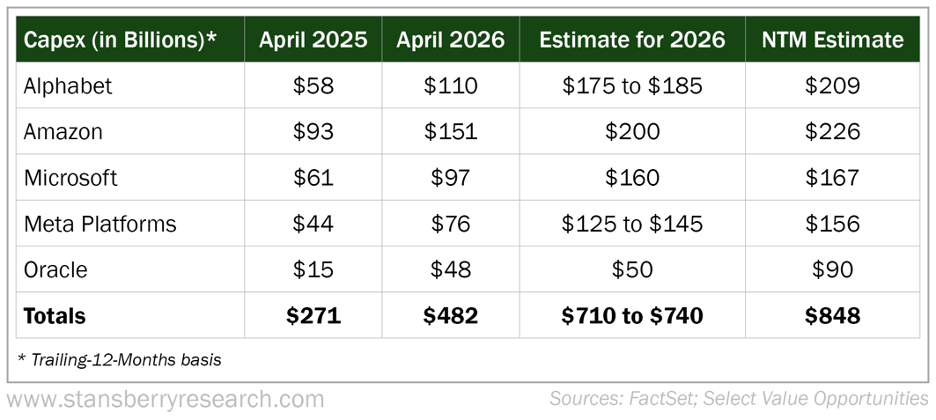
It’s clear that these five tech giants will continue their AI spending spree. And while that’s good for the economy, it has weighed on their stocks thus far in 2026, as investors fear it will hurt profitability.
Only Alphabet is beating the market year to date (“YTD”) – and just barely. The other four are underperforming the S&P 500 Index. Oracle’s 35% plunge YTD (versus a 9% rise in the S&P 500 over the same period) is particularly notable, offering a stark warning to investors.
Investors Should Heed the ‘Oracle Warning’
Oracle announced record fourth-quarter and fiscal 2026 results on June 10. And they were mostly in line with Wall Street’s expectations. But there was a surprise…
Its fourth-quarter capex was 42% higher than the consensus estimate, $16.5 billion versus $11.6 billion.
When asked about the company’s higher spending during the quarterly conference call, CEO Clay Magouyrk said that Oracle is accelerating capex. Why? Because it’s trying to complete contracted AI data-center capacity as quickly as possible so it can begin generating revenue.
Still, investors weren’t impressed. The stock fell 8.5% the next day (June 11) to $184.10 per share. Oracle shares are down by more than 35% so far in 2026.
This negative reaction to Oracle’s accelerated spending is a warning to investors.
What Alphabet says about its own capex spending – and then what Meta, Microsoft, and Amazon say a week later – is sure to move the market. After all, these four stocks combined account for about 17% of the S&P 500’s value.
And when we hear from Alphabet first on July 22, investors will be laser-focused on a single number…
Will Alphabet’s Second-Quarter Capex Exceed Analyst Estimates?
The consensus from analysts covering Alphabet is that second-quarter capex will be about $45 billion, according to FactSet data. That would be a 25% increase over first-quarter spending of $36 billion.
If the company reports higher-than-expected capital outlays and/or raises its full-year forecast ($180 billion to $190 billion), the stock could slide… just as Oracle’s did.
And if Meta, Microsoft, and Amazon also report higher-than-expected capex a week later, a significant market downturn could ensue, potentially triggering the ominous chart formation we first alerted readers to back in November.
A 1-2-3 Pattern Is Forming in the S&P 500
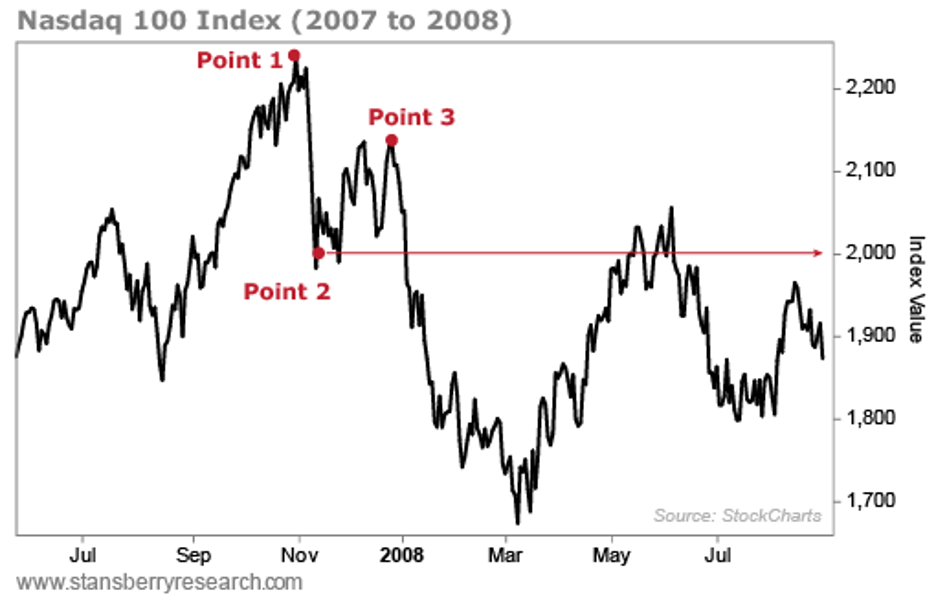
The 1-2-3 formation often signals a market top.
In this pattern, investors shift from buying to selling, causing stocks to fall from an all-time high. (That’s Point 1.) Next, stocks find an intermediate bottom. (That’s Point 2.) Stocks then bounce and retest the Point 1 high.
If they fail and top out below their former all-time high (Point 3), they’ll likely fall again… even more steeply than before. This setup could indicate that a major market reversal is underway. We saw this pattern play out in the Nasdaq 100 Index from 2007 to 2008. Take a look…
This past February, it looked like the same thing was starting to happen with the S&P 500. But then stocks ripped higher in April, and the formation fell apart.
The underperformance of Amazon, Meta, Microsoft, and Oracle (noted earlier) is again weighing on the S&P 500. And another 1-2-3 pattern is forming…
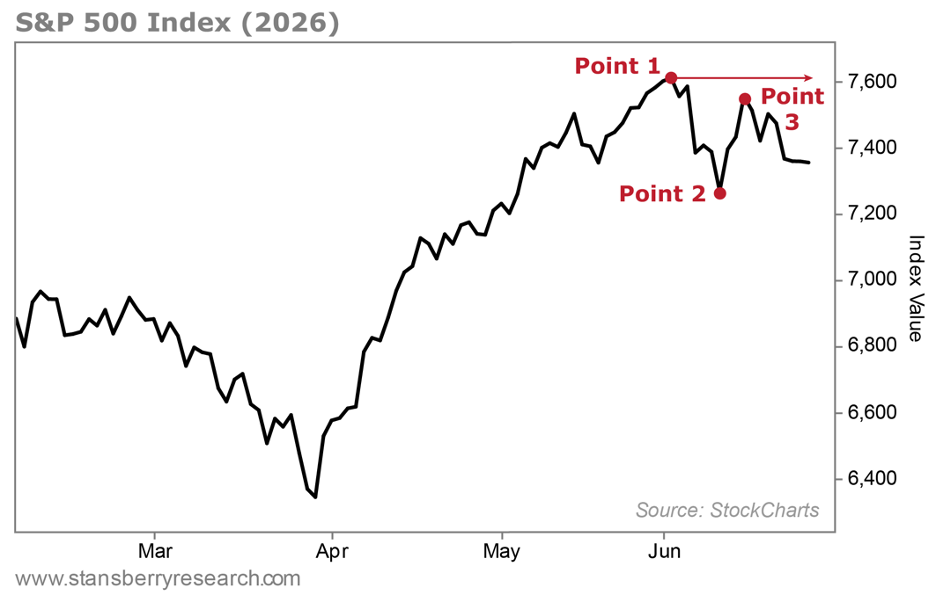
If the S&P 500 fails to make a new high and moves decisively below Point 2 (7,237.85), look for it to continue this downtrend.
Our decades of experience with market cycles tell us to expect stocks to bottom out every four years – that last occurred in October 2022. So if another 1-2-3 top forms, we wouldn’t be surprised to see stocks continue grinding down into another major low this October.
But there’s another potential scenario that could surprise investors…
Moderating Capex Spending Could Send Stocks Soaring
At some point, the tech giants building AI data centers will announce capex figures below Wall Street’s expectations… The massive amount of AI compute capacity (supply) they’re adding will inevitably catch up with demand.
If that happens when the next earnings reports come out for Alphabet, Amazon, Meta, and Microsoft, their stocks could rip higher and take the S&P 500 along for the ride, as investors cheer the lower spending and improved profitability.
Two weeks ago, investors got a sneak peek of what this might look like.
On the morning of July 1, Bloomberg reported that Meta was crafting plans for a cloud-infrastructure business that would sell access to surplus computing power and AI models.
Meta’s stock rose sharply on the news and closed 9% higher for the day at $612.91 per share. Shares have climbed around 15% over the past month.
If Meta is willing to rent out AI compute capacity, that might indicate that demand is finally catching up with supply. That should translate into moderate capex spending and rising profitability for the social media giant.
And that’s essentially what Meta CEO Mark Zuckerberg said during a call with shareholders two months ago: “If we get to a point where we feel that we have overbuilt, then [renting out capacity] is an option that we have.”
Bottom line: Seeing capex by the tech giants begin to moderate could be very good for their stocks and would likely push the S&P 500 to new highs. And it could mean that the S&P 500’s anticipated bottom in October arrived earlier than expected in this cycle, coinciding with the March 30 intraday low of 6,316.91.
In other words, the four-year cycle low could have already been set… meaning that stocks would be poised to move sharply higher into 2027 and beyond.
In summary, we’re monitoring two scenarios that could yield very different market outcomes. Both hinge on the upcoming capex data we’ll get, beginning with Alphabet on July 22.
If we learn that data-center capex is continuing to skyrocket, then leading AI stocks like Alphabet could sell off and trigger a broader market decline.
But if we instead learn that AI compute supply is finally catching up with demand – as Meta’s plan to rent out surplus capacity suggests – then shares of the tech giants could be poised to move sharply higher and push the S&P 500 to new highs along with them.
Prudent investors will be ready for either outcome.
Good investing,
Mike Barrett
Editor’s Note: Whitney Tilson called the rise of Apple, Amazon, and Netflix… as well as the collapse of dozens of companies that went bankrupt. Now the former $200M hedge fund firm manager is stepping forward with what he calls the most important financial warning of his 30-year career. He’s sharing two free stock recommendations (one to buy, one to sell immediately) along with details of a new proprietary system fueling his predictions. See it all in his free presentation.