

Image Credit: Associated Press
The artificial intelligence (“AI”) boom goes far beyond the chips and hardware. More specifically, it’s creating enormous demand for data center real estate investment trusts… or REITs.
After all, all that hardware needs a home. A rather massive home for the seemingly endless aisles of servers, racks, networking components, power equipment, and cooling systems that compose the infrastructure of an AI data center.
So, while investors continue to funnel their money into AI chip and tech stocks, there’s an overlooked layer of the AI boom that’s increasingly becoming an integral piece of the AI ecosystem… real estate.
Data center REITs are an easy way to invest in the AI and data center world, without having to choose which specific technology, hardware, or data center location to bet on.
Let’s look at why data center REITs are becoming an important piece of the AI investment world. We’ll also check out a couple leading the way.
What Are Data Center REITs?
Data center REITs are companies that own, develop, and manage facilities that house IT infrastructure, like computer servers and data storage.
These REITs provide the services data centers need, such as power, cooling, and network interconnection, and lease the space to their clients… typically tech companies, enterprises, and cloud providers.
For example, tech titans like Amazon (AMZN), Apple (AAPL), Alphabet (GOOGL), International Business Machines (IBM), Meta Platforms (META), Microsoft (MSFT), and Oracle (ORCL) all use REIT-owned data centers.
Data center REITs are growing in popularity. Not only among individual investors, who can invest their money directly into a REIT stock or exchange-traded fund (“ETF”). But also with institutional investors that invest through mutual funds, pension funds, insurance companies, and banks.
The appeal is simple. Rather than betting on a single AI-related stock, investors can get in on the real estate upon which the entire AI ecosystem relies. And that provides a blend of long-term leases, stable cash flows, and consistent dividend income.
With the AI boom continuing for the foreseeable future, data center REITs are an enticing investment option.
Especially when you factor in projections that show the “big five” hyperscalers (Amazon, Meta, Alphabet, Oracle, and Microsoft) allocating more than $450 billion in capital expenditure (“capex”) for AI infrastructure in 2026.
AI Training vs. Inference: What Every Data Center Investor Should Know
If you’ve ever wondered what goes on inside an AI data center, the answer can be boiled down to two distinct phases – training and running/inference.
AI Training: Teaching the Model
In this phase, unimaginable amounts of data are collected and prepared. From there, model selection chooses the right algorithm depending on the end goal of the training.
Then, massive clusters of specialized graphics processing units (“GPUs”) are used to process the data and adjust model parameters to improve accuracy. Google uses tensor processing units (“TPUs”) for this same purpose. Next, a separate dataset is used to fine-tune the model parameters and prevent data memorization, so it learns patterns rather than memorizing them.
The final model is tested on new data to gauge its performance. Then it goes live, though the model requires constant monitoring and retraining to ensure accuracy.
AI training requires enormous campuses, primarily used by hyperscalers, to house the hardware it needs to run training models 24/7. And those campuses need a seemingly insatiable amount of power to operate at full capacity.
AI Inference: Delivering the Service
Once the AI model training is complete, it’s ready to run. Inference, the name of this process, uses the already-trained machine learning model to examine data and make decisions and predictions, and to generate responses in real time.
To compare processes, AI training teaches the model, and inference applies its learnings.
Training uses a ton of computing power. Inference, however, requires speed, steady computing, and locality to its end users. It runs on smaller sets of GPUs, application-specific integrated circuits (“ASICs”), or edge computing (the use of a local device, like a phone) for optimal efficiency and speed.
Any type of response from AI is generally considered inference. So, if you ask ChatGPT a question, it’s using inference as it generates and presents its answer. The same applies to self-driving cars recognizing a red light, an autonomous freight truck knowing when it needs to refuel, or even Netflix recommending a movie based on your preferences.
So, training builds the AI model. Inference delivers the AI service. And both processes need specialized data center real estate to function – and the REITs that own it represent one of the most compelling investment opportunities in the AI boom.
Just ask Wide Moat Research editor (and real estate-investing expert) Brad Thomas, who wrote about two blue-chip options in late December:
When I look at blue-chip data-center REITs like Digital Realty (DLR) and Equinix (EQIX), I see world-class businesses, with world-class portfolios, paying world-class dividends, trading with attractive margins of safety… all with a yearslong tailwind thanks to this AI capex boom.
With that in mind, we’ll start with Digital Realty…
Data Center REIT No. 1: Digital Realty Trust (DLR)
Digital Realty has earned the trust of the biggest tech companies in the world to run their data centers and core infrastructure.
The company’s partner list is impressive: Microsoft Azure, Amazon Web Services (“AWS”), Nvidia (NVDA), Google Cloud, Oracle, IBM, Hewlett Packard Enterprise (HPE), and Dell Technologies (DELL), to name a few.
Running 300-plus data centers for more than 5,000 customers across more than 55 global markets, Digital Realty is one of the largest data center operators in the world. And the company has been supporting AI training in its data centers for years.
But it’s increasingly expanding into the larger AI ecosystem and growing its support for AI inference.
Its PlatformDIGITAL helps businesses by offering either move-in ready data center suites or customized models – all equipped with the necessary power and cooling systems. It also offers colocation services that focus on improved efficiency and reduced latency.
And, most importantly, Digital Realty touts its “more than a decade of 99.999% uptime.” That’s reassuring for customers who can’t afford any sort of lag or downtime.
Earlier this month, Digital Realty presented at the 47th Annual Raymond James Institutional Investor Conference. And its highlights were music to investors’ ears. Among them:
- More than $1 billion in bookings annually for two straight years
- A backlog of roughly $817 million
- Global expansion into Greece, Indonesia, and Bulgaria
- A working agreement with Dominion Energy (D) to secure additional power and other energy solutions for data centers
Financially speaking, Digital Realty has been generating consistent adjusted funds from operations (“AFFO”), increasing at a 5.4% compound annual growth rate (“CAGR”) since 2014.
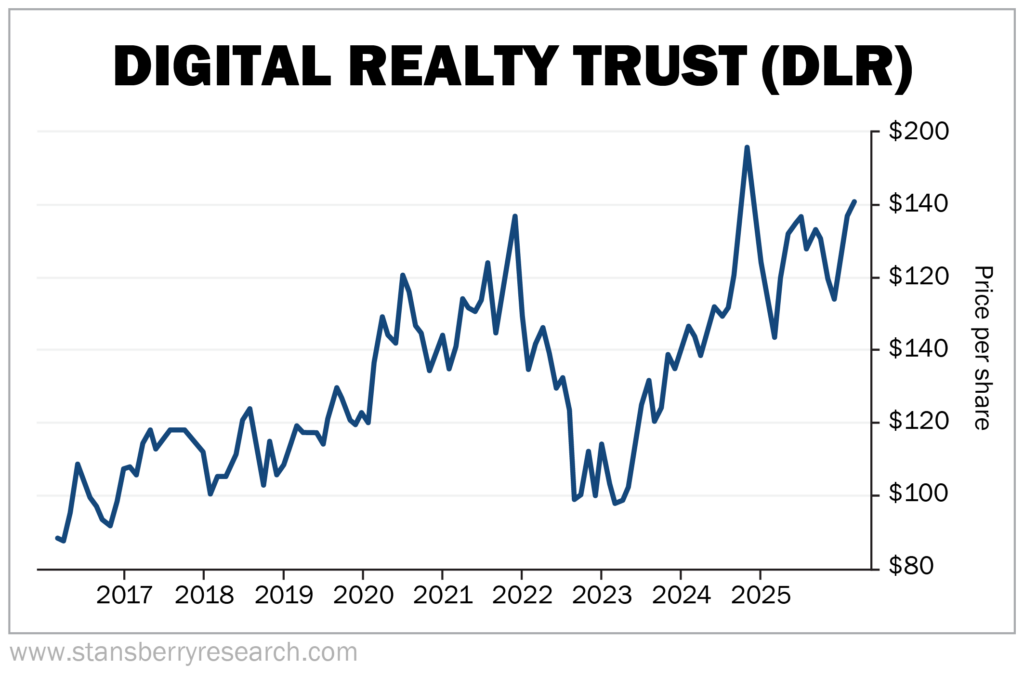
And its stock has been on a (mostly) steady rise for the past decade… from $85.23 on March 10, 2016 to roughly $180 10 years later. That’s growth of more than 111%.
In 2025, the company’s core funds from operations (“FFO”) per share increased 10.1% year over year, finishing at $7.39. Digital Realty’s operating revenues also grew 10% to roughly $6.1 billion. And its net cash from operating activities jumped by $150.7 million year over year to more than $2.4 billion.
Looking ahead, Digital Realty is projecting its core FFO per share to grow by roughly 8% to a 2026 outlook of $7.90 to $8.00. The company’s total revenues are also projected to grow to around $6.6 billion in 2026.
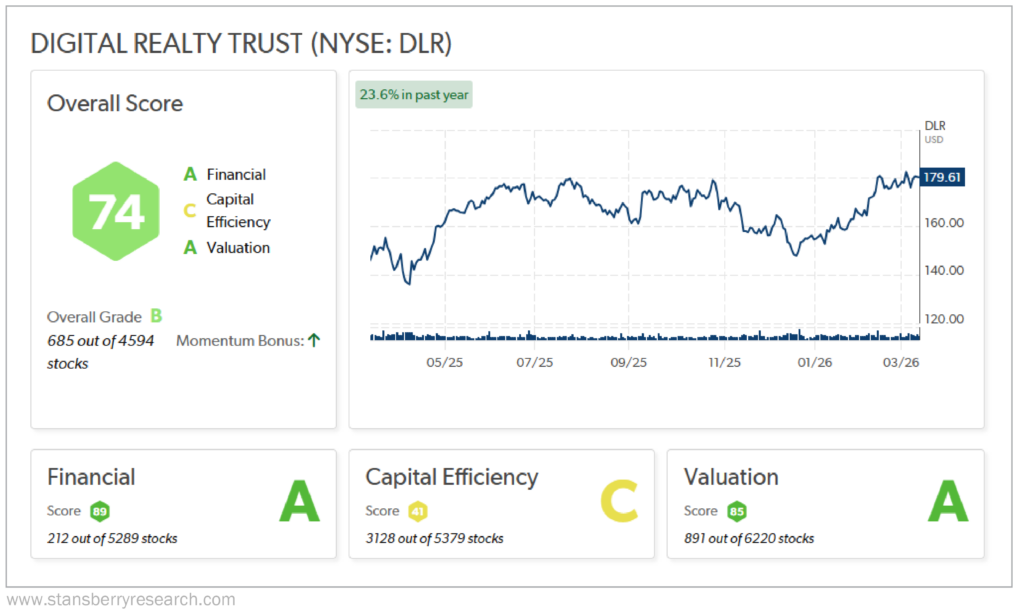
Digital Realty’s Stansberry Score, a tool that helps determine the quality and long-term value of thousands of stocks, reflects these forecasts with a strong “B” grade. Its Financial mark (“A”) is outstanding, as you just read. And DLR’s Valuation also earns an “A”, making the stock a solid bet for long-term investors.
As hyperscalers continue to increase their capex commitments and their AI infrastructure expansion, it’s data center REITs like Digital Realty – and their investors – that will keep reaping the benefits.
Data Center REIT No. 2: Equinix (EQIX)
As the largest data center REIT in the world, Equinix operates more than 270 data centers across 77 global markets on six continents. It also counts hyperscalers like Google, Amazon, and Microsoft as part of its massive customer portfolio.
Equinix, like Digital Realty, serves as a digital infrastructure hub that offers colocation, interconnection, and managed services. And, like its REIT competitor, Equinix also claims 99.999% uptime for enterprise workloads.
Connectivity is the major selling point for Equinix, however. The REIT provides 507,000-plus total interconnections across its more than 10,500 customers, which include more than 2,000 networks, roughly 3,000 cloud and IT service providers, and 5,500-plus enterprises.
Last fall, Equinix introduced its Distributed AI infrastructure, with tools that help enterprises deploy AI workloads efficiently across regions through low-latency AI.
The company is laser-focused on the future as well. It’s investing substantially – $4 billion to $5 billion a year from 2026 through 2029 – in doubling its data center capacity by 2029. That strategy could also double the REIT’s value by 2030.
Equinix currently has the space to deploy 3 gigawatts (“GW”) of capacity. That’s roughly three times the amount it takes to power an entire city the size of San Francisco each day.
Equinix also has nearly 60 significant projects underway globally. This includes 12 of its AI-ready hyperscale xScale data centers.
And in early March, Equinix and Canada Pension Plan Investment Board (CPP Investments) announced a joint agreement to acquire atNorth, a leading Nordic data-center services company, in a $4 billion strategic transaction. Equinix will hold a 40% stake. This deal immediately expands its European AI infrastructure and high-density colocation capacity.
Everything above points to strong revenue and solid dividend yields in the coming years.
Equinix has increased its dividend for 11 consecutive years and pays an annual dividend of $20.64 per share, with an annual increase of 12% over the past five years. The company currently pays roughly 150.1% of its earnings and 59.43% of its cash flow as dividends.
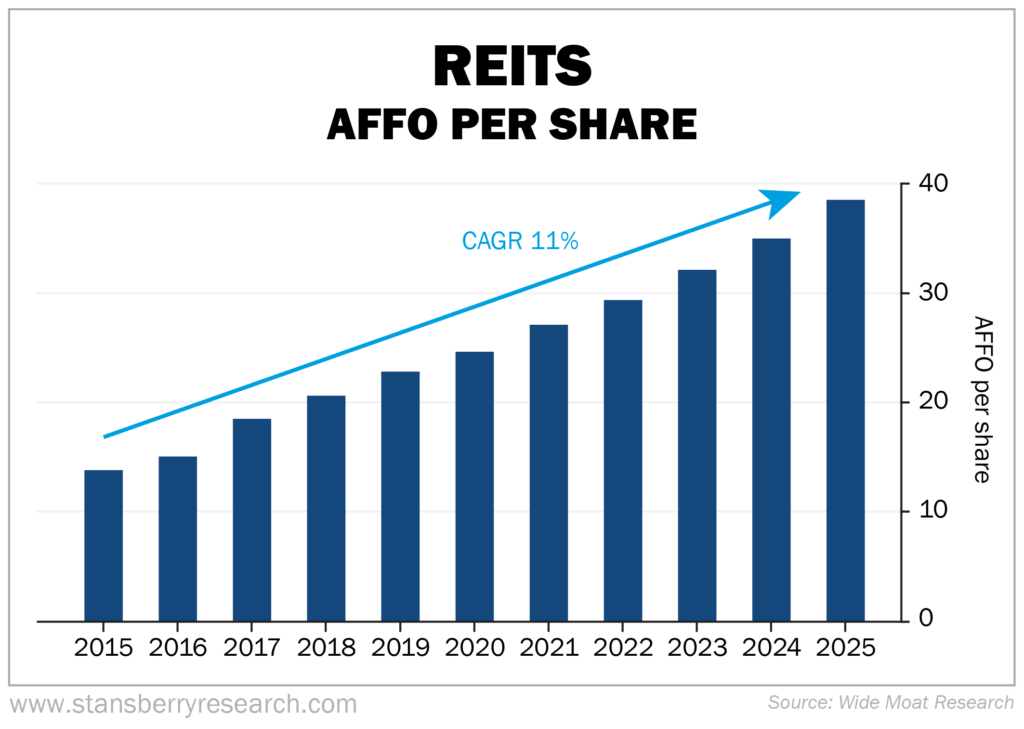
The REIT’s AFFO per-share growth, meanwhile, has consistently increased over the past decade at an 11% CAGR.
Equinix’s agreement to acquire atNorth is also expected to immediately boost the REIT’s AFFO per share upon close.
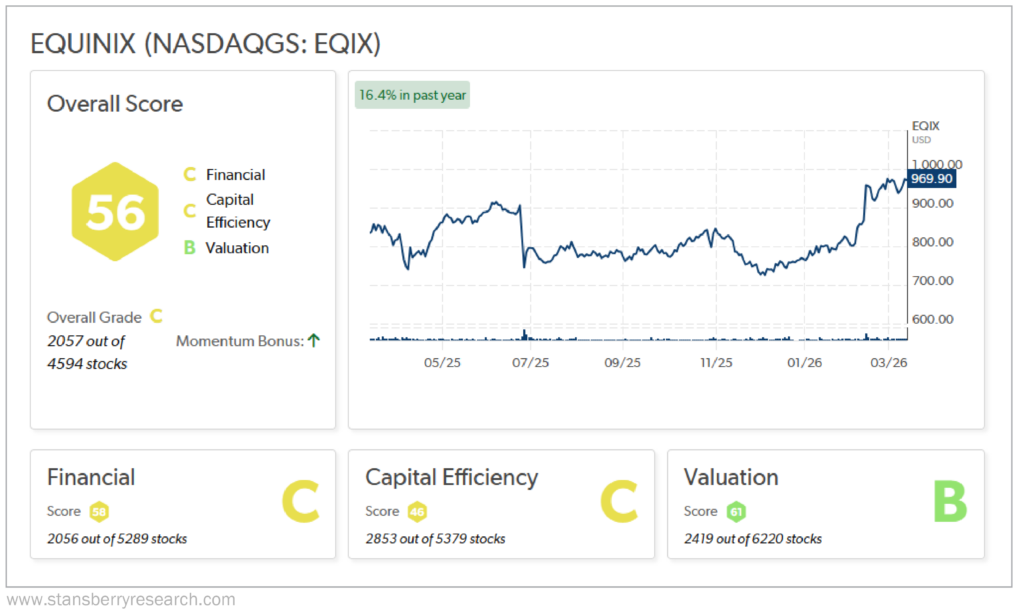
While EQIX’s Stansberry Score may not wow you (an overall “C”), it’s important to keep a few things in mind when considering whether to invest in the REIT.
- Equinix projects 9% to 10% revenue growth in 2026. And 2025 revenue increased 6% from 2024.
- Its AFFO per share is projected to increase 8% to 10% in 2026.
- More than 60% of existing Equinix customers added new services in 2025.
- Equinix delivered $474 million in annualized gross bookings in the fourth quarter of 2025. That’s a 42% year-over-year increase and a company record. Overall, in 2025, annualized gross bookings increased 27% to $1.6 billion.
- Equinix exceeded 500,000 global interconnections in 2025, the most in the industry.
Equinix’s ability to provide fast, connected AI hubs should prove beneficial as AI continues to move closer to users and businesses.
This is clearly a REIT with momentum on its side and tailwinds at its back.
Risks of Investing in Data Center REITs
Investment in any AI-related stock comes with some level of risk. Here are a few to consider before investing in data center REIT stocks:
- AI stocks are highly volatile, and data center REITs are not immune. Boom and bubble sensitivity can swing prices sharply in either direction.
- As we’ve outlined in this space many times, AI’s thirst for power is nearly unquenchable. Energy companies – from natural gas to electricity to nuclear power – are working to address this critical issue. But the reality is that current power grid constraints could slow AI growth.
- REITs are sensitive to interest rates since they rely on debt to buy property. If interest rates rise, borrowing costs rise with them, and profit margins shrink.
- Data center REIT stocks often trade at premium valuations thanks to intense AI infrastructure-driven demand and the instrumental role that REITs play.
- Data center REITs continue to pour more capital into expansion projects. Understandably so, considering how much long-term value those expansions add. But in the short term, more capex equals less cash flow.
Data Center REITs vs. Tech Stocks: A Steadier Way to Play AI
Semiconductors get the headlines, but the role infrastructure plays in this era of AI is just as – if not more – critical.
And data centers, as well as the real estate investment trusts that own and help operate them, are becoming increasingly profitable investments in that infrastructure.
The two data center REITs we looked at today are pivotal players in AI real estate. Digital Realty owns the large campuses used to train AI (while increasing its inference capabilities as well). And Equinix provides the hubs that connect AI technology with users around the world.
While there is an element of risk involved with investing in data center REIT stocks, they may ultimately prove to be a safer, steadier long-term play than the more volatile tech stocks.
In closing, it feels appropriate to go back to Brad Thomas for one more nugget … “REITs are on the rise!”
Regards,
David Engle
Editor’s note: Forbes calls $1 billion fund manager Louis Navellier “the king of quants.”
Today, he’s stepping forward to reveal why he’s investing $358 million of his own firm’s money in the next stage of artificial intelligence… a technological sea change that could erase millions of jobs, solve humanity’s biggest mysteries, and spark a wave of moneymaking opportunities — both in and outside the stock market.
Click here to learn what this next stage of AI is and how you can benefit from Navellier’s insight.