

Listen to the audio version of this article (generated by AI).
Stocks slid again on September 15, 2026. The Dow was on pace for its worst September since 2008, Brent crude sat near $107 a barrel, and the 10-year Treasury yield touched its highest level for the first time since 2007, all as the Federal Reserve opened a two-day meeting. Days like this are when the sell button gets pushed, and for most people, there is no rule behind the click. A 2026 MarketWise survey of 1,012 Americans who invest found that nearly four-fifths have no consistent selling strategy.
Everyone researches what to buy, but almost no one plans the exit. The result is a market full of people who can name every reason they bought a stock and go quiet when you ask when they will sell it. Most say selling is harder than buying, nearly all have held a loser too long or sold a winner too early, and more than half admit fear or greed has picked the moment for them at least once.
Key Takeaways
- Nearly 4 in 5 (78%) Americans who invest have no selling strategy they consistently follow.
- Almost 7 in 10 (69%) Americans who invest say deciding when to sell is harder than deciding what to buy.
- Nearly 9 in 10 (88%) Americans who invest have held a losing investment too long and watched it fall further.
- Nearly 4 in 5 (78%) Americans who invest focus on the price they originally paid when deciding whether to sell.
- Over half (52%) of Americans who invest say fear or greed has caused them to sell at the wrong time.
Most Investors Have No Rule for Selling
Ask people how they decide to sell and most describe a feeling, not a plan.
Most Investors Are Selling Without a Clear Plan
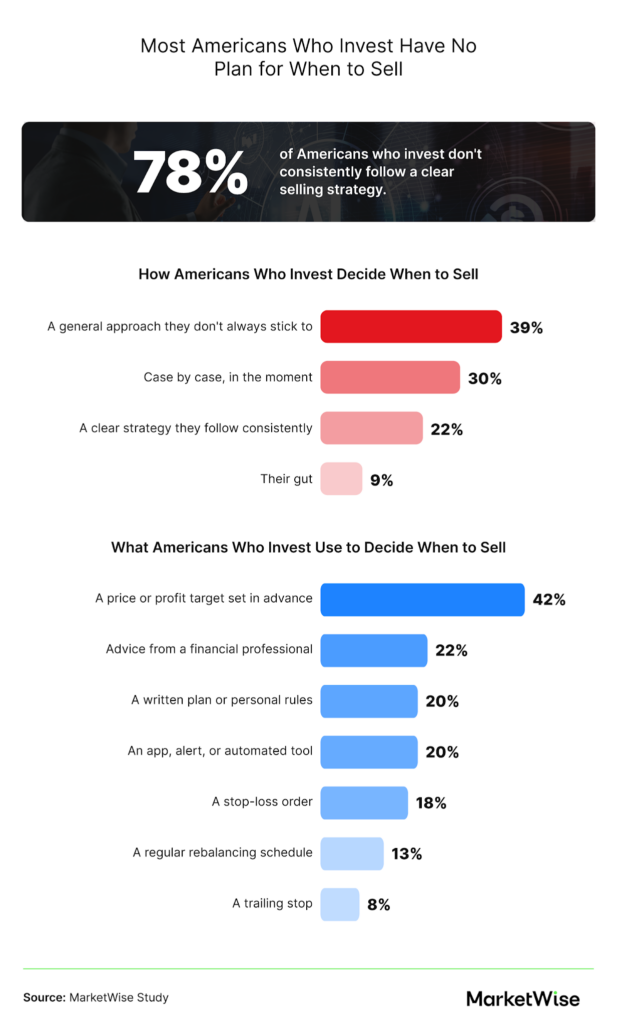
- Nearly 4 in 5 (78%) Americans who invest have no selling strategy they consistently follow.
- Nearly 3 in 5 (58%) wish they had a clearer strategy for when to sell.
- Over half (54%) rate their own ability to know when to sell as only fair or poor.
What Investors Use to Decide When to Sell
- Over 2 in 5 (42%) American investors use a price or profit target set in advance, the most common tool, while over 1 in 4 (27%) use no tool at all and decide as they go.
- Fewer than 1 in 5 use a stop-loss order (18%), an order that sells automatically once a stock falls to a price you set, and fewer than 1 in 10 use a trailing stop (8%), a stop-loss that ratchets up as the stock climbs.
Who Is Most Likely to Sell Without a Set Strategy
- Over 2 in 3 Gen Z investors (68%) don’t consistently follow a clear selling strategy, the lowest share of any generation, followed by millennials (79%), Gen X (80%), and baby boomers (83%).
- Women who invest are more likely than men to decide on a case-by-case basis (35% vs. 26%), and more of them wish for a clearer strategy (63% vs. 54%).
- The gut-feel crowd wants help the most: 76% of those who go with their gut wish for a clearer strategy, compared with 41% of those who already follow one.
Investors With a Strategy Report Less Emotional Selling
- Americans who invest and follow a clear strategy are less likely to say that fear or greed has led them to sell at the wrong time (43%) than those who go with their gut (56%).
- They are also less likely to name anxiety as a driver of their selling decisions (26% vs. 45%) and more likely to name confidence (36% vs. 25%), an association rather than proof that a plan removes the nerves.
- Over 2 in 5 who follow a clear strategy (44%) have never panic-sold in a market drop, compared with 35% of the gut-feel group.
What Actually Triggers Investors to Sell
- Over 2 in 5 (42%) of American investors have sold because they needed the cash, and about as many (43%) have sold because they hit a price target.
- Gen Z is the most likely to have sold on a gut feeling (37%), followed by millennials (33%), Gen X (29%), and baby boomers (28%); a third (33%) overall have done it, and over 1 in 4 (27%) have sold because of a major news or world event.
- Nearly 1 in 4 (24%) have sold simply because they got bored or lost confidence in the investment, and 1 in 5 (20%) have sold in a panic during a downturn.
- Gen Z is also the most likely to call itself a group of active traders (27%), followed by millennials (19%), Gen X (12%), and baby boomers (10%).
The Selling Mistakes Almost Everyone Has Made
Without a rule, selling becomes a feeling, and the survey shows what those feelings have cost.
Investors Struggle With Both Holding Too Long and Selling Too Soon
- Nearly 7 in 10 (69%) U.S. investors say deciding when to sell is harder than deciding what to buy.
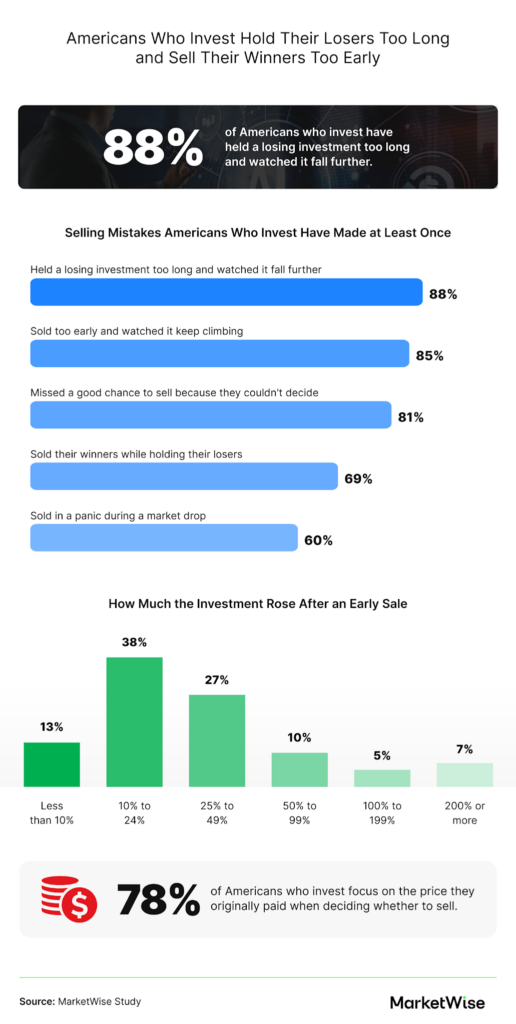
- Nearly 9 in 10 (88%) have held a losing investment too long and watched it fall further.
- Over 4 in 5 (85%) have sold an investment too early and watched it keep climbing.
- Among those who sold too early, nearly half (49%) saw the investment rise by at least 25% after they got out, and more than 1 in 10 (12%) saw it double or more.
Price and Emotion Can Take Over the Decision
- Nearly 4 in 5 (78%) of Americans who invest focus on the price they originally paid when deciding whether to sell, a habit known as anchoring, judging a stock by what you paid rather than what it is worth now.
- Over half (52%) say fear or greed has caused them to sell at the wrong time.
- Anxiety (41%) and fear (34%) are the emotions most likely to drive selling decisions, with impatience (30%) rounding out the top three; nearly 1 in 5 (18%) say they feel nothing about selling at all.
Even Confident Investors Make Selling Mistakes
- Even the confident ones slipped: among those who rated their ability to know when to sell as good, 87% have still held a loser too long, 86% have sold too early, and 81% have missed a good chance to sell.
- Over 1 in 3 (36%) name selling too early as their single biggest selling regret, ahead of holding on too long (28%) and panic selling (13%); just over 1 in 10 (11%) have no regrets at all.
Selling Behavior Varies by Trading Style, Generation, and Gender
- Nearly 9 in 10 active traders (88%) have panic-sold in a market drop at least once, compared with 46% of buy-and-hold investors.
- Over half of Gen Z (57%) have sold or held an investment because of what they saw others doing online, followed by millennials (48%), Gen X (38%), and baby boomers (27%).
- Just over 2 in 5 (41%) say there are investments they will never sell, no matter what happens.
- Men are more likely than women to strongly agree that fear or greed has made them sell at the wrong time (16% vs. 10%).
Methodology
We surveyed 1,012 U.S. investors about how they decide when to sell an investment, including whether they follow a strategy or decide in the moment, what has triggered their sales, how often they have sold too early or held too long, and the emotions behind those decisions. All respondents were adults age 18 or older, representing a mix of generations, investing styles, and genders. The generational breakdown was 49% millennials, 24% Gen X, 18% Gen Z, and 8% baby boomers. By gender, 56% were men, 42% were women, and 1% were non-binary. Data was collected in 2026. Percentages may not total to 100% due to rounding.
About MarketWise
MarketWise is a leading financial research and education platform serving self-directed investors. Through a network of independent brands, including Stansberry Research, Altimetry, Chaikin Analytics, TradeSmith, InvestorPlace, Brownstone Research, and Wide Moat Research, MarketWise delivers independent insights, tools, and software to help individuals navigate complex markets with confidence. Whether you’re exploring emerging opportunities or seeking stability, MarketWise supports every investor with credible research and actionable strategies.
Fair Use Statement
We welcome the use of this study for noncommercial purposes. If you share or reference any part of this content, please include a link back to this page to credit MarketWise appropriately.