

Listen to the audio version of this article (generated by AI).
If you ask a young investor how they built their portfolio, family money is often part of the answer. MarketWise surveyed 704 U.S. investors ages 18 to 34, along with 305 parents of adult children, to find out how family support influences young adults’ ability to invest. The help ranges from covering rent and phone bills to parents opening and funding brokerage accounts, and for some young investors, it’s the only reason they’re in the market at all.
Key Takeaways
- 11% of investors under 35 say they wouldn’t own any investments at all without family support, rising to 25% among those whose family covers their housing entirely.
- 43% of investors under 35 describe themselves as self-made investors, including 37% who still receive ongoing financial support from family.
- The average young investor says one-third of their monthly investing would disappear without family assistance, and nearly 1 in 5 young investors who receive family support would stop investing altogether.
- Nearly 1 in 4 young investors had family involved in opening their first investment account, while 41% of parents say they opened one for their child.
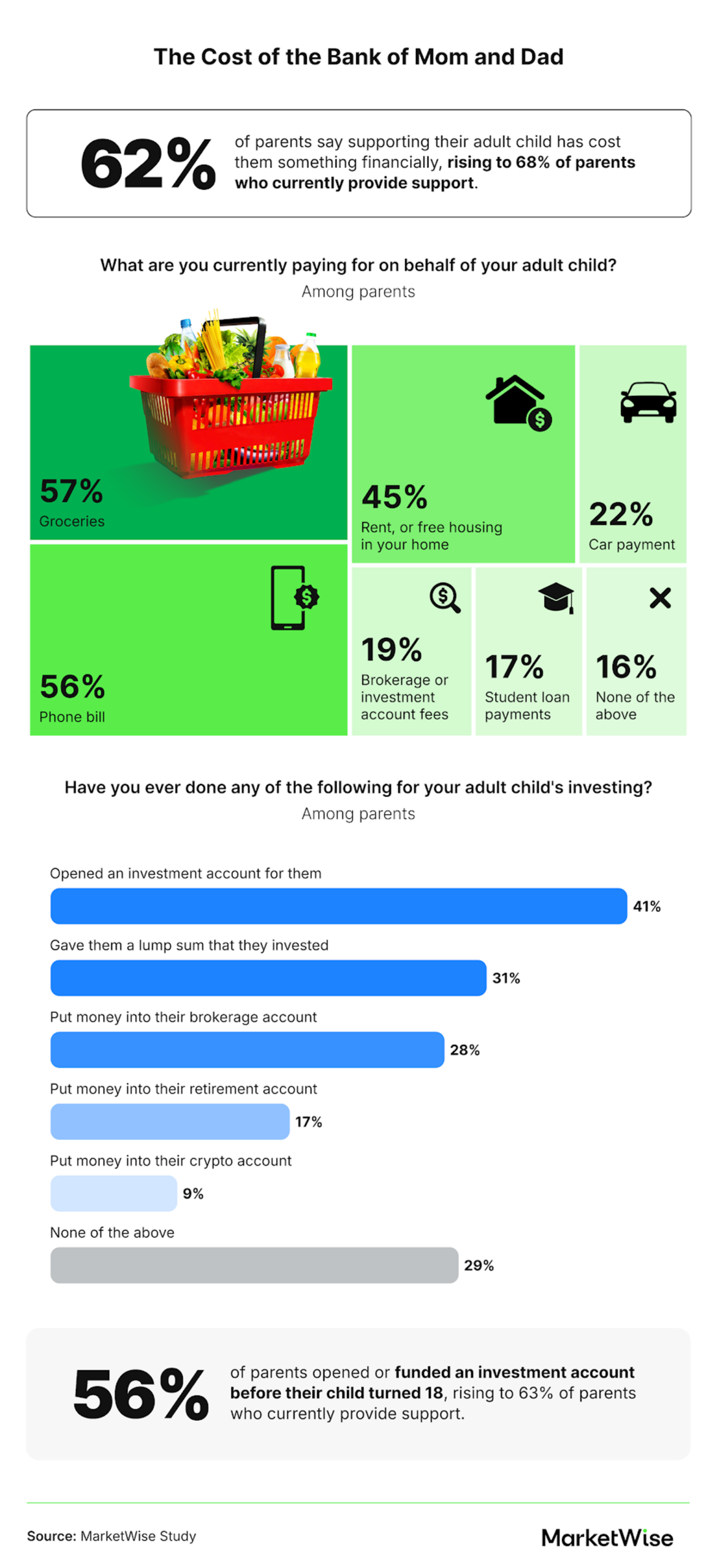
- 43% of parents have cut back on their own savings or investing to support an adult child, and 62% say it’s hurt them financially overall.
Family Support Is Quietly Funding Young Investors
A portfolio balance doesn’t always tell the full story of how someone can afford to invest. For many younger investors, help with everyday expenses creates financial breathing room that can make regular market contributions possible.
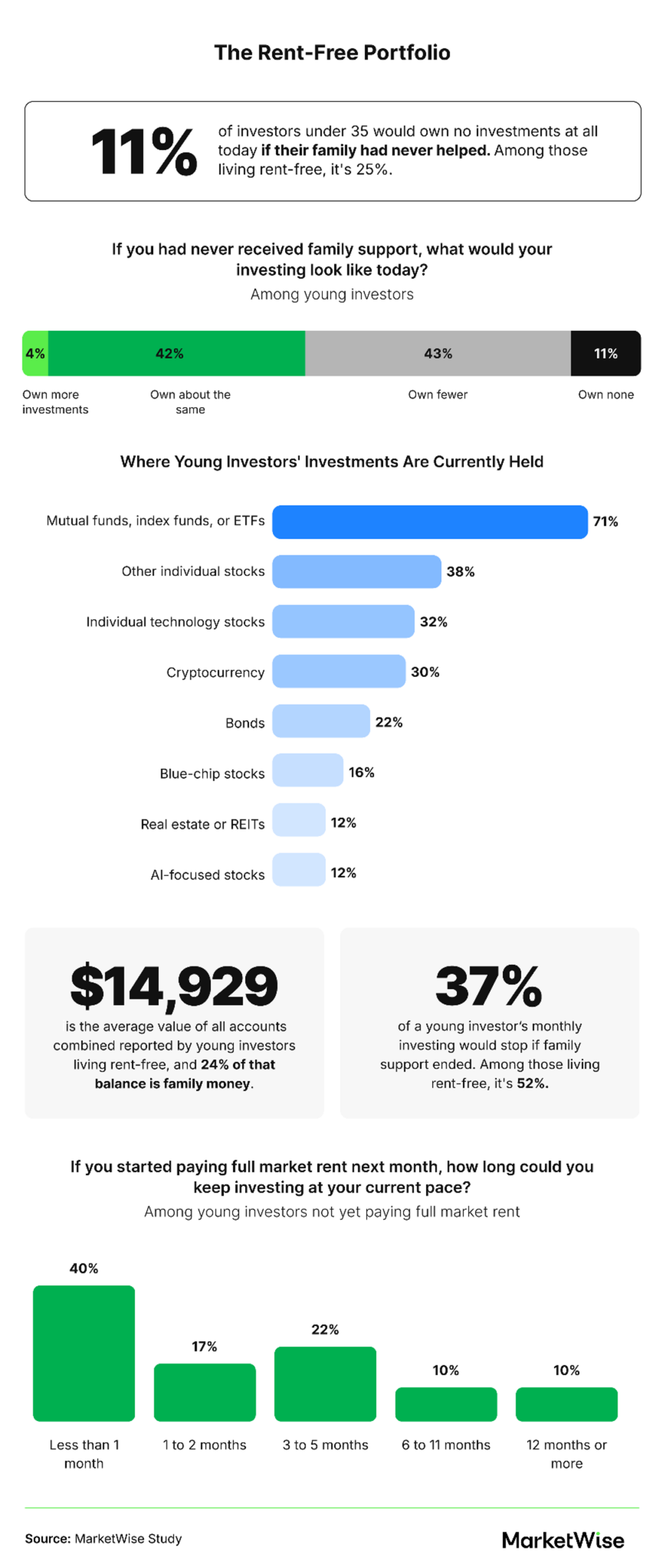
Among investors under 35, 11% said they wouldn’t own any investments without family support. That figure rose to 25% among those living rent-free, showing how something as basic as having housing covered can play an important role in getting money into the market.
Family assistance extended well beyond housing. Young investors reported that parents or relatives currently paid for phone bills (35%), rent or housing (28%), groceries (21%), car payments (10%), student loan payments (8%), and brokerage or investment account fees (4%). Meanwhile, 46% said their families paid for none of those expenses.
Living with family was also common: 37% of investors under 35 still did so. Among that group, half said they were at least three years away from moving out, including 11% who didn’t expect to move out at all.
That support appears to have meaningful consequences for investing capacity. Young investors contributed an average of $492 per month to the market, but estimated that one-third of their monthly investing would disappear without family assistance. Among young investors who receive family support, nearly 1 in 5 said they would stop investing altogether if the help ended.
Self-Made, With a Little Help
Financial independence can mean different things to different people. For many young adults, getting help early doesn’t cancel out the sense that they’ve built something themselves.
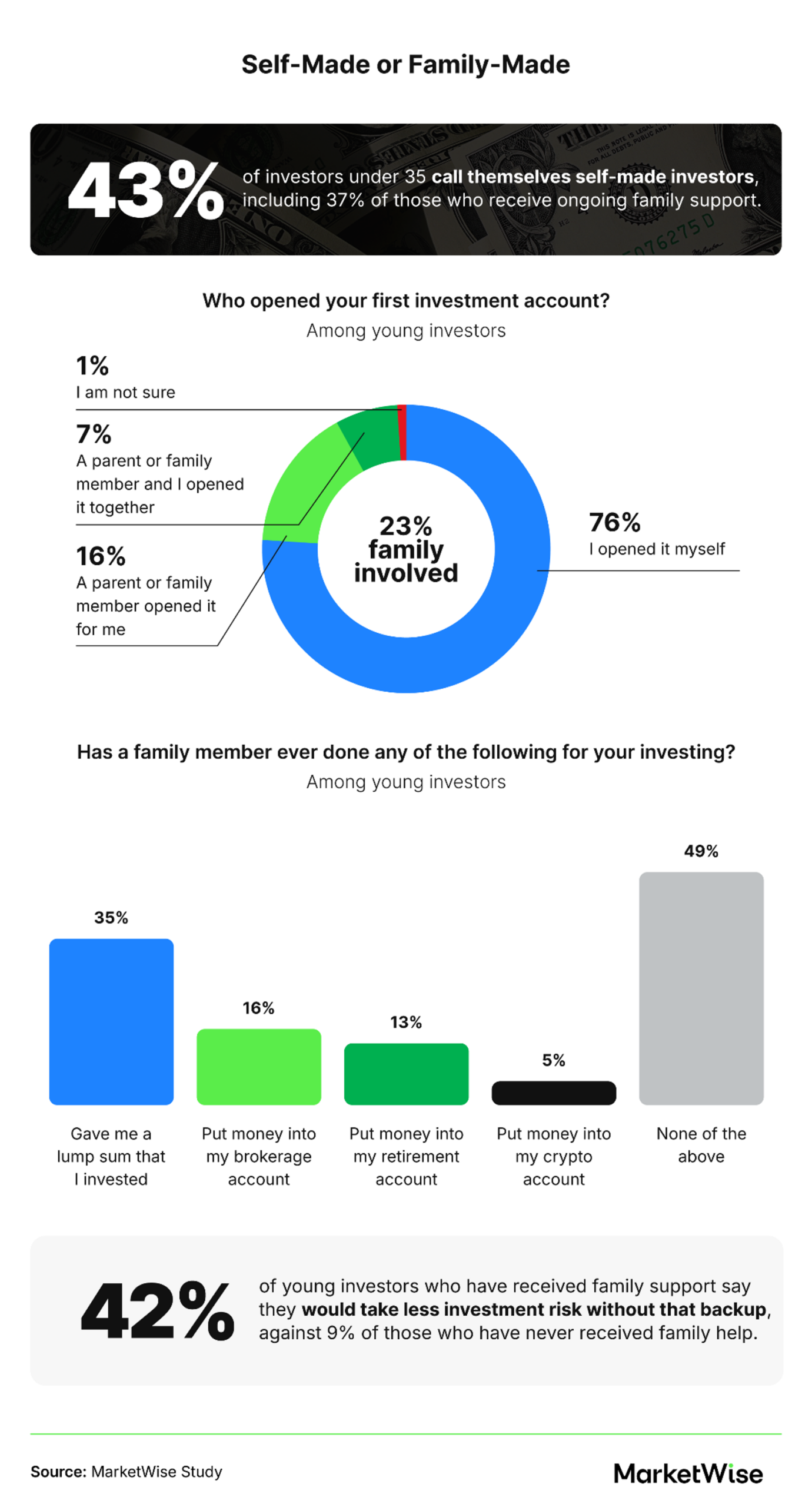
Among investors under 35, 43% considered themselves self-made investors. That included 37% who also received ongoing financial support from family, suggesting that for many young adults, accepting help and feeling self-made can coexist comfortably.
Family involvement can begin before a young investor makes their first trade. Nearly 1 in 4 young investors had a family member involved in opening their first account, whether a parent opened it for them or they opened it together. For a sizable share of young adults, then, the first step into investing may have been a shared one.
Parents See Their Support as an Investment in Independence
Parents aren’t necessarily writing checks with repayment in mind. Many appear to view financial support as a way to give their adult children a stronger foundation, even when doing so creates trade-offs for their own finances.
Nearly half of parents (47%) called the money they gave their adult children an investment in their independence. Just 5% described it as a loan they expected to be repaid. Yet parents didn’t always know where that assistance ultimately went: 26% didn’t know what their adult child invested in, while 34% didn’t know or weren’t sure whether their money had gone into cryptocurrency.
The support also came at a real cost. Nearly two-thirds of parents (62%) said supporting an adult child had hurt them financially, rising to 68% among parents who were currently providing support.
Some parents made substantial trade-offs to keep that support flowing. Among those surveyed, 43% had reduced their own savings or investing, 24% had delayed or reduced travel, and another 24% had taken on debt. Others postponed a major purchase (23%), delayed retirement (15%), or returned to work or took on additional work (14%). Only 32% said supporting an adult child had caused none of those consequences.
The Family Money Behind the Portfolio
Young investors are the names on their brokerage accounts, and family support often helps create the conditions that make investing possible. Some receive free housing or help with recurring bills, while others have parents who opened their first investment accounts. Even among those receiving ongoing assistance, many consider themselves self-made investors, and for this generation, both can be true at once.
Parents, meanwhile, largely viewed their contributions as investments in their children’s independence, alongside the financial sacrifices involved. As younger generations build their own portfolios, the picture that emerges is less about who did it alone and more about how family and personal effort work together to open the door to investing.
Methodology
MarketWise surveyed 704 U.S. adults aged 18 to 34 who hold at least one investment account about what their families cover for them, who opened and funded their accounts, how long they could keep investing if that support ended, and whether they consider themselves self-made. The generational breakdown was 54% Gen Z and 46% millennials, and the gender breakdown was 49% men, 47% women, and 4% non-binary or undisclosed.
MarketWise also surveyed 305 U.S. parents of adult children about what they currently pay for on their child’s behalf, what they have contributed to their child’s investing, how they view that money, and what it has cost them. Of the parent respondents, 56% were women, and 42% were men. Data was collected in August 2026.
About MarketWise
MarketWise is a leading financial research and education platform serving self-directed investors. Through a network of independent brands, including Stansberry Research, Altimetry, Chaikin Analytics, TradeSmith, InvestorPlace, Brownstone Research, and Wide Moat Research, MarketWise delivers independent insights, tools, and software to help individuals navigate complex markets with confidence. Whether you’re exploring emerging opportunities or seeking stability, MarketWise supports every investor with credible research and actionable strategies.
Fair Use Statement
We welcome the use of this study for noncommercial purposes. If you share or reference any part of this content, please include a link back to this page to credit MarketWise appropriately.