

Listen to the audio version of this article (generated by AI).
Picture a successful investor, and you might imagine someone older, wealthy, and glued to a trading terminal. The data tells a different story. When MarketWise surveyed 1,014 U.S. investors about how they research, trade, and handle a falling market, the standout performers were spread across ages and income levels, with about half under 40 and half earning less than $100,000 a year.
We compared the routines of “successful investors,” those with consistent multi-year results and either high confidence in their process or a track record of matching or beating index funds, against everyone else. The same handful of habits kept surfacing, and they had less to do with luck or market timing than with a repeatable approach almost anyone can learn.
Key Takeaways
- Just 29% of independent investors qualify as “successful investors,” a disciplined minority marked by steady, multi-year results and confidence in their outcomes.
- The habit successful investors credit most for their results is holding through downturns instead of selling (27%).
- During the market’s last sharp drop, 42% of these investors bought more, compared to 17% of other independent investors.
- In this year’s volatile market, 49% of successful investors have felt pulled to buy the dip, while just 14% have leaned toward selling to protect gains.
- Successful investors are more than twice as likely to follow a written plan closely (36% vs. 16% of other investors).
- 4 in 5 successful investors say their discipline was learned over time rather than something they were born with.
- A large majority of successful investors (84%) turn to at least one digital source for ideas, though only 22% act on AI and 14% on social media.
- 67% say success comes down to skill and habits rather than luck or timing, a view held by 50% of other independent investors.
The Calm Investing Minority Who Buy the Dip
The investors who came out ahead didn’t stand out for the size of their account balance or their age, but for how they behaved when the market got ugly.
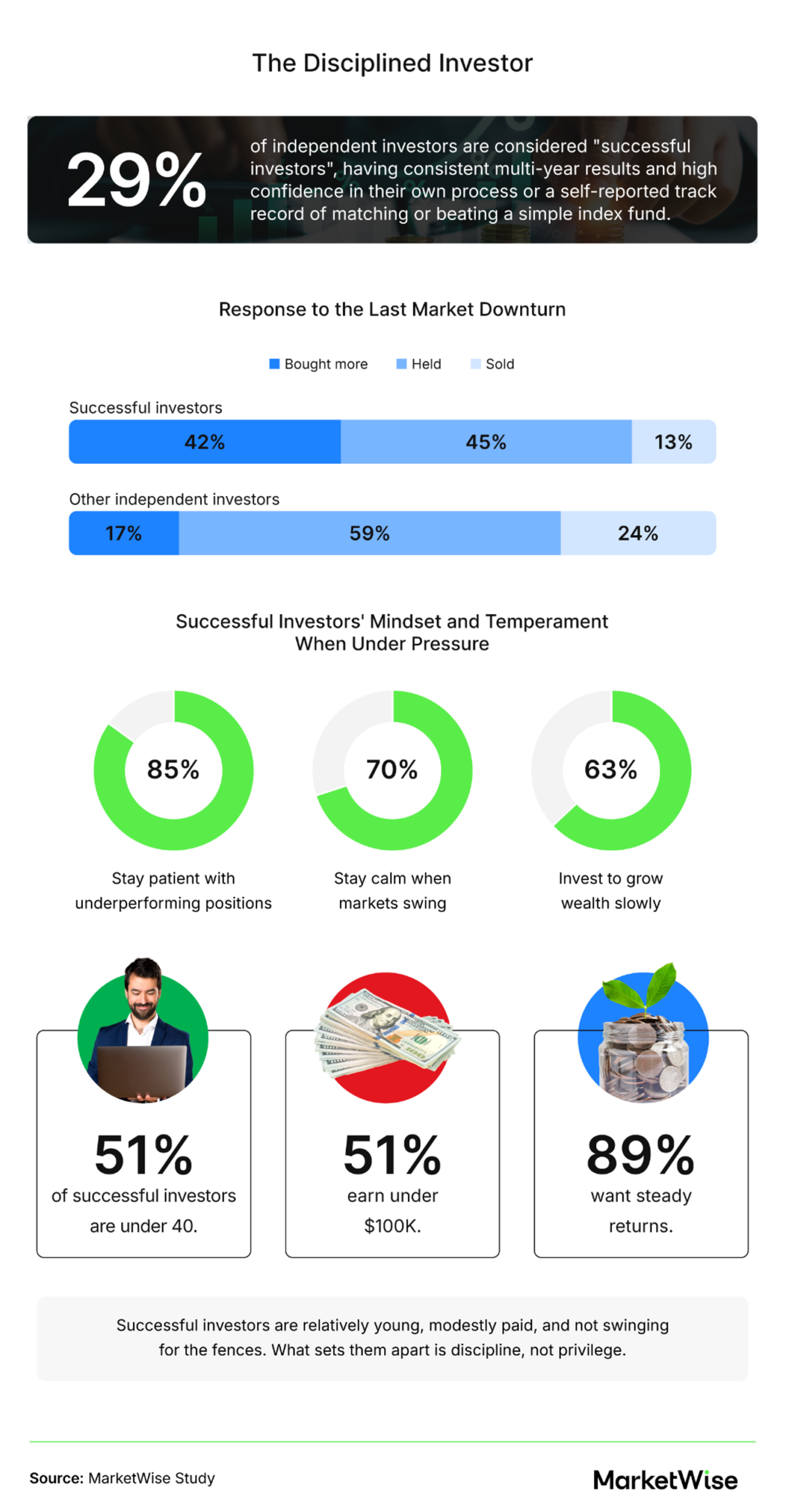
Successful investors accounted for 29% of independent investors in our study, and their edge was clearest during a sell-off. The last time the market dropped sharply, 87% held their positions or bought more, compared with 76% of other independent investors. Even more telling, 42% actually bought more during that drop, versus just 17% of everyone else.
That composure showed up in results. Nearly three-quarters (74%) of successful investors said they had beaten a simple index fund over the past three years, compared with only 11% of other independent investors. And the group looks a lot like the average American investor rather than a corner-office elite: about half are under 40, half earn less than $100,000 a year, and roughly a third hold portfolios under $50,000.
Their edge is temperament as much as tactics. Most stay patient when a position lags (85%) and keep calm instead of obsessively checking their accounts when things get choppy (70%). Most are playing a long game, too: 63% are investing to build wealth slowly, while only 11% are trying to beat the market. So it tracks that heading into this year, 49% felt the pull to buy the dip, while just 14% wanted to sell and protect gains.
The Boring Investing Playbook That Actually Works
If you’re looking for the secret sauce of successful investors, you might be surprised to find it’s not a flashy stock pick. Instead, it’s all about having a reliable game plan that they can follow, day in and day out.
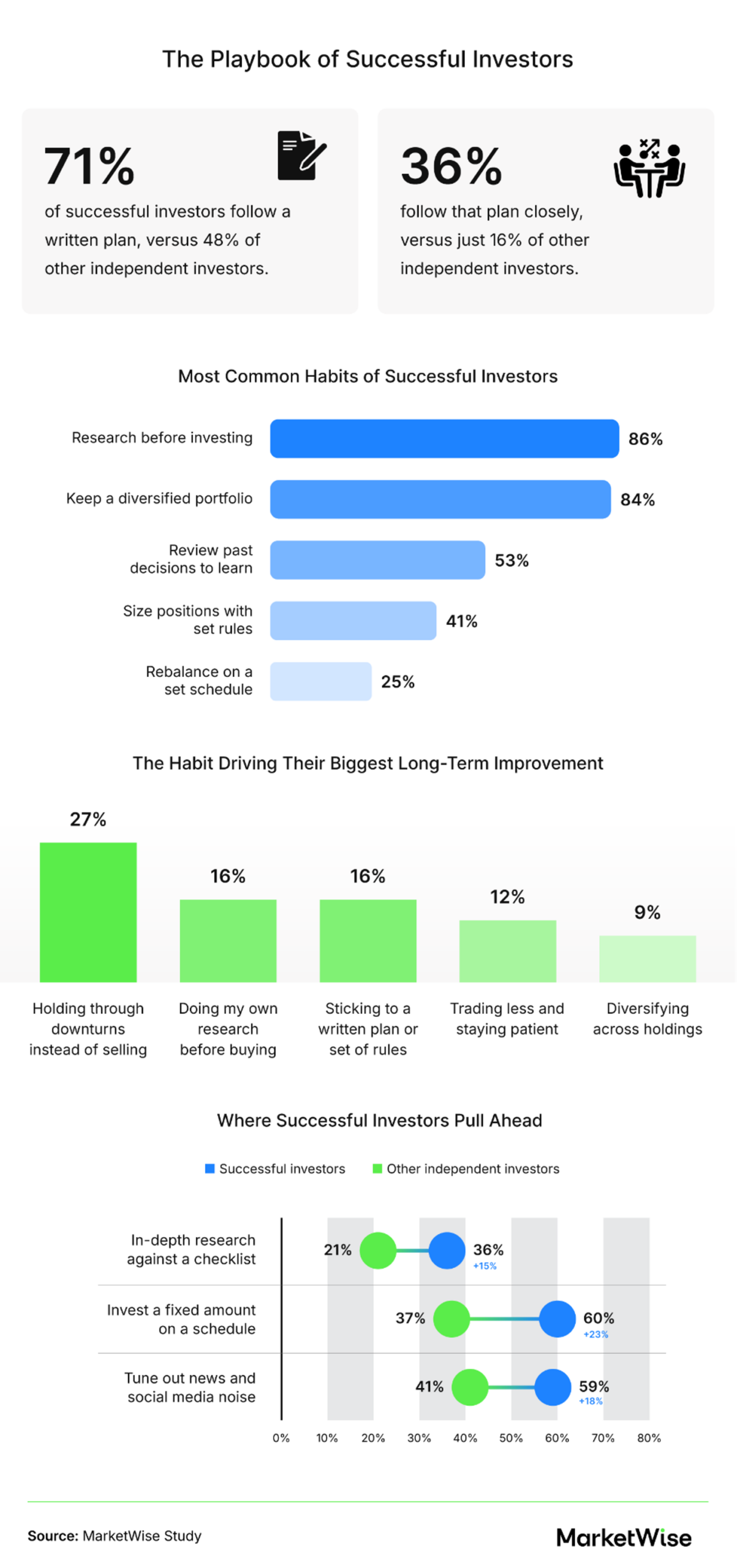
Successful investors were far more likely to keep a written plan (71% vs. 48% of other independent investors) and more than twice as likely to follow it closely (36% vs. 16%). Many pair that plan with homework, with 36% running deep research against a checklist before buying, compared with 21% of everyone else.
When asked which single habit improved their results most, holding through downturns instead of selling led at 27%, ahead of doing their own research (16%) and sticking to a written plan (16%). Their most common habits are simple, too: 86% research before investing, 84% keep a diversified portfolio, and 53% review past decisions to learn from them.
Successful investors were more likely than others to invest a fixed amount on a schedule (60% vs. 37%) and to tune out news and social media noise (59% vs. 41%). Other habits were less common across this group. About 34% trade just a few times a year, 25% rebalance on a set schedule, and 25% keep a written journal of why they buy or sell.
Modern Tools, Steady Hands
Successful investors are far from unplugged, but they treat what they find online as a starting point rather than a signal to act.
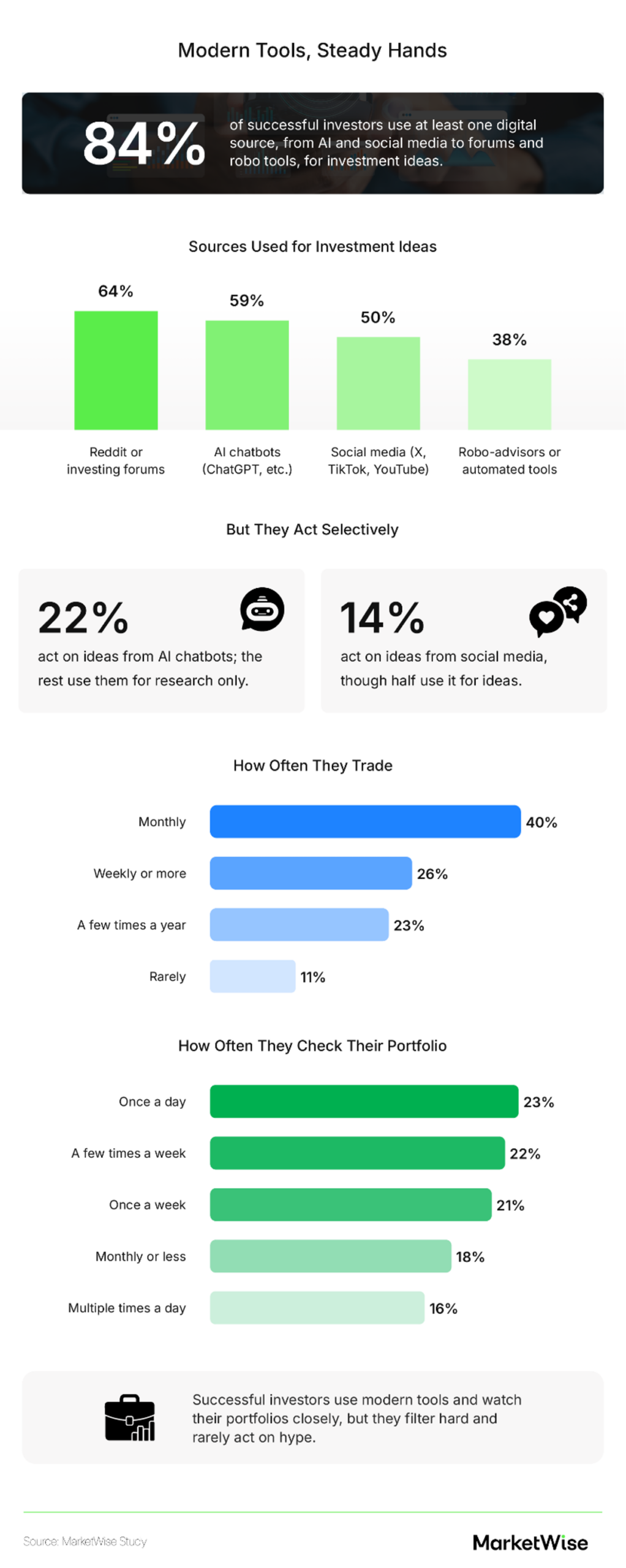
A full 84% of successful investors use at least one digital source for ideas, from AI and social media to online forums and robo-advisors. Reddit and investing forums led the way (64%), followed by AI chatbots like ChatGPT (59%), social platforms (50%), and automated tools (38%).
The discipline shows up in what they ignore. They mine these sources for ideas but act selectively. Only 22% acted on tips from AI chatbots, and only 14% acted on what they saw on social media. They stay engaged rather than detached, too, with 39% checking their portfolio at least once a day and 66% trading monthly or more often.
The Investing Discipline Anyone Can Build
The steadiness that defines this group of successful investors wasn’t handed to them. It came from years of trial, error, and course correction.
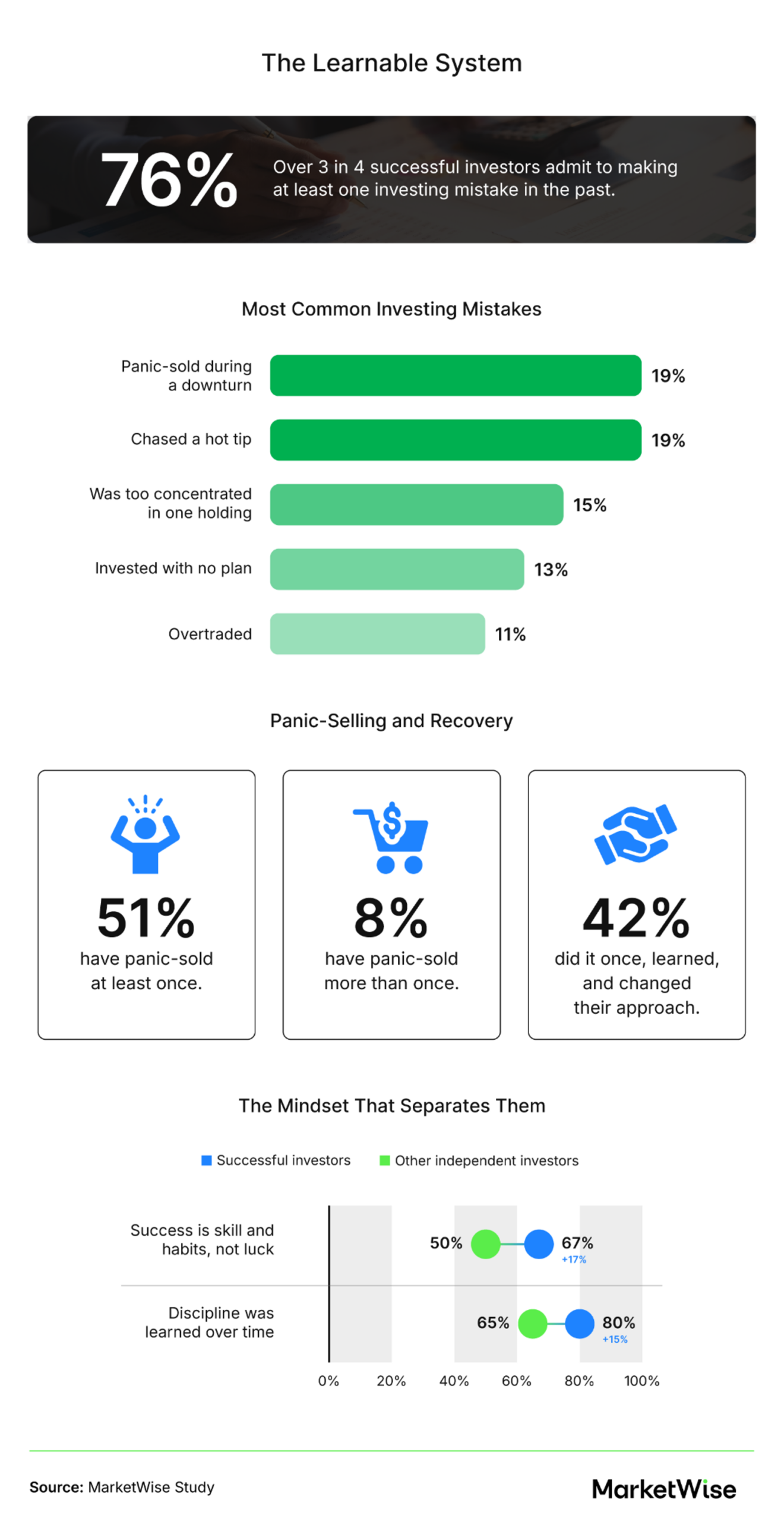
The encouraging part is that these investors’ discipline came from experience. More than three-quarters (76%) owned up to a past investing mistake. The confessions were familiar ones, from panic-selling in a downturn (19%) and chasing a hot tip (19%) to getting too concentrated in one holding (15%), investing with no plan (13%), and overtrading (11%).
That track record of mistakes is the point. Four in five (80%) said their discipline was learned over time rather than something they were born with, well above the 65% of other independent investors who said the same. Roughly half (51%) have panic-sold at least once, and most changed their approach afterward. It adds up to a distinct mindset: 67% believe success comes down to skill and habits rather than luck or timing, compared with 50% of other independent investors.
Investing Success Is a System You Can Build
Successful investing for these investors came down to doing a handful of ordinary things consistently. The calm, confident minority wrote down a plan and followed it, researched before buying, stayed diversified, tuned out the noise, and held steady when the market dropped. Most learned these habits the hard way, through mistakes they were willing to own and fix. If you’re building your own approach, that’s genuinely good news, because the behaviors that set this group apart are ones you can start practicing today, whatever your age, income, or account size.
Methodology
MarketWise commissioned a proprietary online survey of 1,014 U.S. investors, fielded via CloudResearch Connect in 2026. Respondents ranged in age from 18 to 79 and spanned all experience levels, portfolio sizes, and investing approaches. Only complete responses tied to a unique participant ID were retained; duplicate and incomplete records were removed before analysis.
Throughout the study, “successful investors” refers to independent investors who report consistent multi-year results and either high confidence in their own process or a self-reported track record of matching or beating a simple index fund. This cohort represents 251 respondents, or 29% of the 855 independent investors in the sample. Cohort comparisons are drawn against the remaining 604 independent investors.
About MarketWise
MarketWise is a leading financial research and education platform serving self-directed investors. Through a network of independent brands, including Stansberry Research, Altimetry, Chaikin Analytics, TradeSmith, InvestorPlace, Brownstone Research, and Wide Moat Research, MarketWise delivers independent insights, tools, and software to help individuals navigate complex markets with confidence. Whether you’re exploring emerging opportunities or seeking stability, MarketWise supports every investor with credible research and actionable strategies.
Fair Use Statement
We welcome the use of this study for noncommercial purposes. If you share or reference any part of this content, please include a link back to this page to credit MarketWise appropriately.