
Listen to the audio version of this article (generated by AI).
Investors like to think their decisions come down to fundamentals, valuations, and cold, hard numbers. But the calendar may have more influence than many would care to admit.
MarketWise surveyed 1,004 U.S. investors who hold stocks, funds, or ETFs to explore how confidence shifts throughout the year, from the months that feel safest or riskiest to seasonal market beliefs, investing rituals, and the growing role of AI. The results reveal where experience, instinct, and superstition can collide when money is on the line.
Key Takeaways
- Investors say June is the calmest month of the year (27%) and that December is the most dangerous month for the market (30%).
- Investors say January is the month that feels like a fresh start for their investing (58%).
- 1 in 4 investors would follow an AI tool over their own gut if it told them to stay invested.
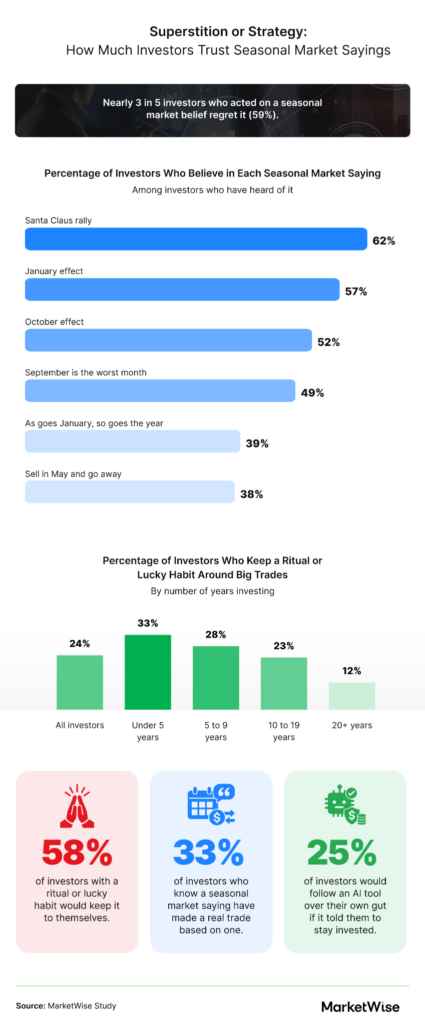
- Nearly 3 in 5 investors who acted on a seasonal market belief regret it (59%).
Investing Superstitions Fade With Experience, but AI Can Challenge Your Gut
Seasonal market sayings have been passed among investors for years. For anyone who’s unfamiliar, here’s what they mean:
- “Santa Claus rally“ refers to how stocks tend to rise during the last trading days of December and the first few trading days of January.
- “January effect” is the belief that stocks, particularly shares of smaller companies, tend to perform especially well in January.
- “October effect” is the perception that October is an unusually risky month for stocks, a reputation influenced by several historic market crashes.
- “September is the worst month” refers to the historical tendency for stocks to post weaker average returns in September than in other months.
- “As goes January, so goes the year” is the idea that the market’s January performance may signal how stocks will perform for the rest of the year.
- “Sell in May and go away” is based on the belief that stocks tend to perform better from roughly November through April than from May through October.
When Seasonal Beliefs and Rituals Influence Investing Decisions
- 59% of investors who acted on a seasonal market belief say they regret it (59%).
- Lucky rituals are less common among experienced investors: 33% of investors with under 5 years of experience have one, while only 12% of those with 20+ years of experience do.
- Gen Z (32%) and millennials (28%) are about twice as likely as Gen X (15%) to have an investing ritual.
- Only 6% of investors say they personally lost money during an October market downturn. More than half of investors (53%) have no particular view of October as a month for investing.
When AI Overrides Investor Instincts
- 23% of investors would trust an AI investing tool over their own judgment in a month they already feel uneasy about.
- 1 in 4 investors would follow an AI tool over their own gut if it told them to stay invested.
The Investor Confidence Calendar: From January Optimism to December Danger
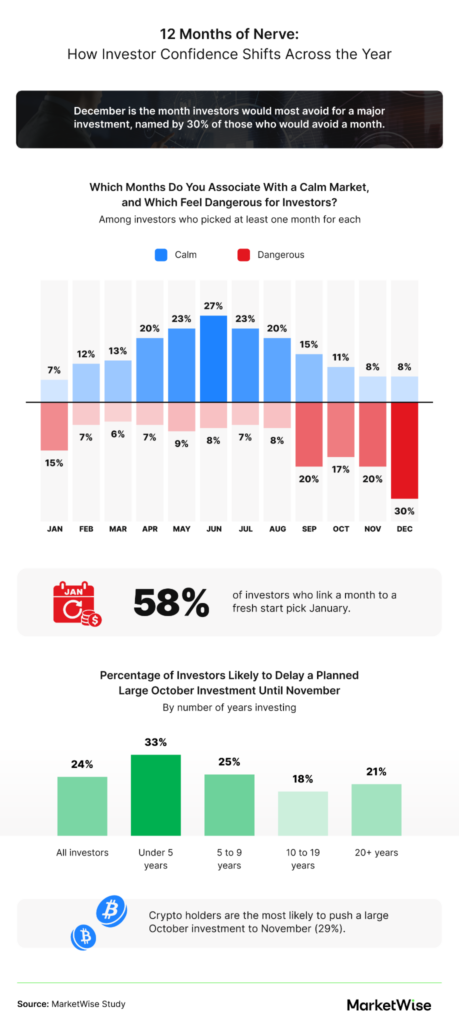
- Investors say June is the calmest month of the year (27%) and December is the most dangerous month for the market (30%).
- Investors say January is the month that feels like a fresh start for their investing (58%).
- Among investors with under 5 years of experience, 33% would likely push a large October investment to November, compared with 24% of all investors.
Methodology
We surveyed 1,004 U.S. investors who hold stocks, funds, or ETFs about how their confidence and decisions shift across the year. We asked which months they consider calm or dangerous, when they would avoid or delay a big investment, whether they believe in or have traded on seasonal market sayings, and whether they would follow an AI tool or their own instincts. The generational breakdown was 48% millennials, 26% Gen X, 18% Gen Z, and 8% baby boomers. Data was collected in September 2026.
About MarketWise
MarketWise is a leading financial research and education platform serving self-directed investors. Through a network of independent brands, including Stansberry Research, Altimetry, Chaikin Analytics, TradeSmith, InvestorPlace, Brownstone Research, and Wide Moat Research, MarketWise delivers independent insights, tools, and software to help individuals navigate complex markets with confidence. Whether you’re exploring emerging opportunities or seeking stability, MarketWise supports every investor with credible research and actionable strategies.
Fair Use Statement
We welcome the use of this study for noncommercial purposes. If you share or reference any part of this content, please include a link back to this page to credit MarketWise appropriately.