

The semiconductor industry is approaching a significant milestone: $1 trillion in global sales.
In the World Semiconductor Trade Statistics’ (“WSTS”) autumn 2025 forecast (released in December), the global semiconductor market was projected to reach $772 billion by the end of 2025. This represented a $45 billion upward revision from WSTS’s summer 2025 projection.
For 2026, however, WSTS predicts the market will grow by at least another 25%, pushing global sales to roughly $975 billion.

As artificial intelligence (“AI”) adoption continues to grow, the semiconductor industry is reaping the benefits thanks to unprecedented market expansion. According to Deloitte research, generative AI chips alone will near $500 billion in revenue in 2026… roughly half of global chip sales.
But this forecast goes beyond a software-driven AI rally. This growth is also an expansion of materials science and manufacturing driven by nanotechnology.
Which may prompt the question: What is nanotechnology?
When it comes to AI, nanotechnology is literally what makes it all possible. Everything AI-related – the advanced chips that handle the AI cloud computing, the training and running of AI models, and AI applications like chatbots, autonomous systems, and machine vision – starts at the molecular level with nanotechnology.
Let’s learn how.
What Is Nanotechnology and Why Is It So Critical for AI?
According to the U.S. National Science Foundation, nanotechnology is “the understanding, manipulation and control of matter at the nanoscale – at size ranges of about 1 to 100 nanometers – to produce new structures, materials and devices. It utilizes the unique physical, chemical, mechanical and optical properties of materials that naturally occur at extremely small scales.”
To put this size in context, a sheet of paper is roughly 100,000 nanometers thick.
Back in 2002, Intel (INTC) was considered a chip pioneer by designing semiconductors at the 90-nanometer (“nm”) level. Intel upped its game just two years later by using 65-nm process technology to incorporate even more transistor nodes onto its memory chips.
Today, manufacturers are producing semiconductors at the 2-nm level. Taiwan Semiconductor Manufacturing (TSM), for example, started 2-nm volume production in Taiwan last year, with plans to ramp up in 2026.
TSM is also upgrading its Arizona fabs (sites where semiconductors are built) from their current 4-nm production to 3 nm by 2027. The company plans to build an Arizona fab for 2-nm production by 2028.
Meanwhile, TSM’s even smaller – and more advanced – A16 (1.6-nm) semiconductors will begin production later this year in Taiwan. And A14 (1.4-nm) processes are right on the heels of A16.
A 1.4-nm transistor node would only be a few atoms wide. Which prompts another question…
Why Create Increasingly Smaller Transistors for Semiconductors?
Put simply, smaller transistors mean there is less distance electrons need to travel. This increases speed while reducing power usage… both very desirable traits for AI data center components.
Plus, smaller transistors create room for more transistors. This allows for more parallel processing units (such as processing cores and AI engines) to improve performance.
For example, compared with the 2-nm process, A16 (1.6 nm) is 8% to 10% faster and 15% to 20% more efficient power-wise. Those improvements make A16 ideal for AI data centers.
And A14 is on its way, so expect even better performance from that generation.
We’re now at the stage where the companies that manufacture chips at this level of nanometer precision literally control the physical foundation of AI.
The Nanotech Core of the $1 Trillion Market
Here, we’ll examine one stock at each layer of the semiconductor process.
ASML (ASML): The Lithography Gatekeeper
One of the big winners of the global chip wars? ASML, a Dutch semiconductor producer that makes photolithography machines.
Lithography is the process of harnessing light to optically etch circuit patterns onto silicon wafers with specialized machinery and optics. ASML accomplishes this with its extreme ultraviolet (“EUV”) lithography machines.
These machines are necessary to build advanced semiconductors below 7 nm. And if a tech company needs these advanced chips to build phones, computers, electric vehicles, or data centers, they’re coming to ASML.
Why? Because ASML is the world’s only provider of these EUV lithography systems. In fact, the company has a legal monopoly on EUV technology.
ASML continues to expand on this technology as well, as evidenced by its High NA EUV system for 2 nm production.
ASML’s innovation translates into revenue. The company reported roughly $37.8 billion in net sales during fiscal year 2025, a 15.6% year-over-year increase. ASML also improved its gross margin to 52.8% in 2025 versus 51.3% in 2024.
And the future is bright. ASML currently holds a record $45 billion backlog, which covers most, if not all, of the company’s 2026 projected revenue of between roughly $393 billion and $45.1 billion.
A look at ASML’s Stansberry Score, a tool that helps determine the quality and long-term value of thousands of stocks, reflects the company’s outstanding performance. With an overall “A+” grade, ASML ranks within Stansberry Research’s top 70 stocks out of nearly 4,600.
This is driven by its stellar Financial performance (“A”) and Capital Efficiency (“A”), thanks in part to roughly $3 billion returned to shareholders in the form of dividends in 2025.
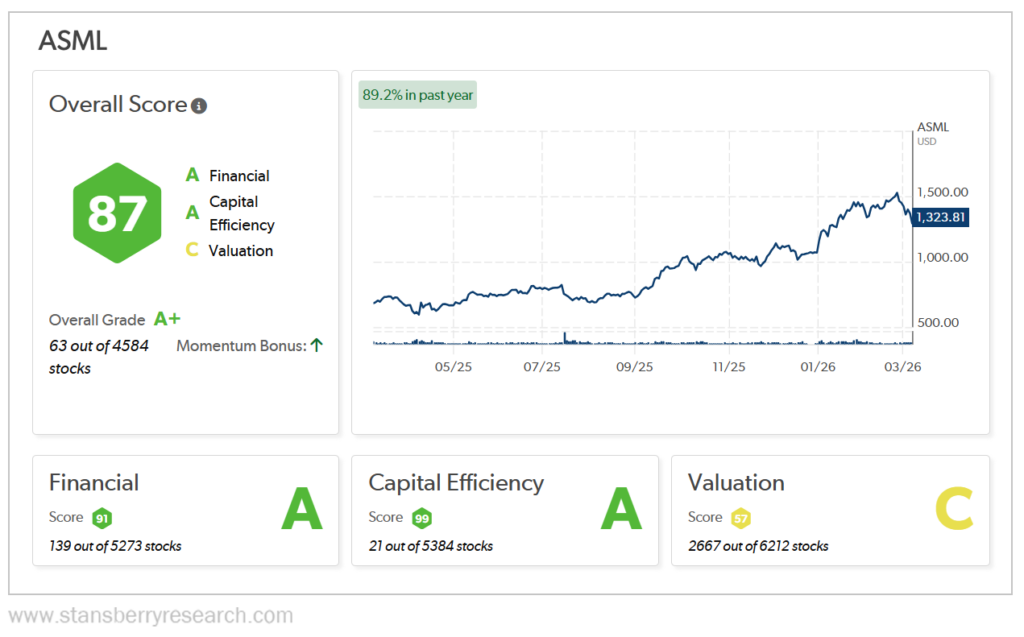
The bottom line? Literally every advanced AI chip starts with patterns created by ASML’s EUV lithography systems. That’s a heck of a moat in the semiconductor supply chain… and a strong foundation for those looking to invest in the semiconductor sector.
Applied Materials (AMAT): Building the Machines That Build Semiconductors
While Applied Materials’ business extends beyond semiconductors, roughly 73% of its revenue comes from designing and manufacturing the equipment and systems needed to fabricate integrated circuits.
While ASML prints the initial blueprint onto silicon wafers using its EUV lithography system, Applied Materials’ machines then complete the processes that physically build, shape, and refine those patterns to create the semiconductor.
Applied Materials also plays a key role in the demand for high-bandwidth memory (“HBM”). HBM is memory architecture that enables faster data transfer, improved energy efficiency, and compact integration – so much so that semiconductor bellwether Nvidia (NVDA) counts on Applied Materials to improve the efficiency of the tools used to make its chips.
I wrote about HBM and its importance in the AI boom back in November:
Currently, AI models are simply too complex and large for the dynamic random-access memory (“DRAM”) available to them. So, new solutions are imperative. One solution is faster memory […]
The key to HBM is its physical design. Traditionally, memory chips are placed next to one another on a flat chip board. HBM uses a 3D stacking structure. Multiple DRAM chips are stacked upon each other using advanced packaging techniques. This unique structure enables HBM to operate with much faster data transfer rates than typical memory solutions like graphics double data rate.
We’ve reached a point where standard memory alone, no matter how advanced or powerful, is not enough to keep up with the memory demands of AI. That’s where HBM comes into play.
Applied Materials’ products allow memory manufacturers such as Micron Technology (MU) and SK Hynix to increase HBM capacity through advanced packaging and 3D chiplet (specialized chips) stacking technologies.
With next-generation HBM3E and HBM4 standards requiring around three times the wafer capacity as DDR5 memory, the memory supply chain is growing tighter. And prices for HBM are soaring accordingly.
That’s a beautiful thing for Applied Materials.
The company is already reporting record memory equipment sales in 2026 and expects memory to be its fastest-growing segment. Applied Materials is also projecting growth north of 20% in its semiconductor equipment business in the second half 2026 and into 2027.
The company’s 2026 first-quarter results were strong, with better-than-expected revenue of more than $7 billion, $1.83 billion in generally accepted accounting principles (“GAAP”) operating income, and a GAAP gross margin of 49%.
Applied Materials is projecting even better second-quarter revenue of $7.65 billion.
Like ASML, Applied Materials stock scores strong grades. Its Stansberry Score (an overall “A”) places it within Stansberry Research’s top 140 stocks, driven by robust performances in the Financial (“A”) and Capital Efficiency (“A”) categories. In the first quarter of 2026 alone, the company returned a total of $702 million to its shareholders – $337 million in share repurchases and $365 million in dividends.
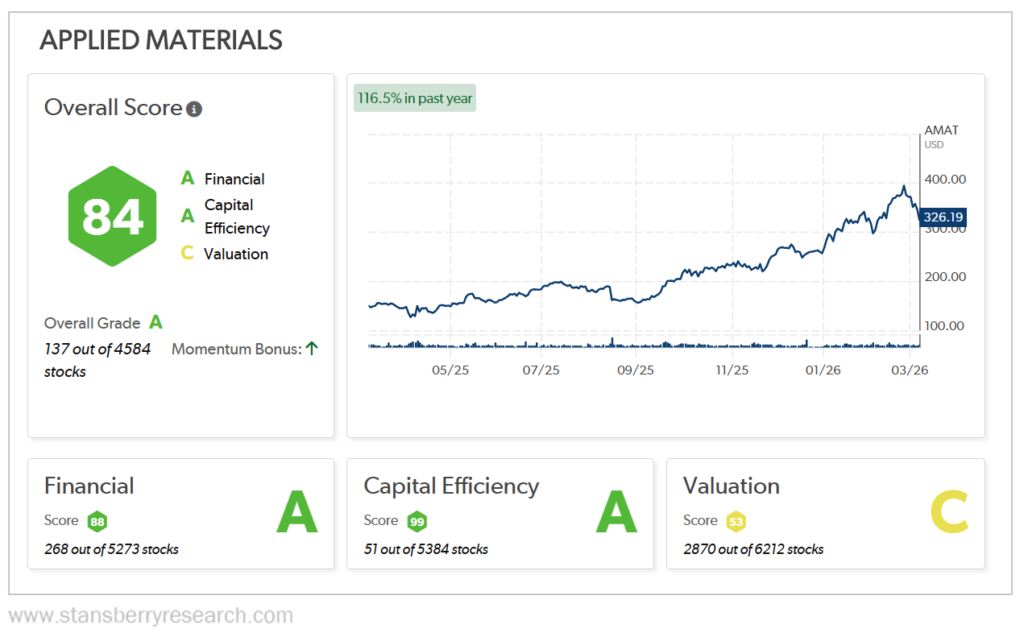
As the world’s largest provider of the manufacturing equipment the semiconductor industry needs to make chips, Applied Materials is a vital link in the AI supply chain.
Taiwan Semiconductor Manufacturing (TSM): The Advanced Manufacturing Nexus
And now we complete the circle by going back to TSM. It wouldn’t be hyperbole to say that TSM is the most important company in the evolution of AI and the backbone of the entire semiconductor industry.
Think about it…
- Virtually every AI chip designer in the world relies on TSM to build their AI hardware. This includes Nvidia, Advanced Micro Devices (AMD), Apple (AAPL), Amazon (AMZN), and Broadcom (AVGO).
- TSM owns a 90%-plus share of the world’s most advanced (sub-5 nm) AI chips and more than 70% share of all chips produced globally.
And TSM continues to push the envelope. The company recently announced a capital expenditure (“capex”) budget of between $52 billion and $56 billion for 2026… one of the largest in history.
Of that amount, roughly 70% to 80% will be put toward accelerating 2-nm process technology as well as the hyper-advanced A16 (1.6 nm) node.
TSM is also allocating around 10% to 20% of capex toward specialized packaging facilities. This will address the current bottleneck caused by the company’s CoWoS (Chip-on-Wafer-on-Substrate) advanced packaging already being sold out for much of 2026.
Not surprisingly, TSM’s 2025 fiscal year was superlative. Net revenue increased to $122.4 billion in 2025, a 35.9% jump from just under $90.1 billion in 2024. Net income soared 46.4% year over year to roughly $54 billion. The company’s gross margin increased 3.8 percentage points to 59.9%, and its operating margin grew by 5.1 percentage points year over year to 50.8%.
TSM stock is nothing short of phenomenal. Its Stansberry Score ranks No. 10 overall (out of nearly 4,600 stocks) with an “A+” grade. Reflecting its outstanding 2025 performance, the stock ranks No. 3 (“A”) out of more than 5,200 stocks graded in the Financial category.
Its Capital Efficiency earns an “A” as well, positioned within the top 70 stocks out of more than 5,300 in that category. TSM’s roughly $14.6 billion cash dividends paid to shareholders in 2025 back up that high grade.

TSM stock keeps proving its worth as the company continues to revolutionize nanotechnology chipmaking and AI hardware design.
Key Risks for AI Semiconductor Stocks
Despite the AI-driven tailwinds semiconductor companies (and their stocks) are currently benefiting from, they do face some potential headwinds that investors should keep in mind.
- The industry’s highly cyclical nature:The semiconductor industry is notoriously cyclical. It generally rides high for a few years and then crashes for a few more before rebounding again. We’re obviously in a boom cycle right now. But supply and demand dictate these cycles, especially when it comes to…
- Memory and its volatility: Memory tends to be the most volatile segment of the semiconductor industry. One reason is the insatiable demand for – and consequently the laser focus on – new, high-bandwidth memory made for AI applications.
This focus on AI memory components has left other types of memory, such as the DDR5 memory used in many personal computers, in short supply. And that results in price increases. Shortages in DDR4 and DDR5 memory have caused prices to skyrocket more than 400% between September and today. And those increases are likely to continue… possibly for another decade.
- The geopolitical landscape: The Iran war, logistically speaking, primarily impacts the oil and gas suppliers shipping their goods through the Red Sea and the Strait of Hormuz. But that impact is trickling down to other industries that use those vital shipping lanes, including semiconductors.
Many electronics components travel through the Red Sea via the Suez Canal to their destinations. But shipping companies are already rerouting or suspending traffic. And this is adding up to two weeks to shipping timelines and causing supply shortages for many industries. Plus, with the closure of the Strait of Hormuz severely impacting global oil supplies, the price of fuel has already skyrocketed. That means transportation costs increase, which typically trickles down to product prices for consumers.
And then there are the ongoing supply chain tensions and export restrictions, mainly between the U.S. and China. Not to mention global tariffs that impact supply and cost. These are all possible headwinds for the semiconductor industry.
While the long-term demand for AI chips appears strong, it’s still important to keep these risks in mind before investing in what can be a cyclical and volatile industry.
Bottom Line: Own the Infrastructure of the Chip Supercycle
Yes, companies like Nvidia, Meta Platforms (META), and Palantir Technologies (PLTR) get the lion’s share of the AI headlines. But with the AI boom showing no imminent signs of slowing, the nanotechnology innovation and engineering required to make the materials and machines that create the semiconductors are critical… and often overlooked.
By investing in each piece of the semiconductor life cycle, you get exposure to the whole industry:
- ASML for its proprietary EUV lithography systems that optically etch circuit patterns onto silicon wafers.
- Applied Materials for its machines and systems that perform the engineering, etching, and deposition processes that build, shape, and refine those patterns to create the semiconductor.
- TSM for making the advanced AI chips that nearly every tech company in the world relies on to build their AI hardware. And for TSM’s sheer domination of the semiconductor market.
I’ll leave you with some words of wisdom from Keith Kaplan, CEO of TradeSmith, who wrote about nanotechnology in February:
The ceiling for AI isn’t just software. It isn’t just algorithms. It’s the physics of building at the atomic scale. And the companies that solve those physics problems sit at one of the most critical chokepoints in the entire AI economy.
That makes nanotechnology the invisible foundation beneath the entire AI infrastructure buildout – and one of the most overlooked ways to profit from the AI boom.
Regards,
David Engle
Editor’s note:If you’re 50 or older… or thinking ahead to retirement… legendary investor Whitney Tilson says this could be your smartest financial move of the entire AI boom.
It’s time to look past Nvidia and the “Magnificent Seven.”
Whitney, a retired hedge-fund manager once dubbed “The Prophet” by CNBC, is sharing a new AI story.
His brand-new stock system just gave one company a near-perfect grade… and it’s not a name you’ve heard on the news.
The company just signed a huge new AI deal with a key tech partner, and you’ll soon see a massive nationwide rollout.
Whitney’s giving away the name, ticker, and full breakdown for free.