
Image Credit: Associated Press
Listen to the audio version of this article (generated by AI).
Key Points
- Fox announced a $22 billion deal to acquire connected-TV platform Roku, extending its reach by more than 100 million households with existing Roku subscriptions.
- The deal would make Fox the No. 1 connected-TV provider in the U.S. by hours watched. It will also place Fox among the country’s top streaming-content providers, with an estimated 10% of total viewership.
- Fox stock crashed by double digits amid $8 billion in new debt to fund the deal, doubts about the network’s neutrality, and a 27% stock dilution that would result from the deal.
Fox (FOX) is diving deeper into the streaming wars. The company said on June 15 that it had reached an agreement to buy streaming-device maker Roku (ROKU) for roughly $22 billion. The deal is the biggest purchase in Fox’s history.
The acquisition will bring Fox’s sports, news, and entertainment programming to the more than 100 million households with a Roku device.
Fox already has an extremely solid slate of programming. And its ad-supported Tubi streaming service boasts more than 100 million monthly active users.
But with Roku, Fox’s content and streaming apparatus will get a major “plumbing” update.
Roku is the world’s No. 1 connected-television platform. It offers streaming services through its line of Roku players and Roku TVs. Its tech is also baked into more than 45 other TV brands worldwide.
Roku also sells ad placement and processes subscriptions for other streamers on its platform. It generated about $5 billion in revenue over the last year.
Fox will be paying richly for Roku’s business. Today, Roku trades just north of 100 times earnings – more than triple the S&P 500 Index’s price-to-earnings (P/E) ratio.
Mr. Market wasn’t happy about the announcement. Fox fell 15% the day of the announcement, and Roku slid almost 2%. Roku still trades around 16% below Fox’s purchase price, so the market is still pricing in the long road to close, as well as some deal risk.
Despite the chilly reception, Fox has much to gain from acquiring Roku. Let’s look closer at what Fox gets in this historic deal.
How Roku Could Supercharge Fox’s Reach and Revenue
According to Fox CEO Lachlan Murdoch, two forces are combining to reshape the way we consume video…
First, news and sports are still leading with consumers. And second is that streaming is still winning the format war.
Fox’s purchase of Roku will bring the network’s focus on some of the most-watched genres worldwide into a new generation of streaming offerings.
We already touched on Roku’s reach and revenue. But let’s dig a little deeper into Fox’s acquisition strategy and how Roku works in its favor.
To start, Roku is the world’s top streaming-TV platform by hours streamed… and it isn’t a close race.
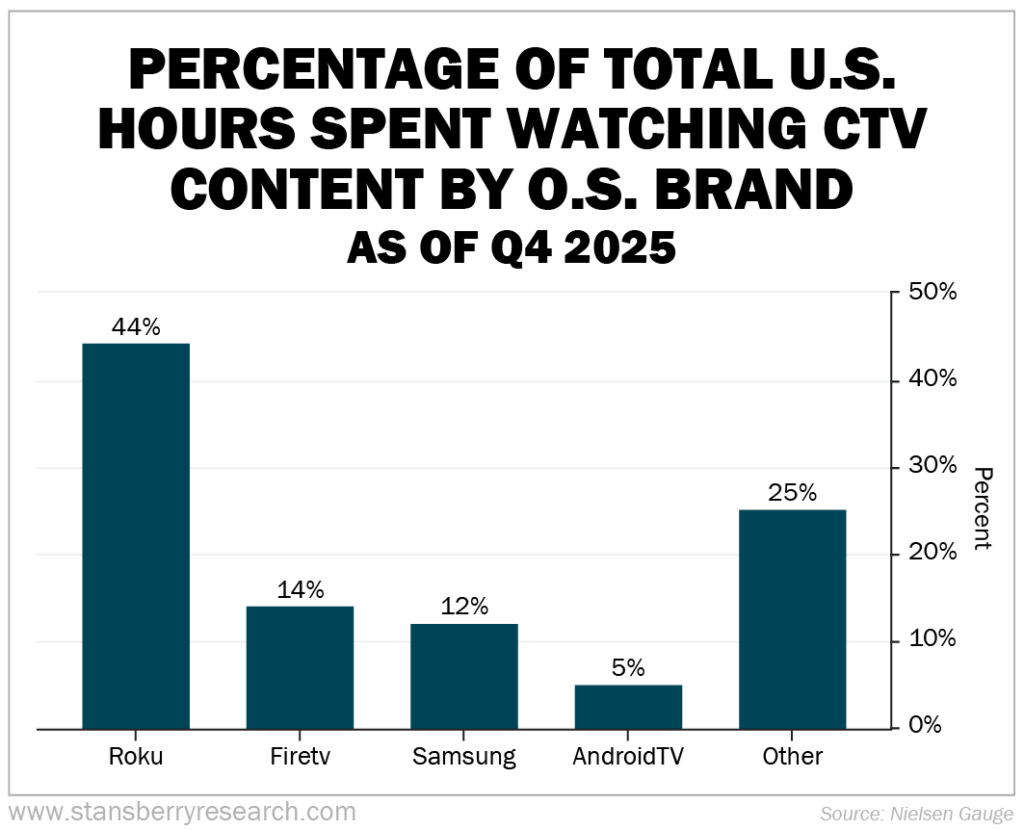
Roku more than triples the next-largest brand of connected TV – Amazon Fire TV – in hours watched.
What’s more, Roku sits squarely at the center of two fast-growing industries – connected-TV advertising and streaming subscriptions. These two segments are projected to grow at compound annual growth rates of 12% and 8%, respectively, from 2025 to 2030. These segments could give Fox’s legacy TV model a big lift.
This chart shows how Roku would change Fox’s business makeup. In a projected-revenue mix combining Fox with Roku for the year ending March 2026, 30% of the total pie came from Tubi and Roku…
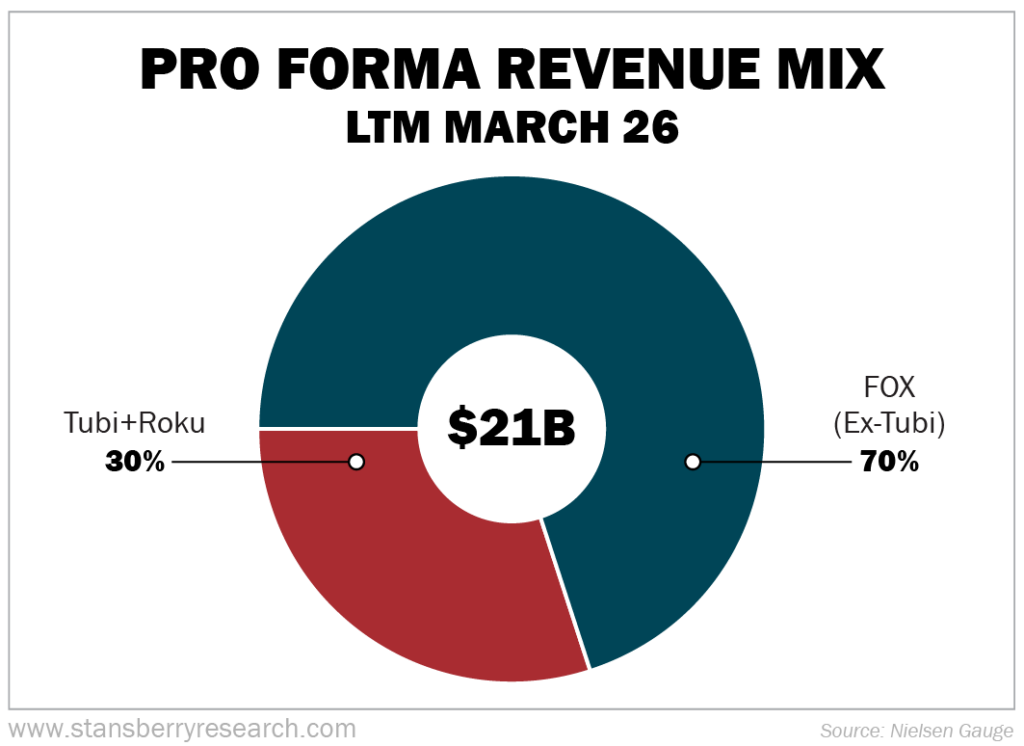
In other words, with this deal, nearly a third of Fox’s revenue would come from high-growth streaming segments.
What’s more, the deal would bring Fox into the ranks of top streamers, such as Alphabet’s (GOOGL) YouTube, Disney (DIS), and Netflix (NFLX), in terms of viewership. Take a look…
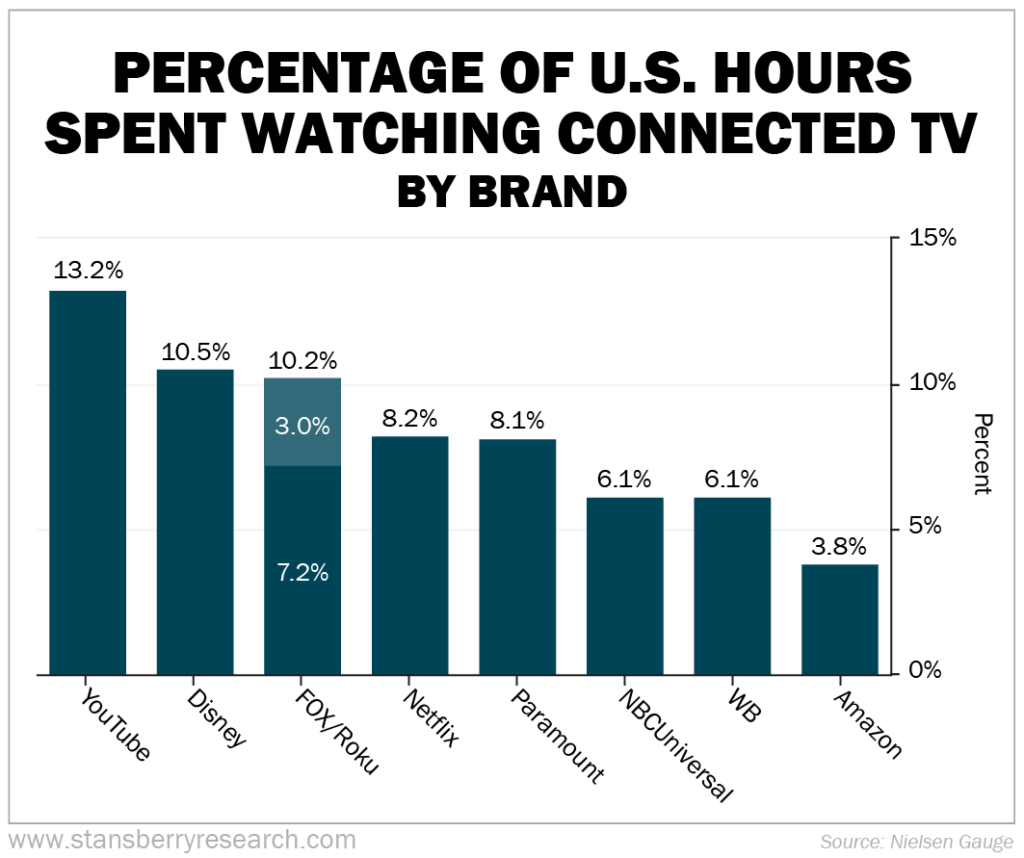
Right now, Fox holds 7.2% of viewership in Nielsen’s Gauge of viewing trends. That places it fifth overall, right after Paramount. Meanwhile, Roku holds a 3% Nielsen rating. Combined, Fox and Roku would be among the widest-reaching programmers in the U.S. – potentially in the top three.
It would be a significant new competitor in the streaming wars.
All in all, Fox has a lot of compelling reasons to absorb Roku’s platform. Regardless, shares of both Fox and Roku slid in the markets on the day of the announcement.
Let’s look at some of the narratives against this massive merger…
The Fox-Roku Merger Has Many Obstacles to Overcome
You may have noticed a contradiction at the heart of this deal…
Roku became America’s top streaming-TV platform by refusing to pick sides. It offers a neutral storefront that hosts everyone’s content. Roku gets paid whether users watch Netflix, YouTube, Disney+, or Peacock. No less than 88% of its revenue comes from selling ads and processing subscriptions.
That toll-taker model cuts two ways, though. It means many of Roku’s biggest clients are direct competitors to Fox.
This deal would potentially compromise Roku’s neutrality. Fox has reason to suppress competitors’ products on its platform. The Roku deal would give Fox the levers to do it.
Whether Fox pulls those levers or not isn’t the point – the merger weakens trust in Roku’s platform regardless. That could cut into Roku’s revenue as clients shift their ad spending elsewhere.
Another problem is the price tag. Again, Fox is paying more than 100 times earnings for Roku, whose net margin was a razor-thin 6.9% in the first quarter. To fund the deal, Fox is taking on about $8 billion of debt.
What’s more, Fox plans to dilute shares to pay for the deal. When the deal is closed, existing Fox shareholders are expected to own just 73% of the combined company – a dilution of 27%. So, part of the sell-off after the announcement can be attributed to shareholders voting with their feet.
None of these issues are fatal to Fox’s bet on Roku. However, they contributed to a 15% drop on the day the merger was announced.
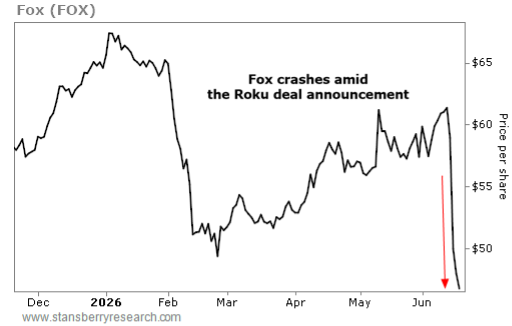
Fox has declined double digits since the Roku deal was announced… and it hasn’t bottomed yet.
Still, this may be a buying opportunity in disguise. Fox is a strong operator with solid fundamentals. We can see it using the Stansberry Score, which combines several factors into a simple rating…
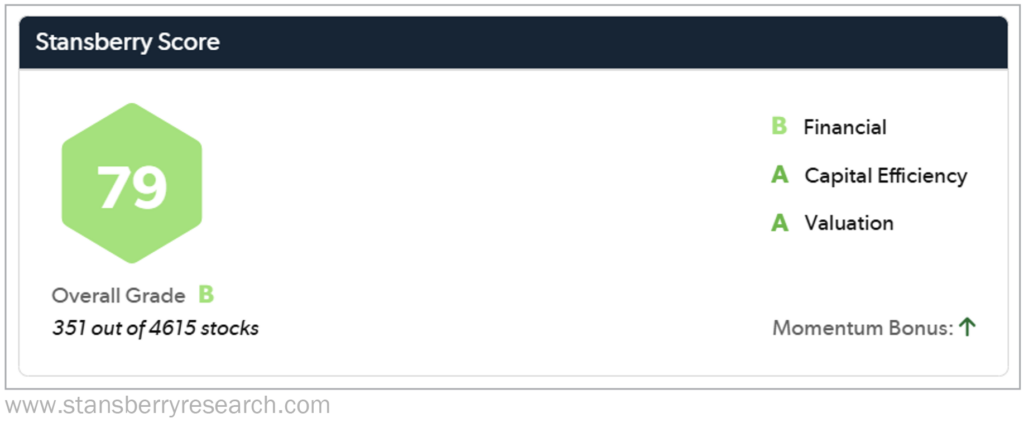
Today, Fox gets a Stansberry Score of 77. That puts it in the top 11% of companies we track.
Fox gets a “B” rating in the Financial category – meaning its balance sheet is solid. It gets an “A” on Capital Efficiency – its history of generating returns. And it also gets an “A” for Valuation – meaning that, after its post-announcement sell-off, it’s relatively inexpensive today.
We can see this by looking at Fox’s current valuation compared with its average since 2019. Take a look…
| P/E Ratio | |
| Fox | 11.8 |
| Fox Seven-Year Average | 12.9 |
Today, Fox trades at a P/E ratio of 11.9 – an 8.5% discount to its long-term average. It’s also trading at a fraction of the broader S&P 500, which has a P/E ratio of about 27.6.
The Roku deal will be a sea change for Fox. Again, Fox’s Lachlan Murdoch calls it a “defining moment” for his company. And it’s already pushing massive moves in Fox’s stock price.
Fox shares may sink lower as the market continues to digest the news. But ultimately, the Roku deal hands Fox a massive new platform – and a new weapon in the battle for America’s living rooms.
Good investing,
Sean Michael Cummings
Editor’s Note: Whitney Tilson — the hedge fund manager CNBC called “The Prophet” — says America has reached its “Ripping Point.” The old financial order is being torn apart, and he believes most investors have no idea what’s coming in the next six months. He’s named the stocks he thinks will be destroyed in the chaos — and the ones he believes will soar. Watch his free presentation while it’s still available.