The “dollar debasement trade” has been on the lips of many investors in the past few months, especially as popular investments such as gold, silver, and bitcoin have soared.
In fact, the dollar debasement trade is how some market analysts explain the run in those assets… that their performance is due to U.S. policymakers deliberately destroying the dollar.
Some investors see the trillions of dollars of U.S. debt being issued or the Federal Reserve’s interest-rate policy leading to a long-term decline in the dollar.
They may be especially worried about the U.S. dollar losing its status as the world’s reserve currency… and the advantages that come with it.
So, those playing the debasement trade have been making certain types of investments, such as precious metals or cryptocurrency, that they believe may help protect them.
The thing is, you don’t need to be a believer (or unbeliever) in the dollar debasement theory to understand that keeping your money in cash is not a good long-term investment.
Other non-cash investments like stocks offer significantly higher returns and can protect you against declines in the dollar, even if they’re not caused by dollar debasement.
The Dollar Debasement Trade: What Is It?
The dollar debasement trade is a strategy to protect your portfolio against, well… dollar debasement. But what is that, exactly?
Currency debasement is the fundamental dilution of a currency’s value through deliberate action to weaken it. It could be due to surging budget deficits, massive outstanding debt, or a swelling money supply that dwarfs the economy’s growth, leading to a crisis of confidence in the currency and a huge devaluation.
Some investors say that’s exactly what’s happening to the dollar. They may also point to the world’s central banks moving away from Treasurys (and toward gold) as evidence that the dollar is being debased. In response, these investors may buy gold themselves.
But there’s plenty of evidence that the dollar remains strong and still enjoys the world’s confidence. The dollar made up about 58% of disclosed official foreign exchange reserves in 2024. While that’s down from its peak of 72% in 2001, it’s right in line with its level of 1995.
The dollar also remains a big part of foreign-currency transactions. Some 88% of transactions involved the dollar on the buy or sell side in April 2022 – in line with the prior 20 years.
One of the consequences of debasement would be a much weaker dollar on foreign-exchange markets. While 2025 did see the value of the dollar fall against major currencies, it was well within historical fluctuations. Certainly, it was not a staggering decline.
With the dollar still enjoying its privileged global position, it hasn’t seen much debasement (yet).
But what about the decline in the dollar’s purchasing power over time? One dollar won’t buy what it could 10, 20, or 30 years ago.
That’s a result of inflation rather than debasement. Inflation is a natural result of a growing economy, the expansion of credit, and a growing money supply.
Inflation eats away at your purchasing power year after year, and it’s why you need to own investments that can maintain purchasing power rather than holding cash.
Dollar debasement or not, your dollars will lose value over time – unless invested.
How Investors Are Betting on the Dollar Debasement Trade
Even if dollar debasement is more story than reality, that doesn’t mean it’s not having real consequences on markets. Markets work reflexively. That is, returns shape the story, which shapes the returns, and so on.
For example, investors may view the run-up in gold as proof that dollar debasement is occurring rather than as an emotional response to it. So, they may rush in, pushing up gold even more.
To protect against debasement, investors have turned to tried-and-true defensive stores of value (gold and silver), newer alternatives (bitcoin), and traditional investments (stocks).
Gold and Silver
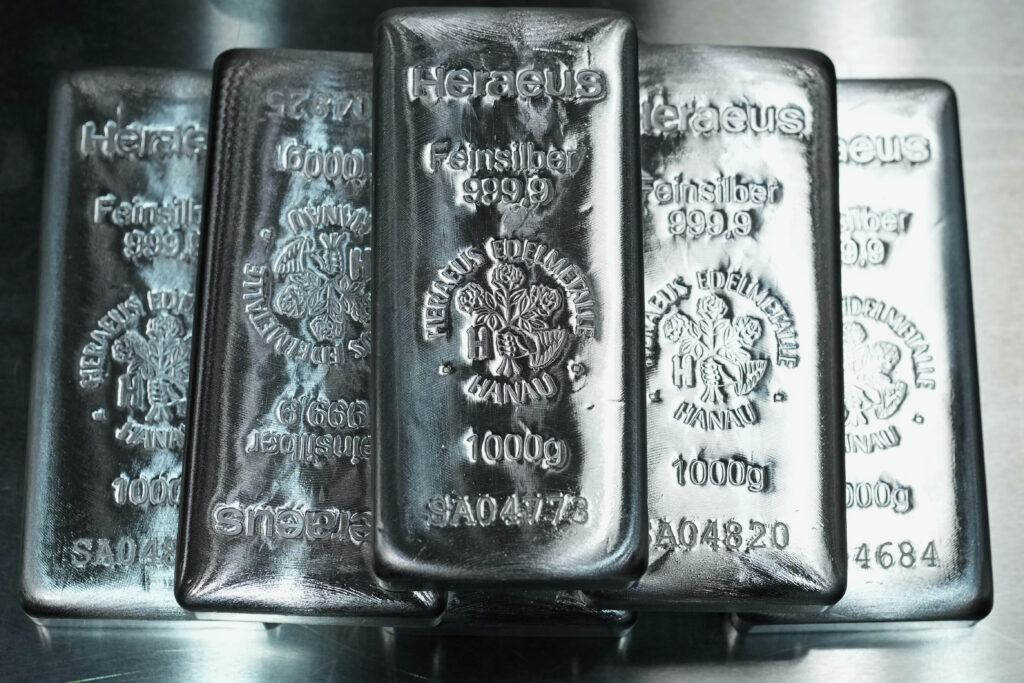
Precious metals such as gold and silver have been huge beneficiaries for those betting on dollar debasement. Both have a proven record as a long-term store of value, meaning that their price has marched up over time, even if the returns have been more modest than stocks’ record.
While these metals are priced in dollars, they’re traded on world markets and so they act like international currencies. Their long-term record ensures that they’re a safe haven when traders begin to get nervous about economic conditions.
Even if their prices are off their recent all-time highs, gold and silver still sit well above where they did even a few years ago. Buy-and-hold investors have done quite well.
Gold started 2024 at about $2,062 per ounce and surged past $5,500 in late January of this year. Even at around $5,000 now, gold investors have enjoyed about a 140% return in that period.
It’s a similar story for silver. It started 2024 at $23.85 per ounce and popped above $120 in late January. It now sits around $75, so investors saw better than a 210% gain in the time.
Rather than buying physical bullion, it’s much easier to trade one of the best gold exchange-traded funds (“ETFs”). You’ll get fair market value, they charge low expense ratios, and you can buy on any market day.
Bitcoin
One of the selling points for bitcoin is that there will only ever be 21 million of them in a world where the number of U.S. dollars moves ever higher. That’s important, but it’s only part of the story here… the supply side of the equation.
On the demand side, traders have been buying more bitcoins over the years, including some major owners such as Strategy (MSTR), which owns 3.4% of them. The rise of spot bitcoin ETFs, which were introduced in 2024, made it easier and safer for everyday investors to buy bitcoin, too.
So, rising demand meeting fixed supply can send bitcoin further into the stratosphere… especially if bitcoin can sustain the narrative of being a long-term store of value.
It just doesn’t have that track record yet, compared with, say, gold and silver, which have held that role arguably for thousands of years. In addition, bitcoin’s intense volatility can throw a curveball for traders who are looking for a hedge against a declining dollar.
In just a few months, bitcoin has lost half its value – and that’s normal in the crypto world.
Stocks
Stocks have a strong long-term track record, and they’re a solid pick for those looking to build wealth. The best companies have the ability to raise their prices over time – pricing power – helping their profits rise year after year… and taking their share price along for the ride.
Those looking to offset the risk of a declining dollar have turned to international stocks, which earn most of their money in foreign currencies. When the dollar is weak, these companies’ earnings translate into more profits in dollar terms, and therefore higher stock prices in dollars.
For example, the Vanguard FTSE Developed Markets Index Fund (VEA) had a strong 2025 – up 35% – as investors played defense against the dollar by buying foreign stocks.
Of course, playing defense doesn’t have to be all about buying foreign stocks. The biggest U.S.-based companies generate a huge portion of their sales abroad. The companies in the S&P 500 Index, for example, garner about 29% of their sales from non-U.S. markets.
So, the S&P 500 stocks offer a natural hedge against dollar weakness.
If investors can find companies that combine exposure to foreign markets with pricing power, they may enjoy strong returns even when the dollar is weak.
Debasement or Not, the Dollar Loses Value Over Time
Whether you believe in the debasement story or not, the dollar will lose value over time due to inflation. That makes cash and low-yield, cash-based investments non-starters for the long term.
Instead, you need investments that can maintain your purchasing power. Stocks are a great long-term investment because the best companies can raise prices over time. That is, by owning businesses that raise prices and benefit from inflation, you’re on the side of “the house.”
For example, the S&P 500 Index contains some of the best companies. They can raise prices over time, increasing their profits and therefore their stock prices.
So strong investments can protect you against inflation and other things that might devalue the dollar in the long term.
Regards,
James Royal
Editor’s Note: Since the start of 2025, more than 700 stocks [KK4] have doubled. That’s incredible. And yet, says True Wealth senior analyst Brett Eversole, we’re not done yet. His latest research shows a new pattern forming that could send today’s record-high market soaring even higher.
He calls this pattern the Melt Up Tsunami. And he’s identified at least six stocks that could benefit, including one stock he says could not just double, but triple. He has named that stock in his new presentation, found here.