Image Credit: Associated Press
Key Points
- Adobe launched a new agentic AI platform, CX Enterprise Coworker, and announced partnerships with major AI players including Anthropic and OpenAI.
- CX Enterprise Coworker functions like a project manager for AI agents, translating business goals into campaigns while keeping humans in the loop.
- Adobe still needs to prove AI can drive sustained growth, and investors should monitor whether AI-driven revenue continues to scale.
Software giant Adobe (ADBE) just gave investors the clearest answer yet to the question hanging over the entire industry: What happens if AI really does start eating software?
Adobe unveiled its CX Enterprise Coworker this week, a new agentic AI platform designed to help corporate customers automate digital marketing, customer engagement, sales, loyalty, and other business workflows.
It also announced partnerships with more than 30 AI companies, including Amazon Web Services (“AWS”), Microsoft (MSFT), Anthropic, OpenAI, Nvidia (NVDA), Google (GOOGL), and IBM (IBM).
This isn’t a minor product update. It’s Adobe’s counterattack.
For months, investors have worried that AI-native tools from companies like OpenAI, Anthropic, and Canva could erode Adobe’s dominance in creative and marketing workflows.
Adobe’s stock has been battered by that fear – and the company’s latest announcement is best understood through that lens.
As I’ll explain, the companies best positioned for the AI era will be the ones that are deeply embedded in the workflows AI is reshaping.
And Adobe is trying to prove that it’s one such company… not just another software app waiting to be disrupted.
Adobe Is Moving From AI Features to AI Infrastructure
Adobe’s new CX Enterprise platform is built around what the company calls “agentic AI.”
Unlike traditional AI tools that simply respond to prompts, agentic AI can plan, take actions, and move through multiple tasks with limited human input.
Put simply, Adobe is moving beyond simple chatbots and image generators.
The headline product is Adobe CX Enterprise Coworker. Adobe says Coworker can act like a project manager for AI agents, translating business goals into multistep campaigns while keeping users in control.
For example, if a marketing team wants to increase cross-sell performance by 3%, CX Enterprise Coworker can assemble the audience segments, creative assets, and performance insights needed for a targeted offer. Then, after the user approves the plan, it can help launch the campaign and monitor results, according to Adobe.
Today, that kind of campaign usually requires marketers to jump between dashboards, reports, approval chains, creative tools, and analytics systems.
Adobe wants CX Enterprise to sit above that mess and coordinate the work for marketers.
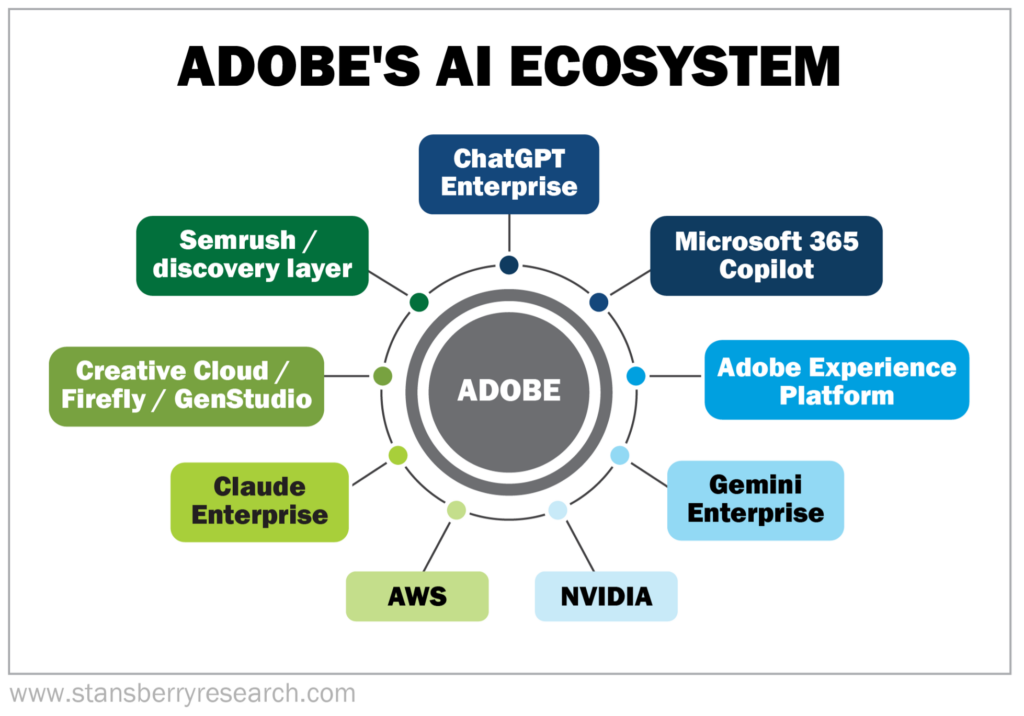
In other words, Adobe is positioning itself at the center of a much broader enterprise AI stack. That includes Adobe’s own creative and data tools, AI assistants like Microsoft 365 Copilot and ChatGPT Enterprise, and partner infrastructure from companies like Amazon Web Services and Nvidia.
Importantly, Adobe already sits in the middle of many of those workflows. More than 20,000 global brands have built their businesses on Adobe. And its Experience Platform helps them manage customer data and power more than 1 trillion customer interactions (e.g., when a customer clicks on a marketing e-mail) each year.
That kind of scale doesn’t make Adobe invincible. But it does make Adobe harder to push to the side.
Moreover, Adobe management said CX Enterprise is designed to deliver “reliable and auditable agentic workflows.”
In practice, that means its AI tools behave predictably and leave a traceable record of what they did.
That’s important. If AI is helping shape a marketing campaign, companies need to know what data informed the output, what rules constrained it, and where human review entered the process.
That kind of traceability is what companies will pay for.
This Is a ‘SaaSpocalypse’ Test Case
Earlier this year, I wrote about the “SaaSpocalypse” hitting software stocks.
Roughly $1 trillion in global software market value disappeared in a single week as the S&P 500 Software & Services Index fell nearly 13%.
But the key point was simple: AI will not disrupt every software company equally.
The most vulnerable companies are the ones that are easily replaceable. The more resilient ones are deeper in the enterprise stack, managing things like customer data, permissions, integrations, approvals, and audit trails.
Adobe sits somewhere in the middle.
Its core creative tasks are clearly exposed. A designer who once spent an afternoon mocking up five ad concepts can now generate dozens of starting points in minutes with the help of AI.
A marketer who once needed an entire creative team for every e-mail variation can now ask AI to draft, rewrite, resize, and localize campaign assets almost instantly.
That’s the danger for Adobe.
But Adobe isn’t just Photoshop anymore. It also owns Acrobat, Creative Cloud, Experience Cloud, Firefly, Express, GenStudio, and a large enterprise marketing suite.
It has meaningful advantages because so much creative work already lives in Adobe file formats. Millions of designers and marketers already know the tools, and so many enterprise workflows are already built around its software.
That’s why Adobe isn’t necessarily an AI casualty.
In my AI Disruption Scorecard (which you can review by clicking the link above), Adobe scored about 6.9 out of 10 for AI resilience.
That’s not outstanding. But it’s not disastrous, either.
For reference, the averagescore across the 177 companies I rated is 6.2. So Adobe is above the pack.
Its score says the company has some AI exposure… but also some robust defenses.
MORE: Best AI ETFs: 7 Top Funds for Artificial Intelligence
Adobe’s New Agentic Platform Is Proof of Its Durability
The most important part of Adobe’s score wasn’t simply whether people like its apps. It was whether Adobe could become more central in an AI-agent world.
That’s where this news matters.
As noted, Adobe announced that it’s expanding AI platform collaborations with more than 30 companies. For instance, its Adobe Marketing Agent – an AI assistant that helps accelerate marketing workflows – is now available in Microsoft 365 Copilot and in beta testing across ChatGPT Enterprise, Claude Enterprise, Gemini Enterprise, IBM watsonx Orchestrate, and Amazon Quick.
Meanwhile, the newly unveiled CX Enterprise is designed to connect its own agent workflows with outside platforms and infrastructure rather than force customers into an Adobe-only system.
That speaks directly to one of the biggest factors in my AI Disruption Scorecard: Application Programming Interface (“API”) surface and ecosystem centrality.
In plain English, this concerns whether a software company is a replaceable app… or infrastructure that other systems still rely on.
In an AI-driven market, the more software behaves like “connective tissue” for the rest of the stack, the harder it is to push it aside.
Adobe is ensuring that when enterprise AI agents look for marketing data, creative assets, brand rules, and campaign workflows, they still pass through its platforms.
The company isn’t saying, “Ignore OpenAI and Anthropic.”
It’s saying, “Use Adobe inside OpenAI and Anthropic.”
That’s a much smarter strategy.
This approach also validates Adobe’s AI capability score, a measure of a company’s ability to adopt and productize AI quickly and safely.
Adding AI features to Photoshop is useful. Turning AI into a coordinated layer of the marketing workflow is more ambitious.
Adobe is moving from “AI can help you create an image” to “AI can help your company plan, execute, measure, and optimize an entire customer campaign.”
The Semrush Acquisition Shows Where Adobe Is Heading
Adobe’s attempt to become infrastructure for AI-driven marketing also makes its recent Semrush (SEMR) deal look more strategic.
On April 28, 2026, Adobe completed its acquisition of Semrush, a leader in search engine optimization (“SEO”) and digital marketing tools, for $1.9 billion in cash. When the deal was first announced last November, Stansberry Research’s Alan Gula argued the deal was about more than just SEO.
Semrush gives Adobe tools that help brands understand how they are discovered online. That includes keyword and content strategies, search-ranking intelligence, traffic analytics, and tools designed to help companies show up in AI-generated answers as well as traditional search results.
That matters because Adobe doesn’t just want to help brands create marketing content. It wants to help them make sure that content gets found.
And that shift is becoming more important as consumers increasingly begin their shopping journeys inside AI tools.
We can already see this in Adobe’s own data. In the first three months of 2026, the company reported that traffic from AI sources to U.S. retail sites grew 393% year over year. And figures from March show that those AI-referred shoppers converted 42% better than non-AI traffic.
In short, Adobe is trying to own more of the loop: creation, discovery, personalization, measurement, and optimization.
And it’s using AI agents to make sure the whole process runs seamlessly.
Adobe’s Business Is Stronger Than the Stock’s Recent Performance May Indicate
None of this means Adobe’s stock has been easy to own recently.
For those who’ve bought Adobe shares in just the past few years, it has been downright painful.
The stock has been in a sharp decline over the past two years, falling more than 60% since its February 2024 high…
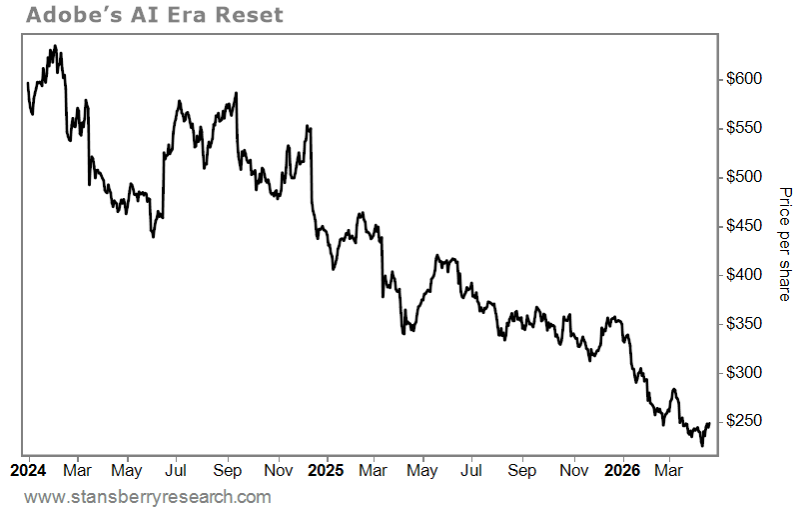
This was largely driven by fear of AI disruption and investor worries that Adobe’s own AI projects wouldn’t pay off. The stock got caught up in the SaaSpocalypse, like many other software companies.
But despite the stock’s poor performance, the underlying business has seen steady growth…
Revenue reached $21.5 billion in the company’s fiscal year 2024, up 11% from 2023. And fiscal-year 2025 revenue rose 11% again to $23.8 billion.
More recently, in its fiscal first quarter of 2026, Adobe reported record revenue of $6.4 billion, up 12% year over year. Adjusted earnings per share rose 19% to $6.06. Operating cash flow hit a first-quarter record of nearly $3 billion. And Adobe also repurchased more than 8 million shares.
Most importantly, Adobe said annualized recurring revenue from its newer AI-focused offerings more than tripled year over year. It also said usage of its generative-AI tools – which Adobe tracks through a credit system for certain features – rose more than 45% from the prior quarter.
In March, Stansberry Research’s Whitney Tilson argued that investor fears around Adobe were overblown. He pointed to the company’s strong margins, free cash flow, buybacks, and AI traction.
Whitney’s point wasn’t that the stock couldn’t fall further. It did.
His point was that the business looked far healthier than its stock chart suggested.
As he wrote in Stansberry’s flagship newsletter Stansberry’s Investment Advisory, Adobe’s fundamentals remain strong, and the company shows “no signs that AI is harming the business.”
What Investors Should Watch Next
Over the next few quarters, investors will need to see whether Adobe’s AI push turns into real customer adoption and recurring revenue.
If it does, Adobe could emerge from this transition more deeply embedded in the workflows that matter most.
If it doesn’t, Adobe risks spending heavily on AI without much to show for it beyond a shiny toy and some PR buzz.
Last week’s CX Enterprise launch suggests Adobe understands the stakes. In the AI era, software companies will be judged less by the apps they sell and more by the workflows they control.
Adobe still must prove it can turn AI into a real growth driver.
But few software companies enter that test with Adobe’s mix of financial strength, entrenched workflows, and industry partnerships.
Good investing,
John Robertson
Editor’s Note: As America celebrates its 250th birthday, a Wall Street legend is sounding the alarm. Whitney Tilson (the hedge fund manager CNBC dubbed “The Prophet”) says the AI revolution is rewriting the rules of wealth faster than most people realize. Some investors are already seeing extraordinary gains. Others are being wiped out. Tilson says the next six months will determine which side you end up on — and he’s sharing exactly what to do about it in his free presentation here.