
Image Credit: Unsplash
Key Points
- Allbirds is abandoning its struggling shoe business and pivoting to AI computing, rebranding as “NewBird AI,” which triggered a massive surge in its stock price.
- The move reflects a familiar pattern from past bubbles, where companies chase hot trends like dot-com or crypto, often signaling peak market hype rather than sustainable growth.
- Despite the AI pivot, Allbirds still has weak fundamentals, including declining sales and lack of consistent profits, making it a risky and uncertain investment.
Beware of companies trying to take advantage of investor frenzy in new technologies…
Over the past few investing bubbles, we’ve seen struggling companies try to attach themselves to the latest craze in order to boost their share price. Think back to the “dot-com” bubble, or the crypto mania in 2018.
Today, that’s playing out with artificial intelligence (“AI”)…
According to FactSet, companies that mentioned AI in their earnings reports performed much better than those that didn’t. From FactSet in December…
It is interesting to note that S&P 500 companies that have cited “AI” on Q3 earnings calls have seen a higher average price increase compared to S&P 500 companies that have not cited “AI” on Q3 earnings calls since December 31 (13.9% vs. 5.7%), since June 30 (8.1% vs. 3.9%), and since September 30 (1.0% vs. 0.3%).
Companies can take it a step further, though. They can go all-in on the trend… even throwing out their core operations to do it.
That’s what we saw this week – from a shoe company…
The Latest Company to Try and Ride the AI Hype Train
On Wednesday, Allbirds (BIRD) – known for its wool athletic shoes – announced that it’s pivoting to AI.
The firm is selling its Allbirds brand and footwear assets and rebranding as “NewBird AI.” From the company’s press release…
The Company will initially seek to acquire high-performance, low-latency AI compute hardware and provide access under long-term lease arrangements, meeting customer demand that spot markets and hyperscalers are unable to reliably service.
Put simply, Allbirds wants to get in on the AI frenzy by providing computing power to companies that can’t get any space in existing (or newly built) data centers.
The company’s shares surged nearly 900% at their highs, and finished the day up nearly 600%. That took Allbirds’ market cap from about $22 billion to almost $160 billion. Even with a 36% decline on Thursday, the stock was still up more than 400% as of Friday morning.
Why Allbirds Is Ditching Shoes for AI
It’s no secret that AI is a booming sector of the economy.
According to the St. Louis Federal Reserve, AI accounted for about one-third of U.S. gross domestic product (“GDP”) growth in the first nine months of 2025. But that’s just telling most of us what we already know…
We’ve covered several times just how much money is flowing into AI-infrastructure investments (even in the face of new laws and opposition). Altogether, the “hyperscalers” – Amazon (AMZN), Alphabet (GOOGL), Meta Platforms (META), Microsoft (MSFT), and Nvidia (NVDA) – have pledged more than $600 billion in capital expenditures (“capex”) for AI this year.
Amazon has even doubled down on AI. In February, it announced plans to invest up to $50 billion in OpenAI, the company behind ChatGPT.
So, the money is clearly there. And as Allbirds wrote in its announcement, a lot of companies are competing for a limited amount of computing power. More from the press release…
The rise of AI development and adoption has created unprecedented structural demand for specialized, high-performance compute that the market is struggling to meet… At the same time, GPU procurement lead times are increasing for high-end hardware, North American data center vacancy rates have reached historic lows, and market-wide compute capacity coming online through mid-2026 is already fully committed.
Said another way, Allbirds believes the AI boom is big enough, and demand is strong enough, that it can carve out a small portion of the computing market.
The Red Flags in a Name Change
Still, the move brings back bad memories of previous bubbles.
As our colleague Dan Ferris explained in the September 12 Digest, companies tend to change directions like this during booms to take advantage of hype from investors…
[In] the final run-up of the bubble, folks were investing in any company whose name ended in “.com.” These IPOs would be a roaring success, and folks who owned shares would enjoy a substantial rise in market value… until it all fell apart after the Nasdaq Composite Index peaked in March 2000.
And it wasn’t just the dot-com bubble. The same thing happened during the first bitcoin bubble in 2017. More from Dan…
Perhaps you remember beverage company Long Island Iced Tea changing its name to Long Blockchain – resulting in a one-day share price gain of more than 200%. The U.S. Securities and Exchange Commission [“SEC”] eventually delisted the company’s stock, saying it was misleading investors.
As Dan highlighted, a 2019 paper showed that companies that put “blockchain” in their name had abnormally high returns for about two months… but then negative returns over five months.
In the case of Long Island Iced Tea, the name change came at a time when bitcoin was going parabolic. Between the start of 2017 and the time Long Island Iced Tea became “Long Blockchain” in December, bitcoin had risen from $1,000 to $10,000.
Cryptocurrency was hitting the mainstream – and the hype was hitting a fever pitch. So the company tried to attach itself to the crypto boom. But the timing was poor…
It turned out, bitcoin had peaked about a week before Long Blockchain pivoted. A year later, bitcoin’s price was down nearly 70%. The attempt to take advantage of the crypto coincided almost exactly with the top of the market.
Now, I’m not saying that Allbirds will end up the same as Long Blockchain and get investigated by the SEC. But it is a sign of massive hype in the stock market. Allbirds has decided to attach itself to a “boom” that’s creating plenty of hype in the stock market… just as we’ve seen in past crazes.
The real test for Allbirds will be if it can follow through on its AI ambitions. For now, it’s clear that Allbirds shares are in the “honeymoon” phase of the name change timeline.
Should You Buy Into Allbirds’ Pivot?
Before Allbirds announced its pivot to AI, the company’s core shoe business was struggling. Sales had declined for three straight years. And Allbirds had never reported an annual profit as a public company.
As for its cash flow, Allbirds had only reported one year of positive free cash flow (“FCF”) since its IPO.
So it’s no surprise that the company hasn’t earned a high rating on our proprietary Stansberry Score…
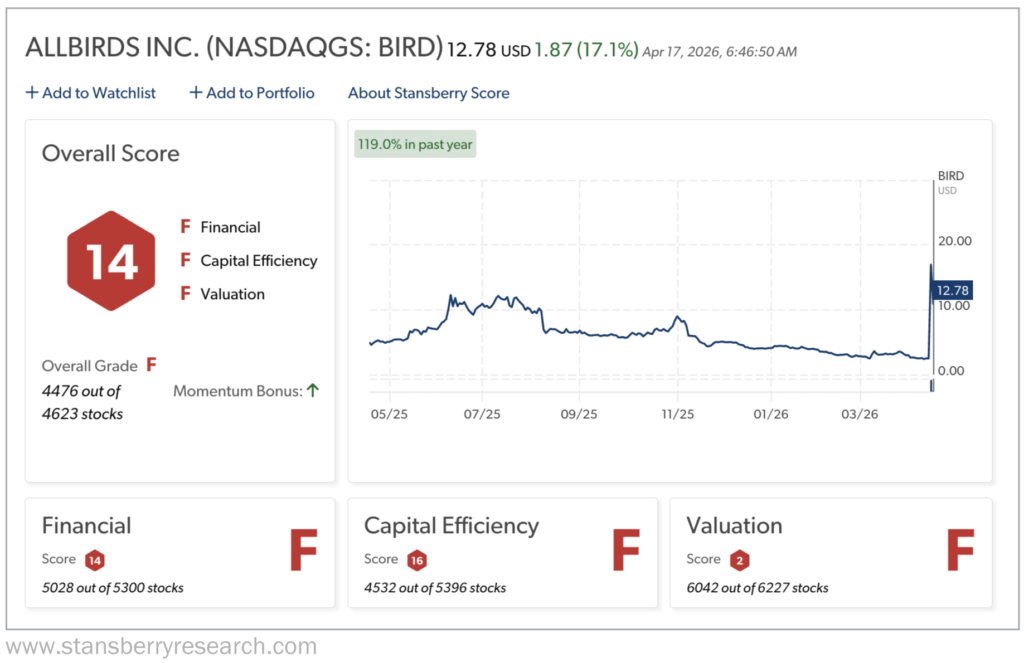
Allbirds gets an overall score of 15 out of 100, giving it an overall grade of “F.” And it receives “F” grades for all three components – financials, capital efficiency, and valuation. That places Allbirds in the bottom 5% of the 4,600-plus stocks we track in our system.
Of course, that could change. Before, Allbirds was “just” a shoe company. Now, as “NewBird AI,” the company is hoping to get a fresh start.
But the future is still uncertain for Allbirds… And there are much better ways to get exposure to AI than a shoe company that has decided to go all in on computing.
If history is any guide, we won’t look back on Allbirds’ pivot as a generational buying opportunity. There’s a much better chance it ends up being a sign of “peak hype” in the AI cycle.
Good investing,
Nick Koziol
Editor’s Note: Whitney Tilson called the rise of Apple, Amazon, and Netflix… as well as the collapse of dozens of companies that went bankrupt. Now the former $200M hedge fund firm manager is stepping forward with what he calls the most important financial warning of his 30-year career. He’s sharing two free stock recommendations (one to buy, one to sell immediately) along with details of a new proprietary system fueling his predictions. See it all in his free presentation.