

Listen to the audio version of this article (generated by AI).
Investors aren’t short on opinions about AI. Many say prices have run too far, yet they’re still weighing which businesses to back, which to avoid, and when to act.
To see how their views translate into decisions, we surveyed 1,002 U.S. self-directed investors who hold investments and make at least some decisions personally. We asked about valuation, fear of missing out (FOMO), favorite and least favorite AI businesses, regret, and timing.
Key Takeaways
- 71% of investors surveyed think AI-related investments are in a bubble, and 58% call them overvalued.
- 45% of investors who bought an AI-related investment mainly out of FOMO have regretted buying or selling one because of hype.
- Nearly 3 in 10 investors (28%) have bought an AI-related investment mainly out of FOMO.
- 36% of investors who call AI overvalued plan to keep or increase their exposure over the next 12 months (vs. 25% who plan to reduce or eliminate it).
- An extremely high valuation is the top thing that would discourage investors from buying an AI IPO (29%), ahead of lack of profitability (17%) and an uncertain business model (16%).
Valuation Worries Run High, but Cutbacks Lag Behind
Valuation and bubble worries are widespread, yet they lead to cutbacks less often than the worry alone would suggest.
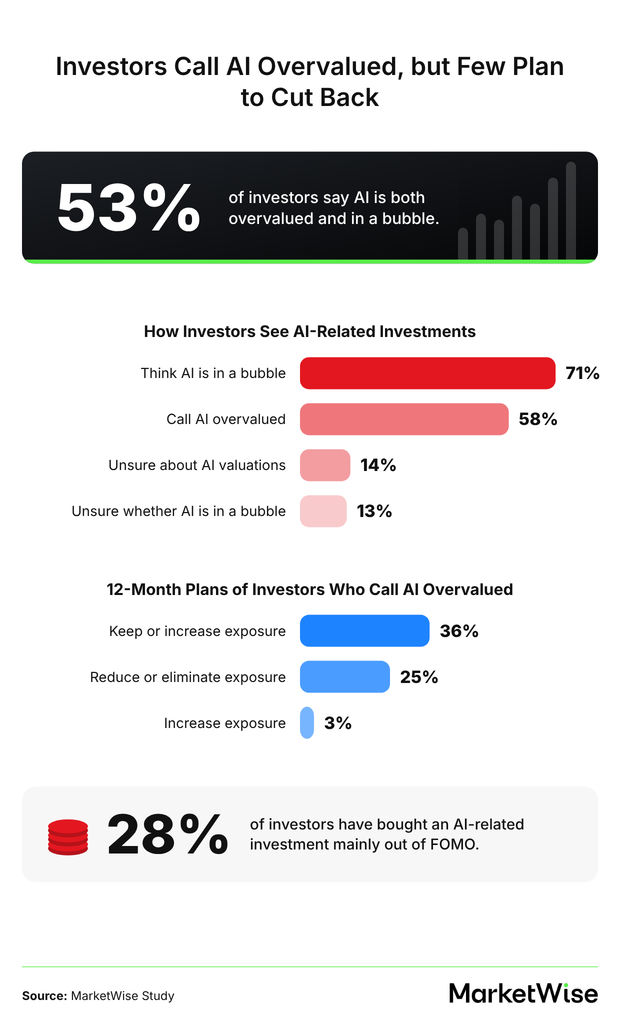
- 58% of investors call AI-related investments overvalued, and 20% say they are very overvalued.
- 71% of investors think AI is in a bubble, while 16% say it isn’t and 13% are uncertain.
- 53% of investors say AI is both overvalued and in a bubble.
- 36% of investors who consider AI overvalued plan to keep or increase their exposure over the next 12 months, while 25% plan to reduce or eliminate it.
- Nearly 1 in 3 investors (30%) are unsure whether their portfolio has AI exposure, while 44% know it does and 26% believe it has none.
- 28% of investors have bought an AI-related investment mainly out of FOMO. That share is 41% among AI buyers who call AI overvalued, 50% among those who call it fairly valued, and 58% among those who call it undervalued.
Who Investors Want to Own and Plan to Avoid
Investors name a business they would own, and one they would pass on.
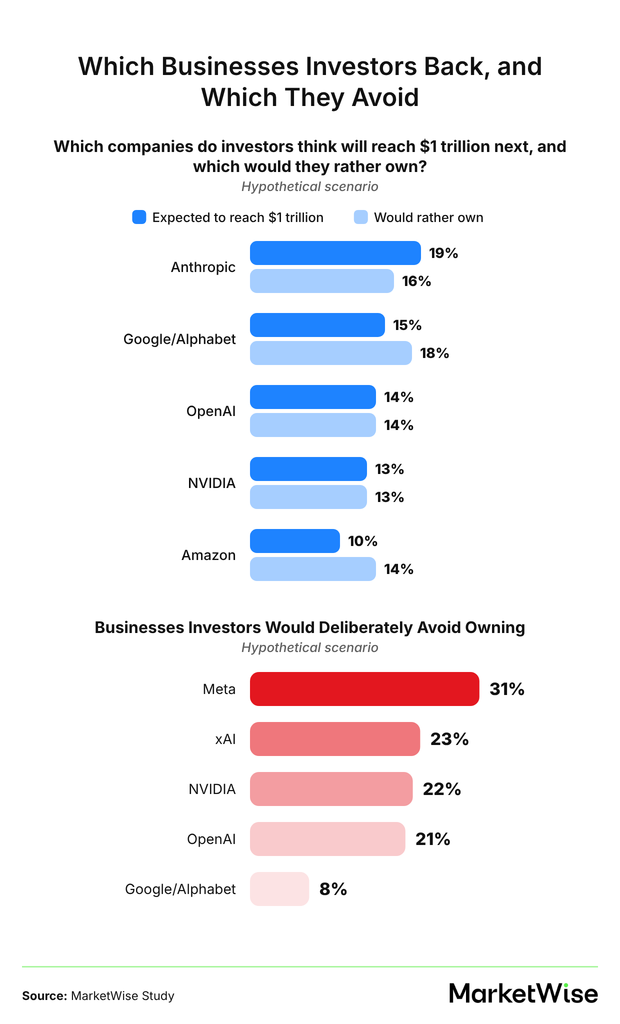
- Google/Alphabet narrowly leads as the business investors would most want to own in a hypothetical choice (18%), followed by Anthropic (16%), OpenAI (14%), and Amazon (14%).
- 31% of investors would deliberately avoid owning Meta in the hypothetical choice, ahead of xAI (23%), Nvidia (22%), and OpenAI (21%), while only 8% would avoid Google/Alphabet.
- 32% of the investors familiar with Anthropic would actively investigate buying its shares in a hypothetical IPO (vs. 27% of those familiar with OpenAI).
- 29% of investors say an extremely high valuation would most discourage them from buying an AI IPO, and 62% name valuation, profitability, or business model as the most discouraging factors.
Regret, Age, and Risk Appetite Shape Who Buys AI
Comfort with AI exposure is modest overall. Regret, age, and risk appetite separate the bold from the cautious.
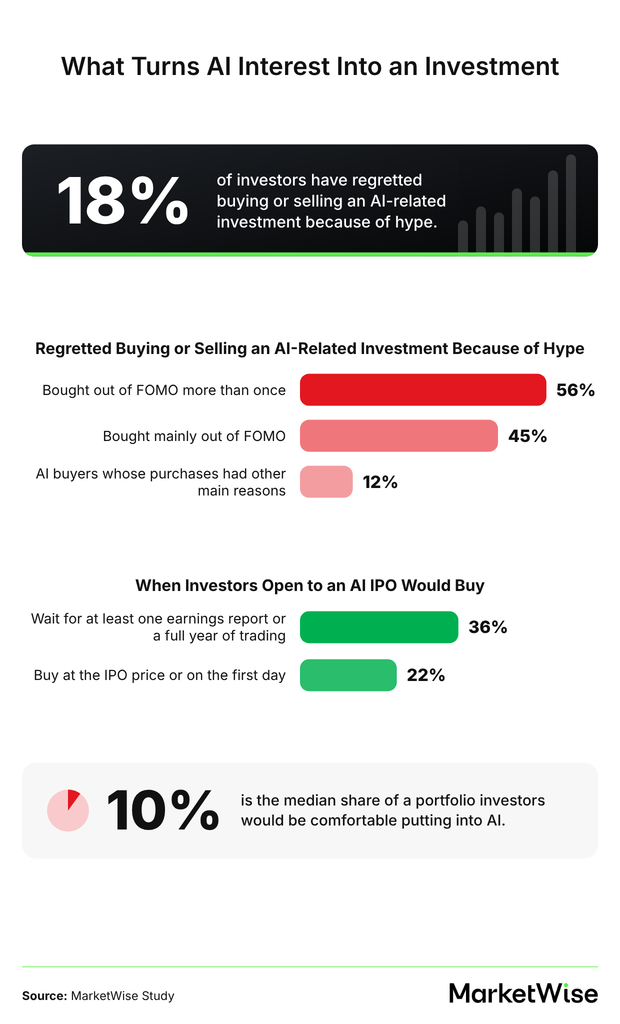
- The median comfortable AI allocation among investors is 10% of a portfolio; 30% of investors would go above 10%.
- 45% of FOMO buyers have regretted buying, selling, or both because of hype (vs. 12% of AI buyers whose purchases had other main reasons), and that rises to 56% among those who bought out of FOMO more than once.
- 18% of investors have regretted buying or selling an AI-related investment because of hype.
- 36% of investors open to an AI IPO would wait for at least one earnings report or a full year of trading before buying, while 22% would buy at the IPO price or on the first day.
- 18% of Gen Z investors would allocate more than 20% of their portfolios to AI, compared to just 2% of baby boomers.
- 43% of the high or very high risk investors have made a FOMO purchase, vs. 15% of the low or very low risk investors.
Methodology
We surveyed 1,002 U.S. self-directed investors. Respondents were 18 or older, lived in the U.S., held investments, and made at least some investment decisions personally. Generationally, 8% of respondents identified as baby boomers, 27% identified as Gen X, 47% identified as millennials, and 18% identified as Gen Z.
About MarketWise
MarketWise is a leading financial research and education platform serving self-directed investors. Through a network of independent brands, including Stansberry Research, Altimetry, Chaikin Analytics, TradeSmith, InvestorPlace, Brownstone Research, and Wide Moat Research, MarketWise delivers independent insights, tools, and software to help individuals navigate complex markets with confidence. Whether you’re exploring emerging opportunities or seeking stability, MarketWise supports every investor with credible research and actionable strategies.
Fair Use Statement
We welcome the use of this study for noncommercial purposes. If you share or reference any part of this content, please include a link back to this page to credit MarketWise appropriately.