
Today’s issue in preview:
-
Stock for investing in the next wave of AI wealth
-
These signals are flashing bullish for the AI infrastructure trade. Are you paying attention?
-
The biggest, most important ETF move you didn’t hear about today
-
Learn our Top Themes to buy now
These signals are flashing bullish for the AI infrastructure trade. Are you paying attention?
Credit: BING-JHEN HONG
Yesterday, the bulls that believe in the “world’s most important trend” got another piece of good news.
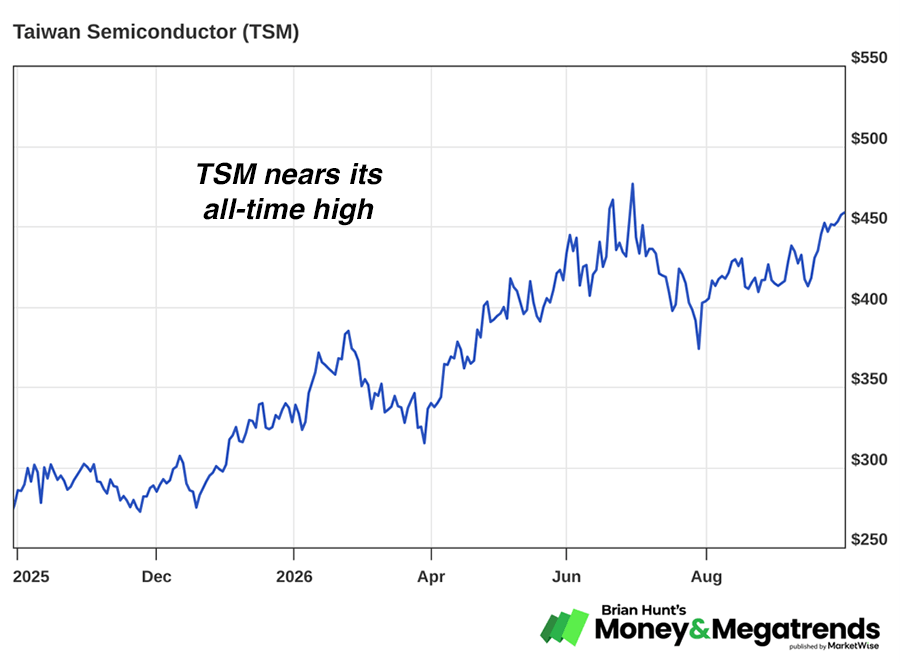
Taiwan Semiconductor (TSM) reached its highest level since June… and has rallied to near its all-time high.
This is a strong, positive signal for the AI infrastructure megatrend.
Over the past week, we have detailed how strong price action in critical AI infrastructure players Nvidia (NVDA) and Micron (MU) strongly supports the AI infrastructure megatrend.
The status of this megatrend has become one of the great sagas of the business and investment world. It is a source of strong disagreement among industry bulls and bears. It’s a trend whose outcome will almost certainly have large effects on your portfolio.
Given AI’s enormous promise, large tech firms such as Amazon (AMZN), Microsoft (MSFT), and Alphabet (GOOG) have invested over $1 trillion in AI infrastructure. They are on pace to invest over $700 billion this year alone and more than $4 trillion after that.
Both the scale and the velocity of this investment boom are unprecedented. It is the largest collective investment effort in history.
Big Tech’s historic investment boom has made the entire “AI infrastructure” trend responsible for a large share of America’s GDP growth and stock market returns over the past two years.
It has also drawn the skeptical scrutiny of many widely followed investment analysts who claim the trend is a bubble… one that will soon explode and cause tremendous damage to stock prices and the global economy.
If this hugely consequential trend isn’t the most important trend in the stock market, then it is certainly in the top three.
I believe the AI infrastructure trend has years to run. I believe the world’s smartest, most connected tech insiders who know the true state of bleeding-edge AI development and have real-time stats on AI investment ROI, such as Elon Musk, Jensen Huang (Nvidia), Satya Nadella (Microsoft) and Andy Jassy (Amazon), could possibly… perhaps maybe… just might… know far more about AI and their businesses than outsiders know about it.
As much press as AI gets, let’s remember that less than 1% of the global population pays for top-tier AI programs. And I estimate less than 10% of large companies believe AI has made a meaningful impact on their businesses.
This revolutionary technology hasn’t yet proliferated, achieved mass adoption, or had mass impact.
However, I place much more weight on what the market thinks about this trend (and every other trend) than on what anyone thinks about it, including me.
In the case of AI infrastructure, the market is favoring the bullish case. Nvidia is displaying impressive strength. Micron is displaying impressive strength. And so is Taiwan Semiconductor.
Taiwan Semiconductor is the world’s largest AI semiconductor chip maker. It performs little design work of its own. Instead, it produces – on a colossal scale – chips designed by companies such as Nvidia, Apple (AAPL), Amazon, and Broadcom (AVGO).
To say TSM is critical to the AI infrastructure boom is an understatement. It is estimated that TSM manufactures around 90% of the world’s most advanced AI chips. It is one of the few truly “mission-critical” parts of the AI infrastructure supply chain.
As you can see in the chart below, TSM stock has been a big winner over the past year but suffered a large correction alongside the rest of the AI infrastructure complex. That correction looks to have ended. Over the past 11 trading sessions, TSM has rallied 10.4%, reaching its highest level since June. This is another data point supporting the bull case for AI infrastructure.
Importantly, the current signals generated by our trend-identifying Heatseeker program are bullish for AI infrastructure as well.
Heatseeker is an AI-powered analytical program that helps us identify powerful trends and themes in their very early stages.
Heatseeker uses a powerful Large Language Model to perform a daily review of every stock that is reaching a new one-month high. After identifying this list of leaders, the program reviews each company’s public filings and analyzes the themes and industries in which the company is heavily involved.
Then, it cross-references company documents to identify “thematic clusters,” or groups of strong stocks that are in the same industry, share the same theme, or have the same business model.
Identifying thematic clusters – groups of stocks heavily influenced by the same business or tech trends – is useful for a simple reason…
When one stock in an industry or theme rallies and breaks into new price territory, it sends an important signal about that industry or theme. The fortunes of that industry or theme may be changing.
But when three, four, or even six stocks in the same industry or theme all move higher at the same time, it’s a much more powerful signal.
When you see a group of similar companies breaking out to the upside at the same time, you know it is not the result of just one company doing something better than its competitors or executing a turnaround. You know it is a broad, industry-wide move. It is the market sending you a signal that a tectonic market shift may be underway.
We used this type of analysis to be very early on the genomics theme, which has been a huge winner. We used it to be very early on the oil sector rally that began in late 2025. We used it to make money in gold stocks and copper stocks in 2025. We used it to identify large winners in the semiconductor industry this year. The list goes on.
Identifying market-leading “thematic clusters” just as they begin to exhibit leadership is a huge help when it comes to making money in stocks.
Right now, the strongest thematic cluster signals we are seeing are in the AI infrastructure trade. On Tuesday, more than 30 stocks that are heavily leveraged to the AI infrastructure megatrend reached new one-month highs.
This group includes specialized semiconductor makers, semiconductor manufacturing equipment makers, semiconductor industry service providers, and data center infrastructure makers.
When you add this industry-wide strength to the strength in TSM, Nvidia, the Mag 7, and Bloom Energy (BE), a clear picture emerges: On “the scales of stock market justice,” the weight of the evidence tilts bullish for the AI infrastructure trade.
Recommended Link:
I was 1 of 6 people in this room. Here’s what I heard.

I was at the Department of Energy with Secretary Chris Wright. What he told six of us about powering America’s AI boom is why I believe the next 18 months could be the most profitable of this commodity cycle. Here’s what was said.
Stock for investing in the next wave of AI wealth

Credit: Kenneth Cheung
It’s official: Meta (META) has a mega hit on its hands with its new personal AI Agent, Muse.
Since its release on September 8, Meta has invested heavily in its awareness and adoption. This has made Muse the most-downloaded app on Apple’s App Store. It is one of the most rapidly adopted products in history. Importantly, it is receiving excellent reviews from customers.
This is further confirmation that the Agent Supernova thesis we introduced back in March was well timed.
Years of development have made AI advanced enough to perform many everyday tasks people do now… and the list keeps growing. Over the next 12–24 months, AI agents will help manage factories, perform financial analysis, manage inventories, write software, design websites, create legal documents… and thousands of other tasks.
Within two years, the number of AI agents operating in the American economy isn’t poised to increase by 10X… or 50X… or even 1,000X. Try at least 10,000X.
This is the coming Agent Supernova: agents working with people, agents working with other agents, agents running businesses, and negotiating with other agents.
The Agent Supernova is about to introduce billions of “AI workers” into our economy with very little day‑to‑day human oversight. The business and investment implications are huge. It will transform many businesses and industries, end many as we know them, and create entirely new ones.
Unlike a conventional AI chatbot, Muse doesn’t just answer questions. It books travel, fills in forms, shops for you, and keeps working after you close the app. Plus, it can buy things for you. That’s both convenient and dangerous.
To buy something for you, Muse and other agents must have a way to pay. This means we’ll soon have millions of agents transferring money and making payments, and they’ll often use blockchain technology to do so.
As we covered in our special series on the coming AI Money Revolution, an AI agent can’t walk into a bank, show an ID, sign forms, or open an account. The current banking system, as we know it, isn’t agent-friendly.
The only logical answer is dollar-backed stablecoins: digital dollars that move on open blockchain networks instead of closed banking systems. Think of them as dollars that computers use without a bank account. Eventually, money will be used more by machines than by humans.
But here’s the problem. Once a blockchain payment goes through, it’s extremely hard to reverse. If an agent gets tricked into sending money, you can’t easily get it back.
And agents are relatively easy to trick for seasoned fraudsters.
Give an agent a card, a browser, and the authority to act, and it behaves like a trusted insider. It holds legitimate credentials. It will also follow instructions from anyone clever enough to slip them in.
That’s exactly how fraudsters attack an agent. There are three main routes:
-
Prompt injection: Fraudsters hide instructions in a web page or email that the agent reads and obeys… like quietly adding a gift card at checkout.
-
Agent credentials: If a criminal steals an agent’s payment token, they can rack up thousands of dollars of purchases within minutes.
-
Spoofed agents: Merchants can no longer tell a legitimate shopping agent from a criminal’s bot impersonating one.
And all of this happens in seconds. According to Innovify, instant transfers increase risk by up to 10x compared with traditional transfers because detection windows shrink to seconds.
Every new agent with a wallet is a target, and every target needs protecting. That’s bullish for companies involved in fraud prevention, identity security, and the infrastructure that verifies who is actually doing the shopping.
Three investment candidates in this theme include:
Riskified (RSKD) is a $1 billion company that operates in e-commerce fraud prevention, determining which orders are real. When a customer places an order, the model decides whether to approve or decline it based on risk scoring metrics. Revenue grew 22% year over year, the fastest pace in over four years, making it a clear beneficiary of the agentic world we’re entering.
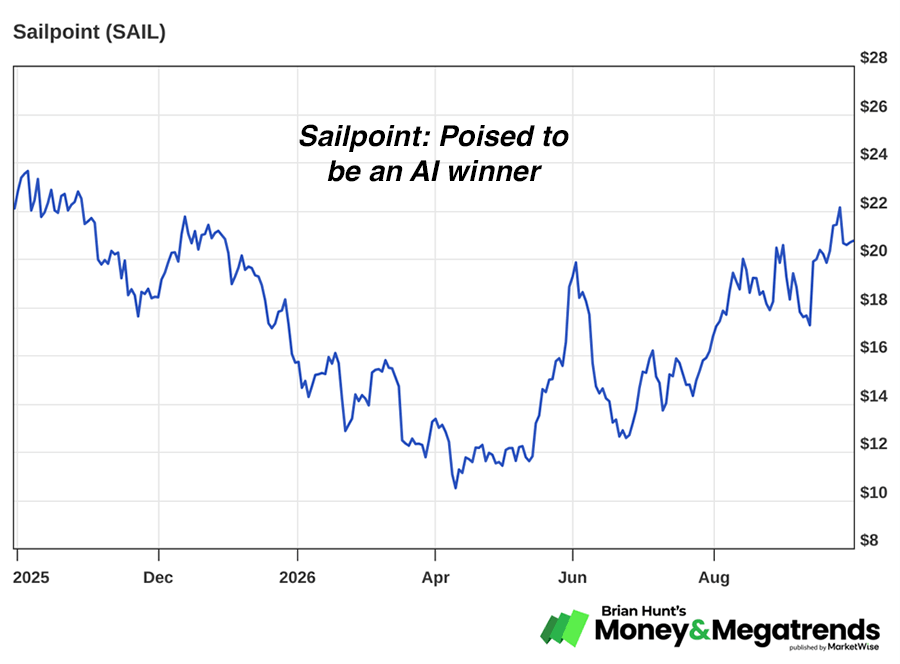
SailPoint (SAIL) is a $11.7 billion company that governs who and what has access to a company’s systems, and it’s riding the tailwind of AI agents being just another identity to protect. Morgan Stanley estimated that the agentic identity market could reach nearly $60 billion over the next few years. Since AI-related annual recurring revenue for SAIL is only at about $60 million now, the greenspace ahead to win is massive.
Cloudflare (NET) is a $126 billion giant. Its CFO just said its network is built perfectly for the agent era, with revenue growing 36% year over year and 2 million more developers signing up to build on its platform in the last quarter alone. The CEO said that non-human traffic passed 50% for the first time ever. It’s now also moved into the payments world with partnerships through Visa, Mastercard, American Express, PayPal, and Coinbase. (As we mentioned on September 21, NET is richly valued right now, so we recommend monitoring it for better prices ahead.)
Agents are about to move more money than any shopper ever has, and fraudsters will try to steal many of those dollars. Companies that can prove who or what is really behind each purchase should benefit from this new AI trend.
The biggest, most important ETF move you didn’t hear about today
Credit: onurdongel
In the research note above, we detailed how our Heatseeker analysis is currently picking up stock price strength across the entire AI infrastructure ecosystem.
More than 30 stocks that are heavily leveraged to this megatrend reached one-month highs yesterday.
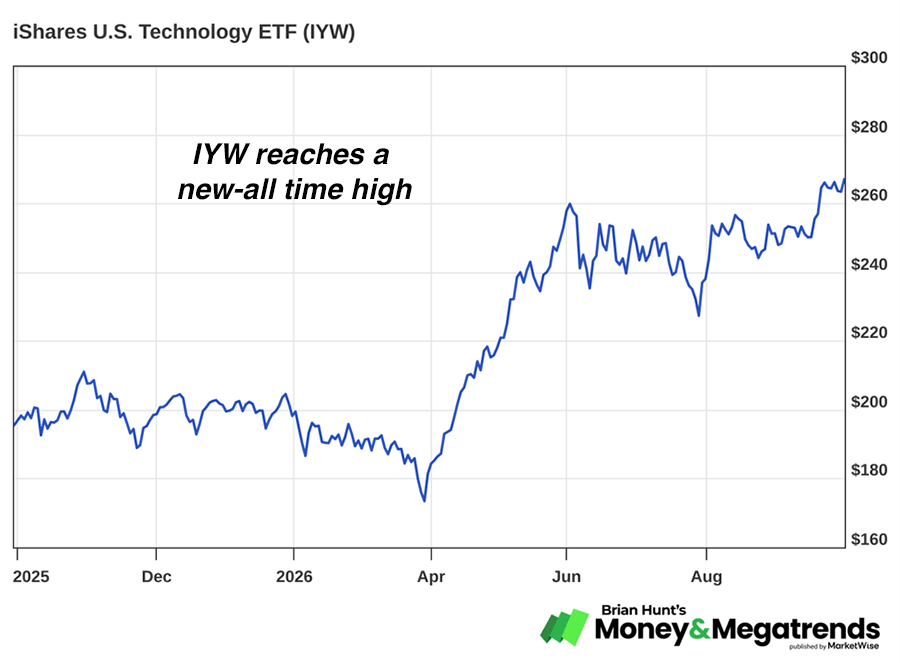
The message from the ETF world is essentially the same, including today’s new all-time high in the iShares U.S. Technology ETF (IYW).
With approximately $26 billion under management, IYW is one of the world’s largest technology-focused ETFs. It is heavily weighted towards megacap leaders Nvidia (NVDA), Apple (AAPL), and Microsoft (MSFT).
However, it has a meaningful allocation in smaller (but still relatively large) tech firms such as semiconductor equipment leader Applied Materials (AMAT), defense leader Palantir (PLTR), and memory giant Micron (MU).
IYW’s extensive exposure to the semiconductor industry and to big “hyperscaler” firms that operate AI data centers makes it a good way to gauge the climate and sentiment in the technology world.
As you can see in the chart below, the climate in technology stocks is 70 degrees and sunny. The ETF has returned 37.5% over the past 12 months and just hit a new all-time high. The trend in tech remains UP.
Market Notes
-
Our recommendation to invest in the genomics megatrend continues to pay off. Sector leaders Natera (NTRA), 10X Genomics (TXG) and Illumina (ILMN) reached new all-time highs today.
-
Our February 17th recommendation to own cybersecurity stocks is paying off. Rubrik (RBRK) just hit a new high and is now up 20% over the last month. Crowdstrike (CRWD) and Palo Alto Networks (PANW) hit new all-time highs.
-
Data storage and infrastructure leaders Hewlett Packard Enterprise (HPE), Everpure (P), and Netapp (NTAP) just hit new highs. This is bullish for the AI infrastructure buildout theme.
-
Toy giant Mattel (MAT) reached a new one-year low today.
-
Home improvement giants Home Depot (HD) and Lowes (LOW) reached new one-year lows today.
Top Themes to Buy Now
₿ Six ways to invest in the revolution in money and banking
⚡ We’re revealing our top AI trade of the month…
🔬 This stock sector is starting to boom. We bet it has years to run. Are you on board?
Regards,


Brian Hunt
Editor, Money & Megatrends
An urgent message from our colleagues:
‘They’re Coming for the Stock Market’ – 12-Time U.S. Congressman Dr. Ron Paul Speaks Out

A political fault line is opening beneath the stock market. At least $27 billion and roughly 30 U.S. companies are already involved, with several stocks down 50%. That’s why legendary Congressman Dr. Ron Paul is issuing a dramatic final warning.
Make these three moves today.