

Listen to the audio version of this article (generated by AI).
Copying a famous investor has never been easier. A member of Congress files a stock disclosure, a hedge-fund manager’s holdings hit the news, or a financial influencer posts a screenshot, and within hours, retail investors can mirror the trade from an app on their phone. The catch is that copying the rich and powerful only works if their edge is real, and for a lot of investors, it comes down to a hunch that famous people, especially politicians, know something the rest of us don’t.
MarketWise surveyed 1,005 U.S. retail investors to find out who they copy, where they get the tips, how much money they’ve made or lost, and where they stand on the politicians whose trades keep going viral. The picture that emerged is part investment strategy and part gamble, along with a striking amount of distrust toward Washington.
Key Takeaways
- Half of American retail investors (50%) copy the publicly disclosed trades of a politician, executive, celebrity, or financial influencer, and about 2 in 5 of them (41%) say it has made them money.
- Warren Buffett (35%) and Nancy Pelosi (34%) are the two most-copied individuals, each followed by about 1 in 3 copycat investors.
- More than 2 in 5 copycat investors (42%) have copied a famous person’s trade without researching the company themselves.
- Roughly 1 in 7 copycat investors (14%) have taken on debt or used margin to fund a copied trade.
- More than 1 in 5 copycat investors (23%) have kept copying someone even after that person lost them money.
- More than 4 in 5 American retail investors (86%) believe members of Congress trade on non-public inside information, and nearly 3 in 5 (59%) say lawmakers should be banned entirely from trading individual stocks.
- More than half of American retail investors (53%) would be less likely to vote for a candidate who actively trades individual stocks.
Who Copycat Investors Follow, and What They’ve Won
Copying famous investors is now about as common as not, and the scoreboard of who gets followed holds a few surprises.
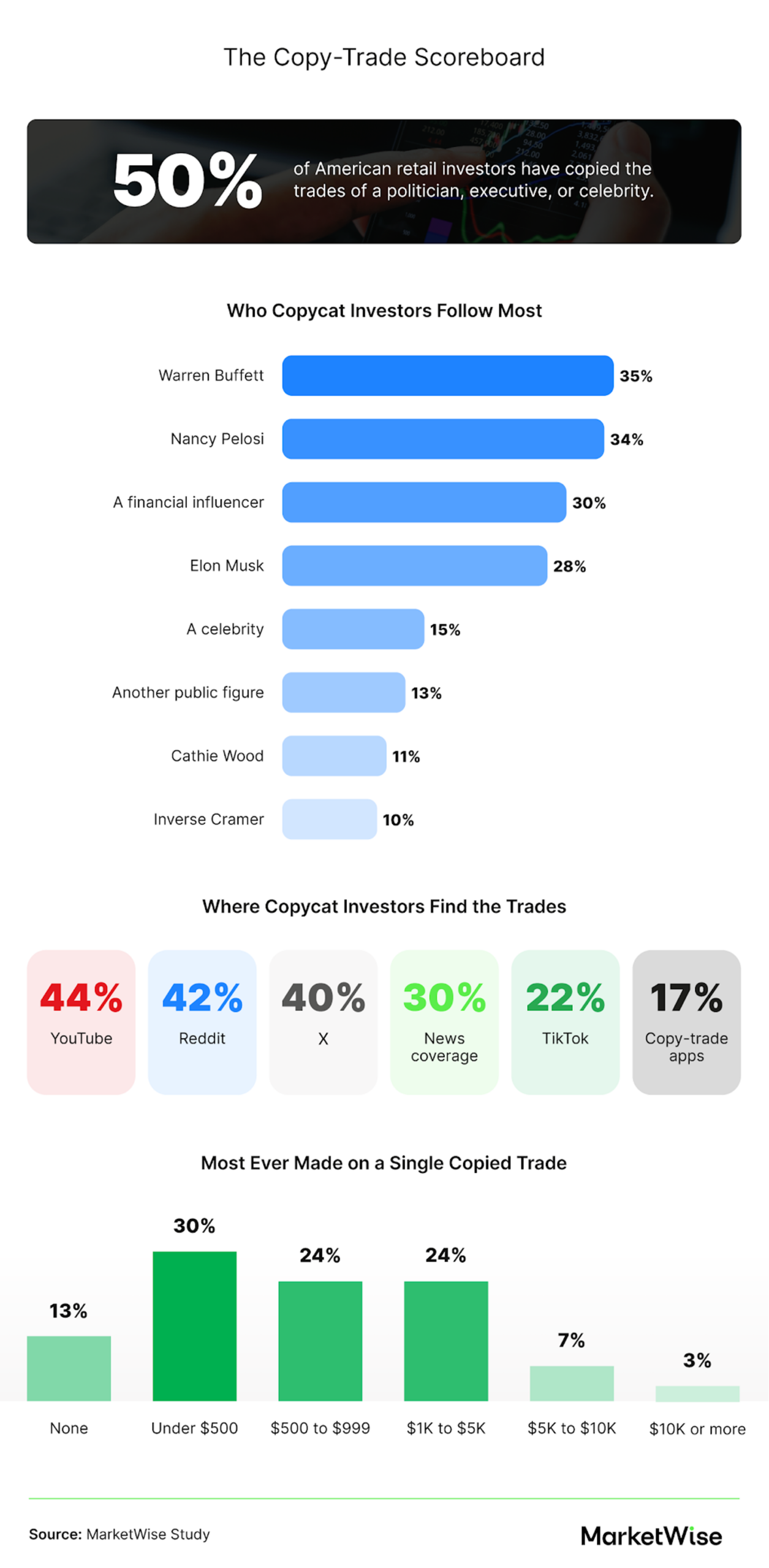
Half of American retail investors (50%) said they’ve copied the publicly disclosed trades of a politician, executive, celebrity, or financial influencer, and 41% of those copycats said it made them money. Two names stood out. Warren Buffett (35%) and Nancy Pelosi (34%) were each copied by roughly 1 in 3 copycat investors, with a financial influencer (30%) and Elon Musk (28%) close behind.
Further down the list came names like Cathie Wood (11%) and even an “inverse Cramer” strategy (10%), where investors deliberately bet against the prominent TV stock picker Jim Cramer’s calls.
Grouped by type rather than by name, financial influencers narrowly beat politicians as the most-copied category (27% vs. 24% among all retail investors).
Most of the trade targets are surfaced on social media. Among copycat investors, 84% said they find trades on YouTube, Reddit, X, or TikTok, with YouTube (44%), Reddit (42%), and X (40%) leading. The habit skews young, too. Gen Z retail investors were the most likely to copy famous trades at 56%, ahead of millennials (53%), Gen X (43%), and baby boomers (39%).
The payouts tend to be modest. More than half of copycat investors (58%) have made at least $500 on a single copied trade, and about 1 in 3 (34%) have cleared $1,000 or more, with politicians the most-credited source of those bigger wins. Even so, the most common best-ever haul was under $500 (30%), and 13% have never made anything at all. Exposure stays limited for most, with 53% saying copied trades account for just 1% to 10% of their portfolio.
When Copying Famous Trades Turns Into Gambling
For many copycat investors, following famous trades is more reflex than research.
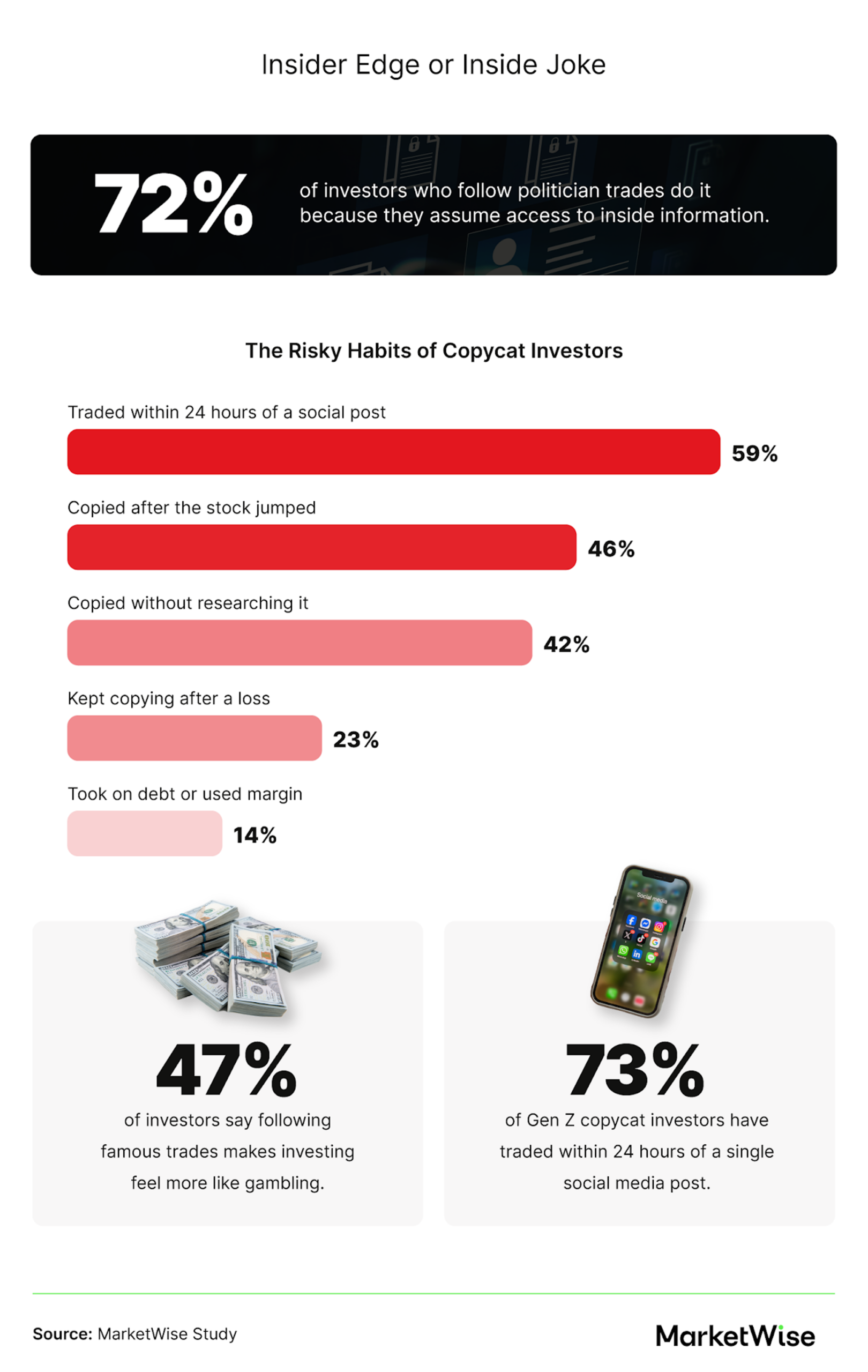
Speed and impulse drive a lot of this trading. More than 2 in 5 copycat investors (42%) have copied a famous person’s trade without researching the company first, and 59% have placed a trade within 24 hours of a single social media post — a reflex that climbs to 73% among Gen Z.
Nearly half of copycat investors (46%) have copied a trade after the stock had already surged, 23% have kept copying someone even after that person lost them money, and 14% have taken on debt or used margin to fund a copied trade.
Plenty of copycats sense the risk, with 47% saying following famous trades makes investing feel more like gambling. The pull for the copycat is strongest when the trader holds public office. Among investors who follow congressional trades, 72% said they do it because they assume lawmakers have access to inside information.
Why Investors Want Congress Out of the Stock Market
The same investors copying Nancy Pelosi’s trades are deeply suspicious of how she and her colleagues get their edge.
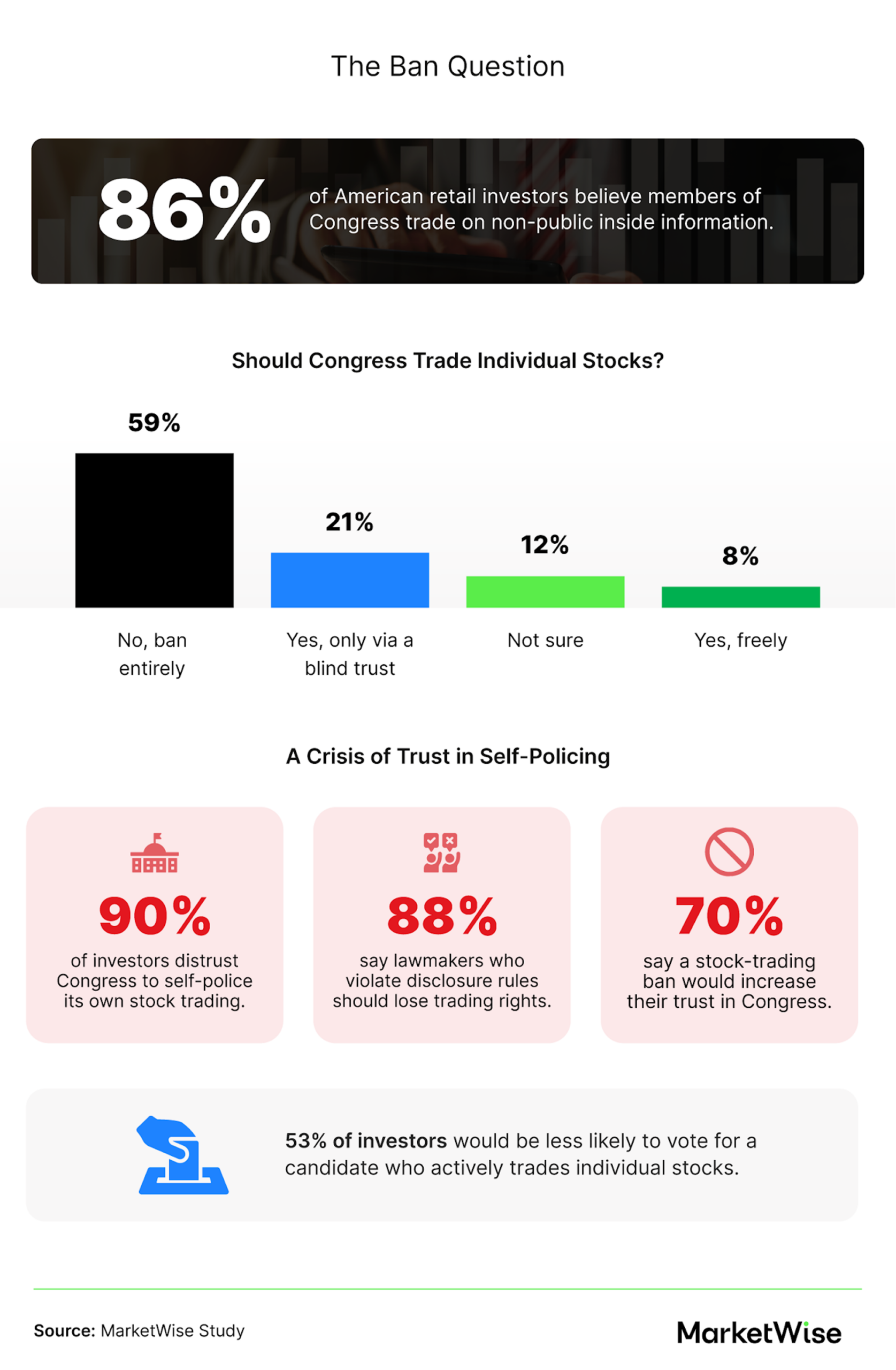
Skepticism ran deep. More than 4 in 5 American retail investors (86%) said they believe members of Congress trade on non-public inside information, and that suspicion ran even higher among older investors, from 79% of Gen Z to 95% of baby boomers. On top of that, 90% said they doubt Congress can be trusted to police its own trading.
That distrust turns into a clear demand. Nearly 3 in 5 investors (59%) said members of Congress should be banned entirely from trading individual stocks, and another 21% would allow it only through a blind trust, where an independent manager controls the holdings and the official can’t direct the trades. Just 8% said lawmakers should be free to trade as they do now. Support for a full ban held up across generations, though Gen Z was the most hesitant (49% vs. 60% to 63% of older investors). Seven in 10 investors even said a ban would boost their trust in Congress.
The distrust could go so far as to reach the ballot box. More than half of American retail investors (53%) said they’d be less likely to vote for someone who actively trades individual stocks, a feeling led by baby boomers (66%) and weakest among Gen Z (48%).
Why Copying the Famous Is the Easy Part
The appeal of copy-trading is obvious, since the information is public and the tools are mostly free. But our data suggests it works best as a starting point rather than a shortcut. The investors most likely to get burned were the ones who skipped their own research, chased a stock after it had already moved, or borrowed money to keep up.
If you’re tempted to mirror a famous portfolio, the smarter move is to treat a disclosure or a viral post as a lead to research rather than a reason to trade within the hour. And if the trades tempting you happen to belong to a member of Congress, you’re not alone in being a little suspicious about why they tend to work.
Methodology
We surveyed 1,005 U.S. retail investors about how many follow or copy the publicly disclosed trades of politicians, executives, celebrities, and financial influencers to explore why they do it, whether the strategy has paid off, and where they stand on congressional stock trading. All respondents were adults age 18 or older, representing a mix of generations, income levels, and genders. The generational breakdown was 51% millennials, 23% Gen X, 18% Gen Z, and 8% baby boomers.
Questions about copy-trading behavior and performance were shown only to the 50% who reported following or copying at least one famous trader, and those figures are labeled as based on copycat investors. Money and performance figures reflect self-reported investor perception rather than verified returns. Data was collected in 2026. Percentages may not total to 100% due to rounding.
About MarketWise
MarketWise is a leading financial research and education platform serving self-directed investors. Through a network of independent brands, including Stansberry Research, Altimetry, Chaikin Analytics, TradeSmith, InvestorPlace, Brownstone Research, and Wide Moat Research, MarketWise delivers independent insights, tools, and software to help individuals navigate complex markets with confidence. Whether you’re exploring emerging opportunities or seeking stability, MarketWise supports every investor with credible research and actionable strategies.
Fair Use Statement
We welcome the use of this study for noncommercial purposes. If you share or reference any part of this content, please include a link back to this page to credit MarketWise appropriately.