
Listen to the audio version of this article (generated by AI).
Today’s issue in preview:
-
This new AI investment strategy could generate 2,000%+ returns
-
Space stocks have huge upside potential. How to trade the group from here
-
BULLISH: One of America’s most important “fun and frivolous” spending stocks just hit a new high
-
Learn our Top Themes to buy now
This new AI investment strategy could generate 2,000%+ returns

Credit: BlackJack3D
Apple. Amazon. Google. Facebook. Netflix. YouTube.
These are among the largest and most successful businesses in history. Their early investors made 10X returns and, in some cases, 100X+ returns.
And they all have one thing in common: They didn’t build the physical network of fiber optic lines, routers, servers, and switches that made up the internet. Instead, they built the wonderful businesses on top of that revolutionary infrastructure.
They were the “applications” layer of the Internet.
It’s important to understand the applications layer concept because we’re on the cusp of a historic boom in companies that don’t build critical AI “hard infrastructure” such as data centers and semiconductors…but instead build wonderful businesses on top of that infrastructure… just like Apple, Amazon, and Google did with the internet.
The revolutionary AI program ChatGPT was released to the public in late 2022. Since then, big tech firms have invested over $1 trillion in semiconductors, networking equipment, computer memory, physical data centers, and other components of AI infrastructure.
Now that so much infrastructure has been installed, thousands of businesses can be built upon it… much like how Amazon, YouTube, and Netflix were built upon the internet.
I’m talking about AI-centric businesses that revolutionize how we develop medicines, how we educate, how we entertain ourselves, how we manufacture, how we shop, how we transfer and invest money, and much more.
The internet changed every industry and created many new ones. AI will do the same.
Investors who follow the Internet applications layer playbook into big AI applications layer winners stand to make giant returns. In fact, I’d say this theme is one of the best places to find 10X+ winners over the next decade.
Some of these future winners are existing businesses that apply AI to greatly increase revenue and crush the competition. Some of them haven’t started yet.
Over the next decade, the AI applications Layer megatrend will prove to be one of the greatest wealth-generating trends in history.
Here is a short list of some promising firms set to succeed with this applications layer “playbook:”
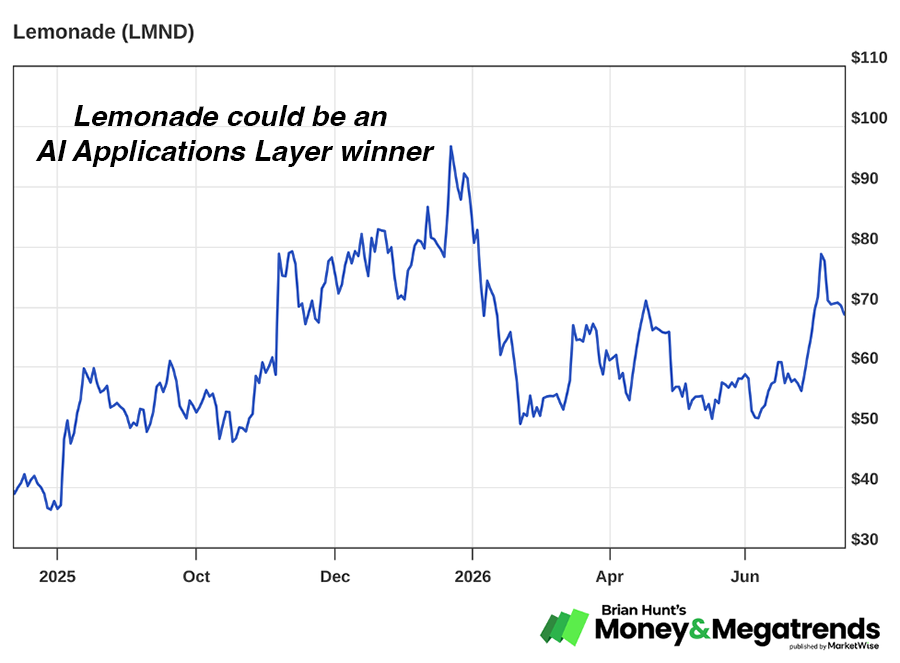
Lemonade (LMND) is a $5.4 billion company that is disrupting the insurance industry. Unlike most legacy insurers, LMND has built its business from the ground up with AI. So much so that operating expenses and headcount haven’t increased over the last 2 years despite more than quadrupling revenue. The company is entering the car insurance market. If it succeeds there, then LMND at a $5.4 billion market cap would be a bargain.
Zeta Global Holdings (ZETA) is a $5.3 billion AI marketing firm. It uses AI and large datasets to help clients track customer behavior and market effectively. Traditional Customer Relationship Management (CRM) systems, such as Salesforce, rely on the data entered by clients, rendering them useless if the data is weak. ZETA challenges this entire model with a massive pre-loaded database containing 2.4 billion consumer identities and trillions of behavioral signals. ZETA has recently partnered with both OpenAI and Palantir.
Upstart (UPST) is a $3 billion lending company aiming to replace traditional “rear-view” credit scoring models with large-scale machine learning models that analyze non-traditional variables such as employment history, income stability, recent promotions, education details, cash flow patterns, etc. It creates a far more detailed and fair picture of the customer than legacy peers, who don’t have the technology and models to do so. Revenue growth is expected to stay +30% for the next 4 years, which is very strong for a company trading at 3x sales.
The AI infrastructure buildout is far from over. But at some point, the stock market will start to reward fresh new businesses built upon that infrastructure. The AI Applications Layer boom is about to begin.
Recommended Link:
The man CNBC calls “The Prophet” just revealed his biggest AI trade

And it isn’t Nvidia, Microsoft, or any chip stock you’ve seen on CNBC. It’s a little-known company that controls the rare assets the entire AI boom can’t exist without. One billionaire already put over half his $9 billion fund into it. Right now it’s trading at a rare discount — weeks before the next dividend hits. Wall Street Legend Whitney Tilson reveals the name and ticker, completely free. Get the name and ticker, completely free.
Space stocks have huge upside potential. How to trade the group from here

Credit:3DSculptor
Is the bottom in for space stocks?
A look at the space industry-focused Procure Space ETF (UFO) tells us that could be the case.
Money & Megatrends readers may recall our belief that the space industry will enjoy significant growth and generate many large stock market winners over the next five years.
On September 22, 2025, I wrote a bullish piece on space stocks and said it’s a sector that the “public could go wild for.” I stated the bull case like this:
When people think of investing in space, they often go towards the business of launching rockets and Elon Musk’s SpaceX. But many of the most promising “space stocks” are in the business of space-based communication platforms and equipment. Think government surveillance, military communication, GPS, internet service, and cell service.
The best big picture fundamental case for space stocks right now is that the Trump administration believes America is in a hugely important competition with China and other countries for “space dominance.” This means regulatory and financial support for the U.S. space industry.
… Top performing individual space names worth checking out include Rocket Lab (RKLB), BlackSky (BKSY), Planet Labs PBC (PL), and AST SpaceMobile (ASTS).
Soon after our note, many space stocks soared 50%-100%, powered in part by anticipation of the gigantic SpaceX (SPCX) IPO in June. Since that runup, however, space stocks have experienced a large correction. I viewed this correction as natural, given its huge preceding run-up. No sector runs higher week after week in a straight line. The space trade needed to “work off” a lot of froth and enthusiasm.
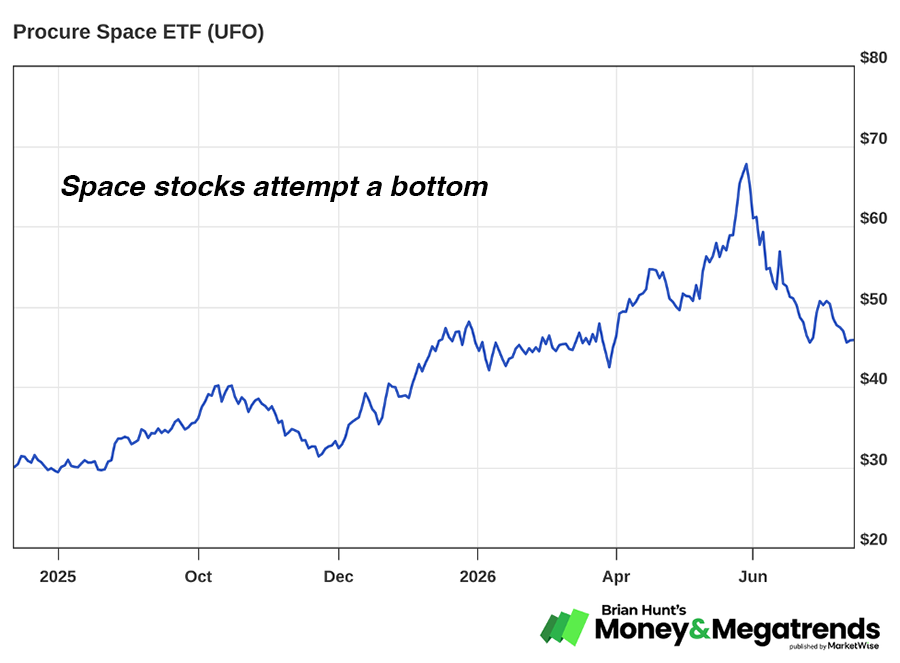
As you can see in the one-year chart below of the Procure Space ETF, the space industry is attempting to form a bottom in the mid-$40 per share range. This is also where the fund traded in a sideways consolidation earlier this year.
Keep an eye on UFO while it trades in the mid-$40s per share. If it breaks this level to the downside, I’ll see the average space stock as a “pass” because the industry trend is weak. If UFO holds this area and uses it as a launching point into the high $40s, I’ll say the uptrend is back and tradeable from the long side. To be continued…
BULLISH: One of America’s most important “fun and frivolous” spending stocks just hit a new high

Credit: Brycia James
In yesterday’s issue, I mentioned that if you’re looking for an excuse to celebrate – or be optimistic on the U.S. economy – the market just supplied one via the new all-time high reached by the iShares U.S. Broker-Dealers & Securities Exchanges ETF (IAI).
IAI is a unique ETF focused on companies that function as the business and investment world’s “support system.” This fund owns a “who’s who” of investment banks, securities exchanges, stock brokerages, financial index providers, and credit rating agencies.
Major holdings include diversified giant Goldman Sachs (GS), fellow giant Morgan Stanley (MS), brokerage firm Robinhood (HOOD), credit rating agency Moody’s (MCO), and financial exchange giant CME Group (CME, formerly Chicago Mercantile Exchange).
These firms provide the grease and gears of the world’s financial markets engine. They eventually get a substantial “cut” of all kinds of financial activities like IPOs, 401(k) management, stock index administration, ETF management, stock purchases, commodity transactions, wealth management, debt issuance, and credit ratings.
Their fortunes rise and fall with the health of global financial markets. The recent new highs in their ETF are a bullish economic signal.
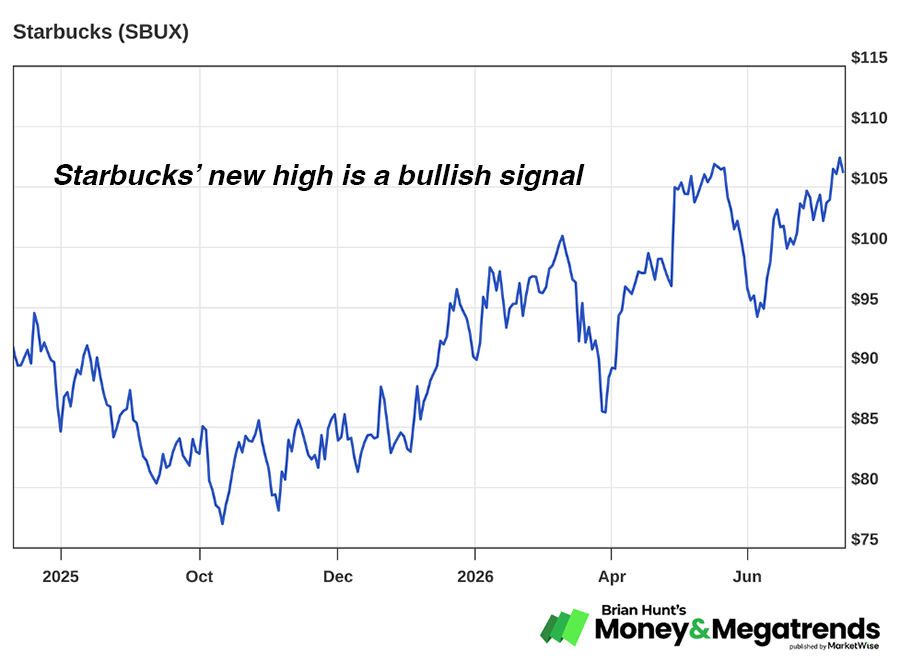
Today, the market gave us another reason to be optimistic. The stock price of Starbucks (SBUX) reached a new one-year high today.
Starbucks is one of my favorite “real world” financial indicators.
Many investors fixate on government data such as unemployment figures, job hirings, and the Consumer Price Index. I like to know that data as everyone else does.
However, when I want a read on what’s really happening in the economy, I place far greater focus on what’s happening in the real world. I look at stock prices. In doing this, I listen to the judge, jury, and executioner of any thesis, any trend, and any claim: The market.
Market prices are the sum total and final expression of all knowledge held by industry insiders, connected money managers, government officials, and bankers who quietly control huge swaths of the economy. These people know much more about their industries of focus than you or I do. Their knowledge manifests itself through action… and that action that sets market prices.
Market prices are not always perfect, but most of the time, they know a heck of a lot more than any economist or investment guru.
The trend in Starbucks’ stock is useful because the decision to buy a Starbucks product is often a “want” rather than a “need.” For many people, buying a round of flavorful $7 caffeinated drinks is a fun way to burn through spending money.
Buying a highly marked-up beverage is something people are more likely to do when they are gainfully employed, making money, and optimistic about tomorrow. Opting to spend less than fifty cents on coffee made at home is what people do when times are tough.
In recent years, Starbucks’ management made some missteps that depressed the company’s stock. However, new management is executing something of a turnaround. Helped by customers willing to make “fun and frivolous” purchases, the stock reached a new one-year high this week. Add this development to our growing list of trends that are moving in a very bullish direction for the U.S.A.
Market Notes
-
Our March 5 recommendation to own the cybersecurity theme is paying off nicely. Crowdstrike (CRWD), Fortinet (FTNT), Cloudflare (NET), and Okta (OKTA) all hit new highs today. CRWD is now up 78% in the last year.
-
Oil refining giants Valero (VLO), Marathon Petroleum (MPC) and Philipps 66 (PSX) reached new three-month highs today thanks to the resumption of armed conflict in Iran.
-
Fintech stocks are starting to come alive. Sezzle (SEZL) and Dave (DAVE) just hit new highs today. SEZL is now up 40% in the last month.
-
Our November 17 recommendation to own biotech is doing well. 10X Genomics (TXG) hit new highs today which puts it up 188% since our recommendation.
-
Our March 20 recommendation to own semiconductor equipment stocks is delivering. Testing equipment small-cap Aehr Test Systems (AEHR) is up 40% today after a blowout earnings report.
-
Our December 8 recommendation to invest in the Battery Tech theme is working. Lithium-ion battery maker Electrovaya (ELVA) is up 39% today on news of a new deal with Amazon (AMZN).
-
Mega banks JP Morgan Chase (JPM) and Bank of America (BAC) reached new all-time highs today. These are bullish economic signals.
Top Themes to Buy Now
💻 Big news in the great “AI Boom or AI Bust” debate
☀ Solar stocks are market leaders … and the customer is usually wrong
Regards,


Brian Hunt
Editor, Money & Megatrends
An urgent message from our colleagues:
5 Wall St. Legends Join Disturbing Event On July 16

On July 16, fintech genius Keith Kaplan unveils a breakthrough new system that could double your portfolio by spotting the biggest jumps on 5,000 stocks, BEFORE they occur, with 83% backtested accuracy. Includes 2 free picks in a major event backed by 5 Wall St. legends, and a disturbing new prediction for the market.