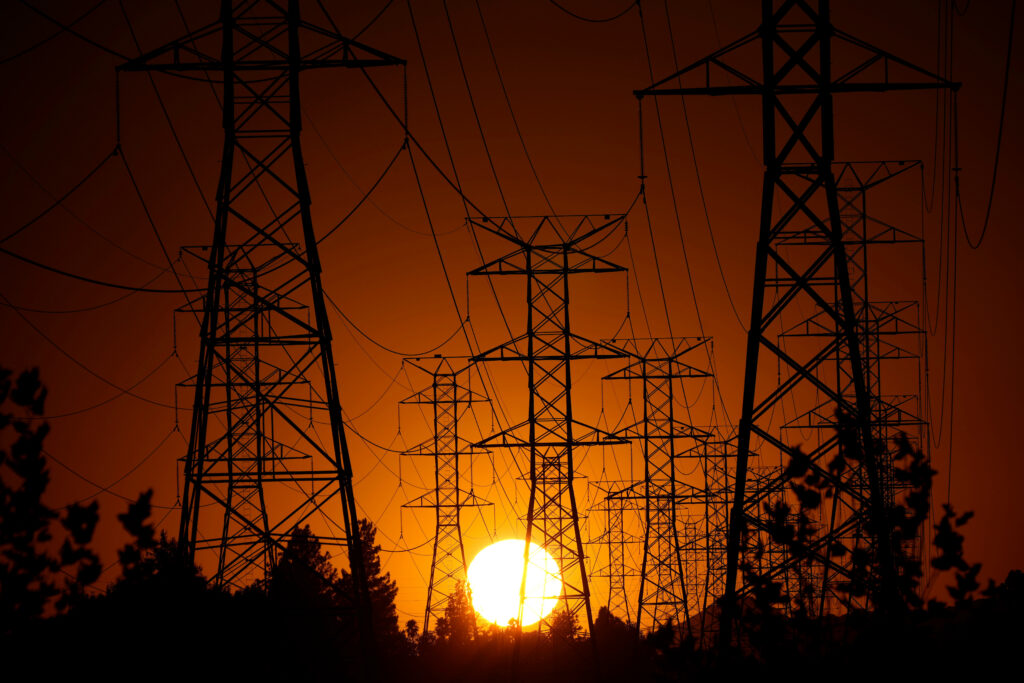

Image Credit: Associated Press
Listen to the audio version of this article (generated by AI).
Key Points
- Power ETFs offer a lower-risk way to invest in the AI data-center boom while providing long-term growth potential and dividend income.
- Utilities and other power companies are benefiting from hundreds of billions of dollars in planned AI infrastructure spending by major tech firms like Microsoft and Amazon.
- The leading AI power ETFs give investors broad exposure to the trend without the need to research and select individual stocks.
Data centers are growing at a breakneck pace, as trillions of dollars of investment are being poured into artificial intelligence (“AI”). All this AI investment is creating opportunities in sectors such as utilities and energy companies, which are making huge investments to keep up with demand. That means higher profits for electric companies – and higher dividends for investors.
Investors interested in playing the data-center boom but seeking lower risk should consider the best AI power exchange-traded funds (“ETFs”). These funds buy shares in the companies powering data centers, where money is flowing into at almost unfathomable speeds.
Just months ago, the four largest hyperscalers – Microsoft (MSFT), Amazon (AMZN), Alphabet (GOOGL), and Meta Platforms (META) – were projected to spend a combined $650 billion in capital investment this year. Now, that figure has climbed to $725 billion.
But there may well be more. Moody’s recently raised its estimate of hyperscaler capital spending to $785 billion this year, with nearly $1 trillion expected in 2027. All those data centers need to be plugged in.
Utilities themselves are spending hundreds of billions in the coming years to keep up. They’re expanding generation capacity, setting up more transmission projects, and upgrading the grid – while sometimes collaborating with the firms behind the AI data center investments.
So, the “power grid upgrade” megatrend can be expected to persist for years, generating billions in profits for investors. Utilities can be a great way to play the trend because they’re lower risk than many other AI investments, but they still benefit from many of the same drivers. Electrical energy use tends to grow year after year, providing a stable, recurring source of revenue.
Plus, utilities benefit from regulations that allow them to earn a return on their investment and to regularly raise prices. It all translates into a lower-risk (but growing) stream of profits. Utilities tend to pay out sizable dividends, so as their profits grow, their dividends are likely to increase as well.
Best AI Power ETFs: Top Dividend Funds
Playing the megatrend through AI power ETFs lowers risk by another notch. These ETFs hold a diversified portfolio of utilities, meaning that any single stock won’t hurt the portfolio too much. ETFs let investors play the trend, rather than having to analyze and pick individual stocks.
So, the best power ETFs offer an easy way for investors of all skill levels to ride the AI data center boom with the potential for strong risk-adjusted returns.
Below are some of the best ways to play the data center boom with energy utilities. Three of the funds take a broadly similar approach, while two are somewhat different. In each case, the funds have delivered strong risk-adjusted returns (i.e., returns relative to the level of risk).
| Fund (ticker) | One-year return | Five-year annualized return | Dividend yield |
| State Street Utilities Select Sector SPDR Fund (XLU) | 14.9% | 10.3% | 2.7% |
| Vanguard Utilities Index Fund (VPU) | 14.7% | 10.1% | 2.7% |
| Fidelity MSCI Utilities Index Fund (FUTY) | 14.7% | 10.1% | 2.7% |
| Invesco S&P 500 Equal Weight Utilities Fund (RSPU) | 18.2% | 12.0% | 2.5% |
| Virtus Reaves Utilities Fund (UTES) | 10.4% | 16.3% | 1.5% |
How MarketWise Selected These Funds
MarketWise chose its best AI power ETFs based on the following criteria:
- Funds with exposure to electrical/energy utilities
- Funds with at least five years of strong returns
- An expense ratio of 0.5% or lower
- No leveraged or inverse funds
1. State Street Utilities Select Sector SPDR Fund (XLU)
This passively managed fund tracks the Utilities Select Sector Index, which includes the utilities sector of the Standard & Poor’s 500 Index. With more than $23 billion in net assets, this ETF is the largest and the cheapest, with an expense ratio of 0.08%.
Assets under management: $23.7 billion
Expense ratio: 0.08%
Top holdings: NextEra Energy (NEE), Southern Company (SO), Duke Energy (DUK), Constellation Energy (CEG), American Electric Power (AEP)
2. Vanguard Utilities Index Fund (VPU)
This passive fund tracks the MSCI U.S. Investable Market Index (IMI)/Utilities 25/50 index, which includes small-, mid-, and large-cap U.S. utilities stocks. The fund charges a low expense ratio of 0.09%, meaning investors would pay $9 per year for every $10,000 invested.
Assets under management: $10.8 billion
Expense ratio: 0.09%
Top holdings: NextEra Energy, Southern Company, Duke Energy, Constellation Energy, American Electric Power
3. Fidelity MSCI Utilities Index Fund (FUTY)
This passive fund also tracks the MSCI U.S. Investable Market Index (IMI)/Utilities 25/50 index, which includes small-, mid-, and large-cap utilities stocks in the U.S. With an expense ratio of 0.084%, it comes in just a hair cheaper than the similar Vanguard fund above.
Assets under management: $2.4 billion
Expense ratio: 0.084%
Top holdings: NextEra Energy, Southern Company, Duke Energy, Constellation Energy, American Electric Power
4. Invesco S&P 500 Equal Weight Utilities Fund (RSPU)
This passively managed fund tracks the S&P 500 Equal Weight Utilities Plus Index, which weights all S&P 500 stocks classified as utilities equally. The expense ratio is higher than several funds on the list, but the long-term returns have made up for it.
Assets under management: $549.3 million
Expense ratio: 0.40%
Top holdings: NRG Energy (NRG), Vistra (VST), Eversource Energy (ES), American Electric Power, Sempra (SRE)
5. Virtus Reaves Utilities Fund (UTES)
This actively managed fund uses its proprietary analytical process to invest in any company that’s considered a utility. This ETF has the highest expense ratio on our list, but it also has the best long-term returns, too – and not by a little. So, the higher cost has turned into higher performance.
Assets under management: $1.4 billion
Expense ratio: 0.49%
Top holdings: Talen Energy (TLN), Constellation Energy, Vistra, Xcel Energy (XEL), CenterPoint Energy (CNP)
Why Utilities ETFs Are Great for AI Data-Center Supertrend Investing
Utilities ETFs offer some advantages for investors looking to play the data-center build-out:
Strong Risk-Adjusted Returns
These ETFs offer the potential for strong risk-adjusted returns. That is, they offer good returns for the level of risk investors take on.
Regulated Utility Income
Many utilities benefit from regulated returns, effectively guaranteeing them a return on their invested capital. They also benefit from statutory increases in their electrical rates, helping to consistently grow their profits.
Less Volatile Than More Direct Investments
Utilities companies and ETFs are much less volatile than more direct investments in data centers, even as they benefit from their build-out. Lower volatility can be attractive to many investors, including those looking to allocate a portion of their portfolios to lower-volatility AI investments.
Attractive Dividends
Power companies generate stable, recurring revenue that is often partly or fully regulated, providing them with reliable earnings to pay a stable dividend. As data center demand increases, utilities can pay growing dividends over time.
ETFs Help to Reduce Risk
Most ETFs hold dozens of stocks, reducing the risk that any single stock would hurt the portfolio too much. With stakes in companies operating all over the United States, ETFs can capitalize on data-center investments wherever they occur.
Lower Overall Risk
Utilities and power companies are generally lower risk than direct investments in data centers. Consumers and businesses will always need electricity, so what these companies lack in razzle-dazzle, they make up for in stability.
Investors also have other ways to play the AI boom, such as the best copper ETFs or the top AI data-center REITs.
With their strong risk-adjusted returns, these AI power ETFs can be an attractive way to capitalize on the data center boom without taking on the same risks. Attractive, growing dividends benefit income investors who prefer some of their return in cash.
Regards,
James Royal, PhD
Editor’s Note: A highly secure site in West Texas now houses an emerging potential $10 trillion technology backed by Elon Musk and Sam Altman. This breakthrough could completely replace our need for foreign oil – and send one small group of stocks soaring in the process. Click here to learn how you can invest in Elon’s next $10 trillion move.