Image Credit: Associated Press
Key Points
- A new home-lending product lets crypto owners use bitcoin or USDC stablecoins as collateral for a mortgage without selling them.
- The product comes with inflated mortgage rates and requires borrowers to borrow against the full property value, potentially making monthly payments much higher than with a traditional loan.
- Under the guise of “stiffing the tax man,” lenders are tempting borrowers with a pitch that could end up costing far more than a traditional mortgage.
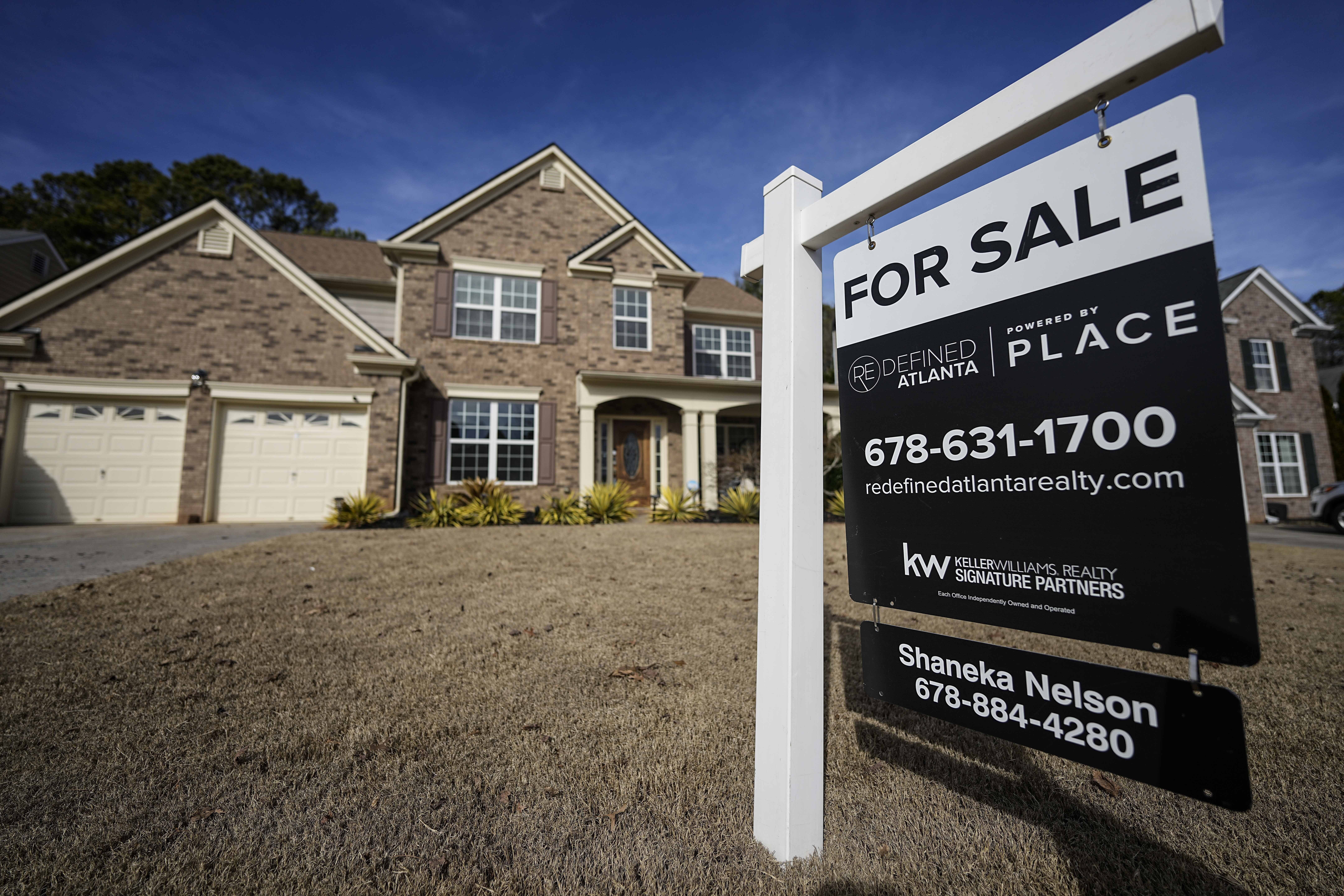
Cryptocurrency keeps trying to work its way into the mainstream financial system, whether that’s as a means of payment or even collateral for a loan. Now, a new lending product lets crypto owners use Bitcoin or USDC stablecoins as collateral for a home mortgage without needing to sell them.
The new crypto-backed mortgage is a product from Better Home & Finance (BETR) and Coinbase Global (COIN), the largest cryptocurrency exchange in the U.S. The press release for the product suggests that it helps make “property financing more affordable than ever before.”
The product comes with feel-good claims about helping “hardworking Americans” to buy housing, “democratizing homeownership,” and increasing “economic freedom.”
This ability to dodge capital gains taxes and put the money to work in a mortgage is a great sound bite, for sure. After all, tax dodging is a primary use case for cryptocurrency. But this new crypto product will help almost no one, because few people own enough crypto to make a home down payment anyway. It’s yet another example of crypto “solutions” that are in search of problems.
“The goal of crypto almost from the start has been to integrate with traditional finance, because crypto needs more users, since it’s a Ponzi scheme,” says Hilary Allen, professor, American University, Washington College of Law. “Mortgages are part of the broader project of integration.”
Even a glance at the numbers shows that these product claims – like much of what’s offered in the crypto world – are questionable, at best. In fact, borrowers may end up paying much more with token-backed mortgages than with traditional loans.
Token-Backed Mortgages: How Better’s Crypto Mortgage Works
Let’s dig into the details of the new token-backed mortgage from Better Home & Finance to see what it promises borrowers, how it works, and why it helps almost no one better afford a home.
The product’s big come-on is that crypto owners won’t need to sell their cryptocurrency to take on a mortgage. Instead, a borrower’s crypto will serve as collateral for a portion of the loan.
Other key details of the product include:
- A borrower takes out a traditional 15- or 30-year conforming loan (eligible to be sold to Fannie Mae) with Better.
- The borrower takes out a second loan in place of the usual cash down payment, backed by bitcoin or USDC stablecoins.
- The interest rates on both loans range from in line with Fannie Mae mortgages to up to 1.5 percentage points higher.
- The crypto-backed mortgage has no margin call, meaning that borrowers are not on the hook if bitcoin drops in value, as long as they make their payments.
- However, borrowers will need to hold their crypto assets for the life of the token-backed mortgage once they’ve been pledged.
Those are the most important factors in Better’s crypto-backed mortgage product.
MORE: Here’s an alternate take on this crypto-backed mortgage
Is a Token-Backed Mortgage a Good Deal?
You don’t even need to get into the weeds to see that this mortgage fails to make mortgages more affordable. In fact, it does the opposite while allowing borrowers to keep speculating with crypto.
Before we get too far into the details, one thing should already be obvious: The monthly payment will be higher than a traditional mortgage simply because the borrower is lending against 100% of the purchase price rather than the more typical 80% to 90% in a conforming loan.
On top of this, the borrower may pay a higher interest rate than a traditional loan and shouldn’t expect a rate lower than that of a conforming loan. So, borrowers with poor credit may be stung here.
In short, this mortgage has the potential to significantly increase a borrower’s monthly payment.
But let’s look at some real numbers and make a few basic assumptions to examine the potential real costs of going with this crypto-backed mortgage.
Let’s assume a homebuyer is looking to purchase a $500,000 home with a 10% down payment paid for by liquidating a bitcoin position that has appreciated 100%. (Stablecoins such as USDC won’t benefit from the tax-dodging gambit that Better proposes since they don’t appreciate.) Next, let’s assume a 30-year mortgage at 6% and three higher rates, up to 1.5% higher.
As a baseline, a traditional 30-year mortgage with 10% down at a 6% interest rate would cost about $2,698 in principal and interest per month. Here’s the monthly payment on the crypto mortgage with those various assumptions.
| Mortgage type | 6% | 6.5% | 7% | 7.5% |
| Crypto, 30-year, 0% down | $2,998 | $3,160 | $3,327 | $3,496 |
Right off the bat, borrowers are paying $300 more per month with the token-backed loan, even though the mortgage has the same 6% interest rate.
At the highest tier, up to 1.5 percentage points higher, borrowers would be paying nearly $800 more with the crypto mortgage. That’s nearly 30% more!
What do those numbers mean over the course of a year and a 10-year holding period?
The extra yearly cost for the crypto loan ranges from $3,600 and $9,576. Over a 10-year period, the extra cost of the crypto loan would be 10 times higher, ranging from $36,000 to $95,760.
But what about the advantages of not selling the crypto and avoiding the capital gains?
In our example, the borrower avoided selling $50,000 in crypto, therefore escaping capital gains of $25,000, assuming 100% appreciation. The maximum capital gains tax rate is 37% for short-term gains (for individuals in 2026 earning more than $626,351 or married filing jointly earning $751,601 – in other words, very few people). This cost amounts to a maximum of $9,250.
Of course, many investors may pay much less if they’re in a lower bracket. For example, long-term crypto holders could enjoy rates ranging from 0% to 20%. Married couples with less than $98,900 in taxable income in 2026 pay a 0% on long-term capital gains, already.
Here’s the real upshot: It would cost a borrower $3,600 a year at a minimum and maybe up to $9,576 a year – every year – to avoid a maximum one-time capital gains tax of $9,250. The numbers become more egregious as the loan amount increases, of course.
But I can hear the crypto proponents in the distance: What about the potential gain from the crypto? It’s immeasurable. Crypto owners could make money, lose it, or somewhere in between.
In any case, the loan locks borrowers into their crypto position, so they’re paying a loan to hold their tokens. To put it another way, they’re paying much more for a mortgage loan so they can maintain their bets on the crypto market. The costs of this decision are certain, while the potential return is not.
And those poor buyers who put up USDC stablecoins as collateral? They’re even worse off. While USDC pays a small return, owners are locked in for the life of their mortgage with no potential for capital gains. They’ll pay much more for a mortgage, even though they had the assets to make a cash down payment and potentially get a lower interest rate. Pity them.
And if your tax bracket is not quite so high? You’ll be even worse off by going with a crypto loan.
Finally, accounting for all benefits: Coinbase One members who get a mortgage – regular or token-backed – through Better receive a 1% rebate (up to $10,000) on their mortgage to cover closing costs and fees. Of course, you can find no-fee mortgages elsewhere, too.
Crypto ‘Solutions’ in Search of Problems
The results here show an approach that’s typical of the crypto industry. Crypto proponents keep trying to come up with ways to solve problems that were solved decades ago. Crypto is simply a series of solutions in search of problems, in the worst way.
“The crypto technology isn’t very good,” says Allen. “Blockchain tech is just a clunky database.”
The thing is, Better Home & Finance is working on similar solutions, using other tokenized assets, such as stock tokens, to back mortgages if they think borrowers might use them.
While Better’s press release touts the launch of the “first token-backed, conforming mortgage,” the reality is much more prosaic, revealing the ham-fisted way crypto must operate.
Recall that the borrower in this token-backed mortgage must take out two loans. One of those is a private loan backed with crypto that actually funds the cash down payment. This cash is then packaged with the second loan to make a conforming loan that Fannie will buy.
So, the same fundamental mortgage process is happening behind the scenes, but integrating crypto into it adds extra complexity and – not surprisingly – extra cost.
With this unnecessary complexity, who does the crypto-backed mortgage even best serve?
Better Home & Finance originates and services loans, so it makes money when it opens a loan and continues to make money as it services it over time. Coinbase benefits from this setup by attracting investors who are locked into its trading platform and can’t really move their pledged coins until the loan is paid off. Both profit by getting potential borrowers excited about it all.
This new crypto-backed loan does virtually nothing to expand affordability, since most Americans don’t own crypto. Even according to the press release, “20% of American adults have owned digital assets.” But this means they have owned it, ever – not just at the moment.
Only a small fraction of this group owns enough crypto for it to make a meaningful contribution to a mortgage.
“We’re bringing this volatile stuff into our financial system, and it has the potential to blow up the system,” says Allen. “The bigger picture is the length to which the Trump administration is going to get crypto accepted in the mainstream, whether that’s mortgages or 401(k) retirement plans.”
Regards,
James Royal, Ph.D.
Editor’s note: Elon Musk reinvented the auto industry, sparked a new era of space exploration, and built the world’s largest satellite network. But his new initiative – “Project Apex” – could become the crown jewel of his career. And, like Tesla, it could make early investors incredibly wealthy. Click here for the details.
Recent Articles

Time to Wake Up. Copper Stocks Are the AI Trade Everyone’s Sleeping On.

GoPro’s $285 Million Rescue: AI and Defense Pivot Leaves Shareholders With a 10% Lottery Ticket