Image Credit: Associated Press
Key Points
- Blue Origin’s first commercial launch successfully reused its booster, but it failed to place its customer’s satellite into the correct orbit, ultimately leading to its destruction in the atmosphere.
- Speculation around a potential SpaceX IPO is intensifying as valuation estimates climb. The company maintains a 99.5% launch success rate and operates more Starlink satellites than all other global operators combined.
- Amazon’s satellite ambitions face mounting pressure, with only months remaining to deploy roughly 1,400 additional satellites and meet a critical FCC milestone.
Amazon (AMZN) founder Jeff Bezos had a splendid start to his Sunday morning.
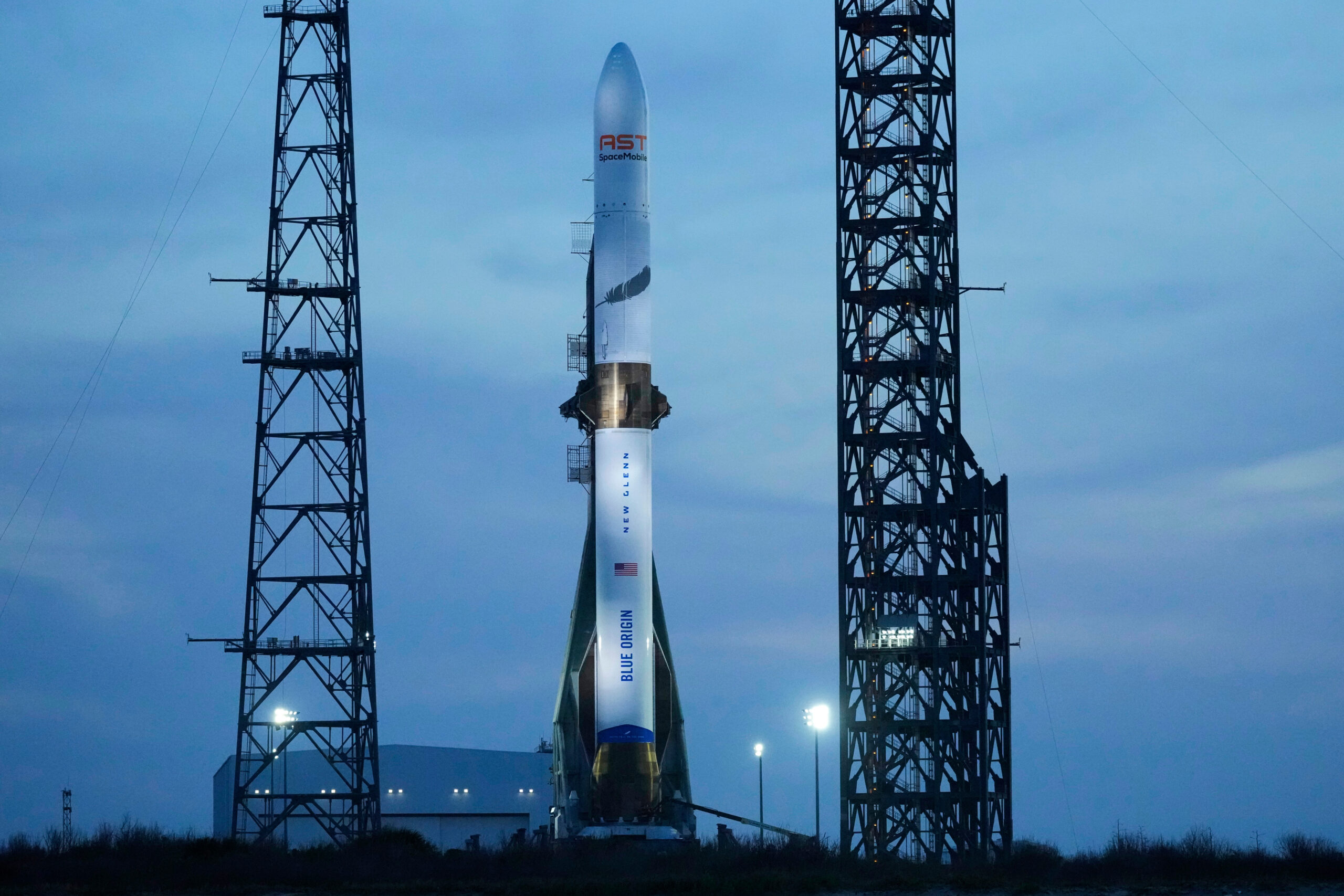
Blue Origin, Bezos’ rocket company, successfully sent its massive New Glenn rocket into space, carrying a customer’s satellite into orbit.
Everything looked good at launch. Shortly after liftoff, the rocket’s giant first-stage booster fell in a controlled descent through the atmosphere, fired its engines, and settled down onto a drone ship floating in the Atlantic. It was the first time the company had successfully reused one of these boosters.
Only one other company on the planet can do that… SpaceX.
Bezos quickly shared the drone footage of the successful landing. Social media lit up. And SpaceX founder Elon Musk even offered his rival a one-word “Congrats” message on X.
Then, a few hours later, the whole thing came apart.
Blue Origin issued a short post stating that the rocket’s upper stage had placed its payload, a BlueBird 7 satellite for AST SpaceMobile (ASTS), into an “off-nominal orbit.”
Around seven hours after liftoff, AST SpaceMobile confirmed the worst: The satellite wasn’t going to make it.
This was Blue Origin’s first commercial launch. It was also the most important test yet of the company’s ability to compete with SpaceX for real, paying customers. And it failed.
Blue Origin Stranded Its Customer’s Satellite
AST SpaceMobile had big plans for BlueBird 7.
The 13,450-pound satellite was supposed to become the company’s eighth in low–Earth orbit. It’s part of a plan to build a cellular broadband network accessible directly from standard, unmodified smartphones.
It boasted an antenna spanning nearly 2,400 feet and was expected to provide data transfer rates exceeding 120 megabits per second. That’s not quite as speedy as SpaceX’s Starlink, but still plenty fast enough for a typical user on 4G and 5G mobile networks.
Blue Origin was supposed to place the satellite in a 460-kilometer circular orbit at a 49.4-degree inclination according to the National Space Society, which had a correspondent at Jetty Park to witness the launch. As he reported…
The upper stage is where the mission became more complicated. BlueBird 7 was scheduled to separate about 75 minutes after liftoff, following a second burn of the upper stage’s BE-3U engines. Blue Origin ended its webcast after the booster landing and did not broadcast during the window when that burn and payload deployment should have occurred.
Tracking data from the U.S. Space Force showed the upper stage and satellite ended up in a parking orbit that was too low and at the wrong angle for the spacecraft to save itself.
As a result, BlueBird 7 will burn up in the atmosphere.
The satellite was fully insured, but what AST can’t recover is time. AST SpaceMobile had previously mostly relied on SpaceX’s Falcon 9 rockets to launch its birds into orbit, before attempting to branch out to the larger New Glenn models.
The company may regret that choice now, as its stock price fell as much as 15% in early-market trading on Monday, and multiple Wall Street analysts cut their price targets.
As Blue Origin Identifies What Went Wrong, SpaceX Will Keep Launching Rockets
While Blue Origin teams are picking through telemetry to find out what went wrong, SpaceX is going to keep launching rockets – one after another, and at a level of reliability and scale that no one else on Earth can touch.
As of Blue Origin’s launch this past weekend, SpaceX had completed 47 Falcon family launches in 2026 alone. That’s more missions in less than four months than every other American rocket company combined will manage all year.
It had another Falcon 9 launch yesterday. And will have another later today.
In 2025, SpaceX set a record with 165 Falcon launches. And SpaceX President Gwynne Shotwell told Time that the company is eyeing 140 to 145 Falcon 9 flights this year.
For some context, the single-vehicle launch record, before SpaceX broke it, belonged to the Soviet Soyuz-U, which flew 47 times in 1979. SpaceX has been shattering that record every year since 2022.
And SpaceX’s 99.5% success rate across 641 Falcon family launches is incredible. The current active version of the rocket, the Block 5, has flown 572 times with only one failure.
Earlier this month, SpaceX launched its 1,000th Starlink satellite of 2026. And it now operates some 11,000 working satellites in orbit, a number that far surpasses every other satellite operator on Earth, combined.
As I noted when sharing how investors can get access to SpaceX before it goes public:
Think about that for a moment. One company is responsible for nearly all of the satellites going into orbit around Earth.
How did we get here?
It started with Musk’s bet on reusable rockets…
Before SpaceX, the economics of space were absurd. You’d spend hundreds of millions of dollars building a rocket, fire it once, and let it crash into the ocean. Think of it as building a brand-new 747 for every single flight and then scrapping it after landing.
That was how the entire industry worked for half a century.
Musk’s team figured out how to land boosters and fly them again. That single innovation cut the cost of reaching orbit by more than 90%. And it was devastating for the competition.
This is what Blue Origin is desperately trying to catch up to. And it helps explain why so many investors are watching the biggest investment story of 2026 unfold in real time.
The $2 Trillion SpaceX IPO on the Horizon
SpaceX is targeting a valuation as high as $2 trillion when it goes public, potentially as soon as June.
The Financial Times reports SpaceX is looking to raise up to $75 billion from its IPO, a figure that keeps getting bigger as the target valuation climbs. You can read my full deep dive on how everyday investors can access SpaceX shares before the IPO right here.
And this isn’t just a rocket story anymore. As I covered in a recent piece on SpaceX’s fight with Amazon at the FCC, Musk filed an application in January to deploy up to 1 million satellites in low-Earth orbit. The end goal, according to an internal memo obtained by the New York Times, is to put AI data centers in space:
Musk told employees that launching 1 million tons per year of satellites, generating 100 [kilowatts] of compute power per ton, would add 100 gigawatts of AI compute capacity annually, “with no ongoing operational or maintenance needs.”
It’s a wildly ambitious plan.
It’s also one that depends entirely on the ability to launch rockets rapidly and reliably, which is exactly what Blue Origin demonstrated on Sunday that it can’t yet do.
For investors weighing the SpaceX story, I’d also recommend my colleague James Royal’s piece on three yellow flags in the SpaceX IPO. Proposed changes to the lock-up period, dual-class share structures, and a valuation of around 110 times sales all deserve careful scrutiny. But if you see big upside in space, then SpaceX is where you likely want to focus your attention.
United Launch Alliance Has Its Own Problems
Blue Origin isn’t the only company struggling to keep pace with SpaceX.
United Launch Alliance (“ULA”), the Lockheed Martin and Boeing joint venture that used to dominate American rocket launches, has been effectively grounded since February. That month, one of the ULA rocket’s boosters suffered a nozzle burn-through. That was the second time this exact same error happened on a Vulcan Centaur rocket… The first occurred on Vulcan’s second flight in October 2024.
As a result, the U.S. Space Force is investigating, and the ULA has paused further Vulcan launches until the root cause is identified. Many estimates suggest three to six months of delays while the company inspects and retrofits its booster fleet.
That timeline is rough for a company that has already massively fallen behind its plans.
ULA chief executive Tory Bruno projected around 20 Vulcan and Atlas V launches in 2025. That would have been the most launches ULA ever completed. Instead, ULA ended 2025 with just six launches, and only one on the Vulcan.
The company has already delayed multiple launches that have to do with national security, and has even accrued financial penalties tied to its military launch contracts.
And with Vulcan grounded, Amazon’s satellite constellation plans, which rely heavily on those launches, have a very real problem.
Amazon Is Running Out of Options to Get to Space
Amazon’s Project Kuiper, rebranded as Amazon Leo in November 2025, is about a year behind schedule.
The FCC license Amazon received back in 2020 requires the company to have half of its 3,232-satellite constellation in orbit by July 30 of this year, with the full constellation operational by 2029.
But as I mentioned last month:
It currently only has 212 satellites in orbit. That’s a massive gap of 1,400 satellites that Amazon needs to launch in less than five months.
So, how’s it going to get its birds in the air?
- Amazon has 38 launches booked on ULA’s Vulcan. Unfortunately, Vulcan is grounded.
- It has 12 launches contracted with Blue Origin’s New Glenn. However, New Glenn just dropped a satellite into the wrong orbit.
- Then it has 18 launches booked with Europe’s French rocket company Arianespace, which has had a high success rate, though not at the scale of SpaceX.
- And while a handful of Atlas V missions remain on the manifest, the rocket is being retired.
The only American launch provider flying at scale right now is SpaceX. And SpaceX has other priorities, chiefly launching its competing Starlink satellites.
FCC Chairman Brendan Carr didn’t mince words in March when asked about Amazon’s chances, after the company filed a 17-page petition trying to block SpaceX’s million-satellite application:
Amazon should focus on the fact that it will fall roughly 1,000 satellites short of meeting its upcoming deployment milestone, rather than spending their time and resources filing petitions against companies that are putting thousands of satellites in orbit.
Carr also told Reuters, “Given the pace at which Amazon is launching satellites, I can see why they would think it would take other people centuries to launch.”
That’s the FCC chairman, on the record, telling one of the largest companies in the world that it’s not going to hit its own deadline.
What the Space Race Means for Investors
A single failed satellite doesn’t end Blue Origin’s commercial prospects.
After all, Blue Origin successfully landed a reused booster for the first time. Personally, I hope they keep hitting these technical milestones and ultimately succeed at scale. Competition is good for us all. Plus, rocket programs crash and burn all the time.
But the contrast with SpaceX and every other rocket company out there is becoming impossible to ignore.
SpaceX is dominating launches. It’s also dominating satellites in orbit. And as I covered in a piece on Musk’s broader AI ambitions, it’s now pushing to combine its rocket dominance with the computing power of the merged xAI subsidiary.
As I wrote:
Musk is building an empire… and playing to win everything.
We suspect the only thing keeping him restrained from even bigger, more specific predictions right now is that he’s currently in the quiet period before what could be the largest initial public offering (“IPO”) in history.
And of course, Musk’s plan to put computing power in space is also about sidestepping the growing public opposition to building more data centers on Earth. As I covered in a piece about how the AI data-center rebellion is growing fast… and getting violent:
To no one’s surprise, anger against AI is building across America.
For some, the AI boom has the potential to be one of the biggest creators of wealth in their lifetime. For everyone else, it will likely be a nightmare. This is how Elon Musk can simultaneously build the most powerful AI supercomputer on Earth in a Memphis warehouse while preparing for the largest technology IPO in history with SpaceX.
There’s no such thing as a level playing field with regard to the space industry right now. There’s SpaceX on one side… and everyone else scrambling to figure out how to compete on the other.
That’s the backdrop for what will almost certainly be the biggest IPO in American history.
And again, if you’re interested in learning how to claim a stake in SpaceX before it goes public, the investment vehicle personally vetted by tech expert Jeff Brown remains available, at least for now… You can hear Jeff explain how to get access here.