Image Credit: Associated Press
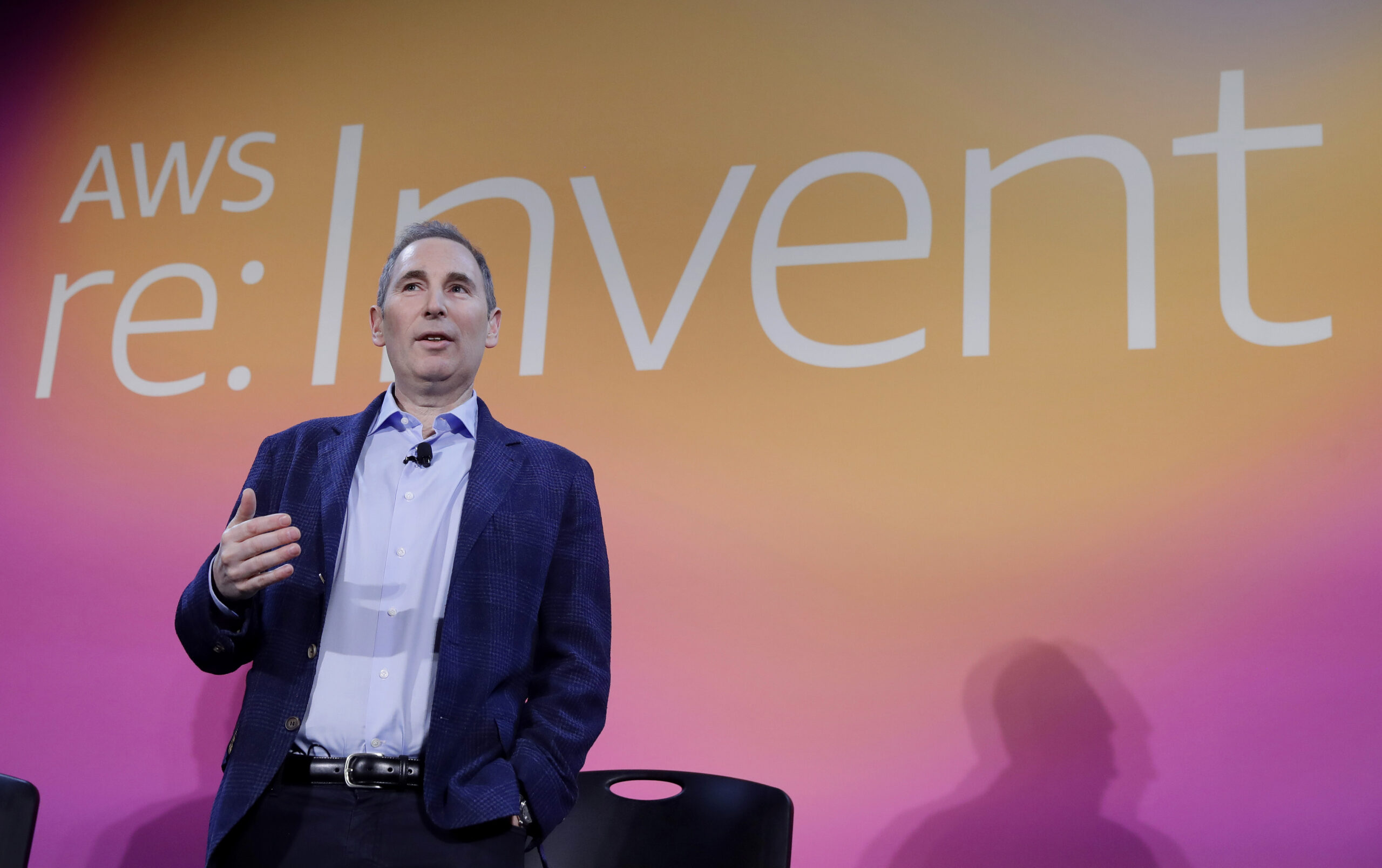
Amazon (AMZN) CEO Andy Jassy made clear his commitment to AI and robotics in his annual shareholder letter.
I believe his vision and efforts will increase efficiencies and margins.
As Jassy wrote:
While we continue to work on productivity and inventory levels, robotics provides a step-level change for how we can deliver faster, reduce the cost of carrying more selection, and automate movements that cause strains and injuries to our teammates. Accelerated by acquiring Kiva in 2012, and investing in numerous robotics initiatives the last 14 years, we now have over one million robots operating in fulfillment centers… While the above progress is substantial, we’re still in the early stages of how we’ll leverage robotics.
Amazon also has its own satellite network that it’s now commercializing, Amazon Leo. It has put more than 200 satellites into space, with thousands more coming in the near future. Again, from Jassy’s letter:
While Amazon Leo is officially scheduled to launch in mid-2026, we already have meaningful revenue commitments from enterprises and governments. Most recently, Delta Airlines, the highest grossing airline in the world, has announced its chosen Amazon Leo for its future Wi-Fi, and will begin with 500 planes in 2028. They join other Leo customers like JetBlue, AT&T, Vodafone, DIRECTV Latin America, Australia’s National Broadband Network, NASA, and others.
Lastly, Jassy makes the case for Amazon’s immense investment in AI. Amazon is increasing its capital expenditures this year to $200 billion, up from $132 billion last year. The bulk of it is going to AI.
Investors’ concerns about such a huge number are weighing on the stock.
AI Boosts Amazon Web Services and its Chips Businesses
But Jassy compares the adoption of AI to that of electricity. “The difference is that electricity took 40 years to get where it was going. AI appears to be moving 10 times faster.”
He then shares some statistics on how Amazon Web Services (“AWS”) is capitalizing on AI:
Amazon is smack in the middle of this land rush, and companies are choosing AWS for AI. Three years after AWS launched commercially, it had a $58 million revenue run rate. Three years into this AI wave, AWS’s AI revenue run rate is over $15 billion in [first-quarter] 2026 (nearly 260 times larger than AWS at that same point) – and ascending rapidly.
The thing that most caught my attention in Jassy’s letter is his description of Amazon’s chips business:
Our annual revenue run rate for our chips business… is now over $20 billion, and growing triple digit percentages [year over year]… If our chips business was a stand-alone business, and sold chips produced this year to AWS and other third parties (as other leading chips companies do), our annual run rate would be [around] $50 billion. There’s so much demand for our chips that it’s quite possible we’ll sell racks of them to third parties in the future.
To put this in perspective, Nvidia (NVDA) trades at 20 times forward earnings. If we apply that multiple to Amazon’s $50 billion of run-rate chip revenue, that’s $1 trillion of value.
As Jassy concludes, Amazon isn’t investing this huge amount and on a “hunch.” He says:
We are willing to make large capex investments and endure short-term FCF [free cash flow] headwinds for the substantial medium to long-term FCF surplus. AI is a once-in-a-lifetime opportunity where the current growth is unprecedented and the future growth even bigger. AWS has a significant leadership position with the broadest functionality, strongest security and operational performance, largest share of customers and revenue, strong desire from customers to run their AI in AWS, and an opportunity to build what could be a new pillar for Amazon in chips. We’re not going to be conservative in how we play this – we’re investing to be the meaningful leader, and our future business, operating income, and FCF will be much larger because of it.
AI and Robotics Make Amazon the ‘Best of the Best’
Needless to say, Amazon remains at the top of my list of favorite stocks.
I’ve been urging readers to invest in my Big Four stocks since I got into the publishing industry seven years ago…
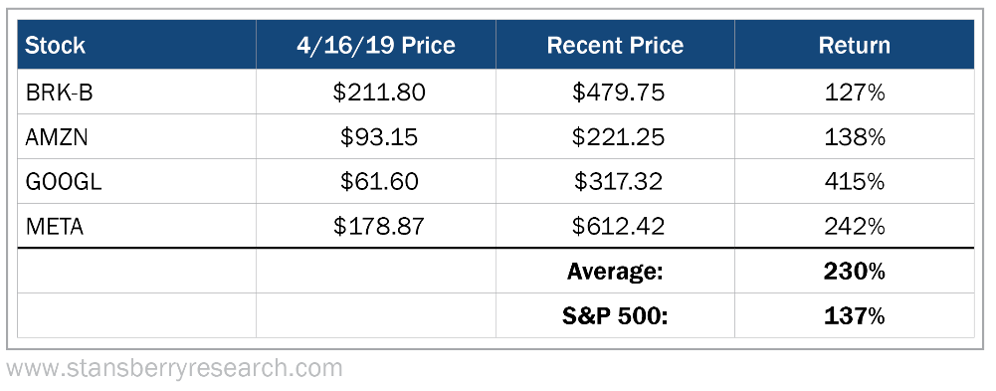
Anyone who bought Berkshire Hathaway (BRK-B), Amazon (AMZN), Alphabet (GOOGL), and Meta Platforms (META) my advice has done very well.
As you can see in the following table, they are up an average of 230% since April 2019. That’s far outpacing the S&P 500’s 137% return.
On January 7, I pointed to Amazon as the first among equals. I called it My Favorite Stocks for 2026:
Since then, Amazon’s stock is down roughly 8%, which makes me like it even more…
Amazon has been exceptional at growing revenues and profits over the past decade. And I believe its investments in robotics and AI could really turbocharge its earnings.
Jassy’s commitment only deepens my conviction on Amazon. It’s the best of the best…
Editor’s Note: This article was adapted from today’s edition of Whitney Tilson’s Daily. Every day, Whitney emails his readers with his comments on the most important topics of the day, including stocks he’s investigating… great articles he has read… his media and podcast appearances. You can sign up here to receive all of Whitney’s daily thoughts and insights.
Recent Articles

The 15 Best Cybersecurity Stocks to Buy Whether AI Booms or Busts

Oracle Earnings: Watch Out for Massive OpenAI Risk Despite Blowout First Quarter