
Image Credit: Associated Press
Most major industries globally have adopted artificial intelligence (“AI”) in some form – retail, health care, pharma, logistics, manufacturing, automotive… the list goes on.
All those AI workloads require massive data centers to provide the high-level computing power AI needs.
And those AI data centers need a ton of constant energy to power their servers, networking equipment, cooling systems, and storage components… 24/7. They require so much power that standard power grids simply can’t handle the load.
Last September, Corey McLaughlin, editor of the Stansberry Digest newsletter, broke down just how much power American data centers need:
The Environmental and Energy Study Institute estimates that U.S. data centers could require as much as 130 gigawatts of power every year by 2030.
That’s enough to power, on average, about 114 million homes for a year. And that’s the equivalent of a huge chunk of all of the housing (148 million units) in the U.S.
Not only would this new demand be a huge draw on utilities, but it would also mean data centers accounting for 12% of all electricity used in the U.S. (versus about 4.4% at the end of 2023).
There are no signs of AI’s expansion slowing down anytime soon.
In fact, a 2025 survey from McKinsey showed that 88% of respondents said their organizations are using AI in at least one business function. And 70% are using AI in at least two business functions. Those figures increased from 55% and 30%, respectively, in just two years.
Globally, another 100 gigawatts (“GW”) of new data centers are expected to be built between now and 2030. That would double the world’s data center capacity to roughly 200 GW.
If traditional energy grids can’t satisfy the power-hungry needs of data centers, what will?
Nuclear energy might be the answer. And the companies instrumental in developing and delivering that energy would be the beneficiaries, as would the folks investing in those nuclear energy companies.
What Are Nuclear Energy Stocks?
Nuclear energy stocks can be broken down into four categories:
- Nuclear operators: These are the companies that own and run nuclear power plants. They generate their revenue by selling electricity through long-term contracts or on the wholesale market.
- Uranium producers: Uranium is the raw fuel used in nuclear reactors. Uranium producers mine the heavy metal, which is primarily found in Kazakhstan, Canada, and Namibia (these three countries account for roughly three-quarters of global production).
- Enrichment and fuel companies: These companies process uranium into reactor fuel, including the high-assay low-enriched uranium (“HALEU”) fuel required for more advanced reactors.
- Small modular reactor (“SMR”) developers: SMRs are advanced nuclear fission reactors with capacities up to 300 megawatts electrical (“MWe”), roughly one-third the capacity of traditional reactors. SMRs feature factory-built modules, so capital costs are lower and construction is faster.
We’ll dig into some companies from each category to determine which nuclear energy stocks should be on your radar in 2026.
Why Nuclear Is an AI Infrastructure Asset in 2026
The breadth of AI infrastructure continues to expand. Once focused primarily on AI hardware like graphics processing units (“GPUs”), semiconductors, and chips, AI infrastructure has grown to include a diverse range of companies, services, and industries.
There are the cloud computing giants like Amazon (AMZN), Microsoft (MSFT), and Alphabet (GOOGL), and their respective Amazon Web Services (“AWS”), Azure, and Google Cloud services.
There’s the physical infrastructure, like the materials needed to construct AI data centers. That includes concrete, steel, and aluminum… as well as the companies that produce and supply them.
And there are the energy providers, who have arguably become the most critical piece of AI infrastructure besides the hardware itself.
Data center operators are frantically searching for solutions to these facilities’ insatiable power needs. Many have turned to natural gas. Some are using renewable energy like solar and wind.
But nuclear energy is quickly becoming a popular option because it offers continuous, carbon-free power.
With that in mind, here are some nuclear power stocks to keep an eye on.
Nuclear Energy Stocks to Watch in 2026
Nuclear Operators
Constellation Energy (CEG)
Constellation is the country’s largest producer of clean, carbon-free energy through its generation of nuclear, solar, and wind power. The Baltimore-based company provides electricity, natural gas, and renewable energy for millions of American residential, commercial, and public sector customers… including the hyperscalers operating AI data centers.
Constellation’s long-term nuclear power purchase agreements (“PPAs”) with Meta Platforms (META) and Microsoft illustrate just how critical nuclear energy is to tech companies operating AI data centers. And they ensure decades of revenue for Constellation.
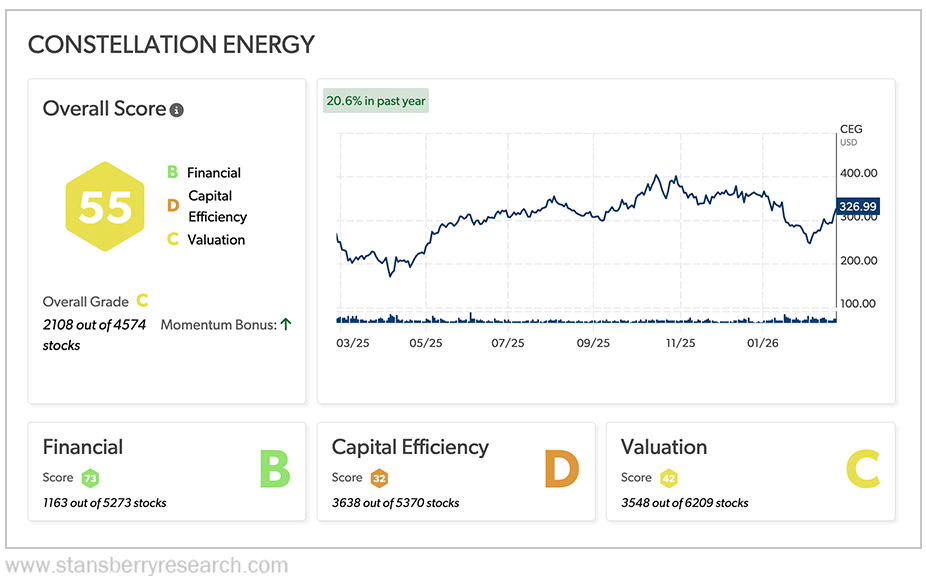
The Stansberry Score, a tool that helps determine the quality and long-term value of thousands of stocks, shows that CGE is a middle-of-the-pack performer with an overall “C” grade. While it’s on solid ground in the Financials category, its Capital Efficiency score is a “D.” That’s primarily driven by consistently high capital expenditures (“capex”) required to satisfy data centers’ power needs.
Vistra (VST)
In December, I wrote this about Vistra:
Vistra offers an array of power generation facilities – natural gas, nuclear, solar, battery storage, and coal – in high-demand energy areas like its home state of Texas, as well as regions within PJM (a Regional Transmission Organization that handles wholesale electricity in all or parts of 13 states). Like Constellation, Vistra provides electricity to millions of residential, industrial, and commercial customers across the U.S.
Vistra’s high-profile PPAs include deals with Amazon and Microsoft for their solar facilities and a 20-year PPA for its Comanche Peak Nuclear Power Plant with an unspecified hyperscaler. Vistra also finalized the acquisition of around 2.6 GW of natural gas power from Lotus Infrastructure Partners in October. This deal expands Vistra’s portfolio with seven natural gas power plants in key American markets.
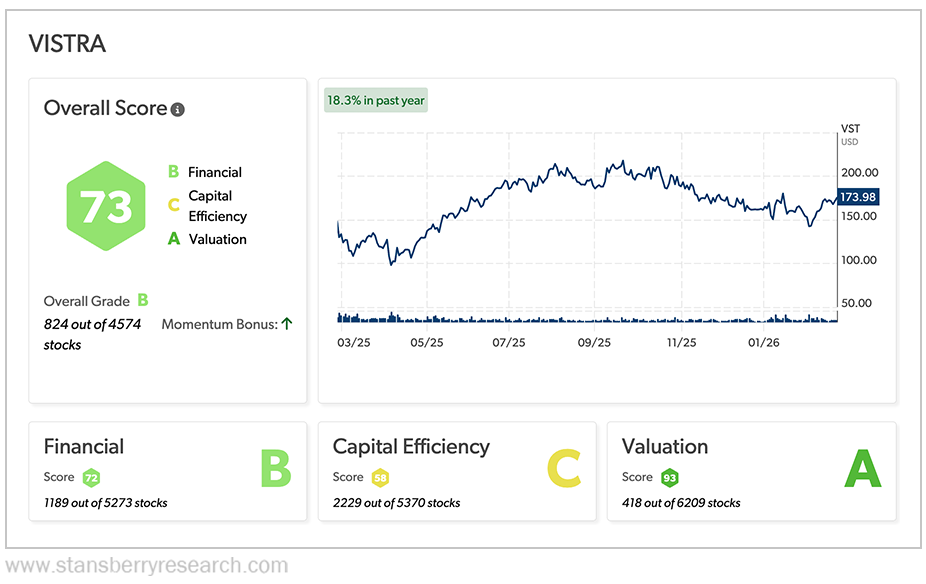
Like Constellation, Vistra’s PPAs ensure predictable cash flow for the foreseeable future. Its Stansberry Score is a strong “B” thanks to outstanding Valuation (“A”) and an above-average Financials grade(“B”).
Fuel Processing and Nuclear Supplier
BWX Technologies (BWXT)
A manufacturer of fuel systems and nuclear components, BWX Technologies is a main defense contractor for the U.S. Navy, as well as government agencies. Though BWXT also works with commercial power plants, roughly 80% of its business is government related.
A few recent examples:
- In October of last year, BWXT received a 10-year, $1.6 billion contract from the Department of Energy’s National Nuclear Security Administration (“NNSA”) to establish a high-purity depleted uranium manufacturing plant.
- In September 2025, BWXT was awarded a $174 million contract to manufacture fuel for the Naval Reactors Program to power aircraft carriers and submarines.
- That same month, BWXT agreed to a $1.5 billion contract with NNSA to build a Domestic Uranium Enrichment Centrifuge Experiment (“DUECE”) pilot plant in Tennessee. This plant will produce uranium for U.S. naval reactors.
- And last July, the U.S. Naval Nuclear Propulsion Program awarded BWXT contracts totaling roughly $2.6 billion for the manufacture of naval nuclear reactor components.
These deals deliver significant and sustained revenue without BWXT having to operate nuclear power plants. And that’s huge, because BWXT can reap the benefits of the nuclear energy boom without taking on expensive and risky capital investments.
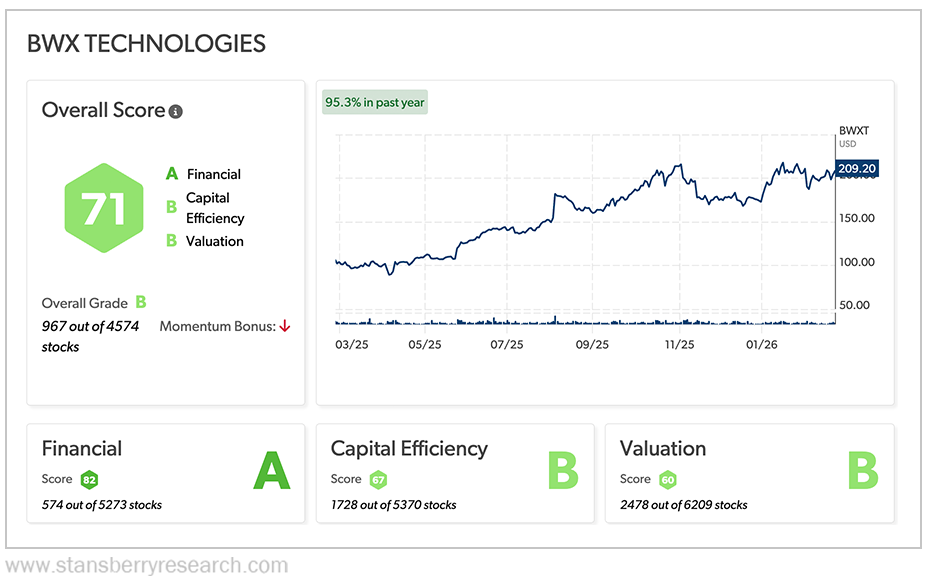
Its Stansberry Score is generally solid all around. It earns a “B” overall, driven by strong showings in the Financials (“A”), Capital Efficiency (“B”), and Valuation (“B”) categories.
Uranium Producer
Cameco (CCJ)
One of the world’s largest uranium producers, Cameco specializes in providing fuel for carbon-free nuclear power generation across the globe. The Canadian company covers the whole nuclear fuel cycle – from mining and refining to conversion and manufacturing.
By the end of 2025, Cameco had secured long-term contracts to deliver around 230 million pounds of uranium. Roughly 140 million pounds of that uranium is scheduled to be delivered in 28 million-pound increments annually from 2026 through 2030.
The Stansberry Score for CCJ is strong overall, with a “B” grade. But its Financial performance (“A”) truly stands out, just missing out on a top 10 ranking in that specific category. And its stock soared nearly 170% over the past year.
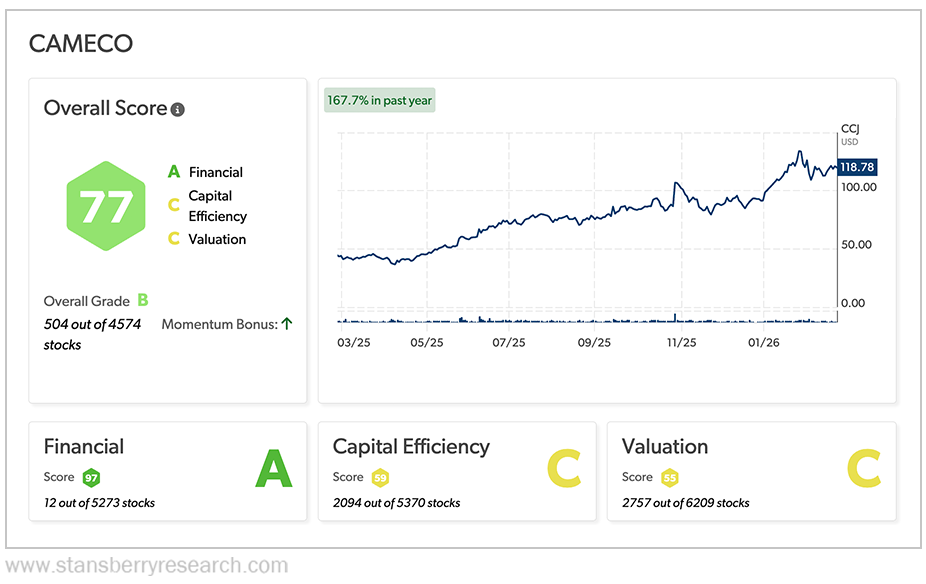
But with a price-to-earnings (“P/E”) ratio of 123.22 as of February 25, it’s fair to question whether CCJ is overvalued.
It’s certainly trading at a premium, which suggests that high future expectations are currently baked into its price.
But that’s likely because the market is counting on long-term nuclear energy growth. So, CCJ isn’t necessarily overvalued… but its price could take a hit if Cameco fails to meet these high expectations.
Small Modular Reactor (“SMR”) Developer
Oklo (OKLO)
Last October, my colleague Nick Koziol examined which nuclear stocks to watch after Westinghouse signed an $80 billion deal to build nuclear reactors for the U.S. government. (It’s worth noting that Cameco owns 49% of Westinghouse.)
He highlighted Oklo as a stock to monitor during the data center boom:
Put simply, Oklo builds smaller, more compact nuclear reactors. Instead of powering entire cities like traditional reactors, SMRs can power individual buildings – like factories and (of course) data centers. Oklo was one of four companies that secured a contract from the U.S. government to build uranium supply lines to ensure a steady stream of the fuel to data centers. And it has a deal to build an SMR for the Air Force.
And in June, my colleague Steven Longenecker also singled out Oklo as a nuclear stock to watch as it amassed one agreement after another:
Oklo is hard to ignore. More important, the Memorandums of Understanding (“MOUs”) are starting to come in…
- Last November [2024], Oklo announced deals to provide up to 750 megawatts of power at two separate data centers.
- In January [2025], Oklo signed an MOU with nuclear fuel tech company Lightbridge (LTBR) to co-locate one of Lightbridge’s fuel fabrication facilities at one of Oklo’s facilities and to explore ways the two businesses can collaborate in recycling nuclear waste.
- In May [2025], Oklo signed a MOU with Korea Hydro & Nuclear Power for a potential global deployment of Oklo’s nuclear technology.
- And days ago [June 2025], Oklo received a notice of intent from the Defense Logistics Agency Energy – the procurement arm that buys fuel and power for U.S. military bases – to sign a long-term power-purchase agreement for a 75 MW fast reactor at Eielson Air Force Base in Alaska.
Oklo is clearly making waves as its next-generation nuclear reactors deliver power to data centers.
But investing in Oklo does present some risks.
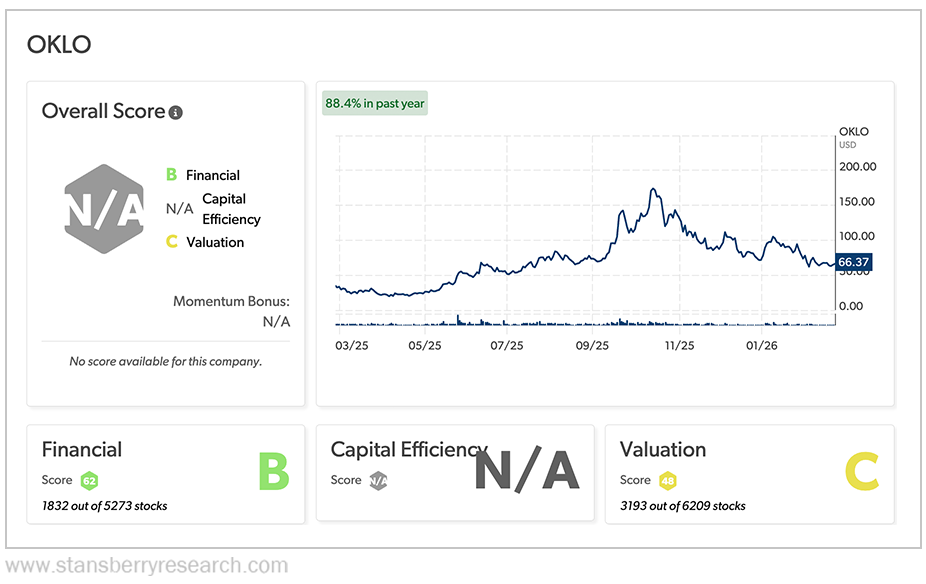
For one, the company’s stock is still in its relative infancy… it only went public in May 2024. And its share price has been quite volatile. OKLO began 2025 trading at roughly $25, soared to an intraday high of around $194 in October, then plummeted to roughly $63, where it trades today.
The Stansberry Score isn’t quite complete because the company remains in its early stages.
Despite its risks, Oklo has certainly caught investors’ attention. And it bears watching in 2026.
Key Risks Investors Should Consider
Investing in nuclear power stocks has plenty of upside, but it’s important to understand some key risks.
- Regulatory risk: Trump has pushed for less red tape and faster regulatory approvals for nuclear power projects. But government approval still takes time, with delays often pushing back timelines.
- Construction costs: As noted earlier, nuclear plants are expensive to build and upgrade. And that capex can eat into margins in the short term.
- Uranium price volatility: Uranium prices are notoriously prone to major swings. These frequently rising and falling prices tend to impact mining companies more than plant operators.
- Grid constraints: Even if new nuclear power sources are built, transmission and grid capacity may lag behind demand.
- Policy risk: Government funding, subsidies, or public support for nuclear energy could change over time and sway policy.
Nuclear energy is now a vital component of AI’s growing infrastructure needs. And AI data centers, as well as domestic fuel security, may have thrust investors onto the threshold of a golden age of nuclear.
Regards,
David Engle
Editor’s note: It’s no secret that artificial intelligence is gobbling up energy at an unprecedented rate… straining America’s already vulnerable power grid.
All the big players are racing to find a new way to meet AI’s power-hungry daily demands, pouring in billions of dollars for alternative energy sources.
Regular folks can still get in on this tech, too – but time is running out.
Because Amazon (AMZN) may have just cracked the code.
This breakthrough technology is being hailed as “the Holy Grail of Power,” and Amazon just went all-in on it…
Get the details right here, including how to prepare and what to buy.
Recent Articles

The 15 Best Cybersecurity Stocks to Buy Whether AI Booms or Busts

Oracle Earnings: Watch Out for Massive OpenAI Risk Despite Blowout First Quarter